eBook - ePub
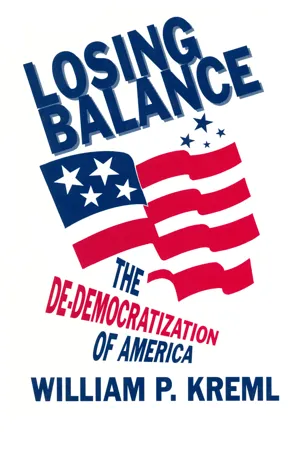
Losing Balance: De-Democratization of America
De-Democratization of America
- 184 pages
- English
- ePUB (mobile friendly)
- Available on iOS & Android
eBook - ePub
About this book
This text offers students a fresh, comprehensive, multidisciplinary entry point to the broader Middle East. Readers will come away from this book with an
Information
1
Jefferson and the Generations
The Current Decline
Thomas Jefferson charged each generation with ensuring that America's constitutional order remain equal to the task of public governance. Arguing that "laws and institutions must go hand in hand with progress of the human mind," Jefferson contended that "as manners and opinions change with the change of circumstances, institutions must advance also and keep pace with the times."1 Above all, Jefferson knew that each generation would pay a cumulative price for a preceding generation's derelictions. He knew that constitutional revitalization is an ongoing matter and that when the prospects of a generation fail to approach those of the one preceding it, we should suspect that the nation's institutions have not kept pace with the times.
Over the last quarter century, the decline in America's economic and political standing, its foreign and domestic debts, its trade imbalances, its abnormally high interest rates, its recurring inflation, and the declining prospects of a goodly number of its citizens have become clear to all. Perhaps less apparently, these indicators have declined even more dramatically when they are compared with those of a number of nations in Europe and even Asia, against whom we should measure ourselves. As a result of the decline, the ability of many Americans in the next generation to purchase a home, to receive a reasonable education, or even to live as comfortably as their parents did is in jeopardy. This situation has arisen, in some part, because of specific public policy failures. But even more, it has arisen because of the failure of the current generation to revitalize the constitutional order in a way that Jefferson, were he alive today, would have required. In more concrete terms, many of the nation's fundamental ills can be laid at the doorstep of the current generation of officeholders. It is they who have encouraged changes in the government in order to pursue their own political careers and to protect a coterie of private, largely economic interests to whom they are increasingly beholden.
Precisely what the current generation of officeholders, in league with private political interests and a top-heavy collection of political accessories who have inflicted themselves on the American government, has done to place the next generation in jeopardy is something that the new generation has every right to know—and every right to reverse. As the next generation will soon assume responsibility for the public affairs of this country, it will, in its turn, also become the trustee for the generation that follows it.
Most criticisms that are made of the American government today are substantive, focusing on the seemingly irresolvable difficulties of the federal deficit, the trade deficit, the sale of American assets to foreign interests, and the like. But these difficulties have not come upon us without profound causes. These causes are identifiable and they are, as we should have expected, as political as they are economic in their nature. The next generation's ability to reverse America's decline depends on its ability to understand what the current generation has done, not merely to our economic institutions but, more importantly, to the American political arrangement as well.
The Preconstitutional Order
In creating the formal and informal arrangements of America's union, the Framers at the Philadelphia Convention and the antifederalists who originally opposed the Constitution did several things. Patently, they agreed on a structure of government that provided for the most dispersed configuration of legislative, executive, and judicial powers that the world had ever known. Constrained within a dispersed structure, most of the delegates argued, government would be less likely to overreach its boundaries and invade the liberties that they held dear. In concert with the antifederalists who eventually gave their consent to the Constitution, they agreed, in effect, that certain preconstitutional balances would keep the American governmental order from being either wholly ineffective on the one hand or overbearing with regard to the American citizenry on the other.
Underlying and informing the formal separation of powers, for instance, less obvious understandings were significant. Perhaps the most important was the delegates' and the antifederalists' conception of the separate and balanced public and private domains. Borrowing from the English experience, they took care to protect a sphere of private life within which American citizens would enjoy at least the same propertied and contractual freedoms that the English yeoman had long enjoyed. The federalists wanted no smaller arena of private activity for America's citizens than the mother country had provided. The antifederalists, though they too viewed the private domain favorably, felt that the capture of the government by large commercial and financial interests necessitated a Bill of Rights that would protect the public as well as the private rights of citizens.
Another of the delegates' preconstitutional assumptions concerned the division of legal and political jurisdictions. By the close of the seventeenth century, the tradition of the English common law was viewed as a central protection against public invasion of the private domain. In the American constitutional arrangement, the common law similarly was allowed a broad jurisdictional arena. Here the antifederalists disagreed, drawing upon the early-seventeenth-century sense of the common law as a protector of the collected citizenry against Stuart-like excesses that might come from an undemocratic government.
Another unspoken preconstitutional assumption underpinned the 1787 Constitution. The delegates were mindful of the necessity for all public institutions to balance the claims of individuals seeking protection from the government against the essentially majoritarian claims of those aggregated citizens who wanted the government to do something for them. The Framers—and I mean the federalists and the antifederalists combined—felt, in other words, that the particular or individualistic forces of the society must balance the claims of the larger citizenry for governmental action. Fearing the majority, the federalists preferred a government that would respond to the singular rather than the aggregate claim. The antifederalists disagreed here too, but, again, the Bill of Rights assuaged their fear by assuring protection for those majoritarian political activities that they expected would be essential for the representation of their interests.
Finally, in their attempt to stabilize the preconstitutional order, the federalists and the antifederalists drew upon one other balance. The federalists in the convention felt that the new government should favor the centrifugal, or decentralizing, forces of a governmental structure over what they considered to be the inevitable tendency of all governments to centralize their institutions and abuse power. Though the antifederalists properly saw the new Constitution's centrifugal arrangements as checking the public aggregations that would lead to popular government, they believed sufficiently in the centripetal nature of the Bill of Rights that they confidently expected aggregate political activity to balance the centrifugal structure of the Constitution's original seven articles. These four balances, then—the private-to-public, the legal-to-political, the antimajoritarian-to-majoritarian, and the centrifugal-to-centripetal structural—constitute the essential pre-constitutional balances of the American government.
In designing this government, particularly with regard to the balance of its centrifugal and centripetal structures, the federalists and the antifederalists felt that, overall, they had worked out a reasonable mix of institutions for the American constitutional order. As time has passed, however, these institutions have been altered as a result of the self-serving adaptations of the order that the government's officeholders and their supporting interests have brought about.
As a result of these adaptations or, better, maladaptations, that will be discussed throughout, and as a result of more recent changes in the American private domain that will be discussed in the next chapter, events have occurred that have particularly disturbed America's usually easy confidence in its ability to deal with its political problems. The first is that the world, as well as America's relationship to it, has changed markedly. For a goodly time, our country, bordered by two large oceans and two small nations, prospered both economically and politically from its isolation from a very distant world. Now our nation is more a part—and an increasingly smaller part—of a less forgiving world. America's share of world economic production has fallen from 50 percent in the late 1940s to below 20 percent today. More important, annual increases in American productivity that had averaged 3 percent from 1946 to 1968 fell to 2 percent from 1968 to 1973, fell further to 1 percent from 1973 to 1978, and have progressed only marginally in the years since. As a result, any improvement in the standard of living of most middle-class families has come almost exclusively through the innovation of the double-wage household. At that, many have fallen out of the middle class, which had been America's greatest protector of its political stability and equity.
But something even more profound than the passing of America's economic domination of the world has occurred in recent years. Under the pressure of those who would not postpone what they believed to be entitled increases in their own standards of living, and with the complicity of those officeholders who have weakened the structural integrity of the government in order to fulfill these expectations and their own expectations of incumbency, the government's ability to understand the public interest and create productive and equitable public policies has been diminished. The informal processes of American government—that set of daily routines, understandings, and all-too-comfortable "networking" that currently typifies it—have altered what is usually called America's unwritten constitution so that the government of today is a far different thing from what it was even a short time ago. The result is that America's preconstitutional balances have been altered significantly in recent years.
Perhaps the debilitating and inequitable structural changes that America's current generation of officeholders with their private interests have inflicted on the nation are best understood as creating three pernicious political developments: (1) an increased isolation of each officeholder from the general public so that he or she is farther from the public trust than at any time in the history of the Republic; (2) an increased isolation of each officeholder from his or her fellow officeholders and from the political parties to which each pretends allegiance; and (3) an increased isolation of each officeholder from the public, ostensibly democratic institutions within which each ostensibly serves. What has resulted from these developments has been an increasingly self-contained political linkage of each officeholder to local, private interests, who in return for their electoral support expect the officeholder to protect those interests to the exclusion of the general good.
Private interests and political incumbency have always reinforced each other to a degree, in the American political system and elsewhere. But the recent significant changes in the American government's unwritten constitution evidence a marked increase in the unwillingness on the part of the nation's officeholders to consider the general welfare as more important than the welfare of their separate constituencies. Though these changes have been made through alterations in America's unwritten, not written, constitution, they are no less damaging to the general welfare. Because they have resulted from fundamental changes in the method of electing public officeholders and in the internal procedures of the government's principal institutions, these developments now ensure that only the least challenging of America's public difficulties, and the least controversial of possible solutions for these difficulties, will survive political debate. Obviously, this situation benefits the current generation of officeholders. With the government unable to adopt innovative but necessary policies for the good of the entire nation, each officeholder has more than ever assured himself or herself that what might prove embarrassing to them in a quest for reelection is kept from public consideration.
Perhaps predictably, today's officeholder argues that the changes detailed above mark a progression to a modern governmental form. This simply is not so. The active involvement of officeholders in the changes that have taken place within the government has stifled the government and made it less democratic. At a superficial level, the government has been forced into a condition of gridlock. At a more fundamental level, that broad participation of America's citizenry in the government that the antifederalists were particularly concerned with in their Bill of Rights has been endangered. America is less of a democracy today for that loss of citizen participation.
Why are these recent alterations in the constitutional order so costly to the nation? As the next generation of American citizens must understand better than does the current one, the economic and political difficulties that America faces today are not solely those of the budget deficit, the trade deficit, the selling of American assets overseas, and the like. The real political difficulties that have been brought about by America's governmental changes are both more immediate and more profound. The United States today lags behind many other industrial nations in health care (20 percent of Americans have no health insurance), in infant mortality (America now ranks seventeenth among the industrial nations), and, most damagingly, in education (cross-national studies consistently place America's students below those of other industrial nations, particularly in the sciences and mathematics). Drugs and crime afflict our nation's inner cities to such a degree that the principal cause of death among young black males is now homicide. These political realities are in great part the progeny of America's recent governmental alterations. For the first time in the history of our nation, Americans must now consider whether the United States government may no longer be the government that most of them have led themselves to believe it is. It may no longer be the best government in the world.
The Next Generation's Challenge
In retrospect, the coming of the United States into the world political community as a nation far different from any that had preceded it marked more than a change in the fortunes of a single people. The creation of the government of the United States marked a historic moment for all political history. The impact of this moment was noted by, among others, the Constitution's principal drafter, James Madison, who felt that the greatest threat to American democracy would not come from the kings, aristocracies, or established churches of the Old World. The threat would come, Madison thought, from the potential excesses of democracy.
In The Federalist, No. 10, and elsewhere, Madison contended that an overly democratic political system might fall prey to the democratic pressures of its general citizenry. Those pressures, Madison feared, would alter the foundational balances of the limited democracy that the American government provided in favor of too much democracy. To prevent such an alteration, Madison's design for the American Republic forbade such democratic guarantees as pure popular representation and included constitutional safeguards that he hoped would prevent the political overwhelming of the government by unpropertied citizens. In the United States, as in so many other nations of the world, even the limited promise of democratic government was compromised from the beginning.
But if Madison's fears centered around the potential for democratic excess on the part of unpropertied citizens, our government's current difficulties have not originated from an imbalance of governmental access on the part of the greater, unpropertied population. Our government's difficulties have resulted from those distortions of the governmental structure that stem from the ever easier access to the government that is enjoyed by America's private economic institutions. That access has diminished the ability of the government to address the public's needs. Though, again, such a diminishing of the government's ability to govern was no more among the corruptions of the Constitution that Madison or the antifederalists feared than was the role of the propertied citizens in that diminishing, that is precisely what has occurred. And it has occurred without violating a word of the constitutional document itself.
As the United States enters its third constitutional century, a rebalancing of the American preconstitutional and constitutional orders is both necessary and proper. That rebalancing may require minor revisions of the written Constitution; our dispersed constitutional structure may need some formal, centripetally directed updating. More certainly, however, that rebalancing will require revisions in the informal structuring of the government's processes. Surely, it will also require a reaffirmation in a modern context of what was explicit in the arguments of the anti-federalists, as well as what was implicit in their acceptance of the Constitution in return for the federalists' acceptance of the Bill of Rights. The next generation must restore the four preconstitutional balances that the American constitutional order always assumed.
In sum, as the next generation stands to be injured by the recent alterations in the unwritten constitution, it will need to develop standards for the third century of American democracy that redresses those alterations. If the genius of the Constitution's Framers, combined with the genius of the antifederalist advocates of the Bill of Rights, was evidenced by their combined ability to find proper balances within and without the structures and the processes of their newly created government, it will depend upon the genius of the next generation to reset those balances.
Let us not forget that the federalists and the antifederalists purposely placed a vitalizing flexibility into the American Constitution. But they did so in order to enable our government to respond to the exigencies of a changing world, not in order to have the custodians of that Constitution bend its structure to their own and to their narrowest constituencies purposes. Demands on America's national government have clearly grown over the past two centuries. It is a truism to say now that coordination within and between the separated centers of America's political arrangement is more essential today than it ever has been before. But the members of the current generation of officeholders, again largely for their own convenience and without regard to the larger necessities of the American people as a whole, have ignored their responsibility to engage in such coordination, much less to engage in constitutional revitalization. They have, again, adjusted the processes of our government, as well as the preconstitutional and constitutional balances of our larger political system, in the opposite direction.
Jefferson's admonition that each generation must undertake its own revision of the Constitution in order to provide for its own needs and the needs of the nation is therefore doubly apt today. The United States, and its government, is fully one generation behind whe...
Table of contents
- Cover
- Half Title
- Title
- Copyright
- Dedication
- Contents
- Foreword
- Acknowledgments
- Introduction
- 1 • Jefferson and the Generations
- 2 • Private and Public Domains
- 3 • The Washington Beltway
- 4 • The Lawyer-Lobbyist
- 5 • The Elections Industry
- 6 • The Levels of Government
- 7 • America's Political Parties
- 8 • Congress
- 9 • The Chief Executive
- 10 • A New World
- 11 • The National Press
- 12 • The Academy
- 13 • Remedies
- 14 • Jefferson's and Lincoln's Lessons
- Index
Trusted by 375,005 students
Access to over 1.5 million titles for a fair monthly price.
Study more efficiently using our study tools.
Frequently asked questions
Yes, you can cancel anytime from the Subscription tab in your account settings on the Perlego website. Your subscription will stay active until the end of your current billing period. Learn how to cancel your subscription
No, books cannot be downloaded as external files, such as PDFs, for use outside of Perlego. However, you can download books within the Perlego app for offline reading on mobile or tablet. Learn how to download books offline
Perlego offers two plans: Essential and Complete
- Essential is ideal for learners and professionals who enjoy exploring a wide range of subjects. Access the Essential Library with 800,000+ trusted titles and best-sellers across business, personal growth, and the humanities. Includes unlimited reading time and Standard Read Aloud voice.
- Complete: Perfect for advanced learners and researchers needing full, unrestricted access. Unlock 1.5M+ books across hundreds of subjects, including academic and specialized titles. The Complete Plan also includes advanced features like Premium Read Aloud and Research Assistant.
We are an online textbook subscription service, where you can get access to an entire online library for less than the price of a single book per month. With over 1.5 million books across 990+ topics, we’ve got you covered! Learn about our mission
Look out for the read-aloud symbol on your next book to see if you can listen to it. The read-aloud tool reads text aloud for you, highlighting the text as it is being read. You can pause it, speed it up and slow it down. Learn more about Read Aloud
Yes! You can use the Perlego app on both iOS and Android devices to read anytime, anywhere — even offline. Perfect for commutes or when you’re on the go.
Please note we cannot support devices running on iOS 13 and Android 7 or earlier. Learn more about using the app
Please note we cannot support devices running on iOS 13 and Android 7 or earlier. Learn more about using the app
Yes, you can access Losing Balance: De-Democratization of America by William P. Kreml in PDF and/or ePUB format, as well as other popular books in Politics & International Relations & Middle Eastern History. We have over 1.5 million books available in our catalogue for you to explore.