- 258 pages
- English
- ePUB (mobile friendly)
- Available on iOS & Android
eBook - ePub
About this book
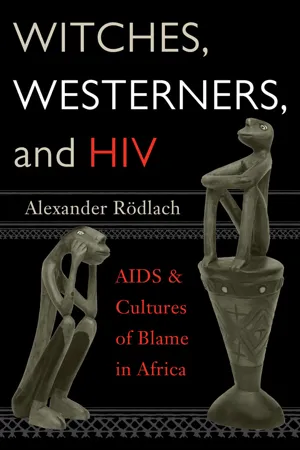
A witch's curse, an imperialist conspiracy, a racist plot—HIV/AIDS is a catastrophic health crisis with complex cultural dimensions. From small villages to the international system, explanations of where it comes from, who gets it, and who dies are tied to political agendas, religious beliefs, and the psychology of devastating grief. Frequently these explanations conflict with science and clash with prevention and treatment programs. In Witches, Westerners, and HIV Alexander Rödlach draws on a decade of research and work in Zimbabwe to compare beliefs about witchcraft and conspiracy theories surrounding HIV/AIDS in Africa. He shows how both types of beliefs are part of a process of blaming others for AIDS, a process that occurs around the globe but takes on local, culturally specific forms. He also demonstrates the impact of these beliefs on public health and advocacy programs, arguing that cultural misunderstandings contribute to the failure of many well-intentioned efforts. This insightful book provides a cultural perspective essential for everyone interested in AIDS and cross-cultural health issues.
Information
Part I
The Cultural Life of HIV/AIDS

Chapter 1
Investigating Sorcery and Conspiracy
Despite my best efforts, quantifiable methods proved to be of limited usefulness for studying sorcery and conspiracy suspicions in Zimbabwe. The data underlying this Zimbabwean case study come from multiple sources, a common strategy in ethnographic fieldwork. I used various types of quantitative methods, including not only door-to-door interviews with a randomly selected sample of the target population but also several techniques of modern cognitive anthropology including free listing, pile sorting, and paired comparison, along with their concomitant analyses—but the results were disappointing. I will get to the reasons for this later.
In contrast, traditional ethnographic methods, such as different types of interviewing with individuals and groups selected by means of convenience sampling, as well as archival and mass media research, yielded an abundance of valuable data. In addition to both quantifiable and textual data, I have collected visual data in the form of photos, video-clips, newspaper cartoons, and even wood carvings of relevant themes by a local artist, Sheunesu Shumba.1
These types of data were collected through long-term participant observation, which is crucial to understanding sensitive issues such as sorcery beliefs and conspiracy theories (Herdt and Stoller 1990:17–18). Both types of belief are held in some degree of privacy or even secrecy, and individuals may express different views and convictions about them in public than they do in private. As Goffman observed, people shift between the normative, expected, and conventional “front-stage” behavior and the “back-stage” behavior that is hidden away from the public eye (Goffman 1959:22–30). Participant observation allows access to that backstage behavior because it can be done at various times for a large number of individuals in diverse social settings. It also allows a deep level of trust between the participant observer and the observed that is impossible to reach quickly, and it is essential for obtaining information about sensitive issues.

Beyond the choice of methods, the success of any research depends necessarily on the anthropologist and on the conditions under which he or she is conducting the research. As Schensul and colleagues have stated, the researcher is the “primary instrument of data collection” (Schensul et al. 1999:273–74). I conducted the case study in Zimbabwe in my double role as a Catholic priest and an anthropologist.2
Some colleagues in anthropology argue that the observing anthropologist is diametrically opposed to the intrusive missionary priest, thereby questioning the validity of some missionary findings. However, anthropologists have also pointed out that researchers are rarely neutral; they assume other roles depending on their gender, racial background, origin, and involvement (LeCompte et al. 1999:4–6). Being a priest is just one of these roles. Any role can introduce some errors by response effects (Bernard 2002:230), but it can also open up new avenues for collecting data. I believe that my priestly role at the research site was more an opportunity than a hindrance.
First of all, being a priest helped in establishing trust. As an example, when I was interviewing an elderly woman, she was upset that I as a “child” dared to ask her personal information! “Child” and “elder” are relative classifications that change depending on various characteristics of the two individuals and the circumstances of the encounter. In this case I was much younger than she, and thus in her eyes the child. Children do not ask elders personal questions.
When I later realized she was a Catholic, I went to her and introduced myself as a priest. Now the roles were changed; I was the elder and she the child. She had no problem responding to the questions I had asked her the day before. She may have even felt compelled to respond honestly to what the “father” asks from his “child.” This illustrates how we anthropologists can actively draw on our various roles and so positively influence the interview process. My priestly role was often helpful in establishing trust between my informants and me.
Establishing a trust relationship is of crucial importance for investigating issues such as HIV/AIDS. The sensitive nature of AIDS-related issues imposes certain constraints on discourses that could compromise the validity of data and the success of a study (Leap 1991:285). The study of a sensitive issue such as HIV/AIDS necessitates a framework of trust and confidentiality (Abramson 1992:108). Being a priest placed me within such a framework, allowing me to collect valid data.
My priestly role, however, had only a limited positive impact on a related issue. In southern Africa, speaking about HIV/AIDS is a taboo-theme in the same way as sexual behavior, promiscuity, and prostitution are. These are not only taboo-themes because of their private or shameful nature. It is taboo to speak about these issues because of the cultural concept of “respect,” called inhlonipho in Ndebele, which regulates much of social behavior, including who speaks in what manner about what topic with whom. Inhlonipho became a potential obstacle to communication across different genders, ages, and social statuses. To minimize inhlonipho’s response effects to my age, gender, appearance, idiosyncrasy, and biases, including those potentially coming from my priestly role, I worked with several assistants of both genders, of varying ages, and of diverse ethnic and educational backgrounds.
Second, my role as a priest proved to be crucial within the context of the political and economic decline that Zimbabwe experienced during the years of my research. Any foreigner or person of European descent who conducted interviews was viewed with suspicion and mistrust by the political leadership. The members of the party in power, ZANU-PF, could have negatively intervened in my study. Actually, the officer in charge at the local police station near the research site gave me a stern warning to remain within the framework of strictly medical research—otherwise the police would arrest and deport me. For the duration of the study, church members protected me, their priest, when members of the party in power became suspicious about my movements.
Third, the priestly role helped me to respond to the immense suffering we witnessed every day without compromising the research. My assistants and I spent long hours discussing with informants the political and economic situation in the country, how HIV/AIDS affects their families and their neighbors, and how they cope with it. These discussions rarely remained calm and rational and frequently led to emotional expressions of pain and desperation. I was able to draw on my other identity, the priest, when I was asked to pray for people. Prayer offered some consolation in those dire circumstances.
I recall a visit in a household with four members: an elderly woman, her daughter, and her two grandchildren. The daughter spoke openly about the fact that she was dying of AIDS, soon to follow her husband who passed away a few months ago. She told me that her lastborn, an infant of about two years of age, who was in great pain, only skin and bones, was also HIV-positive. She and her child were looked after by her aged grandmother; her [the mother’s] chief concern was what would happen to her firstborn, a boy of primary school age. She knew that he would soon be the only one left—with no money, living in an extended family stretched beyond its limits due to the harsh economic conditions in the country, and with hardly any support available from social welfare. She knew he could easily end up destitute. It was emotionally draining for us to be exposed to such extreme suffering.
It is difficult for researchers not to become emotionally involved with the suffering of their informants and respondents (Shelley 1992:79). Strong emotional involvement of the interviewer carries the potential risk of injecting one’s feelings into the study, thus possibly biasing the data (Bernard 2002:219). I felt that my yearlong counseling experience as a priest helped me to separate my own emotional involvement from the information that I gained.
To sum up: The use of multiple types of methods, implementing the study with the help of assistants, and my dual role as a priest and an anthropologist, make me confident that both my data and my analyses are valid and a solid base from which to draw legitimate links between AIDS beliefs and beliefs related to sorcery and conspiracy.

Researching sorcery- and conspiracy-related beliefs pertinent to HIV/ AIDS poses certain challenges that are particular to these types of beliefs. What follows relates mainly to the difficulty of studying sorcery beliefs but some of the arguments are also pertinent to the study of conspiracy theories.
The primary challenge is the difficulty in documenting both knowledge about sorcery and actual evidence of sorcery practices.3 The lack of clear evidence about sorcery-related beliefs seems to be common cross-culturally. Generally, evidence is more accessible in societies where sorcery is not only used for nefarious ends but also, for instance, for protection. Most people with whom I talked had at least some belief in the existence of such practices, yet most claimed not to have any specific knowledge of what is needed for such practices, or how they are performed, or who could be approached about performing them. Although they hardly pinpointed actual evidence of such practices, they expressed belief in sorcery and their fear of it, debating the issue even as they feared possible consequences. In other words, people were greatly concerned about sorcery but had no firm evidence that anyone actually did anything, as the following quote from an interview4 shows:
We have never known someone who was bewitched. But sorcery exists and has to be taken seriously. However, we have never personally experienced it!
Some anthropologists interpret such statements of informants as an indication that sorcery beliefs are merely a way of speaking about a troubling social world. For them, sorcery simply explains misfortune, but most probably does not exist in reality.5 However, the issue of the factual reality of sorcery (and, for that matter, of conspiracies) is not a focus of this book. I am more concerned with the reality of such beliefs in the minds of the people.
For those who hold beliefs in sorcery or conspiracies, these beliefs are perceived as real dangers that threaten the believer’s well-being. Consequently, the issue is not how we can find factual evidence of these secretive beliefs and practices, but how we can break through the veils of secrecy to gain access to the meanings and functions of sorcery beliefs and conspiracy suspicions. I found the following five issues important for explaining the reticence among my informants when asked about sorcery beliefs and conspiracy theories. These five issues complicated the study of such beliefs in Zimbabwe, and some of these issues are relevant for the study of sorcery beliefs and conspiracy theories elsewhere.

When discussing sorcery beliefs with Zimbabweans, I frequently observed that many carefully disassociated themselves from such beliefs and their suspected practice. The Zimbabwean interviewees most probably hesitated to articulate such information, fearing that I may think them to be sorcerers themselves. As elsewhere (e.g., Romberg 2003:209), in Zimbabwe no one wants to be suspected of being a sorcerer or of being implicated in sorcery practices. The headline of a report in a local Zimbabwean newspaper succinctly expresses such a sentiment, stating: “If you smell a witch, you are one yourself” (Wermter 2003). In other words, if you are able to identify a sorcerer by your knowledge of sorcery, you are potentially one yourself. After all, sorcerers are the ones who have expert knowledge on this issue (Niehaus 2001:12). When Ashforth (2000:50) asked a South African about the relation between sorcery and HIV/AIDS, the individual replied, laughing: “Don’t ask me, I’m not a sorcerer. But I know they can do it.”
Diviners and healers, who are the most likely to have knowledge of herbal and other potions used for sorcerous practices, were particularly defensive when asked about sorcery. Perhaps aware that they would be the prime suspects of sorcery practices, they adamantly denied any knowledge of them. They insisted that, although they are aware of such practices, they have no knowledge about how to prepare ingredients and perform rituals. In Zimbabwe, as elsewhere, people suspect that the powers and expertise of diviners and healers may be put to malign use. In many societies, diviners/curers are believed to have the power to control evil, and thus to be capable of using evil for nefarious purposes. Crossculturally, the powers of diviners, healers, and shamans are frequently thought to be involved in benevolent as well as malevolent activities; thus diviners and healers are seen as ambiguous persons with the potential of being sorcerers.6 Both can cure and inflict harm. Healing and sorcery are the “twin forces of white and black, of positive and negative” (Malinowski 1969:194). An Ndebele proverb similarly states that inyanga ngumthakathi, literally meaning that the healer is a sorcerer, that the person who has medicine for healing also has medicine for harming.
The ambiguity of healers matches the ambiguity of what...
Table of contents
- Cover
- Half Title
- Title
- Copyright
- Contents
- Acknowledgments
- Introduction
- Part I The Cultural Life of HIV/AIDS
- Part II HIV/AIDS and Sorcery
- Part III HIV/AIDS and Conspiracy
- Part IV The Implications of Culture
- Glossary
- Bibliography
- Index
- About the Author
Trusted by 375,005 students
Access to over 1.5 million titles for a fair monthly price.
Study more efficiently using our study tools.
Frequently asked questions
Yes, you can cancel anytime from the Subscription tab in your account settings on the Perlego website. Your subscription will stay active until the end of your current billing period. Learn how to cancel your subscription
No, books cannot be downloaded as external files, such as PDFs, for use outside of Perlego. However, you can download books within the Perlego app for offline reading on mobile or tablet. Learn how to download books offline
Perlego offers two plans: Essential and Complete
- Essential is ideal for learners and professionals who enjoy exploring a wide range of subjects. Access the Essential Library with 800,000+ trusted titles and best-sellers across business, personal growth, and the humanities. Includes unlimited reading time and Standard Read Aloud voice.
- Complete: Perfect for advanced learners and researchers needing full, unrestricted access. Unlock 1.5M+ books across hundreds of subjects, including academic and specialized titles. The Complete Plan also includes advanced features like Premium Read Aloud and Research Assistant.
We are an online textbook subscription service, where you can get access to an entire online library for less than the price of a single book per month. With over 1.5 million books across 990+ topics, we’ve got you covered! Learn about our mission
Look out for the read-aloud symbol on your next book to see if you can listen to it. The read-aloud tool reads text aloud for you, highlighting the text as it is being read. You can pause it, speed it up and slow it down. Learn more about Read Aloud
Yes! You can use the Perlego app on both iOS and Android devices to read anytime, anywhere — even offline. Perfect for commutes or when you’re on the go.
Please note we cannot support devices running on iOS 13 and Android 7 or earlier. Learn more about using the app
Please note we cannot support devices running on iOS 13 and Android 7 or earlier. Learn more about using the app
Yes, you can access Witches, Westerners, and HIV by Alexander Rödlach in PDF and/or ePUB format, as well as other popular books in Social Sciences & Anthropology. We have over 1.5 million books available in our catalogue for you to explore.