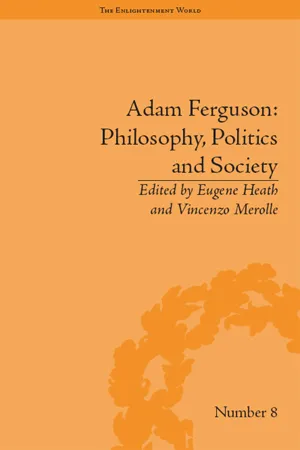
Unique among the leading figures of the Scottish Enlightenment, Ferguson saw two eighteenth-century revolutions, the American and the French. This monograph contains a set of essays that analyse Ferguson's philosophical, political and sociological writings and the discourse which they prompted between Ferguson and other important figures.
- 256 pages
- English
- ePUB (mobile friendly)
- Available on iOS & Android
eBook - ePub
Adam Ferguson: Philosophy, Politics and Society
About this book
NOTES
Introduction
1. L. Hill, The Passionate Society: The Social and Political Thought of Adam Ferguson (Dordrecht: Springer, 2006), p. 27.
2. The account of Hume’s efforts on Ferguson’s behalf are described in J. B. Fagg, ‘Biographical Introduction’, in A. Ferguson, The Correspondence of Adam Ferguson, ed. V. Merolle, 2 vols (London: Pickering & Chatto, 1995), vol. 1 (1745–80), esp. xxviii–xxxiii.
3. This interpretation may be found in J. G. A. Pocock, The Machiavellian Moment: Florentine Political Thought and the Atlantic Republican Tradition (Princeton, NJ: Princeton University Press, 1975), esp. pp. 498–505.
4. Pocock, ‘Cambridge Paradigms and Scotch Philosophers: A Study of the Relations between the Civic Humanist and the Civil Jurisprudential Interpretation of Eighteenth-century Social Thought’, in I. Hont and M. Ignatieff (eds), Wealth and Virtue: The Shaping of Political Economy in the Scottish Englightenment (Cambridge: Cambridge University Press, 1983), p. 235. J. Robertson notes the ‘abstractness of the civic tradition, and the uncertainty of its boundaries’, but he attests that such vagueness does not ‘diminish its significance’. ‘The Scottish Enlightenment and the Civic Tradition’, in Ibid., p. 140.
5. A clear difference also emerges in comparison with a later theorist of the historical development of society, Karl Marx. For Marx, some activities, such as the arts, are the effects of other more fundamental (economic) modes of interaction.
1 Fry, ‘Ferguson the Highlander’
1. Anon., Article II: ‘Adam Ferguson’, Edinburgh Review, 125:255 (January 1867), p. 54.
2. ‘… the barbarous orthography which few, and I among the rest, never learned to read’, Letter to James Macpherson, 30 May 1793, in Ferguson The Correspondence of Adam Ferguson, vol. 2, p. 353.
3. A. Carlyle, The Autobiography of Dr Alexander Carlyle of Inveresk, 1722–1805, ed. J. H. Burton (Edinburgh: Foulis, 1910), pp. 295–7.
4. Ibid., p. 282.
5. First reported by Sir Walter Scott, review of Henry Mackenzie, The Works of John Home, in Quarterly Review, 36 (1827), p.196; see the comment by J.B. Fagg in her Introduction, The Correspondence of Adam Ferguson, vol. 1, p. xxiv.
6. A. Ferguson, A Sermon Preached in the Ersh Language to His Majesty’s Regiment of Foot, commanded by Lord John Murray … (London: A. Millar, 1746), p. 23.
7. F. Oz-Salzberger, ‘Ferguson’s Politics of Action’, in E. Heath & V. Merolle (eds), Adam Ferguson: History, Progress and Human Nature (London: Pickering & Chatto, 2008), pp. 150–1.
8. Carlyle, The Autobiography of Dr Alexander Carlyle, p. 296.
9. Ferguson, Sermon, p. 3.
10. R. Adam to Nelly Adam, 9 April 1757, National Archives of Scotland, GD 18/4387/33.
11. H. Mackenzie (ed.), Report of the Committee of the Highland Society of Scotland, appointed to inquire into the nature and authenticity of the poems of Ossian (Edinburgh, 1805), appendix 4; ‘Account of the Life of Mr John Home’, The Works of John Home (Edinburgh, 1822); D. Thomson, ‘Ossian Macpherson and the Gaelic World of the Eighteenth Century’, Aberdeen University Review 40 (1963–4), p. xl.
12. J. Macpherson (ed.), Fingal (London, 1762), p. xiv and preface; J. H. Burton, Life and Correspondence of David Hume, 2 vols (Edinburgh: William Tait, 1846), vol. 1, p. 468.
13. Hume to Gilbert Elliot of Minto, 2 July 1757, D. Hume, The Letters of David Hume, ed. J. Y. T. Greig, 2 vols (Oxford: Clarendon Press, 1932), vol. 1, p. 255. I have taken a minor liberty with the phrasing and have modernized the spelling; the exact phrasing is: ‘…is it not strange, I say, that in these Circumstances, we shou’d really be the People most distinguish’d for Literature in Europe?’
14. R. Sher, Church and University in the Scottish Enlightenment: The Moderate Literati of Edinburgh (Princeton, NJ: Princeton University Press, 1985), ch. 6.
15. Macpherson (ed.), Fingal, especially pp. 109, 111, 279, 288.
16. A. Ferguson, An Essay on the History of Civil Society, ed. D. Forbes (Edinburgh: Edinburgh University Press, 1966), pp. 76–7.
17. Ibid., p. 77.
18. Ibid., pp. 77–8.
19. Ibid., pp. 79.
20. Ibid., p. 78.
21. Ibid., p. 104.
22. Ibid., p. 115.
23. J. D. Brewer, ‘Ferguson’s Epistolary Self’, in Heath and Merolle (eds) Adam Ferguson: History, Progress and Human Nature, pp. 7–22.
24. See Davie’s essay, ‘The Scottish Enlightenment’, in his collection The Scottish Enlightenment and Other Essays (Edinburgh: Polygon, 1991), pp. 1–51.
25. For the most graphic depictions of this complex, see James Boswell passim.
26. I. S. Ross, Life of Adam Smith (Oxford: Clarendon Press, 1995), p. 33.
27. Ferguson, An Essay, ed. D. Forbes, p. 151.
28. H. Cockburn, Memorials of his Time (Edinburgh: Adam & Charles Black, 1856), p. 74.
29. Ferguson, An Essay, ed. D. Forbes, p. 59.
30. Ibid.
31. Ibid, p. 60.
32. Ibid.
33. Ibid. p. 61.
34. Ibid.
35. Ibid, p. 141.
36. Hume to William Strahan, August 1770, Hume, Letters of David Hume, vol. 2, p. 230.
37. Ferguson, An Essay, ed. D. Forbes pp. 105–6.
38. A. Ferguson, The Manuscripts of Adam Ferguson, ed. V. Merolle, with E. Heath and R. Dix (London: Pickering & Chatto, 2006), pp. 48–9. The text as printed there reproduces the unedited MS, but I have modernized it for these quotations.
2 Buchan, ‘Adam Ferguson, the 43rd, and the Fictions of Fontenoy’
1. A. Ferguson, An Essay on the History of Civil Society (1767), ed. F. Oz-Salzberger (Cambridge: Cambridge University Press, 1995), p. 77.
2. See for example, J.A. Lynn, Battle: A History of Combat and Culture (Boulder, CO: Westview, 2003), pp. 111–15, 143–4.
3. This was the view developed by Duncan Forbes in his ‘Introduction’ to A. Ferguson, An Essay on the History of Civil Society (1767; Edinburgh: Edinburgh University Press, 1966), pp. xxxviii–xl. For further exposition of the relationship between Ferguson’s background and his political thought see, M. J. Kugler, ‘Savagery, Antiquity, and Provincial Identity: Adam Ferguson’s Critique of Civilization’ (PhD Dissertation, University of Chicago, 1994).
4. J. D. Brewer, ‘Putting Adam Ferguson in his Place’, The British Journal of Sociology, 58:1 (2007), pp. 112–13. J. D. Brewer, ‘Ferguson’s Epistolary Self’, pp. 7–22.
5. B. Mazlish, Civilization and its Contents (Stanford, CT: Stanford University Press, 2005), pp. 5–7; A. Pagden, European Encounters with the New World: From Renaissance to Romanticism (New Haven, CT: Yale University Press, 1993), pp. 117, 153–5, 160–5.
6. J. Starobinski, Blessings in Disguise, Or, the Morality of Evil, trans. A. Goldhammer (Cambridge: Polity, 1993), p. 3.
7. A. Pagden, ‘The “Defence of Civilization” in Eighteenth Century Social Theory’, History of the Human Sciences, 1:1 (1988), pp. 33–45; C. A. Bayly, ‘The British and Indigenous Peoples, 1760–1860: Power, Perception and Identity’ in M. Daunton and R. Halpern (eds), Empire and Others: British Encounters with Indigenous Peoples, 1600–1850 (Philadelphia, PA: University of Pennsylvania Press, 1999), pp. 20, 25, 27–9.
8. L. Febvre, ‘Civilization: Evolution of a Word and Group of Ideas’, in P. Burke (ed.), A New Kind of History from the Writings of Febvre, trans. K. Folca (London: Routledge and Kegan Paul, 1973), pp. 223–5; Starobinski, Blessings in Disguise, pp. 14–15.
9. F. Oz-Salzberger, ‘The Political Theory of the Scottish Enlightenment’, in A. Broadie (ed.), The Cambridge Companion to the Scottish Enlightenment (Cambridge: Cambridge University Press, 2003), p. 160.
10. F. Gilbert, ‘The “New Diplomacy” of the Eighteenth Century’, World Politics, 4:1 (1951), pp. 11, 15.
11. J. G. A. Pocock, Barbarism and Religion, Volume 2: Narratives of Civil ...
Table of contents
- Cover
- Half Title
- Title Page
- Copyright Page
- Table of Contents
- Contributors
- Acknowledgements
- Introduction
- I. Life and Works
- II. Philosophy
- III. Politics
- IV. Society
- Notes
- Works Cited
- Index
Trusted by 375,005 students
Access to over 1.5 million titles for a fair monthly price.
Study more efficiently using our study tools.
Frequently asked questions
Yes, you can cancel anytime from the Subscription tab in your account settings on the Perlego website. Your subscription will stay active until the end of your current billing period. Learn how to cancel your subscription
No, books cannot be downloaded as external files, such as PDFs, for use outside of Perlego. However, you can download books within the Perlego app for offline reading on mobile or tablet. Learn how to download books offline
Perlego offers two plans: Essential and Complete
- Essential is ideal for learners and professionals who enjoy exploring a wide range of subjects. Access the Essential Library with 800,000+ trusted titles and best-sellers across business, personal growth, and the humanities. Includes unlimited reading time and Standard Read Aloud voice.
- Complete: Perfect for advanced learners and researchers needing full, unrestricted access. Unlock 1.5M+ books across hundreds of subjects, including academic and specialized titles. The Complete Plan also includes advanced features like Premium Read Aloud and Research Assistant.
We are an online textbook subscription service, where you can get access to an entire online library for less than the price of a single book per month. With over 1.5 million books across 990+ topics, we’ve got you covered! Learn about our mission
Look out for the read-aloud symbol on your next book to see if you can listen to it. The read-aloud tool reads text aloud for you, highlighting the text as it is being read. You can pause it, speed it up and slow it down. Learn more about Read Aloud
Yes! You can use the Perlego app on both iOS and Android devices to read anytime, anywhere — even offline. Perfect for commutes or when you’re on the go.
Please note we cannot support devices running on iOS 13 and Android 7 or earlier. Learn more about using the app
Please note we cannot support devices running on iOS 13 and Android 7 or earlier. Learn more about using the app
Yes, you can access Adam Ferguson: Philosophy, Politics and Society by Eugene Heath in PDF and/or ePUB format, as well as other popular books in History & World History. We have over 1.5 million books available in our catalogue for you to explore.