- 168 pages
- English
- ePUB (mobile friendly)
- Available on iOS & Android
eBook - ePub
About this book
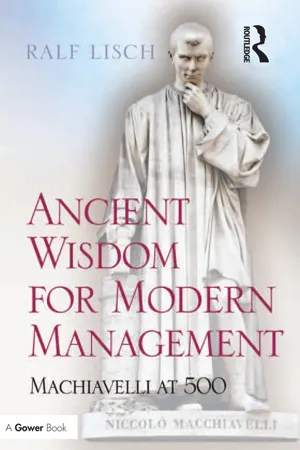
Machiavelli lives. 500 years after Niccolò Machiavelli has written 'The Prince', this classic of the mechanisms behind success in management has not lost its relevance. In an intriguing and inspiring interplay of quotes, interpretations and examples, Dr Ralf Lisch develops Machiavelli's most famous work into a practical guide providing Ancient Wisdom for Modern Management. Many have heard about Machiavelli but few have really read and understood him. Ralf Lisch's analysis of 'The Prince' proves that widespread associations with evil management are a thorough misunderstanding. He has done away with historic ballast and abstains from a moralizing approach that does not do justice to Machiavelli's works. Instead, he lets Machiavelli have his say and provides a positive and pragmatic interpretation of the wisdom of 'The Prince' from a management perspective. It is a fresh approach that combines theoretical analysis with a practical focus. Dealing with a wide range of essential management topics like careers, success, intellect, decision-making, trust, change management, knowledge management, mergers and acquisitions, networking, sustainability, business ethics, working processes and many others, this book proves that the basics of management have hardly changed over half a millennium. Ancient Wisdom for Modern Management is an amazing insight into the essentials of management and a workable guidance to success in daily business. This open-minded and compelling exploration of 'The Prince' combines reading pleasure with a great opportunity to participate in Machiavelli's truly timeless wisdom.
CHAPTER 1
MACHIAVELLI AND THE PRINCE
Admittedly, it is a daring venture to refer to Machiavelli of all advisers when talking about modern management. Niccolò Machiavelli – whose full name was Niccolò di Bernardo dei Machiavelli – did not only live already half a millennium ago, he has also a rather dubious image among commentators, which refers primarily to his best known work under the title The Prince.
Especially those who have not read or hardly understood Machiavelli tend to turn their nose up at his work. They like to describe it as reckless power politics – evil and immoral. Even the term ‘Old Nick’ as epithet of the devil goes back to Niccolò Machiavelli.
And when writers of management advice go nevertheless into Machiavelli’s works, it is often a sinister understanding and used as deterrent rather than as guidance. Such approach follows the tradition of the Anti-Machiavel, which was a countermovement to Machiavelli’s The Prince. This term refers to an eighteenth-century rebuttal by Frederick II1 who later became King of Prussia. His work developed from a correspondence with the French philosopher Voltaire2 who had named Machiavelli one of the great men of his time, which Frederick II criticized. It is understandable that once he had become king, he regretted the publication of the Anti-Machiavel. It appears that he had eventually discovered the wisdom in Machiavelli’s work.
Actually, attempts to refute Machiavelli’s theses started already much earlier. Soon after its publication the religious order of the Jesuits managed to get The Prince added to the Index Librorum Prohibitorum, which was the list of books that were prohibited for the Catholic faithful in order to protect faith and morality.3
Of course, whatever is forbidden becomes even more interesting. As a result, the censorship may even have added to the fame of The Prince. After all, the contradicting perceptions of Machiavelli’s work are a matter of perspective. While his critics come from a humanist and idealistic world view, Machiavelli describes people in a factual manner with all their shortcomings. It is more about how men are instead of how they should be. For sure, the world of the critics would be nicer but unfortunately, Machiavelli’s world view is more realistic.
Unlike many authors of management books, Machiavelli does not succumb to the temptation of describing a rational and cohesive business world full of harmony and prudence. Also the construct of the homo economicus4 is a weak approach to actual management behaviour. After all, business is not ruled by economics or even reason but by psychology and sociology.
Reading Machiavelli’s work with an open mind instead of looking at it from the perspective of a moralist will reveal how factual and timeless his observations and analyses are. Although The Prince has been written already 500 years ago, it has not lost any relevance to the present. The terminology may have changed but the behavioural patterns are still valid and can easily be related to modern management. With this in mind, one may agree that hardly any modern management book provides as much wisdom and advice as The Prince.
1.1 MACHIAVELLI AND HIS TIME
While the wisdom of Machiavelli’s work is timeless, it is helpful and important for its understanding to know more about Machiavelli, his time and the context in which The Prince was written. This approach is always the best way to judge an author’s legitimization as adviser and helps to decide from whom one wants to accept advice.
Niccolò Machiavelli was born in Florence on 3 May 1469 as third child and first son of the attorney Bernardo di Niccolò Machiavelli, and his wife Bartolomea. It was a respected although not rich family into which young Niccolò was borne.
Machiavelli’s time was the prime of the renaissance that determined the fifteenth and sixteenth century in particular and had its origin and centre in Florence. The era of renaissance – from ‘re’ meaning back or again and Latin ‘nasci’ which means to be born – was a rebirth or revival of an interest in classical antiquity that spread all over Europe and affected not only the fine arts but also science, politics, religion and society.
Machiavelli was borne in a dramatic era with permanent changes of the political situation. Italy was split into many kingdoms, principalities, republics and city-states. Governments were short-lived; rulers gained and fell from power at any time. Alliances changed frequently, foreign powers tried to gain influence, the Pope waged wars, condottieri5 with their mercenaries went into battle – and changed sides without warning whenever it appeared to be to their advantage. In economical terms, it was an era of M&A – mergers and acquisitions – whereby most acquisitions were hostile takeovers.
At that time, Florence was one of the most important cities in Europe and its dominance was so great that the language spoken there became the language for all of Italy. Highly respected artists and scientists like Sandro Botticelli, Michelangelo and Leonardo da Vinci were at home in Florence but their influence reached far beyond.
Politically and economically, Florence was dominated by the Medici family. They established modern banking6 and developed networking as a power game to perfection. Various generations of the Medici family were at the helm for some 60 years until they were eventually expelled from Florence in 1494.
Four years earlier, Girolamo Savonarola,7 a Dominican friar, had returned to Florence where his apocalyptic preaching fell on fertile ground. The Medici, whose power was weakening in the context of French-Italian wars, became soon the target of his preaching. After Charles VIII of France8 had invaded Florence and the Medici were overthrown, Savonarola became eventually the new ruler of Florence, which became a republic dominated by Savonarola’s understanding of Christianity. However, his triumph was rather short-lived. Savonarola’s rule lasted only four years.
At the height of his power, Savonarola carried out what was later called the Bonfire of the Vanities. On 7 February 1497, supposed items of vanity and moral laxity like women’s hats and fine dresses, mirrors and whatever was deemed immoral pieces of art were collected from every household and burnt at a public place. With that, Savonarola had overstepped the mark. He had underestimated the fickleness of the people. The Florentines became tired of his rule. Riots developed into a revolt, the Pope excommunicated him and later demanded his arrest and execution. Savonarola was incarcerated and tortured before he was first hanged and then burned in front of a large crowd on 23 May 1498. His execution took place on Piazza della Signoria. It was the same place where Savonarola had carried out the Bonfire of the Vanities. Symbolic power was well received at all times.
That was the environment in which Machiavelli grew up. He received a classical education and learnt Latin and grammar at an age when others had hardly learnt reading and writing. Already at a young age he studied Aristotle, Cicero and other classical authors of antiquity to which he had access in his father’s library. Furthermore, private tutors educated him in the seven liberal arts.9
No doubt Machiavelli was well educated when he was elected at the age of 29 as head of the second chancery of Florence only a few days after Savonarola’s execution. One month later he became also secretary of the Dieci di Libertà e Pace – the Council of Liberty and Peace – that was responsible for foreign affairs and defence. In this role, Machiavelli goes on several diplomatic missions to France, Spain, Germany, Rome and various Italian states. He does not only attend the election of Pope Julius II where he meets all the VIPs of that time, but visits also King Louis XII of France and the Holy Roman Emperor Maximilian I during the following years. It was perfect networking that gave him a deep insight into the political and social developments of his time.
For three years, from 1503 till 1506, Machiavelli is responsible for the defence of Florence, which he builds on its militia instead of mercenaries. The defeat of Pisa in 1509 will prove him right and support his critical view of auxiliaries.
Three years later in 1512, however, the tide has turned. With the assistance of Pope Julius II and Spanish troops, the once expelled Medici defeat Florence and return. The Florentine republic is dissolved and the Medici remove Machiavelli from office. Shortly after, he is accused of conspiracy, arrested and tortured. After no evidence is found, Machiavelli is released from prison but sent into exile. The following years he lives with his wife and six children some 15 kilometres outside Florence on the family estate Albergaccio10 in San Casciano in Val di Pesa from where he can see his beloved Florence but is denied return. Here he writes The Prince within half a year after his arrest and torture. In 1521, Machiavelli is rehabilitated as a citizen of Florence. But the return to his hometown is not a return to his former political importance.
In 1527, the Medici are expelled from Florence for a second time. Once again, the republic is proclaimed and the old liberal constitution is reinstated. When Machiavelli applies for a position as secretary, he is rejected. It is a bitter disappointment. Eleven days later on 21 June 1527, Machiavelli dies at the age of 58.
1.2 THE PRINCE
Although The Prince – or in its Italian origin: Il Principe – is only one of several political, historical as well as fictional works that Machiavelli has written, it is by far his best known and most influential publication. Furthermore, it is relatively short and although already written in 1513, it is published only in 1532 – five years after Machiavelli’s death.
It would be wrong to interpret the title in the sense of guidance for aristocrats thus dismissing the book’s relevance for management. In fact, early translations of the original title Il Principe simply followed the spirit of the Baroque when it was deemed natural that political power was legitimized through descent. For Machiavelli, however, it did not make a fundamental difference how a ruler gained power. He understands Il Principe in the sense of the Roman Princeps who are the ‘first in order’. Insofar, Il Principe could also be translated as The CEO or The Manager or simply: The Boss. Machiavelli’s work is not about aristocracy but about the timeless mechanisms of power – which one is confronted with every day in office.
The Prince is guidance for management success. It does not deal primarily with the question how to gain power but focuses on the question how to stay in power. The book’s 26 chapters can be roughly divided into three parts. The first part deals with different types of principalities and how they are acquired (chapter I–XI). The second part is related to the management of a powerful organization (XII–XIV). The third and most important part deals with the characteristics and behaviour of leaders (XV–XXV). The last chapter – which is not particularly relevant in the context of this book – is a conclusion and exhortation to free Italy from the Barbarians.11
From a management perspective, one can describe the three major parts as a description of (1) possible management career patterns, (2) basic management strategies, and (3) essential elements of management behaviour. On the whole, they provide comprehensive practical advice for daily management.
Machiavelli dedicated his work ‘To the Magnificent Lorenzo Di Piero De’ Medici’ who was the ruler of Florence at that time. The life of Lorenzo II, as he was also named, was relatively short. Born in 1492 he died in 1519, at the age of only 26, from syphilis.
The Medici owed their power mainly to the Banco Medici that they established during the fifteenth century and which was closely related to the Roman Curia. For some time, the Medici Bank was the largest and most respected bank in Europe, which made the Medici family at that time the richest clan in Europe. It was this wealth that helped them to acquire political power in Florence and later also in Italy and Europe.
Lorenzo II’s family relations were quite distinguished. He was the son of Piero de’ Medici who was also called Piero the Unfortunate.12 This was actually a very polite circumscription of his catastrophic political failure that resulted eventually in the expulsion of the Medici from Florence. Like Lorenzo II...
Table of contents
- Cover Page
- Dedication
- Title Page
- Copyright Page
- Contents
- Foreword
- About the Author
- 1 Machiavelli and The Prince
- 2 Roads to Glory
- 3 Manus Agere – the Common Manager
- 4 Staff – the Unknown Creature
- 5 Dealing with Your Staff
- 6 Problems, Decisions, Change – and Resistance
- 7 Mergers and Acquisitions
- 8 Advice
- 9 Intellect
- 10 Morality
- 11 Luck
- 12 Friendship
- 13 Chew On It!
- Index
Trusted by 375,005 students
Access to over 1.5 million titles for a fair monthly price.
Study more efficiently using our study tools.
Frequently asked questions
Yes, you can cancel anytime from the Subscription tab in your account settings on the Perlego website. Your subscription will stay active until the end of your current billing period. Learn how to cancel your subscription
No, books cannot be downloaded as external files, such as PDFs, for use outside of Perlego. However, you can download books within the Perlego app for offline reading on mobile or tablet. Learn how to download books offline
Perlego offers two plans: Essential and Complete
- Essential is ideal for learners and professionals who enjoy exploring a wide range of subjects. Access the Essential Library with 800,000+ trusted titles and best-sellers across business, personal growth, and the humanities. Includes unlimited reading time and Standard Read Aloud voice.
- Complete: Perfect for advanced learners and researchers needing full, unrestricted access. Unlock 1.5M+ books across hundreds of subjects, including academic and specialized titles. The Complete Plan also includes advanced features like Premium Read Aloud and Research Assistant.
We are an online textbook subscription service, where you can get access to an entire online library for less than the price of a single book per month. With over 1.5 million books across 990+ topics, we’ve got you covered! Learn about our mission
Look out for the read-aloud symbol on your next book to see if you can listen to it. The read-aloud tool reads text aloud for you, highlighting the text as it is being read. You can pause it, speed it up and slow it down. Learn more about Read Aloud
Yes! You can use the Perlego app on both iOS and Android devices to read anytime, anywhere — even offline. Perfect for commutes or when you’re on the go.
Please note we cannot support devices running on iOS 13 and Android 7 or earlier. Learn more about using the app
Please note we cannot support devices running on iOS 13 and Android 7 or earlier. Learn more about using the app
Yes, you can access Ancient Wisdom for Modern Management by Ralf Lisch in PDF and/or ePUB format, as well as other popular books in Business & Business General. We have over 1.5 million books available in our catalogue for you to explore.