eBook - ePub
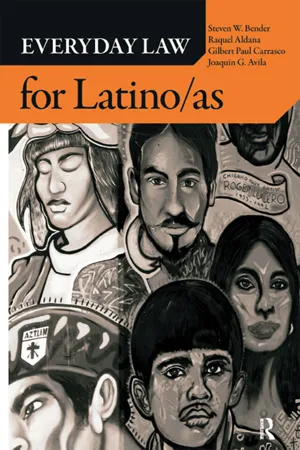
Everyday Law for Latino/as
- 264 pages
- English
- ePUB (mobile friendly)
- Available on iOS & Android
eBook - ePub
Everyday Law for Latino/as
About this book
Now the most populous minority group in the United States, Latino/as increasingly need guidance on the everyday issues that affect their economic livelihood, their freedom, and their equal rights to dignity and opportunity. This comprehensive guide is organized around the three flashpoints that contribute to the unique legal treatment of Latino/as-immigration status, language regulation, and racial/ethnic discrimination. These points are examined in the venues of everyday life for Latino/as-from discrimination in housing to discrimination and language regulation in the workplace and lack of protection for immigrant labor, to classrooms where the bilingual education debate rages, to the voting booth and the criminal justice system where Latino/as confront racial profiling and language barriers.
1
Introduction
We organized our handbook on Latino/as and the law around the three primary flashpoints that contribute to the unique legal treatment of Latino/as—immigration status, language regulation, and racial/ethnic discrimination. We examine these flashpoints in the venues of everyday life for Latino/as—from discrimination in housing to discrimination and language regulation in the workplace and the lack of protection of immigrant labor, to classrooms where the bilingual education debate rages, to the voting booth and the criminal justice system where Latino/as confront racial profiling and language barriers. Before we consider these issues, we reflect on how their histories have shaped the current treatment of Latino/as under U.S. law.
Immigration
Until enactment of the Immigration and Nationality Act of 1965, ceilings on immigration from Mexico and other Western Hemisphere countries did not exist—rather, immigration restrictions focused on excluding or limiting immigrants from Asia and Southern and Eastern Europe. Still, the absence of immigration restrictions did not prevent mass economic and racially driven deportations of Mexicans (even persons with U.S. citizenship) during the Great Depression and Operation Wetback in the 1950s. Initiated during World War II but with roots extending to World War I, the bracero (temporary worker) program facilitated the entry of Mexican workers into the U.S. fields and factories for agreed on wages and terms of employment. By 1964, however, a coalition of labor unions, religious organizations, and Mexican American groups, concerned both with the impacts of abundant bracero labor on wages and conditions for U.S. workers, and about abuses of participants in the bracero program, persuaded Congress to let the program lapse. The next year, the Immigration and Nationality Act of 1965 placed the first restrictions on Western Hemisphere immigration, limiting immigration from Mexico and other Central and Latin American countries. By 1976, in addition to the overall Western Hemisphere quota, immigration from Mexico was restricted to a 20,000-person limit annually. The combination of the end of the bracero program and these new limits on Latino/a immigration created the Latino/a undocumented immigrant problem that still commands headlines. Efforts to address undocumented immigrants have taken several tacks, none of them effective. In 1986, President Reagan signed the Immigration Reform and Control Act of 1986 that offered a pathway to citizenship to undocumented workers, but aimed to curb future undocumented immigration through employer sanctions. In the 1990s, President Clinton championed restrictive legislation arming urban border entry points that resulted in immigrants’ undertaking more dangerous crossings in desolate locations. For his part, President Bush favored a bracero-like guest worker program to import Mexican and other Central and South American workers without a potential for citizenship. Later, Bush supported comprehensive immigration reform that included a pathway, albeit a lengthy, expensive one, to citizenship, but Congress failed to enact reform in 2007.
Today, an estimated 12 million undocumented immigrants, many of them from Mexico, reside in the United States. As discussed herein, U.S. law in the workplace and elsewhere leaves these immigrants largely unprotected, although the Supreme Court has recognized a constitutional right to public education for undocumented immigrant children.
Language
Regulation of non-English languages under U.S. law disproportionately impacts Latino/as, most of whom speak Spanish. Some of these Latino/a Spanish speakers may also speak English, and others may speak a third indigenous language. Mexico and Guatemala alone, for example, are home to about 260 indigenous languages. Although the United States has no comprehensive official English-language law that bars the use of languages other than English in government, government operations nonetheless tend to be conducted in English. Moreover, about half the states have comprehensive English-language laws that declare English the official language, with a few going so far as to require only English for all government operations except when necessary for health or safety. This language regulation, supplemented by nongovernmental language restrictions, causes difficulty for Latino/as who wish to speak or hear the Spanish (or other non-English) language in settings as diverse as their schools, workplace, government offices, the criminal justice system, and places of entertainment.
Some language disputes, particularly those arising in the criminal justice setting over police searches and rights on arrest, involve the right to receive communications in Spanish or languages other than English. Here the sources of law that may confer the right to a Spanish-language translation include statutes as well as constitutional guarantees against unreasonable search and seizure and self-incrimination. By contrast to the right to receive Spanish translations, many language disputes seek the right to speak Spanish in settings that include school classrooms, the workplace, and even the home. Sometimes laws require English in these settings; for example, laws in California, Arizona, and Massachusetts outlaw bilingual education and mandate classroom instruction overwhelmingly in the English language. Other times the language restriction may be court-imposed, such as the possibility of a judge in a custody dispute ordering that a child hear only English from the child’s Latino/a parent. Often, a private source, such as an employer, a landlord, or a neighborhood tavern imposes the restriction against speaking Spanish. Here, those who challenge private language policies rely on civil rights laws protecting against discrimination on the basis of race or ethnicity, with mixed success. Language restrictions may fall heavily on even bilingual speakers, who can understand English and thus overcome the lack of Spanish language translations, but whose desire to communicate in Spanish might be barred in workplaces and places of entertainment.
Language restrictions under U.S. law, as well as private language policies, have deep roots in history. Hostility toward Southern and Eastern European immigrants in the early 1900s prompted many states to mandate English language in schools. Schools in the Southwest have a long history of prohibiting Spanish. Texas, for example, criminalized the speaking of Spanish by teachers in the classroom for most of the twentieth century and punished or expelled students for speaking Spanish on the school grounds.
Discrimination
The history of discrimination against Latino/as includes early forms of racial profiling in California—its antiloitering Vagrancy Act, enacted in 1855 and known as the Greaser Act, targeted only persons “commonly known as ‘Greasers’ or the issue of Spanish and Indian blood … and who go armed and are not peaceable and quiet persons.” In a particularly notorious example from the 1940s of abusive police practices, authorities prosecuted twenty-two Mexican gang members in Los Angeles on charges ranging from assault to murder arising out of the killing of a young Mexican near the Sleepy Lagoon swimming hole. Although a jury convicted seventeen of the Mexican boys in the sensationalized trial during which local newspapers called the defendants “zoot-suit gangsters” and “pachuco killers,” a California appeals court struck down their convictions due to a “total lack of evidence” (People v. Zammora, 152 P.2d 180 [Cal. Dist. Ct. App. 1944]).
Discrimination historically has also taken the form of segregating or excluding Latino/as in schools, businesses, places of entertainment and recreation, and even from juries. Litigation in Texas that reached the Supreme Court in the 1950s stemmed from the finding that although 14 percent of a Texas county’s residents had Latino/a surnames, for the previous twenty years not a single Latino/a surnamed resident ever served on a grand jury or criminal jury (Hernandez v. Texas, 347 U.S. 475 [1954]). Segregation, both by government and in the private sector was rampant in the Southwest where schools separated Mexican American from Anglo children ostensibly to protect the Anglo youth from higher rates of communicable disease among poor Mexican children, and to accommodate the alleged slower academic progress of the Mexican students. Challenges by Latino/as (Mendez v. Westminster School District of Orange County, 64 F. Supp. 544 [S.D. Cal. 1946]) and African Americans to segregation practices in schools culminated in the famous 1954 Supreme Court decision Brown v. Board of Education (347 U.S. 483 [1954]) that struck down separate but equal facilities in public education as violating the constitutional Equal Protection Clause. In addition to abolishing government-sponsored segregation in public education, the Brown decision enabled lawyers to eradicate longstanding segregation practices in other government facilities such as parks and buses. In the mid-1900s, for example, a Texas public park sign read: “This park was given for white people only. Mexicans and Negroes stay out. Order of Park Board.” Although the Brown decision outlawed official segregation in public facilities, private segregation continued. For example, movie theaters and restaurants in the Southwest often excluded altogether or relegated Mexicans to certain days of use or to certain permitted areas. In the 1960s, however, Congress enacted civil rights laws that prohibited segregation and other forms of discrimination by private parties in some settings. For example, Title II of the federal Civil Rights Act of 1964 barred racial or ethnic segregation or discrimination in places of public accommodation such as hotels, restaurants, gas stations, and theaters. Further, the federal Fair Housing Act of 1968 outlawed discrimination in real estate transactions, Title VI of the Civil Rights Act of 1964 targeted discrimination in public education, and Title VII of that act prohibited employment discrimination.
Broad Scope of Latino/a Population
A broad range of groups comprise the U.S. Latino/a population. According to the 2000 U.S. Census, most (66.1 percent) are of Mexican origin, with Puerto Ricans the next largest group (9 percent), followed by those of Cuban origin (4 percent); another 14.5 percent of Latino/as identify as Central or South American in origin, and 6.4 percent as “other Hispanic origin.” Although possessing unique cultural and historical backgrounds, these groups share common issues of immigration (aside from Puerto Rico), language barriers, and anti-Latino/a discrimination. Therefore, our book encompasses all these groups. But, in some instances, particularly in the context of immigration, our book will address rules applicable to Latino/as of a specified origin.
Sources of Law
The materials in this book encompass federal and state statutes, as well as constitutional provisions and judicial decisions. All of these sources of law have the potential to endanger the interests of Latino/as as well as to liberate them from unfair treatment. Federal law establishes various civil rights of Latino/as, particularly in the areas of employment, schools, voting, and housing. At the same time, restrictive federal immigration law creates a gauntlet for undocumented immigrants as well as documented immigrants seeking citizenship. State law duplicates many of the civil rights protections of federal law, in some cases providing enhanced rights and remedies. Still, some state laws target Latino/as through English-language laws, laws eradicating bilingual education and affirmative action programs, and laws denying government services to undocumented immigrants.
Latino/as rely on federal and state constitutional guarantees to ensure language rights in the criminal justice system. Constitutional guarantees may also help establish immigrant rights. For example, the Supreme Court relied on the federal Constitution’s Equal Protection Clause to strike down Texas law withholding state funds to educate undocumented children. The First Amendment guarantee of free speech, however, impedes legal attack on media productions that invoke derogatory stereotypes. Still, lawyers invoked the First Amendment to strike down Arizona’s former English-Only law that unconstitutionally burdened communication in Spanish and other non-English languages between politicians and their constituents and between government service providers and residents.
Courts have aided Latino/as, among other ways, by creating and applying judicial grounds to scrutinize the fairness of contracts between merchants and Latino/as with a language barrier. At the same time, some courts are reluctant to function as lawmakers to offer relief to Latino/as beyond what the legislature has provided; for example, the California Supreme Court refused to require an aspirin manufacturer to provide a Spanish-language translation of product dangers, instead suggesting translation was best mandated by the legislature, if at all (Ramirez v. Plough, Inc., 863 P.2d 167 [Cal. 1993]).
Overview of the Book
Our book addresses discrimination against Latino/as in the workplace (Chapter 1), housing (Chapter 2), and the criminal justice system (see the discussion of racial profiling in Chapter 8). Language-based discrimination is the subject of Chapter 4, but language rights and language oppression are also discussed in Chapters 2 (employment), 3 (housing), 6 (education), and 8 (the criminal justice system). Protection against hate speech is addressed in Chapter 5. Recognizing the limits of legal remedies, Chapter 5 also outlines proactive nonlegal strategies such as protests and walkouts.
Affirmative rights of Latino/as are also the subject of discussion in Chapters 2 (farm worker wages), 3 (housing), 6 (education), and 8 (the right to remain silent).
Our book contains extensive treatment of the rights of Latino/a documented and undocumented immigrants in all facets of their everyday lives, including the right to education of the undocumented (Chapters 6 and 11), rights in the employment setting (Chapter 2), rights to government benefits (Chapter 11), and the needs of everyday living (Chapter 11). Rights of legalization, and of citizenship, including family reunification procedures and asylum, are addressed in Chapters 10 and 11. The criminalization of immigration and the consequences for immigrants who commit crimes are the subject of Chapter 8.
Practical Guidance for Latino/as
Our goal is to convey sometimes complex legal issues in readable, accessible text. To implement our goal of a reader-friendly text, we have kept legal citations to a minimum. In addition to summarizing applicable laws, we have included practical, nonlegal strategies for Latino/as and Latino/a community groups such as tactics in the face of workplace immigration raids (Chapter 2), advice to college applicants (Chapter 6), and advice when choosing an immigration lawyer (Chapter 9). Recognizing that the best long-term solution for unfair treatment of Latino/as under the law comes from political power, we have also included discussion of how Latino/as can protect their right to vote (Chapter 7).
2
Employment Law
Discrimination in Hiring and Employment
When the civil rights movement gained momentum in the late 1950s and early 1960s, Congress finally took comprehensive action against discrimination in employment in passing the Civil Rights Act of 1964. Regarding employment, the critical provision is Title VII (42 U.S.C. § 2000e-2[a]), which makes it an unlawful employment practice “to fail or refuse to hire or to discharge any individual, or otherwise discriminate against any individual with respect to his compensation, terms, conditions, or privileges of employment, because of such individual’s race, color, religion, sex, or national origin.” Among those covered by Title VII are private employers with fifteen or more employees, public employers, labor unions, and employment agencies. All hiring practices are covered by this federal law, including recruitment, job advertising, pre-employment inquiries, written application requirements, and job interviews. The law also governs the recruitment and referral actions of unions and employment agencies.
What You Can Do as a Victim of Employment Discrimination. There are two places you may initiate a claim of discrimination ...
Table of contents
- Cover
- Half Title
- Title Page
- Copyright Page
- Dedication
- Table of Contents
- Acknowledgments
- 1 Introduction
- 2 Employment Law
- 3 Discrimination in Housing
- 4 Language Discrimination
- 5 Hate Speech
- 6 Education
- 7 Voting Rights
- 8 Criminal Justice System
- 9 Immigrants Choosing Lawyers and Filing Taxes
- 10 Documented Immigrants
- 11 Undocumented Migrants
- 12 Conclusion
- Index
- About the Authors
Trusted by 375,005 students
Access to over 1.5 million titles for a fair monthly price.
Study more efficiently using our study tools.
Frequently asked questions
Yes, you can cancel anytime from the Subscription tab in your account settings on the Perlego website. Your subscription will stay active until the end of your current billing period. Learn how to cancel your subscription
No, books cannot be downloaded as external files, such as PDFs, for use outside of Perlego. However, you can download books within the Perlego app for offline reading on mobile or tablet. Learn how to download books offline
Perlego offers two plans: Essential and Complete
- Essential is ideal for learners and professionals who enjoy exploring a wide range of subjects. Access the Essential Library with 800,000+ trusted titles and best-sellers across business, personal growth, and the humanities. Includes unlimited reading time and Standard Read Aloud voice.
- Complete: Perfect for advanced learners and researchers needing full, unrestricted access. Unlock 1.5M+ books across hundreds of subjects, including academic and specialized titles. The Complete Plan also includes advanced features like Premium Read Aloud and Research Assistant.
We are an online textbook subscription service, where you can get access to an entire online library for less than the price of a single book per month. With over 1.5 million books across 990+ topics, we’ve got you covered! Learn about our mission
Look out for the read-aloud symbol on your next book to see if you can listen to it. The read-aloud tool reads text aloud for you, highlighting the text as it is being read. You can pause it, speed it up and slow it down. Learn more about Read Aloud
Yes! You can use the Perlego app on both iOS and Android devices to read anytime, anywhere — even offline. Perfect for commutes or when you’re on the go.
Please note we cannot support devices running on iOS 13 and Android 7 or earlier. Learn more about using the app
Please note we cannot support devices running on iOS 13 and Android 7 or earlier. Learn more about using the app
Yes, you can access Everyday Law for Latino/as by Steven W. Bender,Raquel Aldana,Gilbert Paul Carrasco,Joaquin G. Avila in PDF and/or ePUB format, as well as other popular books in Law & Civil Rights in Law. We have over 1.5 million books available in our catalogue for you to explore.