eBook - ePub
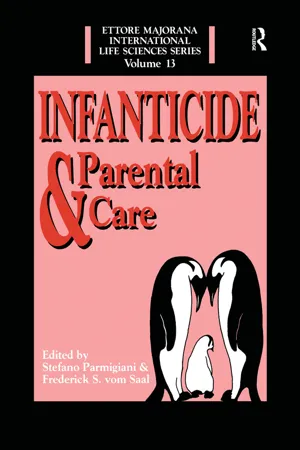
Infanticide And Parental Care
- 496 pages
- English
- ePUB (mobile friendly)
- Available on iOS & Android
eBook - ePub
Infanticide And Parental Care
About this book
First published in 1994. Infanticide is an extremely complex behavioral pattern that occurs throughout the animal kingdom and it must be considered not only in isolation but also from the viewpoint of an animal's care of its young. Infanticide and Parental Care will be of interest to zoologists, evolutionary biologists and biological anthropologists. The concept of infanticide is considered in different mammals such as humans, primates, pinnipeds, lions, dwarf mongooses and prairie dogs and in non-mammals including insects and birds. Infanticide and Parental Care also views the topic in different environmental conditions such as the natural habitat of an animal and animals kept in laboratory conditions. The wide implications of infanticide mean that this book will also be useful to historians, anthropologists, sociologists and psychologists.
Information
Part 1: Historical, Anthropological, Sociological and Psychological Approaches to the Study of Infanticide and Parental Care in Humans
Chapter 1
Fitness Tradeoffs in the History and Evolution of Delegated Mothering with Special Reference to Wet-Nursing, Abandonment and Infanticide
SARAH BLAFFER HRDY
Department of Anthropology, University of California, Davis, California, USA
Department of Anthropology, University of California, Davis, California, USA
Early European accounts of infanticidal savages bristled with ethnocentric moralizing...And yet as we read the tragic accounts...from one society to another, it is not the inhumanity of the unfortunate perpetrators that confronts us, but rather their humanity...
Martin Daly and Margo Wilson, 1988:591.
I Introduction: Motherhood as Compromise
The dilemma confronting working mothers in the western world today has universal dimensions. To imagine that there is anything new in the conflicts faced by modern women is to adopt a mythologized concept of self-sacrificing motherhood. For motherhood has always meant compromise, compromise between subsistence needs of the mother and the time, energy, and resources needed to mate and reproduce (reproductive effort). In addition to conflicts between the mother's own needs and a general commitment to reproduction, iteroparous mothers (breeding over a lifetime) must also partition their reproductive effort among different offspring. Parental investment of time, energy or resources in the production or nurturing of one offspring can diminish a mother's ability to invest in older offspring, or in her ability to produce additional offspring in the future (Trivers, 1972).1
As Robert Trivers pointed out (1974), individual infants may attempt to extract greater investment from their parents than the parents have been selected to give. Herein lies the source of the chronic tension between parental commitment to the survival and well being of offspring and parental frustration at the frequency and insistence of infant demands. Although a primate infant should rarely seek to extract more reproductive effort from a mother than is compatible with her survival, it might well seek to extract additional parental investment when it would come at the expense of future siblings, rather than the mother's survival. In this paper I will be dealing with maternal dilemmas and decision making at two levels: 1) at the level of reproductive effort – her own survival versus that of her progeny; and 2) at the level of parental investment – investment in one particular infant versus investment in offspring of another sex, born with different qualities and/or under different circumstances.
In most mammals, and all primates, newborns are dependent on their mother for warmth, protection, locomotion and nutrition. Substitute providers of these functions occasionally crop up in evolutionary history (e.g. van Lawick, 1973 for wild dogs; Hrdy, 1976 and Thierry and Anderson, 1986 for primates) and have even been common during some periods in human history. More often than not however, survival of the infant depends on the mother's survival. From an evolutionary perspective then, it is the mother who is the critical unit of selection and the mother's survival would always have priority except in the case of older or incapacitated mothers with low probabilities of reproducing again, that is, mothers with very low reproductive value. Even here, maternal survival should take priority if survival of the infant depends on her nurturing.
Where parental rank is correlated with the survival and breeding prospects of selected offspring, even the maintenance of parental status may take precedence over the survival of less favored infants. Some of the best documented examples derive from human parents who cloister in convents or actually destroy daughters whose dowry costs jeopardize family socioeconomic status, or destroy daughters who threaten to injure family standing or "honor" (Dickemann, 1979; Manzoni, 1961:134ff; Boone, 1986).
In other mammals who produce either sequential young or litters, parents respond to local conditions in evaluating the worth of a particular offspring in terms of probabilistic assessments of future conditions and "as a function of the proportion that this child represents of his total future reproductive prospects" (Dawkins and Carlisle, 1976:132). That is, parents respond with what Daly and Wilson (1980; 1983) refer to as "discriminative parental solicitude" – an amalgam derived from assessments of probable degree of relatedness (clearly more important in the case of males and egg layers than for most female mammals); worth of the offspring in terms of its ability to translate parental investment into subsequent reproduction, and finally consideration of alternate uses to which the parent could devote the resources, such as diverting resources to a stronger child, a child of a preferred sex or sustaining the parent until more favorable opportunities to breed should present themselves. In humans these levels of solicitude are tempered (albeit rarely overridden completely) by cultural ideals, especially ideals about continuation of the household or the lineage, ideals which are in turn shaped through historical time by the changing productive and reproductive value of children (Hrdy, 1990).
Here I focus on fitness tradeoffs made by mothers through human history. In humans, however, as in so many species, maternal subsistence and especially the survival of her offspring are so heavily influenced by other group members that it is impossible to consider the mother in isolation from the web of fitness tradeoffs by other individuals in the social network she is part of (see Hill and Kaplan, 1988 for an exemplary case study exploring how reproductive decisions "mutually constrain one another" and involve complex tradeoffs between alternative behavioral options among Ache hunter-foragers of Paraguay). Relevant individuals may include former and future mates of the mother, biological relatives, affines and unrelated individuals linked to her in either cooperative or competitive arrangements, subordinate individuals she exploits as well as dominant individuals exploiting her. For the purposes of this paper, I will sometimes substitute the term "parental" for maternal when my knowledge of the situation is too limited to separate maternal from paternal interests, or when in fact there is good reason to assume they coincide.
II. Fitness Tradeoffs in Determining the Level and Type of Solicitude
For the purposes of this article, I assume that infanticide (were information available) could be documented for virtually all human populations, although frequencies differ markedly, ranging from near zero to over 40% of live births (section IV-B). The main functional classes of infanticide that have been described for non-human animals (Hrdy, 1979) can all be documented among humans, if only anecdotally. Nevertheless, the patterning of infanticide in humans is considerably different. For example, in other primates unrelated males are the most likely perpetrators of infanticide (Hrdy, 1977, 1979; Leland, Struhsaker and Butynski, 1984). While the close proximity to the mother of males unrelated to her infant (either captors or step-fathers) can represent a threat to human infants (e.g. see Biocca, 1971; Hill and Kaplan, 1988 for Amazonian hunter-foragers; Exodus 1:16 and Matthew 2:16 for ancient Near Eastern pastoralists; Daly and Wilson, 1988 for contemporary North American populations), biological parents are apparently responsible for the largest portion of infanticides, and marriage and inheritance systems, religious beliefs and social norms concerning individual and family honor play central roles in parental decisions to terminate investment in these human infants. Furthermore these parental decisions are informed by a unique awareness of history, the future, and long-term goals for family survival. Hence, although thresholds for parents to invest may be set by evolved motivational processes (Daly and Wilson, 1980; 1988), adjustments in parental investment are consciously calculated to achieve culturally as well as biologically defined goals and are played out in specific demographic and cultural contexts (e.g. see Korbin, 1981; Skinner, 1988 and in press).
By far the most common goal for parents committing infanticide involves the manipulation of family size, composition, or the adjustment of the timing of parental investment by the mother and/or father. In fact, however, infanticide in the sense of Langer's (1974) classic definition ("the willful destruction of newborn babies through exposure, starvation, strangulation, smothering, poisoning or through the use of some lethal weapon") represents only the extreme end of a continuum of behaviors which function to reduce the costs (in terms of time, energy, risk and resources) that offspring impose upon parents. In contrast to rodents and other mammals who may cannibalize supernumerary infants (Day and Galef, 1977; Gandelman and Simon, 1978), thereby recouping nutrients, there are virtually never any benefits to killing one's own offspring apart from perceived benefits in rare cases of child sacrifice (e.g. points to be won with a god for sacrificing a valued son, Genesis 22; see Stager and Wolff, 1984 for ancient Carthage). And quite often, there are costs.
Hence, we would expect that infanticide involving direct destruction of the young occurs only as a last resort when other options for reducing postpartum investment are constrained by legal sanctions which makes abandonment riskier than murder, by the lack of supportive kin networks or other potential caregivers, or else by particular sorts of environmental hazards which make abandonment impractical. A different set of constraints may also pertain in the upper reaches of stratified societies where the continued existence of a child may represent a threat to social status, family "honor" or orderly succession. Although it is very common to read in the literature on infanticide that parents were responding to scarcity by eliminating their infants, limited resources by themselves (except in special circumstances, see section IV-A) are no reason to destroy an infant. Scarcity is merely a reason for parents to REDUCE investment in a current infant, perhaps abandon it. There exist a wide array of alternatives to infanticide whose availability varies according to specific historical and ecological contexts.
Compared to infanticide, these alternative means of reducing parental investment in offspring have received less emphasis in the literature. Yet between infanticide and John Bowlby's ideal of a Pleistocene mother linked by an intense emotional bond to her infant, and physically in close contact with this semi-continuously suckling infant (Konner, 1976), there lies a continuum of compromises. Indeed, such retrenchments from the Bowlbian or "primate ideal" are far more common, sociologically and demographically more important, than actual infanticide (exceptions are discussed in section IV-B). I list below seven different ways of dealing with infants, each of which functions to mitigate or terminate parental investment without outright destruction of the infant. This list is by no means exhaustive:
- 1) Exploitation of the infant as a resource, usually selling the infant, which entails some immediate (usually small) gain to the parents (e.g. see Boswell, 1988:170-171; Fildes, 1986:6). Although prostitution or slavery would be likely fates for offspring sold (Boswell, 1988), some children could conceivably end up with improved prospects of survival or even reproduction.
- 2) Abandonment of the infant where the parents leave the infant typically out of harm's way so that there is some prospect that the infant will be taken up and cared for by someone else (Trexler, 1973a; Boswell, 1988; see Exodus 2, for the story of Moses). Admittedly, there can be a fuzzy distinction between abandonment and infanticide when real or imagined parental optimism comes up against the realities of infant starvation or hypothermia. Nevertheless, the practice common in Medieval Europe of abandoning infants with identifying tokens indicates – at least for those cases – the existence of a parental mind set where retrieval of the infant one day remained a possibility. Some parents found solace by fantasizing fabulous destinies of upward social mobility for abandoned progeny (e.g. Romulus, who founds a d...
Table of contents
- Cover
- Half Title
- Title
- Copyright
- Contents
- Introduction to the Series
- Preface
- List of Contributors
- PART 1: HISTORICAL ANTHROPOLOGICAL, SOCIOLOGICAL AND PSYCHOLOGICAL APPROACHES TO THE STUDY OF INFANTICIDE AND PARENTAL CARE IN HUMANS
- PART 2: INFANTICIDE IN NONHUMAN PRIMATES
- PART 3: FIELD STUDIES OF INFANTICIDE AND PARENTAL CARE IN INSECTS, BIRDS AND MAMMALS
- PART 4: EXPERIMENTAL STUDIES OF INFANTICIDE AND PARENTAL CARE IN RODENTS
- Index
Trusted by 375,005 students
Access to over 1.5 million titles for a fair monthly price.
Study more efficiently using our study tools.
Frequently asked questions
Yes, you can cancel anytime from the Subscription tab in your account settings on the Perlego website. Your subscription will stay active until the end of your current billing period. Learn how to cancel your subscription
No, books cannot be downloaded as external files, such as PDFs, for use outside of Perlego. However, you can download books within the Perlego app for offline reading on mobile or tablet. Learn how to download books offline
Perlego offers two plans: Essential and Complete
- Essential is ideal for learners and professionals who enjoy exploring a wide range of subjects. Access the Essential Library with 800,000+ trusted titles and best-sellers across business, personal growth, and the humanities. Includes unlimited reading time and Standard Read Aloud voice.
- Complete: Perfect for advanced learners and researchers needing full, unrestricted access. Unlock 1.5M+ books across hundreds of subjects, including academic and specialized titles. The Complete Plan also includes advanced features like Premium Read Aloud and Research Assistant.
We are an online textbook subscription service, where you can get access to an entire online library for less than the price of a single book per month. With over 1.5 million books across 990+ topics, we’ve got you covered! Learn about our mission
Look out for the read-aloud symbol on your next book to see if you can listen to it. The read-aloud tool reads text aloud for you, highlighting the text as it is being read. You can pause it, speed it up and slow it down. Learn more about Read Aloud
Yes! You can use the Perlego app on both iOS and Android devices to read anytime, anywhere — even offline. Perfect for commutes or when you’re on the go.
Please note we cannot support devices running on iOS 13 and Android 7 or earlier. Learn more about using the app
Please note we cannot support devices running on iOS 13 and Android 7 or earlier. Learn more about using the app
Yes, you can access Infanticide And Parental Care by Stefano Parmigiani, Frederick vom Saal, Stefano Parmigiani,Frederick vom Saal,Frederick S. vom Saal, Stefano Parmigiani, Frederick S. vom Saal in PDF and/or ePUB format, as well as other popular books in Biological Sciences & Health Care Delivery. We have over 1.5 million books available in our catalogue for you to explore.