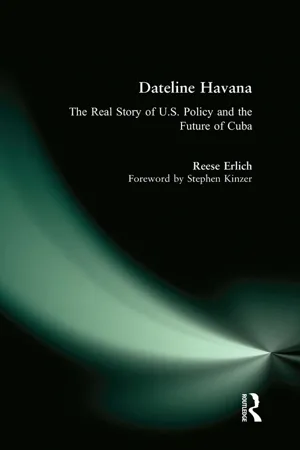
Expertly researched and deftly reported, <i>Dateline Havana</i> is a probing exposé of U.S. policy and the future of Cuba on the occasion of the 50th anniversary of the Cuban Revolution. Covering art, music, and Cuban politics, Reese Erlich creates a tableau that is at once moving and informative.
<br>
<br>
eBook - ePub
Dateline Havana
The Real Story of Us Policy and the Future of Cuba
- 260 pages
- English
- ePUB (mobile friendly)
- Available on iOS & Android
eBook - ePub
About this book
Information
1
A Very Personal Journey
WE ZOOMED DOWN THE STREET IN HAVANA AS WAVES crashed against the famous Malecón seawall, inundating the four-lane road. I quickly rolled up the taxi’s windows, but it was too late, and we took a short bath from the sea water. It was March 2008. “A cold front has hit Havana,” explained the taxi driver, making a shivering motion with his shoulders for extra emphasis. The waves were high, the sky was filled with dark clouds, and rain threatened. People on the streets wore jackets. The temperature had dropped to the low 70s. Welcome to Havana’s version of a frigid winter.
I’d traveled this road for many years. As we approached the turnoff for Old Havana, the same grand houses stood along the Malecón, with their cracked marble facades, crumbling cement pillars, and peeling paint. During my first trip to Cuba in 1968,I marveled at how those old buildings had survived the waves and salt air. Forty years later, some looked like they hadn’t been repaired since my first journey. I then remembered seeing a photo of these same houses in the 1920s. Even back then they looked weathered and in need of a coat of paint.
But in 2008 some of the houses along the Malecón were being remodeled and repainted. Foreign-owned businesses were setting up shop on the ground floors of some buildings; residents were repairing others. I saw similar activity all over Havana, a sign of the relative economic improvements since my last trip five years earlier.
The wet drive down the Malecón showed that appearances could be deceiving. American journalists come to Cuba for a short trip. They see the crumbling infrastructure and report about Cuba’s massive economic problems and lack of democracy. If they did more research or stayed longer, they might learn that most Cubans, particularly those in rural areas, live better today than they did in 1959.1 Leftist supporters of the Revolution, on the other hand, visit the island for a short time and praise the country’s free hospitals and schools. They learn about the bad conditions before 1959 but often don’t acknowledge the country’s very real problems today. Young Cubans in particular complain angrily about the lack of food, consumer goods, and affordable access to the Internet.
Cuba has become an icon for both sides in a bitter battle. For 50 years the U.S. government has called Cuba a strategic threat. For conservative Cubans in Miami, the island is a totalitarian dictatorship denying the most basic human rights to its people. For supporters of the Cuban Revolution, the government has resisted U.S. domination and built a shining, socialist society. In reality, Cuba is neither the totalitarian hell depicted in the United States nor the socialist paradise claimed by some admirers.2
I began freelance reporting from Cuba in 1968 and have been back a total of 11 times, covering developments for National Public Radio, the San Francisco Chronicle, and the Christian Science Monitor, among others. I also reported from hotspots around the world where the United States accused Cuba of aggression: Grenada right after the 1983 U.S. invasion, El Salvador, Nicaragua under the Sandinistas, and Angola.
I visited Washington DC to understand why the United States had established normal diplomatic and trade relations with China and Vietnam, but not with Cuba. In Miami I met with conservative and ultraconservative Cubans, some of whom had funded terrorist attacks against civilians on the island. They spoke openly about their views and the power of the Cuba Lobby, even though they denied any ties to terrorism.
One sector of Miami Cubans, Republican leaders, and major Democratic politicians in Washington support the U.S. embargo against Cuba, a policy backed by no other country in the world. The embargo has proved so ineffective that even some of the Miami stalwarts admit its flaws. Joe García, a former leader of the Cuban American National Foundation (CANF) and 2008 candidate for Congress from Miami, compared the embargo to belief in Christianity. “There is an ideology and credo. We all recite it. There is a history of miracles but we’ve never seen them. It’s been in existence for 50 years, but we don’t see results. But we are strongly committed to the credo. As a guy who still works that church, you don’t argue with the saints.” Understanding those saints—along with the money and power of the rightists in Florida—is key to understanding the future of U.S.-Cuban relations.
In 2008 I reencountered people I had interviewed years earlier. Their lives reflect the rapid changes in Cuba today. Most of the people had stayed on the island and continued to support the Revolution. Two had immigrated to New York (I later flew up to Buffalo to find out why). I talked with Cubans about controversial issues such as racism, homophobia, economic reforms, the Internet, and democratic political control. Everyone on and off the island spoke openly and intelligently. Only a few people asked that their names be withheld.
Many books have been written about Cuba. Dateline Havana seeks to combine analysis with firsthand reporting. Cuba has undergone major changes over the past 40 years, and so have I.

In 1968 I traveled to Cuba for the first time as a staff reporter for Ramparts magazine.3 I also went as part of a group of 40 members of Students for a Democratic Society (SDS), the largest radical student group in the country.4 Neither I nor my editors saw any contradiction in the fact that I was both a member of SDS and reporting on the trip. In fact, it gave me more access and insight. I was writing in the spirit of gonzo journalists like Hunter S. Thompson—but possessing less talent and fewer hallucinogenic substances. However, I did develop a lifelong admiration for a well-made mojito.5
By the time ofthat trip I had accumulated a bit of a resume. I had helped organize Stop the Draft Week in October 1967, when 10,000 people blocked the streets of downtown Oakland to protest the Vietnam War and the draft. The University of California, Berkeley, kicked me out of school because we used the campus as a launching pad for the protest. Then, Alameda County indicted several of the leaders on conspiracy charges, and we became known as the Oakland 7.I had gotten a job at Ramparts despite having no journalism experience, but sympathetic editors trained me on the job. And just a month before my Cuba trip, I turned 21.
Not surprisingly, I opposed U.S. policy on Cuba. The Kennedy and Johnson administrations had sponsored terrorist attacks on Cuba by Miami exiles.6 They prohibited Cuban trade with the United States, and did everything possible to stop Cuban economic activity with Latin America and Europe. Many of Cuba’s problems in those years flowed directly from the U.S. embargo.7
I was enthusiastic about the Cuban Revolution. Bearded, longhaired revolutionaries overthrew a hated dictatorship and were thumbing their noses at U.S. presidents. The romanticism of the Revolution appealed to me as well. Ernesto “Che” Guevara emphasized the need for moral incentives, not just higher wages, to increase production. Cuba was going to harvest a record 10 million tons of sugar cane by mobilizing volunteer labor. The Isle of Pines, renamed the Isle of Youth, would become the world’s first communist island, where everyone worked according to their ability and took according to their need (see chapter 7).
There was only one problem. Those policies didn’t succeed. Che’s moral incentives didn’t put food on the table and, in fact, the work ethic declined after the early enthusiasm of the 1960s. People on the Isle of Youth faced extreme food shortages, and the notion of building communism on one island was abandoned. Che Guevara was murdered in Bolivia in 1967 by the CIA. His guerrilla “foco” theory had failed to attract support among Bolivians.8
Some years later, I figured out that Cuban leaders had put their own revolutionary enthusiasm ahead of reality. And I was doing the same thing as a student radical. I wanted revolution; everyone I knew in SDS wanted revolution; therefore, it was only a matter of time before the working class joined us. When American student radicals acted on these ideas, nobody came out to our demonstrations. When Cuban leaders did it, the consequences affected the lives of millions.
This is not one of those “I was a socialist before 30, but now I’ve come to my senses” stories. The ideals that we fought for in SDS in the 1960s are still valid: opposition to interventionist wars; political empowerment for people of color; and support for gay, women’s, and workers’ rights. The ideals of the Cuban Revolution remain valid: land reform, ending racism, ending U.S. domination, economic equality, and self-sufficiency, among others.
But the Cuban Revolution has made serious mistakes and hasn’t progressed nearly far enough. To understand why, we’ll have to go back to that first trip in 1968. And, as with any voyage of discovery, getting there was half the fun.
I found my old diary from the 1968 trip and was immediately struck by one thing: I had incredibly neat penmanship. I’ve been able to reconstruct the trip from those original notes and interviews with some of my former trip mates.
President Kennedy imposed the embargo against Cuba in 1962, which severely restricted travel to the island. SDS recruited people nationwide to take trips starting in 1967. Our trip lasted part of August and September 1968. We represented a range of political views from the bubbling cauldron of America’s New Left. The trip members included Ted Gold, who died several years later in a New York town-house where Weathermen were making bombs.9
It wasn’t easy getting to Cuba. You had to fly from Mexico or take a freighter from Montreal. Just weeks before our departure, Mexican authorities detained and deported a group from the National Lawyers Guild and another from the Black Panther Party. Acting at the behest of U.S. officials, Mexican police threw them in jail and, in the case of the Panthers, stole their money and luggage. So, those of us on the SDS trip were worried.
We converged in Dallas from all over the country and stayed at the house of the Dallas Notes, the local underground newspaper. Conditions weren’t great. There were no showers, not enough toilets, and we mostly slept on the floor. Three of us flew ahead to Mexico City because we had official State Department clearance to visit Cuba as journalists. Those were perilous times in Mexico. Students were preparing for massive demonstrations at the Olympics in October. A few months after our visit, Mexican police murdered hundreds of students at the Plaza Tlatelolco.10
As soon as we arrived at the Mexico City airport, we rushed to the taxi stand and jumped into the second cab in line. We had seen enough James Bond movies to know that the first cab is always driven by the American spy. Unfortunately, none of us spoke Spanish. In my best Marlon Brando-cum-Emiliano Zapata accent, I mumbled, “Embajada de Cuba (Cuban Embassy), muy rápido.” Unfortunately, the cab driver had absolutely no idea where the Cuban Embassy was. We got out of the cab. I spent 15 minutes checking the phone book. We found another cab. When we finally did arrive at the embassy, our contact person wasn’t there.
We carefully planned how to avoid being kidnapped by the Mexican police. The other 37 passengers would arrive from Dallas and never leave the airport. We were prepared to offer nonviolent resistance by sitting down in the airport and refusing to drink anything but Corona beer. That never became necessary. We flew to Havana without incident and were welcomed at the airport with frozen daiquiris.
As veterans of battles against the Vietnam War and university administrations, we were full of self-importance. But we also had serious questions about Cuban society. We wanted to find out about democracy. Was there still sexism and racism in Cuba, and if so, what was the government doing to combat it? For the next three weeks, we were feted like visiting dignitaries. We stayed in the finest hotels and ate elaborate meals washed down with rum and beer. We lived better in Cuba than we did at home. And, of course, we lived far better than the average Cuban. We resented it. One SDS member told me, “They’re treating us more like a delegation from the American Hotel Manager’s Association than a group of radicals.”
As we explored on our own and met ordinary Cubans, however, we began to understand more about the society. The most interesting adventures involved going off the beaten path, literally. One day, we were hiking in the Sierra Maestra foothills east of Santiago. Most of the residents still lived in bohios, the traditional thatched-roof houses. Some of us developed stomach problems. In the small town of Chivirico, seemingly in the middle of nowhere, we found a modern medical clinic. We met a young doctor who had studied in Havana. He told us the clinic provided free medical care, including dentistry and ophthalmology. The doctor explained that such medical care was rare before 1959 in rural areas.11
The government provided top-notch medical education for free; in return, ...
Table of contents
- Cover
- Half Title
- Title Page
- Copyright Page
- Table of Contents
- Dedication
- Foreword
- 1 A Very Personal Journey
- 2 A Short History of U.S.-Cuban Relations
- 3 Is Cuba a Strategic Threat?
- 4 The Origins of the Cuba Lobby
- 5 The Cuba Lobby: Bush and Beyond
- 6 The U.S. Embargo
- 7 Cuba’s Controversial Domestic and Foreign Policies
- 8 Food, Organic Farms, and Jewish Jokes
- 9 The Real Story of the Buena Vista Social Club and Artistic Freedom
- 10 Women, Gays, and Machismo
- 11 Racism in Cuba?
- 12 Dissidents, Democracy, and the Internet
- 13 Prospects for Change
- Notes
- Acknowledgments
- Index
- About the Author
Trusted by 375,005 students
Access to over 1.5 million titles for a fair monthly price.
Study more efficiently using our study tools.
Frequently asked questions
Yes, you can cancel anytime from the Subscription tab in your account settings on the Perlego website. Your subscription will stay active until the end of your current billing period. Learn how to cancel your subscription
No, books cannot be downloaded as external files, such as PDFs, for use outside of Perlego. However, you can download books within the Perlego app for offline reading on mobile or tablet. Learn how to download books offline
Perlego offers two plans: Essential and Complete
- Essential is ideal for learners and professionals who enjoy exploring a wide range of subjects. Access the Essential Library with 800,000+ trusted titles and best-sellers across business, personal growth, and the humanities. Includes unlimited reading time and Standard Read Aloud voice.
- Complete: Perfect for advanced learners and researchers needing full, unrestricted access. Unlock 1.5M+ books across hundreds of subjects, including academic and specialized titles. The Complete Plan also includes advanced features like Premium Read Aloud and Research Assistant.
We are an online textbook subscription service, where you can get access to an entire online library for less than the price of a single book per month. With over 1.5 million books across 990+ topics, we’ve got you covered! Learn about our mission
Look out for the read-aloud symbol on your next book to see if you can listen to it. The read-aloud tool reads text aloud for you, highlighting the text as it is being read. You can pause it, speed it up and slow it down. Learn more about Read Aloud
Yes! You can use the Perlego app on both iOS and Android devices to read anytime, anywhere — even offline. Perfect for commutes or when you’re on the go.
Please note we cannot support devices running on iOS 13 and Android 7 or earlier. Learn more about using the app
Please note we cannot support devices running on iOS 13 and Android 7 or earlier. Learn more about using the app
Yes, you can access Dateline Havana by Reese Erlich,Stephen Kinzer in PDF and/or ePUB format, as well as other popular books in Politics & International Relations & Diplomacy & Treaties. We have over 1.5 million books available in our catalogue for you to explore.