eBook - ePub
Engendered Economics
Incorporating Diversity into Political Economy
- 256 pages
- English
- ePUB (mobile friendly)
- Available on iOS & Android
eBook - ePub
Engendered Economics
Incorporating Diversity into Political Economy
About this book
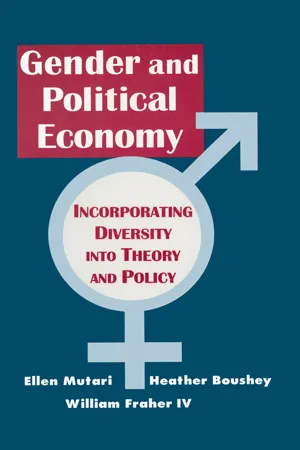
This book provides an overview of current developments within feminist political economy, including reformulations of economic theory, historical and empirical research on the economic roles and status of women and people of color, as well as proposals for broadening the public policy agenda. Rather than offering a feminist critique of neoclassical economics, this volume presents feminist economics in dialogue with progressive economic theory and public policy. It differentiates itself further by addressing issues of class, race and sexuality in interaction with gender.
1
Introduction
The Development of Feminist Political Economy
Ellen Mutari and Heather Boushey
Feminist economics has experienced a recent flourishing of interest and research activity. The key characteristic of this emerging research is a critical stance toward many of the premises, categories, and methods of neoclassical economics (see, for example, Ferber and Nelson 1993; Kuiper and Sap 1995). Taking a cue from the work of feminist philosophers of science, feminist economists view economic discourse as a social practice with concrete historical origins. This new feminist work augments the important contributions of empirical research on women’s economic experiences by challenging the gendered assumptions guiding the neoclassical paradigm.
More than the other social sciences and humanities, economics has been a discipline dominated by a reigning paradigm. The wide-ranging theoretical and policy interests of the early classical political economists (such as Adam Smith, David Ricardo, and Karl Marx) were subsumed into a “scientific” quest for natural laws. Neoclassical economics, defined as the study of the allocation of scarce resources toward the satisfaction of human desires, narrowed the scope and tools of economic inquiry. Yet there has always been a sizable contingent within the discipline that has embraced broader theoretical approaches and methodologies, including Marxists, institutionalists, social economists, and post-Keynesians. Like feminist thought, political economy is less rigid in its disciplinary boundaries. Further, most political economists reject the naturalization of the economy as an ahistorical, disembodied entity. They also question the form of economic rationality posited by neoclassicals as the basis of behavior (see, for example, Block 1990).
Feminist economics, and more specifically feminist political economy, recognizes this shared critical perspective toward mainstream theoretical constructs, but also asserts that feminist analyses provide unique contributions to economic and social theory. Feminist political economy is in many ways an act of synthesis—the creative combustion of insights drawn from diverse intellectual standpoints in the hopes of generating new illumination. Because feminist political economists take inspiration from so many sources, their work reflects a range of interests, principles, and methodologies.
Gender and Political Economy presents some of these diverse approaches to feminist political economy in dialogue with progressive economic theory and public policy. It is an outgrowth of a conference held at the New School for Social Research in New York City in April 1996. The conference on which this volume is based provided a forum to explore how feminist political economy provides greater insight into economic theory and produces fruitful ways of approaching policy. The goals of the conference and of this volume are to extend the boundaries of political economy by incorporating gender in interaction with class, race, and sexuality. This compilation includes a broad range of authors representing diverse perspectives—including a new cadre of feminist political economists who build on the work of their feminist forebears.
The contributors utilize gender analysis in reformulations of political economic theory, empirical studies of women’s economic activity, and proposals for broadening public policy agendas. Parallel to the feminist critique of neoclassical economics, the development of gender-blind categories in political economy, most especially the category of class, is challenged by feminist political economists. Exposing the limits of gender-blind analyses, they demonstrate the centrality of gender in understanding the functioning of the macroeconomy and labor markets as well as the household.1 Gender itself is presented as a complex construct. Therefore, these studies emphasize the historical contingency of gender and its reformulation during periods of economic transformation. Yet gender alone is also insufficient. The authors are attentive to gender’s intersections with class, race, and sexuality.
The Development of Feminist Political Economy
In the United States, contemporary feminist political economy emerged with the second wave of feminism out of the civil rights and antiwar struggles of the 1960s.2 Feminists, along with others influenced by this grassroots New Left politics, grappled with their relationship with the intellectual tradition that seemed to provide important insights into the process of social change: Marxism. At a time when the line between academic and political discourse was blurred, political economists were among those most involved in these discussions. The early “Marxist-feminist debates” centered on the appropriateness of certain key Marxist categories in analyzing women’s experiences in and out of the labor force. For example, the domestic labor debate posed the question of whether Marx’s labor theory of value could be applied to reproductive labor in the home (see, for example, Seecombe 1974; Gardiner 1975; Himmelweit and Mohun 1977; Folbre 1982).3 Did women’s domestic labor create surplus value and, if so, for whom? Similarly, feminist political economists debated whether Marx’s concept of a reserve army of labor, that is, a pool of marginally employed workers who were used to pressure wages downward, could be applied to married women (Benston 1969; Bruegel 1979; Humphries 1983; Power 1983).
Implicitly and explicitly, these discussions addressed (1) the role of women’s paid and unpaid labor in the perpetuation of capitalism, and (2) the relative primacy of class or gender interests. Who benefited from women’s unpaid housework: men as husbands, or capitalists who needed their workers nurtured and sustained? Who benefited from women’s low wages and secondary status as workers: husbands or capitalists? In retrospect, these questions appear unnecessarily reductionist. If the classic feminist critique is that many theories attempt to “add women and stir,” (Andersen 1988), some early efforts by political economists can be accused of adding reproduction and stirring. The domestic labor debate also tended to reify a particular model of gender relations, the male breadwinner and the female homemaker, ignoring historical and cultural variations.4 Nevertheless, the influence of these early discussions continues to be felt. One lasting effect of these debates was the systematic recognition of the economic contribution of domestic labor in regenerating labor power as a productive input. Challenging the dichotomy between “work” and “leisure,” attention was drawn to unpaid work in the home. Methodologically, the Marxist-feminist debates highlighted the systematic nature of women’s secondary economic status, rather than suggesting that it resulted from individual choices or prejudices.
Yet many feminists remained dissatisfied with analyses that appeared to subsume women’s issues within Marxist analysis. In a series of landmark articles, Heidi Hartmann (1976, 1979, 1981) suggested that reliance upon Marxist categories (such as class, reserve army of labor, and wage labor) could not explain why women were the ones who did domestic labor or occupied low-wage jobs. Marx’s analytic categories were gender-blind. Hartmann proposed a systematic analysis of relations between women and men that utilized materialist methodology rather than specific class-based categories. Drawing upon the work of radical feminists, she utilized the concept of patriarchy as a social and economic structure that interacted with capitalism. Hartmann’s (1979) oft-cited definition of patriarchy as “a set of social relations between men, which have a material base, and which, though hierarchical, establish or create interdependence and solidarity among men that enable them to dominate women” remained influential for a new stream of socialist feminist thought (see, for example, Eisenstein 1979; Sargent 1981).5
Socialist feminists viewed capitalism and patriarchy as distinct, autonomous systems, and analyzed the nature of their interaction. Thus, Hartmann proposed a solution to the dilemma (for both neoclassical and traditional Marxist perspectives) of why capitalism had not eradicated labor market inequality: the conscious organization of male workers to maintain relative privilege in the labor market and household. Protective legislation, the family wage, and the development of job segregation were historical examples of institutionalized solutions that enabled mutual accommodation between capitalists and male workers. Sylvia Walby (1986) argued that the contemporary relationship between capitalism and patriarchy has been fraught with tension, as domestic patriarchy competes with public capital for women’s labor. Part-time work for married women was one resolution of this tension in the postwar period—a “new form of compromise” (Walby 1986, 207). In her early writing, Zillah Eisenstein (1979) portrayed the process of mutual accommodation as leading to a fusion into one system, which she termed capitalist patriarchy.
Some feminist political economists critiqued socialist feminism (or dual systems theory) for positing capitalism and patriarchy as autonomous systems. Instead, Jane Humphries and Jill Rubery (1984) presented a theory of the “relative autonomy” of social reproduction, building on the methodological approach of French Marxist Louis Althusser. They viewed the interaction between production and reproduction as a dialectical and historically contingent process (see also Beneria 1979). Utilizing Humphries’ previous research on the historical evolution of the family wage, they disputed the tendency of both Marxists and socialist feminists to portray family structure as accommodating the needs of capitalism (see also Humphries 1977a, 1977b). In contrast, Humphries and Rubery asserted that family structure constrained capitalist development. The institution of a family wage for male breadwinners resulted from efforts by working-class families to minimize the family members’ involvement in wage labor—which, in the nineteenth century, was more exploitative than emancipatory. Restricting women’s labor supply was a deliberate working-class strategy to pressure up the male wage, enabling families to survive on one income.
The strength of this analysis was its focus on the historical process of defining family structure. Humphries (1977a, 1977b) rejected depictions of working-class women as passive victims of patriarchal conspiracies, differentiating the short-term benefits of the family wage from its long-run reinforcement of women’s powerlessness. However, Veronica Beechey (1988) has noted that Humphries and Rubery’s framework presumed families make rational decisions about labor supply based upon an economic calculus in which there are unitary interests among family members. As Folbre (1993, 328) has pointed out, conflict within households and the collective interests of men and women across classes, in addition to the role of social reproduction, are key feminist insights that need to be incorporated into political economy.
Dual systems approaches, grounded in feminist analysis of patriarchy in the household, continued to face criticism in the 1980s. Perhaps the most inescapable problem confronting socialist feminists was their trivialization of racism and colonialism. Thus, socialist feminists found themselves accused of doing unto people of color as Marxism had done unto them (hooks 1981; Joseph 1981). Further, many of the issues addressed by early feminist political economists generalized from the experiences of white women in industrialized countries. The emphasis on married women’s unpaid domestic roles ignored the extensive labor force participation of both married and single black women. Women of color affirmed the importance of families as a source of strength in a racist society (Zinn 1987; Dill 1988). While much of this work on race was authored by sociologists, political economists researching Third World women and the process of economic development emphasized the dynamic nature of the gender division of labor (Beneria and Roldan 1987; Sen and Grown 1987).
In the 1988 introduction to her book originally published in 1980, Michèle Barrett reflected on the theoretical challenges that had been posed in the intervening years:
Women’s Oppression Today is not a book that was unduly exercised by these questions. In terms of the substantive argument of the book, … the major problem lies in the treatment (or lack of it) of issues of ethnicity, race and racism. … More significantly, some of the theoretical formulations of the book I would now regard as ethnocentric: perhaps the strongest example of this would be the analysis of the ‘male breadwinner-dependent wife system’ which does not in fact apply to the black British population of West Indian origin to the same extent as it does to the dominant white ethnic group. (1988, vii)
Barrett goes on to critique her prior emphasis on “‘the family’ as the major agency of women’s oppression and hence unilaterally oppressive, and the consequent tendency to underplay the role of state coercion and violence” (vii).
From the added dimension of racial analysis came several theoretical advances. Feminists rejected the dichotomy between families as a site of power imbalance (as in the work of Hartmann) and families as a site of resistance to domination (as in the work of Humphries). Variations in household structure and women’s economic activity were accentuated (Glenn 1987). The difficulties in generalizing about women’s experiences led to philosophical critiques of “women” as an analytical concept (Barrett 1988, vi, on the work of Gayatri Chakravorty Spivak). The multiplicity of women’s experiences and prevailing ideologies about gender roles became the starting point of many analyses. As articulated by Sen and Grown (1987, 18–19), “While gender subordination has universal elements, feminism cannot be based on a rigid concept of universality that negates the wide variation in women’s experience. There is and must be a diversity of feminisms, responsive to the different needs and concerns of different women, and defined by them for themselves.”
Not only did the male breadwinner model of family life exclude the concrete experiences of women of color, it has appeared less and less representative of white family structure. Thus, social, economic, and political changes were increasingly visible in the 1980s. The shift of manufacturing to newly industrialized countries, the expansion of the service and information sectors, global market integration, and the demise of Keynesian welfare states in the West became fodder for new directions in political economy in general, and feminist political economy in particular. The process of restructuring economic, political, and social institutions, historically and contemporarily, became important intellectual projects. As exemplified by the contributions to this volume, the process of constructing and reconstructing gender relations was analyzed as one dimension of this historical change (see also Beneria and Stimpson 1987; Jenson, Hagen, and Reddy 1988; Rubery 1988).
The concept of patriarchy became increasingly weighted down by all of this diversity and historical change. It seemed more and more difficult for one system, no matter how broadly defined, to incorporate all of the variations in women’s and men’s experiences (Lorber 1994, 3). Although patriarchy continues to be used as “a popular shorthand term for systemic male dominance” (Cockburn 1991, 8), gender has become a core analytical tool. Drawing upon interdisciplinary work in gender studies, feminist contributions to political economy are grounded in an understanding of the social construction of gender. As elaborated by historian Joan Scott (1988), gender as an analytical category is used to reject biological determinism and the tendency to naturalize a socially constructed gender order. While the gendered division of labor is central to the material dimensions of patriarchy, gender theory has also embraced the importance of culture and ideology as social determinants, not mere “superstructure” (Amott and Matthaei 1991). Since the social construction of gender is located in ideology as well as society’s institutional structures, this approach has been termed “poststructuralism.”
Post-structural accounts of the interaction of gender, race, and class (and, more recently, sexuality, nation, and age) permit researchers to address complex variations in institutional arrangements and social norms. The recent work of Nancy Folbre (1994) is exemplary of this approach. Folbre conceptualizes gender, race, class, nation, sexuality, and age as “structures of collective constraint” rather than as autonomous systems, in order to highlight the interaction between different dimensions of collective identity and action (53). She also maintains room for a structural definition of patriarchy as “a variable set of structures of collective constraint based on gender, age, and sexual preference (74).” Feminist political economists inspired by radical institutionalism have also contributed to theoretical developments in this area (Peterson and Brown 1994). Because institutionalist theory has traditionally rejected the pursuit of universal laws of causation as well as narrow concepts of materialism, there is an affinity between institutionalism and postmodern gender theory.6
One strength of contemporary gender theory lies in its reading of gender in all aspects of social organization. Transcending the identification of gender solely with reproduction and the household, these approaches acknowledge that economic concepts and structures are gendered. For example, nineteenth-century concepts of class were themselves gendered since they often embodied ideas of masculinity, such as physical strength and being a breadwinner (Scott 1988). The organization of this volume reflects this desire to dissolve dichotomies by engendering production, that is, to emphasize the permeance of gender, interacting with class, race, and sexuality, in all aspects of economic life.
Overview of This Volume
The essays in Part I contest conventional depictions of the gendered division of labor between production and reproduction. Eschewing the tendency of earlier writers to universalize women’s and men’s experiences, these authors explore both the stability and variability o...
Table of contents
- Cover
- Half Title
- Title Page
- Copyright Page
- Table of Contents
- List of Tables and Figures
- Acknowledgments
- 1. Introduction: The Development of Feminist Political Economy
- Part I Dissolving Dichotomies: New Approaches to Social Reproduction and Labor Supply
- Part II Engendering Production: The Social Construction of Low-Wage Labor Markets
- Bibliography
- About the Editors and Contributors
- Index
Trusted by 375,005 students
Access to over 1.5 million titles for a fair monthly price.
Study more efficiently using our study tools.
Frequently asked questions
Yes, you can cancel anytime from the Subscription tab in your account settings on the Perlego website. Your subscription will stay active until the end of your current billing period. Learn how to cancel your subscription
No, books cannot be downloaded as external files, such as PDFs, for use outside of Perlego. However, you can download books within the Perlego app for offline reading on mobile or tablet. Learn how to download books offline
Perlego offers two plans: Essential and Complete
- Essential is ideal for learners and professionals who enjoy exploring a wide range of subjects. Access the Essential Library with 800,000+ trusted titles and best-sellers across business, personal growth, and the humanities. Includes unlimited reading time and Standard Read Aloud voice.
- Complete: Perfect for advanced learners and researchers needing full, unrestricted access. Unlock 1.5M+ books across hundreds of subjects, including academic and specialized titles. The Complete Plan also includes advanced features like Premium Read Aloud and Research Assistant.
We are an online textbook subscription service, where you can get access to an entire online library for less than the price of a single book per month. With over 1.5 million books across 990+ topics, we’ve got you covered! Learn about our mission
Look out for the read-aloud symbol on your next book to see if you can listen to it. The read-aloud tool reads text aloud for you, highlighting the text as it is being read. You can pause it, speed it up and slow it down. Learn more about Read Aloud
Yes! You can use the Perlego app on both iOS and Android devices to read anytime, anywhere — even offline. Perfect for commutes or when you’re on the go.
Please note we cannot support devices running on iOS 13 and Android 7 or earlier. Learn more about using the app
Please note we cannot support devices running on iOS 13 and Android 7 or earlier. Learn more about using the app
Yes, you can access Engendered Economics by Ellen Mutari,Heather Boushey,William Fraher in PDF and/or ePUB format, as well as other popular books in Economics & Political Economy. We have over 1.5 million books available in our catalogue for you to explore.