- 168 pages
- English
- ePUB (mobile friendly)
- Available on iOS & Android
eBook - ePub
About this book
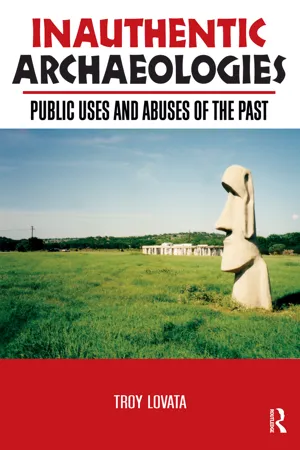
Archaeology has an impact on the public far beyond what any archaeologist would imagine. In this concise, student-friendly look at the public appropriation of archaeology, Troy Lovata examines outright hoaxes, fanciful re-creations, artistic representations, commercial enterprises, and discredited replicas of the past. The book explores examples from around the world and across time to help readers understand how the past becomes social currency for both professional archaeologists and the public at large. Lovata addresses central questions of authenticity, ownership of the past, and the use of archaeology by everyone from artists to multinational corporations. Examples include the Piltdown Hoax, replica Anasazi cliff dwellings at Manitou Springs, Colorado, reconstructed Spanish torreons, and playful Stonehenge replicas. Student exercises, cartoons, interviews, and illustrations add to the pedagogical value of this concise, fascinating work for students in introductory archaeology classes.
Information
Chapter 1
Studying Inauthentic Archaeologies
Inauthentic archaeologies are indeed archaeology. Perfunctory dismissal of them as only pseudoscientific beliefs and forged artifacts is a failure to recognize their social roles. The inauthentic can still be meaningful to people engaging with the past. Yet authentic artifacts and sites are different from archaeological fakes, frauds, replicas, and re-creations. The differences vary because not all inauthentic archaeologies are the same. Inauthentic archaeology, like authentic archaeology, is context dependent. Study of inauthentic archaeologies helps us understand how archaeology operates and how the discipline affects people.
A First-Hand Introduction to Inauthentic Archaeology
The archaeological record is not confined to only a few special places in the world. Yet we need to know what we're looking at, and what we should be looking for, to see the variety of archaeology all around us. First-hand experience can be a key to this process. First-hand experiences with the archaeological record are often the most meaningful interactions that either professional archaeologists or the general public can have with the past. They can produce an epiphany or "ah-ha" moment that brings the past into perspective.
In the summer of 1996, I took a job as a crew member on an archaeological survey of a massive reservoir that bridges the American state of Texas and the Mexican state of Tamaulipas. The region was in the midst of a severe, multi-year drought, so the water level of Falcon Reservoir had dropped tens of meters for the first time in fifty years. Archaeologists had previously studied the area when this section of the Rio Grande was first dammed in the middle of the last century. Now receding water provided an opportunity to reexamine sites, gauge how sites had been impacted, and see what new archaeology had been uncovered after decades submerged.
Our crew spent the days systematically walking the newly exposed shoreline and marking the location of any artifacts we saw. This stretch of the border is sparsely settled today, yet we encountered a large number and a wide range of artifacts in our survey. It was not out of the ordinary to find a thousand-year-old Native American dart point the same day that I saw shards of glass bottles left by Mexican American ranchers only a hundred years ago. These individual finds would later be used to define entire sites. The federal law that initiated our survey stated that these sites must be at least fifty years old to be deemed significant—that is, significant enough to qualify for nomination to the National Register of Historic Places. Archaeologists uncover interesting artifacts and sites all the time that are less than fifty years old. But I was doing a government job that had very specific guidelines about what we recorded and what we ignored.
The vegetation around Falcon Reservoir had come back quickly after decades of being submerged. During my surveys, I walked across grassy pastures with only the husks of dead trees to remind me that quite recently I would have had to swim the same path. One morning, I reached the end of one such field and, under the shade of a fast-growing salt bush, I happened on a small pile of sharp stones. They were grey colored and fine grained and experience had taught me that they were a chert from central Texas. They weren't a tool themselves, but I saw that they could be pieced together. The flakes matched each other and had obviously come off the larger chunks. Hi is was the debris left over from making a single stone tool. I congratulated myself for having found not just a set of artifacts, but a real archaeological rarity—a discrete site that encompassed a single instance of human behavior.
However, my enthusiasm had already started to wane by the time the rest of the crew arrived to admire the find. The artifacts clearly weren't half-buried. Instead, even the smallest flakes sat on the surface. Most sat atop the vegetation. This pile seemed just a little too tidy to be prehistoric. The crew spotted dusty footprints around the artifacts and noticed tire tracks nearby. Border smugglers, ranchers, recreational fisherman, and hunters frequented this area and had created a jumble of impromptu dirt roads across the newly dry lake bed. We also saw that the site lay on a low, but nonetheless scenic, prominence with a good view of the water. I noticed that I had taken advantage of the shade when I sat down to inspect the stones. And we all thought back to the local sportsmen, many of whom collected arrowheads. We thought about the large number of collectors who had become avid amateur archaeologists and tried their hand at flint knapping. Flint knapping is a popular pastime in Texas—there are clubs, organized competitions, and frequent demonstrations of how people had once made stone tools. Amateurs valued the high quality and easily attainable cherts from central Texas.
The entire crew agreed that I had found an interesting site but that it was of modern making and perhaps even less than a year old. It was certainly a fine example of the skill involved in working stone and it clearly showed us how to interpret the remains of lithic manufacturing. But it wasn't what we were looking for. It wasn't nearly old enough for our employer's fifty-year cut off. So we decided against marking the site. As we walked away, I thought about how the rains would eventually return to this section of the border. Then, in a year or two, the water level of the reservoir would rise again. I thought about how further down the line, perhaps in only fifty years, another once-in-a-century drought might pass this way again. I doubted this particular site would stay just intact enough for another archaeologist to next time find what they were looking for.
Judgments about Authenticity
Authenticity and its opposite, inauthenticity, are concepts that encompass a range of states. Both concepts are judgments based on the contexts in which things are experienced, considered, and presented. They encompass terms that range from real, genuine, accurate, valid, and verified to forged, faked, inaccurate, re-created, and replicated. These concepts are of use because they let us describe and demarcate the archaeological record. They are also valuable—perhaps more valuable—because they let us understand how archaeology operates. Judgments of authenticity and inauthenticity necessitate a contemplation of context that reveals the choices archaeologists and the wider public make and the reasons behind those choices. Understanding context is valuable because, as historian of archaeology Bruce Trigger (1989:380) has noted, the influence of society on the discipline "appears to remain one of archaeology's permanent features."
The use of authenticity to describe and define the archaeological record is similar to what art historians term nominal authenticity (Dutton 2003). This is the process of identifying and naming things. Nominal authenticity answers questions of classification and physical integrity. For instance, an art historian might determine—that is, authenticate—that an unsigned work of art was, in fact, created by the artist to which it is popularly credited. Archaeologists don't generally credit something to a particular person. Rather, they most often make judgments of nominal authenticity about specific attributes of artifacts, site morphology, or how material culture might relate to groups of people. For example, an archaeologist might use radiocarbon tests to attribute a firm date to burned fibers from a prehistoric burial. Another archaeologist might compare the decoration on a fragment of pottery to a reference collection or guide book and then deem it the product of a specific cultural group. Finally, still another archaeologist might examine a bone under a microscope and determine that a set of interesting scratches weren't made by people at all, but instead were the teeth marks of a scavenging porcupine.
Asking and Answering Meaningful Questions
Nominal authenticity obviously has a key role in archaeology I made two such judgments—concerning age and cultural affiliation—when, first, I deemed the lithic manufacturing site at Falcon Reservoir to be product of human activity and, second, when I decided against officially recording it. My judgments allowed the crew to complete our survey and finish the job that we had been hired to do according the conditions laid out in federal law. There would have been a problem if we were unable to estimate the age or cultural affiliation of the objects we encountered. Without these kind of judgments, we would be endlessly walking—or, perhaps, swimming—the border today. But archaeologists should be aware of the limitations of simply naming or describing things. The act of labeling is dependent on our ability to discern the context in which things are deemed authentic or inauthentic.
Archaeologist Ian Plodder (2003) notes that students of archaeology must learn to identify artifacts to excavate correctly as well as make valid interpretations about what we find. For instance, there are serious problems if an archaeologist can't differentiate between the dirt surrounding the artifacts and mud bricks that are themselves artifacts. There are even more serious problems if an archaeologist is unable to place our work within a wider perspective. Hodder (2003:59) goes on to explain that if archaeologists, "do not look beyond the individual context or unit they are excavating, they will not be able to deal with interpretative issues that involve other contexts and other sets of data." Archaeologists must understand how the artifacts we uncover relate to entire sites, how such sites relate to other sites, and how all this material culture relates to actual people. Isolated facts and trivia about the past are not enough to constitute a discipline. Connections need to be made between contexts and facts because they operate in tandem. Philosopher Peter Kosso (2001:72), in his studies of the ways in which we come to know archaeology, explains that, "the necessity for negotiation between the content of a knowledge claim and its larger context, and the benefit of reciprocity between background knowledge and evidence, are key features in knowledge of both the facts and the values of the past."
It is more meaningful to understand why the laws that guided my survey of Falcon Reservoir had a fifty-year cut off than it is to simply determine whether something meets that minimum. What is implied by this standard? Are things that last at least this long significant because they've stood the test of time? Is a half-century enough time to step back from what past generations thought was important so contemporary archaeologists can more easily determine what's not worth saving? Or is a fifty-year deadline just an arbitrary, nicely round number that made its way into law and has little to do with the process of understanding the past? These are all questions about the contexts in which archaeology operates. Attempting to answer questions like these is a useful exercise for archaeologists in training. But they are also relevant for practicing archaeologists because the context of the discipline is not set at a single point and static thereafter. Archaeologists aren't just technicians who merely record data. Finds must be understood and interpreted in relation to past, current, and future contexts. Methodologies change because ways of understanding change.
Regulations Protecting Archaeology
Many different municipal, state, and federal laws protect the archaeological record in the United States. One key piece of legislation is the National Historic Preservation Act of 1966. It authorizes the secretary of the interior to keep a list, called the National Register of Historic Places, of districts, sites, buildings, structures, and objects significant in American history, architecture, archeology, engineering, and culture. Archaeological surveys are often conducted when federal property is affected by—or when federal money is used for—disruptive activities like construction. The archaeologists directing these surveys need some way to sort through the material culture they encounter. Archaeology sites are usually considered significant enough for further study, or even outright preservation, when they are eligible for inclusion on the National Register. The regulations that guide the National Register, known as at 36CRF60, specify that most archaeology needs to be at least fifty years old to be included. Understanding this regulation helps explain the contexts of, and reasons for, federal archaeological preservation. The relevant section of regulation reads as follows:
Sec. 60.4 Criteria for evaluation.
The criteria applied to evaluate properties (other than areas of the National Park System and National Historic Landmarks) for the National Register are listed below. These criteria are worded in a manner to provide for a wide diversity of resources. The following criteria shall be used in evaluating properties for nomination to the National Register, by NPS in reviewing nominations, and for evaluating National Register eligibility of properties. Guidance in applying the criteria is further discussed in the "How To" publications, Standards & Guidelines sheets and Keeper's opinions of the National Register. Such materials are available upon request. National Register criteria for evaluation. The quality of significance in American history, architecture, archeology, engineering, and culture is present in districts, sites, buildings, structures, and objects that possess integrity of location, design, setting, materials, workmanship, feeling, and association and
(a) that are associated with events that have made a significant contribution to the broad patterns of our history; or
(b) that are associated with the lives of persons significant in our past; or
(c) that embody the distinctive characteristics of a type, period, or method of construction, or that represent the work of a master, or that possess high artistic values, or that represent a significant and distinguishable entity whose components may lack individual distinction; or
(d) that have yielded, or may be likely to yield, information important in prehistory or history.
Criteria considerations.
Ordinarily cemeteries, birthplaces, or graves of historical figures, properties owned by religious institutions or used for religious purposes, structures that have been moved from their original locations, reconstructed historic buildings, properties primarily commemorative in nature, and properties that have achieved significance within the past 50 years shall not be considered eligible for the National Register. However, such properties will qualify if they are integral parts of districts that do meet the criteria of if they fall within the following; categories:
(a) A religious property deriving primary significance from architectural or artistic distinction or historical importance; or
(b) A building or structure removed from its original location but which is significant primarily for architectural value, or which is the surviving structure most importantly associated with a historic person or event; or
(c) A birthplace or grave of a historical figure of outstanding importance if there is no appropriate site or building directly associated with his productive life.
(d) A cemetery which derives its primary significance from graves of persons of transcendent importance, from age, from distinctive design features, or from association with historic events; or
(e) A reconstructed building when accurately executed in a suitable environment and presented in a dignified manner as part of a restoration master plan, and when no other building or structure with the same association has survived; or
(f) A property primarily commemorative in intent if design, age, tradition, or symbolic value has invested it with its own exceptional significance; or
(g) A property achieving significance within the past 50 years if it is of exceptional importance. This exception is described further in NPS "How To" 2, entitled "How to Evaluate and Nominate Potential National Register Properties That Have Achieved Significance Within the Last 50 Years," which is available from the National Register of Historic Places Division, National Park Service, United States Department of the Interior, Washington, D.C.20240.
Context Dependenc...
Table of contents
- Cover
- Half Title
- Title
- Copyright
- Contents
- Acknowledgments
- Chapter 1 Studying Inauthentic Archaeologies
- Chapter 2 Hoax at Piltdown
- Chapter 3 The Fake Anasazi of Manitou Springs
- Chapter 4 Marking Culture: Torreón as Cultural Icon
- Chapter 5 Three Artists on Archaeology
- Chapter 6: Megalithomania! Archaeology at Play
- Index
- About the Author
Trusted by 375,005 students
Access to over 1.5 million titles for a fair monthly price.
Study more efficiently using our study tools.
Frequently asked questions
Yes, you can cancel anytime from the Subscription tab in your account settings on the Perlego website. Your subscription will stay active until the end of your current billing period. Learn how to cancel your subscription
No, books cannot be downloaded as external files, such as PDFs, for use outside of Perlego. However, you can download books within the Perlego app for offline reading on mobile or tablet. Learn how to download books offline
Perlego offers two plans: Essential and Complete
- Essential is ideal for learners and professionals who enjoy exploring a wide range of subjects. Access the Essential Library with 800,000+ trusted titles and best-sellers across business, personal growth, and the humanities. Includes unlimited reading time and Standard Read Aloud voice.
- Complete: Perfect for advanced learners and researchers needing full, unrestricted access. Unlock 1.5M+ books across hundreds of subjects, including academic and specialized titles. The Complete Plan also includes advanced features like Premium Read Aloud and Research Assistant.
We are an online textbook subscription service, where you can get access to an entire online library for less than the price of a single book per month. With over 1.5 million books across 990+ topics, we’ve got you covered! Learn about our mission
Look out for the read-aloud symbol on your next book to see if you can listen to it. The read-aloud tool reads text aloud for you, highlighting the text as it is being read. You can pause it, speed it up and slow it down. Learn more about Read Aloud
Yes! You can use the Perlego app on both iOS and Android devices to read anytime, anywhere — even offline. Perfect for commutes or when you’re on the go.
Please note we cannot support devices running on iOS 13 and Android 7 or earlier. Learn more about using the app
Please note we cannot support devices running on iOS 13 and Android 7 or earlier. Learn more about using the app
Yes, you can access Inauthentic Archaeologies by Troy R Lovata in PDF and/or ePUB format, as well as other popular books in Social Sciences & Archaeology. We have over 1.5 million books available in our catalogue for you to explore.