eBook - ePub
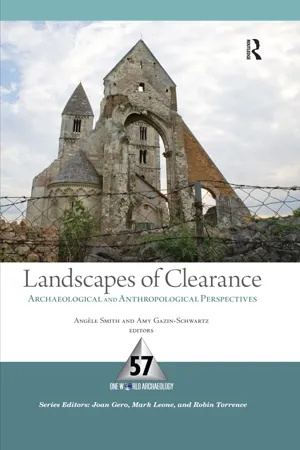
Landscapes of Clearance
Archaeological and Anthropological Perspectives
- 222 pages
- English
- ePUB (mobile friendly)
- Available on iOS & Android
eBook - ePub
Landscapes of Clearance
Archaeological and Anthropological Perspectives
About this book
This volume examines landscapes that have been cleared of inhabitants—for economic, environmental, or socio-political reasons, by choice or by force—and the social impacts of clearance on their populations. Using cases from five continents, and ranging from prehistoric, through colonial and post-colonial times, the contributors show landscapes as meaningful points of contestation when populations abandon them or are exiled from them. Acts of resistance and revitalization are also explored, demonstrating the social and political meaning of specific landscapes to individuals, groups, and nations, and how they help shape cultural identity and ideology.Sponsored by the World Archaeological Congress
Information
Introduction
Chapter 1
Landscapes of Clearance: Archaeological and Anthropological Perspectives
Charles Orser writes that “to archaeologists, the way in which people abandoned their homes is as important as the activities they conducted within them” (2005:47). However, he continues that
archaeologists have not yet studied eviction to any significant degree and that a full understanding of … history will require archaeologists to consider the significance of eviction for numerous reasons, not the least of which relates to its effect on transcontinental migration and the modification of huge tracts of land. (ibid.:57)
He is referring specifically to the famine-era evictions in nineteenth-century Ireland, but his argument can most certainly be made for many places and social landscapes across the globe. Migration and movement through the landscape have always been part of human behavior and hence have shaped past landscapes and the way we view them. Indeed, as archaeologists, our specialty is generally the “abandoned place.” Michael Schiffer’s work (1972, 1987) on the process of site abandonment, defining the systemic and archaeological contexts, the latter the result of various processes/transformations of the “lived experiences” of the people, the landscape, and their material culture, is solidly part of the archaeological canon. And though empirically tested in terms of the reasons for abandonment and the likelihood of the inhabitants return to the site, what is less well explored is the impact and significance abandonment and clearance have on those who have been forced to move from their lands.
This book was the result of many discussions between the editors and with other archaeologists and anthropologists concerning the importance and meaning of place and landscape in people’s lives. The topic of landscape has become a theme central to many archaeological and anthropological studies in the last decade and a half. Thus it was that at the World Archaeological Congress in 2003 (Washington, DC) the theme of a session organized by Mark Leone entitled “Landscapes, Gardens, and Dreamscapes” focused on “the lands around, between, and beyond human settlement” and explained landscapes broadly to include a growing range of definitions for the concept. While the focus on landscape has held much attention (Bender 1993, 1998; Hirsch and O’Hanlon 1995; Tilley 1994; Ucko and Layton 1999), less well explored are the social processes involved in clearing the landscapes of the past and the present and the significant and meaningful impact of these actions (although see Bender 2001; Bender and Winer 2001). Landscapes are made by the people that engage with them, and in making landscapes, the people themselves are made: their sense of place, belonging, and their social identity is constructed alongside the construction of the landscape. But the corollary to this is that landscapes are often highly political and contested, as different communities of people try to negotiate different interpretations of the same landscape. Thus landscapes can be dynamic and even volatile places that witness removals and clearances in the attempt to exclude and erase some inhabitants from the land.
Intrigued by the complexity of these issues, we organized a WAC session entitled “Landscapes of Clearance” to examine how landscapes, which by their very nature are meaningful, become artifacts of contestation when peoples are removed from or have abandoned their homes and homelands. We wanted to speak to issues of the colonial and post-colonial experience of eviction and forced removal from the landscape. Many of the papers, both those presented at the conference and those here in this volume, through richly detailed case studies, discuss various methods, means, and tools of removing people from the lands they occupy. In doing so, they reinforce the argument that landscapes are imbued with meaning and significance for those who live, work, and die in these places. The discussions in these chapters bring to light a poignant understanding of how rupture from one’s sense of home, place, and belonging is a meaningful and often stark reality. This is also witnessed by acts of resistance against the forces that are clearing the lands and by attempts to revitalize the “emptied” landscapes. Such ruptures, resistances, and revitalizations have implications for understanding ideologies of landscape in the recent historical past (a colonial past), as well as the more distant (prehistoric) past, and should influence how we think about and interpret sites that have been “abandoned,” “avoided,” or from which people have been “expelled.”
The discourse concerning “clearance” allows us to focus on the concepts of occupation and situatedness as well as abandonment. While we tend to concentrate more on sites and places, the discussion of clearance can also include the routes along which people left or are leaving. Further, beyond the simple physicality of the leaving, the concept of clearance allows us to look at the social and ideological processes it engages.
The papers in this book address the archaeology of apparently empty landscapes, demonstrating the complex and rich ways that cleared landscapes have been created, inhabited, and endowed with significance. Within the shared context of understanding the significance of landscapes, chapters in the book address such themes as the politics of memory and forgetting, individual and community experiences of clearance, and the ways ideology, identity, and diasporic experiences are linked.
Landscapes and Clearance
“Landscape” has become a fashionable concept. While once perceived as the mere backdrop to human action and life, it is now recognized as having a more critical role in how people live and make sense of who they are and what is their identity. More than simply a physical place, landscape is now understood as also having social and ideological or cognitive elements. It has taken on a metaphorical quality in which people talk about the landscape as the general shape and lay of the land, as a body of knowledge, and most significantly as a body of lived experiences of the world. To know the landscape is to know and control the access to that knowledge or to those experiences.
Soja (1989) argued that “space” was simultaneously physical, social, and ideological. This, in part, accounted for his definition of spatiality: spatial relations are both produced by and are the product of social relations. Therefore, spatial/social relations are fraught with tension and conflict. For Soja, social space, along with material and cognitive space, is contingent on the cultural and historical context. The definition of material space is dependent on its topological configuration within a physical setting, i.e., its association to other physical spaces. Material space is also defined within and by a cultural context as being “physical” and “natural,” measurable and tangible. Cognitive space has to do with ideas, ideologies, and interpretations of space, which in turn define the space. It involves human perception and cognition and is thus a product of its cultural, political, and historical context (see Downs and Stea 1977; Gould and White 1974; Ryden 1993 for discussions of cognitive space and mapping). Archaeologists have traditionally tended to focus on physical and material space (Clarke 1977a, 1977b; Hodder and Orton 1976). More recently, we have come to appreciate that no less important are the social and ideological dimensions of space (Bender 1993, 1998; Delle 1998; Hood 1996; Thomas 1993; Tilley 1994). We recognize in this multi-layered definition that space is at once material, social, cognitive, and ideological. In keeping with these explanations, the current understanding of landscapes similarly recognizes that the landscape is inherently connected to social relations, power, meaning, and social identity, and because of those connections it is often a site of contestation.
Yi-Fu Tuan wrote in the 1970s about the concepts of place and space—two terms often associated, even interchanged, with the concept of landscape. In Space and Place (1977), Tuan defines place as the fixed and static location of past actions, experiences, and memories or, as de Certeau (who later takes up the same oppositional positioning of these two concepts) writes, “place is time made visible” (1984:117). There is a physical tangibility to place because it marks past (and potentially continuing) actions and experiences with and in the landscape. Places in the landscape give meaning and identity to people, who have real emotional attachments rooted to the landscape through their memories and heritage (e.g., of their home or homelands). In contrast, space is dialectical and is about process, motion, and action; it is not tangible in the same sense as it is always in the process of becoming. Again to quote de Certeau, space “defines itself by action … [and] is a practiced place” (1984:117); it is the journey between places. Without the actions and experiences of the process of space, places do not come into being; no spatial journeys can happen (take place) without places in which to take root. Perhaps more useful is to combine or bridge these two concepts in a dialectical relationship. Thus, in order to make sense of the lived experience of people we must link these two concepts of space and place within the landscape. That is, landscape bridges and encapsulates both the action and fluidity of space and the rootedness and memory/history of place.
Landscapes are imbued with meaning and significance for those who live, work, and die in them. Individual, as well as collective, senses of identity are inherently tied to a sense of belonging to a place or landscape. Our sense of who we are and where we come from is linked to our experiences and memories of living in a place and acting in a landscape. In the phenomenology of landscape (Bender 1993; Thomas 1996; Tilley 1994), this is what is called “dwelling”; it assumes a long and lasting rootedness in the landscape, one that has a history and heritage that goes back through generations. But as Ingold (1993) would rightly argue, dwelling in the landscape is a product (and process) of living in, working in, and acting in the landscape; it is these dynamic processes and actions that make the memories and histories that continually shape and reshape our landscapes. Landscapes are thus meaningful not only to individuals but also to collective groups that share a commonness of experiences and memories. Lovell talks about this meaningful experience as belonging and locality (the term she uses in lieu of place), and argues that a sense of identity can never be divorced from a sense of place/locality:
Locality often appears subsumed within the notion of belonging itself, which serves to provide collective identity and a sense of cohesion and cultural commonality (although conflict and differentiation can also emerge out of these processes) … Yet belonging itself also appears at least partly predicated upon locality or a memory of locality … [that is] belonging to a place is viewed as instrumental in creating collective identities. (1998:4)
She continues by arguing that a “placedness” is also represented and reified in the discipline of anthropology. As anthropologists go to “places” to study communities, the people themselves become synonymous with their geographical locality, ultimately constructing a heightened sense of the meaning of place while also creating a boundedness (and hence boundaries) to the social unit on the landscape.
I would add that archaeology too focuses on “placedness.” In archaeology, material culture and actions are always contextualized in locale. Indeed it is the provenience, whether at a general site level or at a more specific within-site positioning, that makes material culture meaningful. Archaeology is often the documentation of people’s lived experience in place; it marks both the temporality and the spatiality of living. Maps, profiles, and other spatial tools abound in archaeological texts as “proof” or “evidence” of the archaeological past (or present, if we expand our understanding of archaeology to also encompass the analysis of spatiality and process in the contemporary context). In this way, the process of archaeology further reifies the “placedness” of human life, though it is often uncritical and sometimes unaware that it does so.
It is ironic, then, that archaeology “clears” the landscape of the very cultural information it is simultaneously trying to retrieve and interpret. However, archaeology is also a valuable tool for understanding the social processes by which a landscape is cleared of people, their past, and their meaning or understanding of that place. Clearance can have many forms, including removal by a peaceful evolution as people’s use of the land changes, the eviction or the forceful removal of people by some external force, or the abandonment of sites as a process of changing perceptions of place. This latter is witnessed in Barbara Bender’s work Stonehenge: Making Space (1998), in which she richly details the historical evolution of the Stonehenge landscape, including the periods of time when people abandoned or stayed away from the site due to its supernatural power. The Christian Church promoted the idea that the stones were the work of the devil and that the place was evil. This, however, does not mean that during these periods of nonoccupation Stonehenge lost its power of place or its meaningful impact on the local population. In fact, the power of Stonehenge was so strong that it influenced people’s actions to stay away.
The Meaning of Clearance
What is the impact of clearance and removal of people from their homes and lands? If the meaning of landscapes in terms of a sense of place and identity is so great, then what must be the terrible impact on people who have had to leave, for whatever reason? Archaeologists can turn to the research conducted on placelessness, homelessness, and diaspora to better understand the personal and collective sense of grief, defeat, outrage, and resistance that often follows on clearing people from their landscape.
Featherstone describes the place of home as that sustained by the collective memory, dependent on ritual performances, bodily practices, and commemorative ceremonies, or as the “batteries which charge up the emotional bonds between people and renew the sense of the sacred” (1993:177). Hence, homelessness is the loss of wholeness, moral certainty, and genuine social relationships.
Neil Smith (1993) writes about the scales of spatiality, beginning at the smallest scale of the body. The next scale is concerned with home and is associated with family, identity, and safety. The next scale again is community, which defines the collective sense of a people’s daily lived experiences. The scales continue to include urban, regional, national, and global.
Clearance as an act of colonialism is an act of ethnocide, perhaps even genocide—rupturing people’s sense of place and thereby destroying some part of the people themselves. Short of killing and doing bodily harm, this is one of the worst and most effective acts of cruelty and violence against a people. We tend to imagine that acts of clearance (especially when linked to colonialism) might be situated in the scale of the global, that it is the outsider that seeks to lay claim to new lands and thus is the cause of the dispossession. But can there be other circumstances where clearances might occur? The case of the Palestinians and Israelis provides an intriguing example of a contested landscape in which all parties stake their identity, heritage, and right to stay and live, in their connection to those lands (see Abu El Haj 2001). In this way, the landscape and the people who have been cleared from it are linked too to the national scale and to ideologies of nationalism and belonging at a larger scale of the politics of space.
Removing people and communities from the landscape, and thus their sense of belonging and identity, has drastic impact. In British Columbia, Canada, for instance,...
Table of contents
- Cover Page
- Half Title page
- Series Page
- Title Page
- Copyright Page
- Contents
- List of Illustrations
- Preface
- Part 1: Introduction
- Part 2: Colonial Tools of Clearance
- Part 3: Resistance and Revitalization
- Index
- About the Authors
Trusted by 375,005 students
Access to over 1.5 million titles for a fair monthly price.
Study more efficiently using our study tools.
Frequently asked questions
Yes, you can cancel anytime from the Subscription tab in your account settings on the Perlego website. Your subscription will stay active until the end of your current billing period. Learn how to cancel your subscription
No, books cannot be downloaded as external files, such as PDFs, for use outside of Perlego. However, you can download books within the Perlego app for offline reading on mobile or tablet. Learn how to download books offline
Perlego offers two plans: Essential and Complete
- Essential is ideal for learners and professionals who enjoy exploring a wide range of subjects. Access the Essential Library with 800,000+ trusted titles and best-sellers across business, personal growth, and the humanities. Includes unlimited reading time and Standard Read Aloud voice.
- Complete: Perfect for advanced learners and researchers needing full, unrestricted access. Unlock 1.5M+ books across hundreds of subjects, including academic and specialized titles. The Complete Plan also includes advanced features like Premium Read Aloud and Research Assistant.
We are an online textbook subscription service, where you can get access to an entire online library for less than the price of a single book per month. With over 1.5 million books across 990+ topics, we’ve got you covered! Learn about our mission
Look out for the read-aloud symbol on your next book to see if you can listen to it. The read-aloud tool reads text aloud for you, highlighting the text as it is being read. You can pause it, speed it up and slow it down. Learn more about Read Aloud
Yes! You can use the Perlego app on both iOS and Android devices to read anytime, anywhere — even offline. Perfect for commutes or when you’re on the go.
Please note we cannot support devices running on iOS 13 and Android 7 or earlier. Learn more about using the app
Please note we cannot support devices running on iOS 13 and Android 7 or earlier. Learn more about using the app
Yes, you can access Landscapes of Clearance by Angele Smith, Amy Gazin-Schwartz, Angele Smith,Amy Gazin-Schwartz in PDF and/or ePUB format, as well as other popular books in Social Sciences & Archaeology. We have over 1.5 million books available in our catalogue for you to explore.