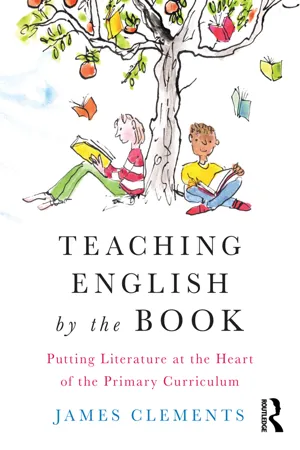
Teaching English by the Book
eBook - ePub

Teaching English by the Book

Putting Literature at the Heart of the Primary Curriculum

  1. 230 pages
  2. English
  3. ePUB (mobile friendly)
  4. Available on iOS & Android
eBook - ePub

Teaching English by the Book

Putting Literature at the Heart of the Primary Curriculum

About this book

Teaching English by the Book is about putting great books, wonderful poems and rich texts at the heart of English teaching, transforming children's attitudes to reading and writing and having a positive impact on learning. It offers a practical approach to teaching a text-based curriculum, full of strategies and ideas that are immediately useable in the classroom.

Written by James Clements, teacher, researcher, writer, and creator of shakespeareandmore.com, Teaching English by the Book provides effective ideas for enthusing children about literature, poetry and picturebooks. It offers techniques and activities to teach grammar, punctuation and spelling, provides support and guidance on planning lessons and units for meaningful learning, and shows how to bring texts to life through drama and the use of multimedia and film texts.

Teaching English by the Book is for all teachers who aspire to use great books to introduce children to ideas beyond their own experience, encounter concepts that have never occurred to them before, to hear and read beautiful language, and experience what it's like to lose themselves in a story, developing a genuine love of English that will stay with them forever.

Frequently asked questions

Yes, you can cancel anytime from the Subscription tab in your account settings on the Perlego website. Your subscription will stay active until the end of your current billing period. Learn how to cancel your subscription.
No, books cannot be downloaded as external files, such as PDFs, for use outside of Perlego. However, you can download books within the Perlego app for offline reading on mobile or tablet. Learn more here.
Perlego offers two plans: Essential and Complete
  • Essential is ideal for learners and professionals who enjoy exploring a wide range of subjects. Access the Essential Library with 800,000+ trusted titles and best-sellers across business, personal growth, and the humanities. Includes unlimited reading time and Standard Read Aloud voice.
  • Complete: Perfect for advanced learners and researchers needing full, unrestricted access. Unlock 1.4M+ books across hundreds of subjects, including academic and specialized titles. The Complete Plan also includes advanced features like Premium Read Aloud and Research Assistant.
Both plans are available with monthly, semester, or annual billing cycles.
We are an online textbook subscription service, where you can get access to an entire online library for less than the price of a single book per month. With over 1 million books across 1000+ topics, we’ve got you covered! Learn more here.
Look out for the read-aloud symbol on your next book to see if you can listen to it. The read-aloud tool reads text aloud for you, highlighting the text as it is being read. You can pause it, speed it up and slow it down. Learn more here.
Yes! You can use the Perlego app on both iOS or Android devices to read anytime, anywhere — even offline. Perfect for commutes or when you’re on the go.
Please note we cannot support devices running on iOS 13 and Android 7 or earlier. Learn more about using the app.
Yes, you can access Teaching English by the Book by James Clements in PDF and/or ePUB format, as well as other popular books in Education & Education General. We have over one million books available in our catalogue for you to explore.

Information

Publisher
Routledge
Year
2017
Print ISBN
9781138213142
eBook ISBN
9781315448947
Edition
1

PART 1

Teaching by the book

Introduction

A case for books: putting literature at the heart of primary education

A story about peaches

Long ago and far away, a traveller was walking through a village when he came across an old man sat by the side of the road. Next to the old man was a great basket filled to the top with ripe peaches. The traveller stopped to watch as the man took a peach from the basket and bit into it. When he had finished, the old man licked his fingers clean and then carefully planted the peach stone in the sandy soil. Then he took another peach from the basket, ate it and again planted the stone.
The traveller watched this process continue for a few minutes before approaching the old man. ‘Excuse me for interrupting, but I have a question. Why are you bothering to plant these peach stones? It will be many years before they grow into trees tall enough to bear fruit. You are an old man and you will not live long enough to enjoy their fruit.’
The old man smiled. ‘You’re right,’ he said. ‘But I’m not planting them for me. Just as my ancestors planted the trees that gave me these peaches, so the stones that I plant today will one day be covered in sweet fruit that will be enjoyed by those who come after me. I am planting them for my grandchildren and my grandchildren’s grandchildren.’ With that, the old man passed the traveller a peach.
The traveller ate his peach in silence. When he had finished, he bent down and carefully planted the stone in the soil.

Teaching English by the Book

Teaching English by the Book is based on a very simple idea: great books, wonderful poems and other rich texts should sit at the heart of the primary English curriculum.
Of course this sounds like an obvious idea. And yet, in many primary classrooms, the English curriculum has come to be organised in a different way. The pressures of the curriculum, national assessments and demands on time can lead to a model where reading, writing and grammar and punctuation are given separate slots on the timetable; a model where different aspects of English are taught as separate skills: grammar and punctuation knowledge here, answering ten comprehension questions about an extract there; a model where writing is taught through learning the features of different text types, separate from the books that children are reading in class.
It is unlikely that the curriculum has been planned in this way. Often the curriculum in schools grows organically and, over time, new features and initiatives are added to the overall body of what is taught. Teaching English by the Book will make a case for thinking about English as a connected whole, considering why and how a rich text can be the catalyst for teaching the many different facets of English.
While the chapters of the book consider each element of the English curriculum individually, the central message that runs through this book is that they are not discrete elements. Each facet of English that we teach depends on the others: spoken language makes reading and writing possible; an understanding of how English grammar works supports our comprehension; reading widely is crucial for effective writing. Where teaching uses great books to make links between them, each of these elements creates something greater than the sum of their parts. How these elements are weaved together will be different in every school, reflecting the beliefs of teachers and school leaders and the needs of the children the school serves. Rather than mandate one way of teaching English, this book seeks to share the key knowledge and ideas that will support a school to create a curriculum and model of teaching that are right for the school and its unique context.
A second message from Teaching English by the Book is that great English teaching is about more than just reading, writing, speaking and listening. These four aspects of the curriculum form literacy. Being literate is the very minimum we should expect from children when they leave primary school. Literacy is important, but it is just one part of the subject of English. As well as learning to read well and express themselves clearly through speech and writing, English teaching means giving children access to all the things we can learn from great books and stories. It gives them the chance to consider ideas beyond their own experience and encounter concepts that have never occurred to them before, to hear and read beautiful language and experience what it’s like to lose themselves in a story, caught up in excitement, laughter, fear or joy.
The third key message in this book is that while we are teaching children to become accomplished readers and writers, to master the elements of reading and writing that are assessed in national tests, we should concentrate on some of the more-subtle aspects of English, too. The technical aspects of reading – decoding, understanding and responding – are vital but so is helping children to develop a genuine desire to read. Technical proficiency in writing, including a control of grammar and punctuation for effect, is necessary for success but so is children seeing themselves as writers, approaching writing like a craftsman and measuring their words carefully to communicate exactly what they wish to their reader. There is a reciprocal relationship between technical skills and attitude in both reading and writing, and we can help children to develop their proficiency in English by encouraging both strands to flourish.

Another story about peaches

A rich text-based curriculum does more than help children to become better readers and writers. Sharing great books gives children the opportunity to encounter new language and new ideas, broadening their horizons and helping them to think about something in a different way. Books can transport children to new places and different times, allowing them to see through the eyes of others. Great texts give children a model for expressing themselves clearly in speech and writing, building an understanding of how language can be shaped for a particular purpose or audience.
Sometimes the effect of sharing a book is immediate. Perhaps a child takes an idea and it changes the way they see the world. Perhaps a word or phrase is borrowed and appears in a child’s next piece of writing. Perhaps a book prompts a child to go and read another similar book, setting a chain of reading in motion. When this happens, it is wonderful.
But it is more likely that the benefits of a rich text-based curriculum will be more gradual, building slowly over time. As teachers, the language and ideas in books we share might not bear fruit until long after the children we teach have left our class.
When we share great literature with children, we are planting peach stones.
James Clements – March 2017
1 Choosing the right texts

Exploring the potential of great books

In the 2014 National Curriculum (DfE, 2013) progression in reading is driven by the challenge of the texts children read. There is no set of reading skills that grow steadily more challenging. Instead, the same broad skills and competencies are applied to texts that gradually increase in challenge.
Despite this, the teaching of reading in primary schools can sometimes focus on the discrete teaching of comprehension skills. This may be due to the lasting influence of the Primary Strategy and its assessment focuses, individually assessed and recorded using the Assessing Pupil Progress sheets (DfES, 2006). It may be the influence of published reading schemes that are built on ladders of reading skills. Or it could be a desire by schools and teachers to achieve well in the high-stakes national assessments by trying to make use of the Key Stage 2 test domains (originally created for test developers to ensure coverage of the National Curriculum) as a basis for teaching reading (DfE, 2016) in an effort to cover all of the elements that will be tested.
Whatever the reason, the teaching of reading (and writing) in the primary years is often broken down into a set of generic skills to be mastered. If children can learn to predict and infer, retrieve and record, then they will go on to become confident readers and writers. While research suggests that there are specific reading strategies that can be actively and consciously used to support comprehension (Palincsar and Brown, 1984), this is very different from basing all teaching on a set of generic comprehension skills that a reader draws on to make meaning from a text. Indeed, there is discussion about the value of basing the teaching of reading on these skills and whether they are transferable from book to book (Willingham and Lovette, 2014).
The fact is that reading and writing cannot be taught in a vacuum. Children need the opportunity to practise and develop as readers and writers by reading texts and being inspired to write by those texts.
And it matters which texts we choose to share with children.

Choosing ‘the right text’

Choosing the right texts sits at the heart of an effective text-based curriculum. But who should do the choosing, by what criteria should they choose and what exactly makes ‘the right text’?
The books children will read at school can be divided into different purposes depending on where in the curriculum they will be used, what they will be used to teach and who they will be read with. There will be books that children have chosen themselves and others that have been chosen by an adult. There will be texts that are being read purely for the pleasure they bring and others that have been selected to be studied in a particular area of the curriculum. The purpose of reading a text helps to define whether it is ‘the right text’. The right text for teaching a Year 2 unit of work on letter writing will be very different from the right text for a Year 6 looking for something to read on the bus as they travel to school.
Of course this distinction between ‘books to study’ and ‘books for enjoyment’ is an artificial one. We would hope that there would be considerable overlap between the two. We want children to enjoy the books they study at school, finding them interesting, exciting or delightful. Equally, it is through children’s own self-directed reading that they will develop into confident readers, putting in the reading miles that will develop their fluency and reading stamina, building their vocabulary and imp...

Table of contents

  1. Cover
  2. Half Title
  3. Title Page
  4. Copyright Page
  5. Dedication
  6. About the author
  7. Table of Contents
  8. Acknowledgements
  9. Part 1 Teaching by the book
  10. Part 2 Teaching reading by the book
  11. Part 3 Teaching writing by the book
  12. Part 4 Teaching English by the book
  13. Appendix I: Text-based curriculum map
  14. Appendix II: The Labours of Hercules unit plan
  15. Appendix III: Recommended books
  16. Index