- 278 pages
- English
- ePUB (mobile friendly)
- Available on iOS & Android
eBook - ePub
About this book
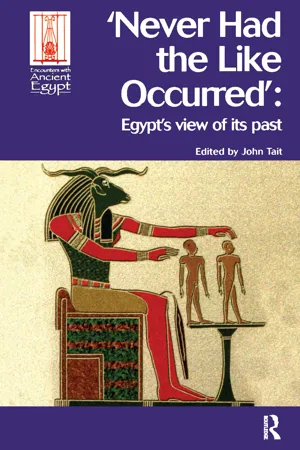
"Never Had the Like Occurred" examines Ancient Egypt's own multifaceted encounters with its past. As Egyptian culture constantly changed and evolved, this book follows a chronological arrangement, from early Egypt to the attitudes of the Coptic population in the Byzantine Period. Within this framework, it asks what access the Egyptians had to information about the past, whether deliberately or accidentally acquired; what use was made of the past; what were the Egyptians attitudes to the past; what sense of past time did the Egyptians have; and what kinds of reverence for the past did they entertain? This is the first book dedicated to the whole range of these themes. It provides an explanatory context for the numerous previous studies that have dealt with particular sets of evidence, particular periods, or particular issues. It provides a case study of how civilizations may view and utilize their past.

CHAPTER 1
INTRODUCTION - ‘… SINCE THE TIME OF THE GODS’
John Tait
Time and time again, and in response to a variety of challenges and problems, Egyptians of the dynastic period made use of the past to confirm – and to explore – their own identity. Therefore these ideas of identity need to be understood before the kind of past the Egyptians had in mind can be seriously investigated.
Dynastic Egypt has usually been seen by scholarship since the early 19th century as a very self-confident culture: the Egyptians were sure that Egypt was where the cosmos came into being, and that foreign lands were merely useful appendages provided and overseen by the gods for the purpose of helping to maintain the world-order within the only part of the world of any significance – Egypt. This attitude may be perceived in the whole range of ‘official’ religious and royal texts that survive, although these texts do not often state the totality of this view in any explicit way, as it was not open to question. The Egyptians had no idea of any need for ‘faith’, or expressions of faith.
Nevertheless, there are some texts which apparently saw a necessity to defend the Egyptian worldview. The last sections of the Middle Kingdom (earlier second millennium BC) ‘Tale of Sinuhe’ can be interpreted as a deliberate assertion that Egypt (and above all the royal court) was the only place where it was worthwhile living (Baines 1982; Loprieno 2003: 38; Morenz, Chapter 6). The ‘Tale of Wenamun’, which represents an official of the Karnak temple of Amun as sent upon an errand to claim a load of timber for the construction of a replacement for the sacred boat of the god, has often been interpreted as a faithful representation of the decline of Egyptian power and prestige in the Levant at the opening of the first millennium BC (Loprieno 2003: 45–48). Some recent studies (Baines 1999; Eyre 1999) have seen its statements more in terms of literary discourse. There could be no doubt, however, that the words in the ‘Tale of Wenamun’ put in the mouth of the ruler of Byblos, addressing the Egyptian Wenamun, concerning the supremacy of the Egyptian ‘state’ god Amun, were meant to show – or rather to consider the view – that Egypt was at the heart of the cosmos: “Amun has established all lands; but he established them only after he had first established the land of Egypt, from whence you (that is, Wenamun) have come” (2.19–2.21).
This text shows an Egyptian concern about Egypt’s own place in an increasingly complex world at a particular point in time (even if the precise point in time is debatable: 10th century BC, ninth century BC?). The text specifically looks to the past: “He (that is, the ruler of Byblos) had the ledgers of his ancestors brought, and had them read out to me (that is, Wenamun).” In the fictional world of the text, the ruler’s purpose is to establish what had been the tradition of proper diplomatic practice, in order to extract payment from Wenamun. On another level, it suggests that one cannot act properly without reference to the past.
Traditionally, Egypt’s own view of its past has been studied primarily in works that treat a particular period, or a particular kind of evidence. For example, recently, Manuelian (1994) has concentrated upon the Saite period (664–525 BC), while Vernus (1995) has essentially exploited textual sources. In this book, the time-range covered is (deliberately) vast, and some contributors are chiefly concerned with texts, while others concentrate upon material culture. Overall, the authors try to combine and to use in conjunction the two types of evidence, whatever the chronological period.
The focus of this book is the Egyptians’ view – down to the end of the first millennium BC – of their own past. It is possible for a society to conspire to forget its past, above all the recent past, especially if this has been inglorious or miserable – or simply to be indifferent to it. One theme that emerges from the following chapters is that the Egyptians did not ever take these paths, unless this is what happened in the Coptic period – that the past became irrelevant, and was ignored.
Egyptian identity and foreigners
In terms of lexicography, the Egyptians did not have an emotive term for their own ‘country’ or ‘nation’: there is no equivalent to concepts such as ‘Greek’, ‘Macedonian’, or ‘Arab’. It is a commonplace in modern discussions to state that the Egyptian term for their own country was kmt, and that this meant ‘the black (land)’, that is, the cultivatable flood plain of the Nile Valley and Delta, as opposed to the ‘red’, the desert. The Egyptian for ‘Egyptians’ was rmt(.t) n(t) kmt, ‘people of Egypt’ (Erman and Grapow 1926–1950: ii, 423), a term that remained standard into the Coptic stage of the language (Crum 1939: 110). Yet the term presents a problem, since rmt(.t) be seen to mean ‘real people’ (civilized persons?), so that the Egyptians’ view of themselves could be argued to be exclusive: to be rmt(.t) n(t) kmt you had to be a real Egyptian, and speak Egyptian. Nevertheless, there are abundant indications that the Egyptians in one sense saw as ‘Egyptian’ anyone who lived in Egypt: that is, within the Nile Valley from the Mediterranean coast in the north to the First Cataract in the south. Herodotus (II.18) in the fifth century BC reported what has every appearance of being an Egyptian tradition concerning the inhabitants of the western Delta region (or perhaps it should be called a ‘myth’) that states the idea very explicitly. It is also very relevant to the topic of Libyan ethnicity discussed further below (and see Cline and O’Connor 2003).
Those from the city of Marea and that of Apis, living in the part of Egypt neighbouring Libya, reckoned themselves to be Libyans and not Egyptians. They felt aggrieved at the religious observances that required them not to touch the meat of cows. They sent to (the Oracle of) Ammon, saying that they had nothing in common with the Egyptians, and that they themselves lived outside the Delta, and did not at all agree with them. They wished to be allowed to taste everything. However, the god did not allow them to do this, saying that ‘Egypt’ was whatever the Nile irrigated in its course, and ‘Egyptians’ were those who lived downstream of the city of Elephantine and drank from that river.
To have an idea of what makes one Egyptian, one has to know what is not ‘Egyptian’. O’Connor (Chapter 9) suggests as a starting-point for discussion the apparent ‘brutality’ that Egyptians considered (throughout the dynastic period) as appropriate behaviour towards those who patently were not Egyptian. Such reported action might, of course, have been ‘metaphorical’ rather than actual. No doubt the situation varied from case to case. Also, it seems clear that Egyptian attitudes to foreigners outside Egypt varied according to how – how well – they were seen to ‘choose’ to behave. There may well not have been one fixed mode of behaviour, but rather a variety of attitudes and responses. For example, the attitudes towards foreigners were significantly different in periods when Egypt was unified and had strong central control from the attitudes when the country was fragmented. Further, some differences in the stance taken towards different foreign peoples seem to have lasted over long periods of time, even though in scenes of offering ‘tribute’, the attitude seems uniform. An extreme case is the Puntites (Harvey 2003; Meeks 2003). The well-known depictions of their culture in the mortuary temple of Queen Hatshepsut at Deir el-Bahri have often been discussed as if they were an ethnographic record (Herzog 1968; Kitchen 1999), but it is difficult to know if these are stereotypes of the representation of ‘others’ (not otherwise explicitly attested) that are being depicted. The representation of the Queen of Punt, often described as grotesquely obese, is accompanied by a routine textual caption, and there is no hint as to whether the viewer is supposed to see her as bizarre or just as a Puntite queen.
It is very commonly suggested that foreigners who entered Egypt and became fully Egyptianized were fully accepted into Egyptian society. This must be at least in part a realistic view, although it is difficult to argue whether or not it might have applied at all levels of society. It is also doubtful whether such Egyptianization was always an available option, and assimilation may sometimes have been enforced. This is presumably not a matter that Egyptian texts would have wished to involve themselves with.
What is mentioned is the special case of the education of the children of conquered rulers of Syria-Palestine in the Egyptian palace school, with the intention that they should in due course return to rule their territories with a favourable attitude towards Egypt. This is quite the reverse of the case of the Egyptian abroad. In the Middle-Kingdom ‘Tale of Sinuhe’ (Fischer-Elfert, Chapter 7; Loprieno 1988; Loprieno, Chapter 8; Morenz, Chapter 6), Sinuhe spends many years in Syria-Palestine with the ruler of Upper Retjenu, and comes to adopt the appearance, dress, and whole way of life of a local ruler. Eventually he returns to Egypt, and is re-accepted into Egypt and the Egyptian court; but he has to be divested, almost ritually, of all the marks of ‘foreignness’ acquired during his years in Syria-Palestine. The text clearly involves conscious reflection on ‘Egyptianness’. It can perhaps be taken more to reflect a view that an Egyptian always remains an Egyptian, rather than a fear that it is dangerously easy to turn into a foreigner.
The later periods of Egyptian history show a number of better documented crises in the Egyptian view of themselves and their own past. In the Third Intermediate Period, the (earlier first millennium BC) Libyan rulers and officials appeared in art highly Egyptianized, and yet retained some clear outward indications of their Libyan origins. They essentially stemmed from disparate Libyan groups settled in the Delta, an area of Egypt always in the ancient world difficult to unify politically. No textual evidence survives that expresses an anti-Egyptian view: their wish to retain distinctive identities was conceivably more related to a desire to differentiate themselves from other Libyan groups (Cline and O’Connor 2003) (as Egyptian representations had always indicated the ‘Libyans’ had done) than to show themselves as not quite Egyptian. The situation was very different in the case of the Kushite conquerors (twenty-fifth Dynasty, 751 BC until the 660s/650s). In royal public display, at any rate, they had long adopted much of Egyptian practice (Morkot, Chapter 5). However, they chose to regard the contemporary Egyptians as failing properly to keep up Egyptian religious practices, and they therefore strongly maintained various distinctive Kushite features, for example of royal iconography, while also initiating, within Egypt itself, a new era of ‘archaizing’ in art based on Egyptian models of several periods (Morkot, Chapter 5). Thus the Kushites seem to present a unique phenomenon among catalysts for change in the Egyptians’ view of themselves and their past. They aggressively presented themselves as both Egyptian and not Egyptian, and they did this, not in distinct contexts, but consistently. The solid evidence for any difference between the impact of the Libyan and Kushite periods on Egypt is limited: official texts of the Kushite period take an aggressive stance. In his ‘Victory Stela’, Piye is represented as telling the defenders of the besieged Egyptian town of Per-Sekhemkhepera:
O you who live in death, you who live in death; you poor wretches, you who live in death! If the moment passes without your opening to me, you will be counted slain according to the King’s judgement.
(Lichtheim 1980: 74)
In royal iconography, the use, for example, of the double uraeus must surely be seen as an overt comment on Egyptian kingship. One can also look to later Egyptian reactions to the plight of Egypt in these periods (Bresciani 2001; Loprieno, Chapter 8).
The immediate reaction to the Kushites, under the Saite dynasty, was not a simple one. The most distinctively ‘Kushite’ features of royal iconography, for example, disappear, but the apparent enthusiasm for archaizing is continued and taken to greater lengths. There does not appear to have been any attempt to erase the Kushites from memory. The dismantling of their monuments, even within a short period of time, should not be misinterpreted; this was an indignity suffered by many kings, without any necessary indication of disapproval. Later traditions reported by Greek authors imply that each of the Kushite rulers was remembered on their merits or their faults. The traditional set of views of Nubian foreigners returned, and remained into the Roman Period. There is nothing to suggest that the experience of Kushite rule resulted in any new attitudes towards Nubia, although it must presumably have led to a sharper and more self-conscious interest in the nature of being Egyptian and in the Egyptian past and identity.
The Persians of the first Persian period (525–404 BC) were a very different case (Cook 1983; Kuhrt 1995, ii: 647–701; Ray 1988). In general, the Persian king was not resident in Egypt, making it difficult for the Egyptians to see him as fulfilling the role expected of an Egyptian king. ‘Collaborators’ among the Egyptian elite may have persuaded themselves – or sought to persuade others – that Darius the Great or Cambyses really was of divine descent (Lloyd 1982: 170–175), but there is no indication that this was effective, certainly not in the longer term: the later Egyptian view that we can detect was not a positive one, even if the very negative Greek views of the Persian occupation of Egypt were coloured by Greek attitudes to their own struggle with Persia. The Great King is depicted on some Egyptian stelae and monuments as an Egyptian king, but in general the Persians themselves seem to have had little interest in exporting the trappings of Egyptian royal display, or Egyptian culture in general. Egyptian craftsmanship may have been a different matter, and it has been suggested that artisans were transported to Persia in considerable numbers. A statue of Darius I found at Susa seems to have been of Egyptian workmanship and may have been made in Egypt. It depicts him in purely Persian form. The sole Egyptian feature is the row of the names of the peoples subject to Persia around the base, carved in good Egyptian hieroglyphs, in the traditional Egyptian manner, such as we see in the lists of foreign subject states at Karnak: the head of a foreign captive surmounting a cartouche containing the name. The Persian occupation, then, offered little enduring threat to the Egyptians’ ideas of their self-identity: the Persians were viewed simply as foreign invaders. In several ways it seems to have promoted an interest in the past. Assmann (1996: 6) has suggested that the Persian period was crucial to developments in Egyptian views of the past: that stronger ideas emerged of the need to categorize and to canonize the knowledge of the past.
The Ptolemaic period presented the Egyptians with quite new problems of identity. The Macedonian rulers in Alexandria and their immediate court maintained a style that was not just Greek, but Macedonian (La’da 2003). Yet they were depicted on Egyptian temple walls and stelae and in statuary as Egyptian kings and queens (Ashton, Chapter 12), and they were given royal titles that overtly linked them with the Egyptian past (already Alexander had been given a cartouche name partly based on one of those of the last native ruler of Egypt, Nectanebo II). A portion of Alexandria (and other cities) was very Greek. More importantly, Greeks and other foreigners lived up and down Egypt in great numbers and some at first had no intention of Egyptianizing themselves, in the sense of deliberately trying to be assimilated into Egyptian culture. For Egyptians above the lowest levels of society, it became essential to learn Greek, and advantageous to adopt some kind of Greek identity, even if they could not, and perhaps did not wish to, match the culture and status of the Greeks of Alexandria and the few other great Greek cities of Egypt. That is, they could not establish their own gymnasia as foci of education and culture, and seemingly did not want to attempt to construct large-scale ‘civic’ buildings, such as existed at Hermopolis. Egyptian priests in the temples of the traditional gods on the one hand laboured to maintain Egyptian religion and general culture, with a stro...
Table of contents
- Cover
- Half Title
- Title Page
- Copyright Page
- Contents
- Series Editor’s Foreword
- Contributors
- List of Figures
- A note on transliteration from ancient Egyptian
- 1 Introduction - ‘… since the time of the Gods’
- 2 The Ancient Egyptian View of World History
- 3 Archaism and Modernism in the Reliefs of Hesy-Ra
- 4 Looking Back into the Future: The Middle Kingdom as a Bridge to the Past
- 5 Archaism and Innovation in Art from the New Kingdom to the Twenty-sixth Dynasty
- 6 Literature as a Construction of the Past in the Middle Kingdom
- 7 Representations of the Past in New Kingdom Literature
- 8 Views of the Past in Egypt During the First Millennium BC
- 9 Egypt’s Views of ‘Others’
- 10 Foreigners at Memphis? Petrie’s Racial Types
- 11 All in the Family? Heirlooms in Ancient Egypt
- 12 The Ptolemaic Royal Image and the Egyptian Tradition
- References
- Index
Trusted by 375,005 students
Access to over 1.5 million titles for a fair monthly price.
Study more efficiently using our study tools.
Frequently asked questions
Yes, you can cancel anytime from the Subscription tab in your account settings on the Perlego website. Your subscription will stay active until the end of your current billing period. Learn how to cancel your subscription
No, books cannot be downloaded as external files, such as PDFs, for use outside of Perlego. However, you can download books within the Perlego app for offline reading on mobile or tablet. Learn how to download books offline
Perlego offers two plans: Essential and Complete
- Essential is ideal for learners and professionals who enjoy exploring a wide range of subjects. Access the Essential Library with 800,000+ trusted titles and best-sellers across business, personal growth, and the humanities. Includes unlimited reading time and Standard Read Aloud voice.
- Complete: Perfect for advanced learners and researchers needing full, unrestricted access. Unlock 1.5M+ books across hundreds of subjects, including academic and specialized titles. The Complete Plan also includes advanced features like Premium Read Aloud and Research Assistant.
We are an online textbook subscription service, where you can get access to an entire online library for less than the price of a single book per month. With over 1.5 million books across 990+ topics, we’ve got you covered! Learn about our mission
Look out for the read-aloud symbol on your next book to see if you can listen to it. The read-aloud tool reads text aloud for you, highlighting the text as it is being read. You can pause it, speed it up and slow it down. Learn more about Read Aloud
Yes! You can use the Perlego app on both iOS and Android devices to read anytime, anywhere — even offline. Perfect for commutes or when you’re on the go.
Please note we cannot support devices running on iOS 13 and Android 7 or earlier. Learn more about using the app
Please note we cannot support devices running on iOS 13 and Android 7 or earlier. Learn more about using the app
Yes, you can access Never Had the Like Occurred by John Tait in PDF and/or ePUB format, as well as other popular books in History & Egyptian Ancient History. We have over 1.5 million books available in our catalogue for you to explore.