eBook - ePub
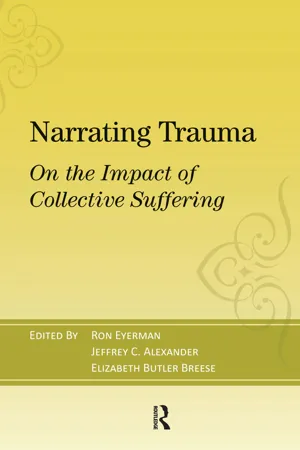
Narrating Trauma
On the Impact of Collective Suffering
- 336 pages
- English
- ePUB (mobile friendly)
- Available on iOS & Android
eBook - ePub
Narrating Trauma
On the Impact of Collective Suffering
About this book
Through case studies that examine historical and contemporary crises across the world, the contributing writers to this volume explore the cultural and social construction of trauma. How do some events get coded as traumatic and others which seem equally painful and dramatic not? Why do culpable groups often escape being categorised as perpetrators? These are just some of the important questions answered in this collection. Some of the cases analysed include Mao's China, the Holocaust, the Katyn Massacre and the Kosovo trauma. Expanding the pioneering cultural approach to trauma, this book will be of interest to scholars and postgraduate students of sociology.
Information
National Suffering and World War
1
A Fire That Doesn't Burn?
The Allied Bombing of Germany and the Cultural Politics of Trauma1
Volker Heins and Andreas Langenohl
A lot of seriously bad things happened to Germans during and immediately after World War II. More than five million soldiers were killed, most of them on the eastern front. Those who survived the war in the east were often wounded, half-crazed, or frostbitten and were further decimated by the harsh conditions in Soviet POW camps. British and American bombers attacked more than one hundred German cities and towns, reducing many of them to a sea of rubble, killing around six hundred thousand civilians, and making many more homeless. Millions of ethnic Germans who had settled in Poland or Czechoslovakia fled the onslaught of the Red Army or were expelled by the newly established communist governments. On their way to Berlin and in the fallen capital itself, Soviet soldiers raped altogether perhaps one and a half million women, often “in the presence of their menfolk, to underline the humiliation” (Evans 2009, 710).
This list of horrors is, of course, deliberately one-sided in that it ignores not only the endless suffering inflicted by Germans on their non-German victims, including their own Jewish fellow-citizens, but also questions of causal and moral responsibility. Historians like Richard Evans have shown that such questions have not only been asked in hindsight but were already on the minds of many ordinary people during the war itself. To some degree at least, Germans saw their own misery filtered through a sense of what had been done to others in their name. Given the context that has shaped the experience of suffering especially of German civilians, we believe it is interesting to explore how they have represented their own suffering, how these representations have been transmitted into the collective and national memory, and to what extent the political culture has been shaped by war-related memory projects.
In his influential lectures On the Natural History of Destruction, the German-born writer W.G. Sebald notes that some of the occurrences of the war, in particular the mighty air raids against German cities “left scarcely any trace of pain behind in the collective consciousness” (Sebald 2004, 4). We suggest to rephrase this statement by saying that the memory of the bombing war has not been turned into a national or “cultural trauma.” This is not to deny that the defeat of Germany set the stage for a trauma process in the course of which Germans began to fundamentally redefine themselves. Yet this process was successful precisely because Germans learned to connect their own suffering to the suffering of others. They remember that their cities were firebombed and often completely flattened by identifiable actors, but it is not this fact in itself that is remembered and commemorated as a psychologically searing, identity-changing event. The question we try to answer is why this particular collective experience of suffering has not, in spite of its horrifying proportions, given rise to a cultural trauma. The answer given by Sebald (2004, 11) is that there has been a “taboo” on speaking about the devastation and suffering caused by the Allied air war. What is implied is that Germans felt no longer entitled to speak of themselves as victims as they increasingly accepted their image of being perpetrators of war crimes and the Holocaust. We believe that this answer is flawed. For one, the term “taboo” insinuates that Germans should finally break the silence and lay claim to their own suffering, something they have done all along. In modern societies, calling something a taboo does not end a conversation but, on the contrary, introduces issues into the public debate in a sensationalist way. Sebald’s claim also implies that there is something fundamentally wrong with German war memories. Yet, we argue that there is considerable controversy, incoherence, and awkwardness but nothing pathological or repressed about the way in which most Germans remember and commemorate the devastation of their cities and the death of civilians during the war.
In developing our argument, we not only agree with but also wish to bolster Jeffrey Alexander’s and Ron Eyerman’s point that a cultural trauma does not directly flow from historical occurrences, however horrible they may have been. Rather, cultural traumas are socially constructed through narratives and other forms of representation. For Sebald, the absence of almost any trace of pain in the memory of the bombing war is something “paradoxical” (Sebald 2004, 4) because he assumes that there is a positive correlation between the magnitude of suffering experienced by a collectivity and the intensity of memories transmitted from one generation to the next. For us, such a correlation exists only to the extent in which a social and political consensus on the meaning of the relevant historical instance of suffering can be constructed and effectively communicated. Yet it is also true that a recognizable instance of massive suffering is always the raw material of cultural trauma. In fact, the most prominent examples of sociological trauma theory have so far been American slavery (Eyerman 2002) and the Holocaust (Alexander 2003, 27–84). Slavery in the antebellum South was an instance of collective suffering that has been turned into a cultural trauma for successive generations of the same victim group of Afro-Americans. The Holocaust was an instance of collective suffering that has been turned into a cultural trauma of successive generations of the victim group, Jews, as well as for successive generations of (non-Jewish) Germans and other national membership groups who were the perpetrators and bystanders of the Holocaust. Our case study breaks new ground by focusing on an instance of collective suffering—the Allied bombing of German cities during World War II—that has not become a cultural trauma, not even for the successive generations of the victim group. This points to the crucial argument that the trauma drama must not be conflated with the traumatizing event itself. As a cultural trauma may be constructed even if the society in question is deeply divided about the meaning of the traumatizing events (see Chapter 8, “Extending Trauma Across Cultural Divides: On Kidnapping and Solidarity in Colombia”), so it conversely may fail to materialize even under conditions of a supposedly coherent social body.
In what follows, we give a short overview of the ways in which the air war has been remembered, memorialized, and commemorated in postwar Germany. We begin by rejecting the widespread claim that the memories of German victims, in general, and of civilian bombing victims, in particular, were actively silenced in postwar Germany. Instead, we sketch out the memory matrix that in our view has underpinned and constrained practices of remembrance of the Bombenkrieg. We then turn to three case vignettes to shed light on the reasons why the bombings have not given rise to a cultural trauma. First, we highlight the case of Hamburg, which among German cities was hit the hardest by British bombers in 1943. More specifically, we are interested in how the rise of the Holocaust trauma has rendered the remembrance of the firebombing of Hamburg more complex, inconsistent, and ultimately nontraumatic. Second, we look at attempts to draw analogies between the high-altitude bombing of German cities and the bombing of other places, in particular Baghdad in the Second Gulf War (1990–1991). These attempts have displayed the deep historical embeddedness of bombing memories in Germany without, however, indicating the belated beginning of a trauma process. Third, we briefly explore the memory and commemoration of the 1945 bombings of Dresden, in which neo-Nazi extremists, who would like to redefine the memory of the bombings as the new cultural trauma of post-reunification Germany, play a major role. The final section summarizes the reasons why we believe that memory projects aiming at the establishment of a cultural bombing trauma in Germany are unlikely to succeed anytime soon.
The German Bombing War Memory Matrix
Since the reunification of Germany in 1990, every major broadcast or publication on the bombing of the country during World War II has been pitched as taboo-breaking. However, there has never really been a taboo on representing the suffering of Germans. In fact, this is a rumor or legend so ubiquitous that it requires explanation. Still, like all rumors and legends, the idea of a taboo on representing Germans as victims is based on a small kernel of truth.
Our main point is that what has been forgotten is not the bombing war itself but its many traces in the memories of those who survived and documented it. Artists, in particular, began drawing, painting, carving wood, writing about, and photographing the destruction often literally as soon as the dust had settled after the air raids. Ignoring an official ban imposed by the Nazi government, which was later renewed by the Soviet military authorities, more than thirty “rubble photographers” emerged in Dresden alone, some of whom like Kurt Schaarschuch and Richard Peter quickly rose to fame (Kil 1989). As early as 1949, Peter published a much-reprinted collection of photographs under the title Dresden, eine Kamera klagt an (Dresden: A Camera Accuses). There were early bestsellers such as Axel Rodenberger’s memoir Der Tod von Dresden (The Death of Dresden) and a whole new genre of German “rubble films” depicting the destruction of cities in flashbacks (Shandley 2001). German studies scholars such as Jörg Bernig (2005), Thomas Fox (2006), and Ursula Heukenkamp (2001) have offered overviews of the range of artistic representations of the bombing war experience, listing novels, memoirs, anthologies, films, poems, plays, song texts, and audio recordings that have escaped the attention of those who claim that the air war has fallen into oblivion.
Thus, what we have seen after the war was not a taboo on the remembrance of suffering but rather an irrepressible zeal to give meaning to the harrowing experiences of the recent past. Ulrike Heukenkamp has observed that writers often did not use a vivid, authentic language to describe the experience of being bombed, not because they forgot what had happened but because part of that experience was a sense of panic, of emptiness, of loss of self that led authors to use clichéd metaphors such as “hell,” “inferno,” or “Judgment Day” to fix the meaning of the bombings (Heukenkamp 2001, 470–472). She also points out that talking was less easy for the civilian survivors of the bombing war than for the exhausted, defeated, and disillusioned soldiers who returned from the front lines of what they saw as the “real” war. The soldiers were often compulsively loquacious and have left detailed descriptions of their war experiences in the memories of families as well as in literary texts. To the extent it was real, the silencing of civilian bombing victims, a majority of them being women, was the result of the restoration of the patriarchal family order in which men decided about what counts as an experience worth telling and transmitting (Heukenkamp 2001, 470).
Apart from the perceived lack of authenticity in literary representations and the dominance of the memory of front soldiers over the memory of women, there is a third factor that has contributed to the notion of silence surrounding the human consequences of the bombing war. West Germans, in particular, were eager to rebuild their cities and their economy and felt that they had no time to look back. Sebald mentions “the unquestioning heroism with which people immediately set about the task of clearance and reorganization” (Sebald 2004, 5). This is something very different from a taboo, although it may as well have had a silencing effect on memories.
That the immense suffering caused by incendiaries and high-explosive bombs dropped from the sky was not forgotten does, however, not imply that this particular memory fit easily into a larger, agreed-upon frame of public remembrance of World War II. In fact, all the controversies and struggles in recent decades have been about this problem: how to insert the memory of the air war into the larger process of meaning-making in a way that is in harmony with the self-description of Germany as a liberal Western democracy. Before we delve into the political struggles over the memory of the bombings, we want to outline the memory matrix that has guided activists and audiences in their attempts to represent those occurrences as broadly meaningful and significant.
We suggest distinguishing four basic positions in recent German memory struggles. Three of these positions share the implicit assumption that there was no alternative to the defeat of Germany and the Axis Powers by the combined military forces of the Allies. Obviously, neo-Nazis beg to differ on this point. But we are not aware of a position saying that the German people were able or willing to overthrow the government of Hitler on its own. There is thus a widely shared conviction that Germany had to be defeated militarily. A classical early statement of this consensus can be found in the preface to the first edition of Franz Neumann’s Behemoth, “A military defeat is necessary . . . More and better planes, tanks, and guns and a complete military defeat will uproot National Socialism from the mind of the German people” (Neumann 1942, ix). Note that Neumann wrote before the emergence of a transnational Holocaust trauma, which in retrospect has made the imperative to destroy Nazi Germany by military means even more compelling. Today, German historians and democratic politicians across the board basically agree on the connection that existed between defeating Germany and ending the mass extermination of Jews and others groups (see, e.g., Nolte 2008 and White 2002). Differences among the following first three discursive positions emerge only against the backdrop of this taken-for-granted consensus. The fourth position is an outlier, at least for now.
A just-war position has been articulated by military historians in Britain and the United States and continues to influence in particular leftwing memory activists in Germany to this day. This position states that the air bombing of German cities contributed to the defeat of National Socialism and was therefore by definition legitimate.2
The moderate anti-Machiavellian position says that, in pursuing highly legitimate war aims, the Allies employed illegimate means such as the indiscriminate bombing of entire cities. Moderate anti-Machiavellians usually refrain from using the term “crime” to describe the bombings. They are often members of the liberal academic and political elites in Germany and have called for reconciliation and for strengthening international humanitarian law.3
A radicalization of the anti-Machiavellian position can be observed among those groups who claim that the air bombing of cities did not serve its alleged military purpose. There has been, it is argued, a growing disjuncture between ends and means in the final stages of the war. Radical anti-Machiavellians use the term “crime” to describe the bombings. Yet these groups, too, call for reconciliation and for a moralization of international affairs that goes beyond legal reforms.4
A revisionist right-wing position has been adopted by those who claim that the bombings were not meant to serve a limited military purpose but were launched to commit genocidal crimes against the Germans. These groups, some of which sh...
Table of contents
- Cover Page
- Half-Title Page
- Title Page
- Copyright Page
- Dedication
- Table of Contents
- Preface
- Introduction: On Social Suffering and Its Cultural Construction
- Part 1 National Suffering and World War
- Part 2 Ethnic Suffering and Civil War
- Part 3 The Performance of Suffering and Healing
- About the Contributors
Trusted by 375,005 students
Access to over 1.5 million titles for a fair monthly price.
Study more efficiently using our study tools.
Frequently asked questions
Yes, you can cancel anytime from the Subscription tab in your account settings on the Perlego website. Your subscription will stay active until the end of your current billing period. Learn how to cancel your subscription
No, books cannot be downloaded as external files, such as PDFs, for use outside of Perlego. However, you can download books within the Perlego app for offline reading on mobile or tablet. Learn how to download books offline
Perlego offers two plans: Essential and Complete
- Essential is ideal for learners and professionals who enjoy exploring a wide range of subjects. Access the Essential Library with 800,000+ trusted titles and best-sellers across business, personal growth, and the humanities. Includes unlimited reading time and Standard Read Aloud voice.
- Complete: Perfect for advanced learners and researchers needing full, unrestricted access. Unlock 1.5M+ books across hundreds of subjects, including academic and specialized titles. The Complete Plan also includes advanced features like Premium Read Aloud and Research Assistant.
We are an online textbook subscription service, where you can get access to an entire online library for less than the price of a single book per month. With over 1.5 million books across 990+ topics, we’ve got you covered! Learn about our mission
Look out for the read-aloud symbol on your next book to see if you can listen to it. The read-aloud tool reads text aloud for you, highlighting the text as it is being read. You can pause it, speed it up and slow it down. Learn more about Read Aloud
Yes! You can use the Perlego app on both iOS and Android devices to read anytime, anywhere — even offline. Perfect for commutes or when you’re on the go.
Please note we cannot support devices running on iOS 13 and Android 7 or earlier. Learn more about using the app
Please note we cannot support devices running on iOS 13 and Android 7 or earlier. Learn more about using the app
Yes, you can access Narrating Trauma by Ronald Eyerman,Jeffrey C. Alexander,Elizabeth Butler Breese in PDF and/or ePUB format, as well as other popular books in Social Sciences & Social Theory. We have over 1.5 million books available in our catalogue for you to explore.