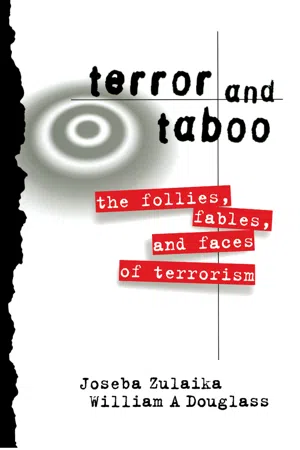
Terror and Taboo is about the mythology of terrorism; it is an exploration of the ways we talk about terrorism. It offers incontestable evidence to support the idea that we give power to terrorism by the way we write and talk about it. According to Zulaika and Douglass, we make terrorism worse by the way we represent it in the media and in everyday conversation. Through their examination of terrorism, they propose to remove the taboos surrounding terrorism. Terror and Taboo is full of examples to ground the authors premise, ranging from specific examples, such as tendency to talk more about where Timothy McVeigh shopped for weapons than about the international traffic in arms by legitimate nations, to more theoretical interpretations that will be familiar to readers of cultural studies books.
eBook - ePub
Terror and Taboo
The Follies, Fables, and Faces of Terrorism
- 304 pages
- English
- ePUB (mobile friendly)
- Available on iOS & Android
eBook - ePub
About this book
Information
Fashioning Terrorism Discourse
1
Waiting for Terror
Thriller writers, who are ever searching for plots of intrigue and characters worthy of the trumpeted New World Order, increasingly invoke terrorism as a substitute for espionage. The evil other of the Cold War being moribund, we will no longer be taken to Checkpoint Charlie or be presented with a cast of KGB villains. Now we must visit terrorist haunts and contemplate desperate madmen from the beleaguered corners of the earth or the estranged sectors of society, their hands holding not just guns or conventional bombs but nuclear devices and biological weapons as well. Thus, we confront the new exemplar of inscrutable wickedness, the latest perpetrator of ultraviolent gore. This is all fiction, we know, but what about that other discourse on terrorism, the starkly factual one, the one invoked by politicians, journalists, and scholars, the one we hear and read about daily in the media?
The credibility of the political thriller would imply that the nonfictional discourse must be deadly real. The definitive evidence of its truth has been presumably provided by the World Trade Center and the Oklahoma City explosions; terrorism experts have never been so firmly on the side of seemingly unquestionable "reality."
There is no need to deny or diminish by one iota the atrociousness of these chilling events. What we call into question here, however, is the apocalyptic and absolutist framework within which terrorism discourse casts its characters and networks, i.e., its assumptions of all-encompassing discursive coherence. The exaggerated and conspiratorial style of terrorism rhetoric itself should be a warning that we are dealing with political pathology. As Richard Hofstadter noted, "What distinguishes the paranoid style is not...the absence of verifiable facts...but rather the curious leap in imagination that is always made at some critical point in the recital of events."1 We believe that regarding terrorism, the brandishing of stark facts goes hand in hand with great leaps into discursive fantasy. The present intellectual world is, after all, one of self-referential illusions and postmodern self-parodies, of crimes perpetrated in real life whose public significance is far greater in terms of their commercial value for increasing TV ratings, a world in which the boundaries between the real and the make-believe are increasingly blurred. We therefore question to what extent all discourse on terrorism must conform to and borrow from some form of fictionalization.
By "fictional" we "do not mean their feigned elements, but rather, using the other and broader sense of the root word fingere, their forming, shaping, and molding elements: the crafting of a narrative."2 Doesn't terrorism provide the arena for a chamber of horrors in which imagined events are as possible as factual ones, and the latter are frequently perceived, in their senseless atrocity, as a kind of fictional reality? Indeed, it is often argued that the news media, the terrorism specialists, and the terrorists themselves require one another in order to thrive. This relationship is quite complex, however, and warrants much more consideration than a mere indictment of journalistic and academic opportunism.3 Yet their interests coincide in that the more dramatic the account, the more mysterious, threatening, and incomprehensible the terror, the greater its public impact and enhanced audience appeal–aspirations shared by all three.
Rhetoric thus becomes quintessential to the phenomenon in the sense that the actions themselves are related to their goals "only through the ways in which the terrorist strategy is interpreted by those responding to it. It is the response which becomes the primary persuasive vehicle for the terrorists."4 We begin by underscoring the inescapable complicity between fact and fiction in terrorism discourse.
I
Overall, the volume of terrorist activity has grown at an annual rate of about 12-15 percent. If the rate of increase continues, we could see a doubling of terrorism by the end of the decade–not an inconceivable prospect.
–B. Jenkins, "Future Trends in International Terrorism"
"The 'real' is supposed to be self- sufficient. "
–R. Barthes, "The Reality Effect"5
Brute facts in their speechless horror are the very substance of serious terrorism discourse. Examples include the downing of Pan Am flight 103 over Lockerbie, Scotland, with the deaths of 270 innocent travelers; the World Trade Center bombing, which killed six people and injured more than one thousand; and the Oklahoma City explosion, which killed 167. Then there are the 3,100 deaths in Northern Ireland, the 4,500 people murdered by the Tamil bloodshed in Sri Lanka, the 23,000 people assassinated by the Shining Path in Peru, and so on. As if to dispel any doubts regarding terrorism's compelling reality, it is routine for writers to begin their journalistic reports or scholarly papers with such dreadful statistics about the innocent victims. These are indeed the hardest of facts, and who can doubt their validity?
It is difficult to transcend the initial shock over such numbers in order to contemplate the reality behind them. The reporting of innocent travelers killed in the bombing of an airplane is so brutally factual that no possible explanation makes sense; indeed it is so "real" that it requires no frame, so "true that no interpretation is necessary, so "concrete" that no meaning need be inferred. Its reality appears to belong more to nature than to society. This is discourse so overwhelmed by the "reality effect" of the facts that the very suggestion that it authenticate itself appears ridiculous. Potentially anybody and concretely almost nobody, everything possible and nothing predictable–this is how the randomness of the terrorist threat denotes little yet turns that very absence into a situation that connotes terror.
Yet the play with the shock value of statistics can also be turned against terrorism discourse itself. Sociologist William Catton studied the approximately 800 deaths attributable to terrorism worldwide between 1968 and 1975 and noted that "The annual death toll from influenza in the United States is almost ten times the seven or eight year global toll from terrorism, yet people tend to think of flu as more of a nuisance than a dire peril:"6 The period 1980-1985 was the peak of the counterterrorist campaign during which the Reagan administration had labeled terrorism its major international problem; at times over 80 percent of Americans regarded it as an "extreme" danger,7 although only seventeen people were killed by acts of terrorism in the United States.8 In 1985, one of the worst years in terrorism history, in the 812 incidents of terrorism worldwide, 23 Americans were killed, or "about one-fourth the number who die each year as a result of being struck by lightning."9 In April of 1986, a national survey showed that terrorism was the most frequently mentioned problem facing the country, "the number one concern."10 Between 1974 and 1994-two decades in which terrorism loomed large as a threat-more people died in the United States of bee stings.11 Jenkins's prediction that by the end of the 1980s terrorism incidents might double is in fact belied by the fact that in the United States between 1989 and 1992 there was not a single fatality from terrorism. 12 During this same four-year period, the United States reported approximately 100,000 homicides.
What is the mystique of something that, while statistically less fatal than choking to death on one's lunch,13 has been perceived as one of the greatest public threats? What are the cultural premises and discursive strategies that provide terrorism with its rhetorical power? 14 Why do America's few domestic "terrorist" murders annually arouse a fear that, annually, 25,000 "ordinary" murders cannot? As in the "referential illusion" of the realist aesthetic of modern literature, "the very absence of the signified ... becomes the very signifier of realism:"15
At a primal level, terrorism is set apart from any other form of struggle. The terrorist becomes the paradigm of inhuman bestiality, the quintessential proscribed or tabooed figure of our times. In contrast, despite its toll in millions of lives, the discourse concerning conventional warfare neither taboos the soldier nor defines and defiles war as an incomprehensible aberration. There are even military conventions that distinguish between licit and illicit warfare. War, then, does not pose the perplexities of a Lockerbie, which is perceived of as entirely arbitrary. As spectators and lectors we can project ourselves aboard Pan Am flight 103 much more readily and vividly than into the trenches of the Bosnian conflict; the injustice perpetrated upon innocent passengers is much more personalized for each of us than are the deaths of civilians in the former Yugoslavia. The one is terrorism; the other is war.
Furthermore, the terrorist has a far greater capacity to garner public attention than does the soldier. It is a particularly salient confirmation of the common perception in postmodern discourse that reality is being shattered into images and that everyday life is becoming confused with TV's hyperreal world. For example, the spectacular case of the TWA hostage crisis in the summer of 1985 received massive media attention: for two weeks, the three major TV networks devoted 65 percent of their news coverage to the incident and the most prestigious newspapers 30 percent of their A sections. 16 The media's decisions regarding what constitutes news determine to a great extent the public's perception of the facts and the threat they pose. CBS provided as much coverage to the fifty hostages held in the Teheran embassy as it did to the 150,000 American soldiers overseas during the peak of the Vietnam War in 1972.17 ABC's Ted Koppel, himself a product of terrorism news, summed up the situation nicely:
Without television, terrorism becomes rather like the philosopher's hypothetical tree falling in the forest: no one hears it fall and therefore it has no reason for being. And television, without terrorism, while not deprived of all interesting things in the world, is nonetheless deprived of one of the most interesting.18
At the same time, the media's depictions can have "important, even fatal, consequences" for the affected communities, as Sluka found in Belfast. 19
The present media paradigm for treating terrorism emerged during the early 1970s and, once in place, acquired a life of its own. It both established the parameters of further terrorism reporting and provided the exemplar of how aspiring terrorists should look and act. Scholarly paradigms form no exception to it. It is not surprising, therefore, that more than one author has concluded that terrorism is essentially a media creation.
There is no question that journalism as storytelling has benefited from terrorism. For example, consider the feature article, "The Capture of a Terrorist: The Hunter and Her Witness," by Steven Emerson in a Sunday New York Times Magazine. 20 Its subtitle proclaims that "After a decade of mayhem, Iraq's top bomb courier awaits trial in a Greek jail:' It portrays the mastermind of an underground terrorist organization supported by Saddam Hussein, located in Baghdad during the 1980s, responsible for dozens of terrorist attacks in at least thirteen countries, and in possession of technological advances such as "invisible" bombs. The organization had tried to kill more than 1,000 people by planting as many as 15 high-powered bombs on American airplanes and in Western embassies. The terrorist was finally brought to justice thanks to the perseverance of a woman in the U.S. Department of justice. She had pursued the vicious murderer despite the stated policies of the Reagan administration, which had removed Iraq from the list of countries supporting terrorism, and against the explicit wishes of Oliver North's National Security Council during the Iran-Contra affair.
As visual support of the story about "perhaps the most dangerous terrorist in custody today,"21 an adjoining inset sums up a long list of his numerous terrorist actions. Examined more closely, however, the total count of casualties and damages is seven people killed, sixteen injured, and six buildings damaged. Without dismissing its victims and the destruction, one still wonders how such an apocalyptic organization, with an international base and the support of (who else but) Saddam Hussein, throughout a decade of unbridled activism and in possession of "high-powered bombs," could be so impotent? It makes for a great story, but it can also be taken as evidence of terrorism discourse's penchant for ominous representations. Furthermore, it is the story of an "expert," Emerson, who later became notorious for his preposterous speculations regarding the World Trade Center and Oklahoma City bombings.
The consequences of the terrorism scare are enormous. Consider its effects during the recent Persian Gulf War. After daily TV warnings of massive terrorist threats–which were reinforced by sinister appeals from Baghdad, many interviews with experts, and implementation of strict safety measures–duringJanuary 1991 alone, an estimated 10 million people were dissuaded from taking an international flight. 22 And yet nothing happened. The proponents of the measures aver that they deterred the potential terrorists–a contention that, conveniently, can be neither proved nor disproved. 23
Still, was the post-Gulf War terrorist threat real or hocus-pocus? That we cannot know; that is the very essence of the phenomenon, call it threat, play, bluff, or terrorism. It is, of course, in the very nature of such behavior that one wishes to keep one's opponent guessing and that success in doing so translates into leverage/power. The perception of threat, in particular, is notoriously subjective. Once again, the very absence of concrete denotation turns into the most doom-ridden foreboding–if we at least knew their intentions; if there was perhaps an explanation for their villainy, a clear grievance that could be redressed; if they would show themselves and fight face-to-face, if only .... There is the news–later proven to be false–that terrorists have placed a bomb somewhere. This time, but only this time, the public is spared the burden of contemplating an orchestrated atrocity. However, the reasons for being terrified were, after all, "real:' Furthermore, rather than being sanitized or vaccinated against further fear we have been predisposed for it. Fear breeds fear in the certain expectation that the bomb will, in fact, go off eventually. The lack of certainty regarding when and where simply raises the level of terror.
It is worth noting that the reality effect in terms of terrorism's costs has been staggering to the American taxpayer. By 1985 the U.S. government was spending $2 billion a year and employing 18,000 people to deal with terrorism; the outlays of Special Operation Forces grew from $441 million to $1.7 billion in 1987. In February of 1985, U.S. Secretary of State Schultz announced the creation of the Overseas Security Advisory Council, composed of twenty-two members, and the government asked Congress to authorize a $4.2 billion budget to fund a ten-year project on counterterrorism.24 Yet when Trans World Airlines' flight 847 was skyjacked, "none of the organizations–the Terrorist Incident Working Group, the Joint Special Operations Command–the bureaucracy had created to fight terrorism was of any use in the TWA crisis:'25 The economic costs of t...
Table of contents
- Cover
- Half Title
- Title
- Copyright
- Contents
- Acknowledgments
- Preface
- Part One FASHIONING TERRORISM DISCOURSE
- Part Two THE CULTURES OF TERROR
- Notes
- Bibliography
- Index
Trusted by 375,005 students
Access to over 1.5 million titles for a fair monthly price.
Study more efficiently using our study tools.
Frequently asked questions
Yes, you can cancel anytime from the Subscription tab in your account settings on the Perlego website. Your subscription will stay active until the end of your current billing period. Learn how to cancel your subscription
No, books cannot be downloaded as external files, such as PDFs, for use outside of Perlego. However, you can download books within the Perlego app for offline reading on mobile or tablet. Learn how to download books offline
Perlego offers two plans: Essential and Complete
- Essential is ideal for learners and professionals who enjoy exploring a wide range of subjects. Access the Essential Library with 800,000+ trusted titles and best-sellers across business, personal growth, and the humanities. Includes unlimited reading time and Standard Read Aloud voice.
- Complete: Perfect for advanced learners and researchers needing full, unrestricted access. Unlock 1.5M+ books across hundreds of subjects, including academic and specialized titles. The Complete Plan also includes advanced features like Premium Read Aloud and Research Assistant.
We are an online textbook subscription service, where you can get access to an entire online library for less than the price of a single book per month. With over 1.5 million books across 990+ topics, we’ve got you covered! Learn about our mission
Look out for the read-aloud symbol on your next book to see if you can listen to it. The read-aloud tool reads text aloud for you, highlighting the text as it is being read. You can pause it, speed it up and slow it down. Learn more about Read Aloud
Yes! You can use the Perlego app on both iOS and Android devices to read anytime, anywhere — even offline. Perfect for commutes or when you’re on the go.
Please note we cannot support devices running on iOS 13 and Android 7 or earlier. Learn more about using the app
Please note we cannot support devices running on iOS 13 and Android 7 or earlier. Learn more about using the app
Yes, you can access Terror and Taboo by Joseba Zulaika,William Douglass in PDF and/or ePUB format, as well as other popular books in Politics & International Relations & Terrorism. We have over 1.5 million books available in our catalogue for you to explore.