eBook - ePub
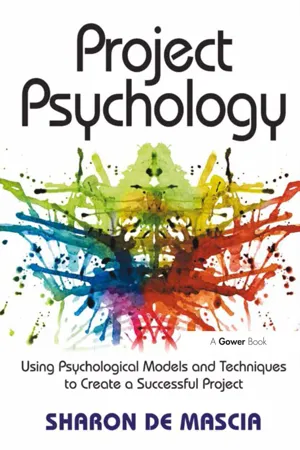
Project Psychology
Using Psychological Models and Techniques to Create a Successful Project
- 218 pages
- English
- ePUB (mobile friendly)
- Available on iOS & Android
eBook - ePub
Project Psychology
Using Psychological Models and Techniques to Create a Successful Project
About this book
Why do carefully planned projects fail? Projects are affected, for good or ill, by the humans who undertake them. If the plan fails to take account of the psychology of managing people and the psychology of managing change there may be trouble ahead. Sharon De Mascia's Project Psychology uses human behaviour and emerging psychological models to provide an insight into the successful management of people in projects. By selecting the right team, facilitating a common vision and by gaining a psychological understanding of how the team and the project stakeholders interact together, a project manager improves the chance of a successful outcome. Whether you are looking to set up and manage a new project or working to develop the competence and maturity of your organization's project management capability, Project Psychology will provide you with insights and tools for making sense of the people involved and for managing them to best effect.
1 The Project Team_ Skills and Attitudes
DOI: 10.4324/9781315602448-2
Identifying the Skills/Attitudes of the Project Team and Selecting the Project Team
This chapter of the book looks at the types of skills and attitudes that you are likely to need from both a project manager and a project team. It looks at skills and attributes required and how they have changed in the light of the changing project environment and recent research into what makes projects successful. It also looks at some of the differences between the skills required for general teams and those required for project teams. This chapter ends with a brief look at ways of helping you select the right project team.
What Are the Skills And Attitudes Normally Associated with Being a Project Manager?
The earlier project management literature tends to focus on the differences between line managers and project managers for example; there is an emphasis on project management as a discrete short-term entity.
| PROJECT MANAGEMENT | LINE MANAGEMENT |
|---|---|
| A narrower focus aimed at delivering a short-term project. This would involve building close working relationships in order to meet project milestones | A broader, long-term focus on organisational performance. This would involve general management in order to achieve broader organisational objectives |
However, these boundaries have blurred over time and twenty-first-century projects can last for many years with multiple strands or foci to them. Consequently, it is probably more helpful to look at the types of skills and attributes that are essential for a project manager.
Meredith and Mantel (2003) suggest a list of skills and attributes that they perceived to be popular in the selection of project managers:
- a strong technical background
- a hard-nosed manager
- a mature individual
- someone who is currently available
- someone who is on good terms with senior management
- someone who can keep the project team happy
- someone who has worked in several departments
- someone who can walk on water
Most of us will have witnessed some of these criteria on show in various organisations; however, in themselves, they are unlikely to increase the potential success of the project. Lientz and Rea (2000) also describe a list of attributes that they feel are essential to project managers. The list has much in common with that provided by Meredith and Mantel (2003) with the addition of ‘being a good problem solver’, ‘being energetic and ambitious’, ‘being a risk taker’ and finally, ‘having a sense of humour’.
Meredith and Mantel (2003) quote a survey reported by Posner (1987) in the Project Management Journal. Posner asked project managers to complete a questionnaire which asked about the skills required to be a project manager. The results from the questionnaire suggested that project managers should have good communication skills and be able to listen and persuade. They should have good leadership skills so that they can create a positive vision and act as a role model. The results also suggested that project managers need good organisational and coping skills; along with team building and technological skills. As expected, there is a lot of commonality in what we have seen so far.
Gok (1997) carried out some research with project managers (all were full members of the UK Association of Project Managers) and he found that his participants identified 14 attributes that were important for project managers. These characteristics fell into four categories:
- the ability to meet project deadlines
- human related abilities
- personal traits
- technical ability
Examples of attributes within these categories included: being recognised as a team player, ability to manage budgets and so on. Having looked at the attributes identified by Meredith and Mantel (2003), Lientz and Rea (2000) and Posner (1987) they could all be subsumed under categories identified by Gok (1997); however, like most things, the devil is in the detail. A comparison of the various lists of attributes reveals that there are many similarities between them, particularly those produced by Lientz and Rea and Posner and the attributes cited are those which anyone would be hard pushed to disagree with, for example communication, the ability to motivate, vision, organisational skills and energy. There are, however, some differences; for example, the Lientz and Rea list refers to risk-taking which is lacking in the Posner list whilst the Posner emphasises team-building skills. Let's explore what light, if any, recent research into project success factors and psychological research generally sheds on these lists of attributes.
Attributes That Have Been Found to Contribute to Project Success in the Twenty-First Century
The findings reported in the previous chapter (Hylväri 2007, Yukl 2002, Zimmerer and Yasin 1998, Barrezeele 2000) suggest that the following attributes in project managers are significantly associated with successful projects.
- Experience in change management – this was considered to have great significance for project success. It is important when delivering a project to be able to manage both the technical elements and the people elements of a project. As we have already said, projects are about change so it stands to reason that a project team which understands the fundamentals of achieving change is more likely to succeed than their less experienced counterparts.
- Leadership ability – Zimmerer and Yasin (1998) found that 76 per cent of project success could be attributed to positive leadership, for example being visionary, leading by example and also being technically competent.
- Ability to inspire and motivate people – this is tied in with leadership skills, in that, the project manager's ability to motivate and inspire the project team and stakeholders has been identified as a significant factor in project success.
- Team building/developing – the ability of the project manager to build and develop the skills of the project team has also been identified as a crucial factor in project success. This also an understanding of group dynamics, that is, how individuals in groups/teams relate to each other and to those outside the immediate group/team.
- Good communicator – project managers need to be able to inspire and motivate people. The ability to communicate effectively is fundamental to this. Political awareness and sensitivity were also found to be significant factors.
- Good decision-maker – projects involve decision-making and the project manager needs to be able to make timely, effective decisions even if the decision is to delegate the decision upwards or sideways.
- Good conflict manager – projects often depend on matrix management and a range of stakeholders so it is not surprising that conflict occurs from time to time. Equally it is hardly surprising that the ability to manage conflict has emerged as a critical skill for project managers.
- The ability to create a structured project environment – along with good planning/networking, organisational skills were found to be significant factors in the effective delivery of projects.
This list does not purport to be an exhaustive one; it merely contains the attributes that have been demonstrated to have a link with successful performance. It is probably worth looking at some of these areas in more detail and we will continue exploring some of these ‘success factor’ attributes throughout subsequent chapters.
In my experience, the existence of Prince2 and other easily accessible models for delivering projects is creating a trend for project managers coming from certain backgrounds and to have certain skill sets. Prince2 and similar project-management methodologies are based on sets of processes which are clear and fairly prescriptive, the idea being that if you put these processes in place, you will have a successful project. Given that the processes are fairly linear and mechanical they appear to be attracting non-people-oriented project managers – that is, people with IT and technical backgrounds who are, no doubt, attracted by the current image of project management as a set of linear and logical processes to be delivered in a predetermined sequence. This can be very useful for IT projects; however, in my experience, there appears to be a skill set missing around dealing with people and managing the people aspects of change and I believe that this is one of the reasons why a number of the big expensive projects either fail completely or fail to realise the benefits that they set out to achieve. Consequently, as well as the skills identified above, I would also include emotional intelligence, risk-taking preferences, engagement ability, coaching ability, integrity, personal resilience and goal setting. We will go on to look at these skills in more detail throughout subsequent chapters.
What Skills and Attitudes Do You Need from a Project Team?
Within society there are many different groupings of people. A team is one particular type of group. Moxon (1993) suggests that a team has the following attributes:
- a common purpose
- recognition by each individual as belonging to the same unit, that is, team identity
- interdependent functions
- agreed norms or values which regulate behaviour
Project teams have some complexities that are not always present in other types of teams. To take one example, project teams usually have a limited existence as they are exist for the duration of the project. Secondly, they are often matrix-managed which means that some (or all) team members may have a manager for their day job and the project manager for that portion of their work that relates to the project. This can cause conflicts for both the project manager and the project team. An additional complication is that, as for a number of teams today, project teams are often not co-located physically and may be spread across the country or even the world. These additional complexities make it even more necessary that the project manager invest time in building his/her team, which we will go on to talk about in Chapter 3.
Team Member Skills
The number of people in a project team and the variety of specialisms that they possess will vary considerably according to the nature, scope and value of the project. A small project may only have two or three members, whereas a larger-scale project could have hundreds.
Some projects will require more specialist skills than others. In my experience, when delivering IT projects it is essential to have appropriate knowledge and experience in the project team around existing systems, relevant software, requirements of any new system and knowledge of interfaces and user requirements. Similarly in HR-related projects, it is essential to have someone who understands how current HR policies and procedures work and what impact the project will have on those. Regardless of the degree of specialist knowledge needed, however, there are some underlying attributes that are necessary in every project team if it is to be successful.
There is considerably less in the literature generally on the skills associated with being a project team member than there is on being a project manager; however, even the best project manager will struggle to succeed if he or she lacks the appropriate skills and knowledge within the project team. Consequently, it is just as important look at the sorts of skills that you require in your project team members; over and above any specialist skills as mentioned above. I think it is fair to say that most project team members will need the same types of skills to be a project team member as they do to be a member of other types of organisational teams. There are, however, certain skills which are more strongly emphasised in project teams simply due to the nature of project management itself.
Tyson, M...
Table of contents
- Cover
- Half Title
- Title Page
- Copyright Page
- Table of Contents
- List of Figures
- List of Tables
- About the Author
- Introduction
- Chapter 1 The Project Team: Skills and Attitudes
- Chapter 2 What Sort of Leader Should a Project Manager
- Chapter 3 Building the Project Team and its Culture
- Chapter 4 Coaching the Project Team
- Chapter 5 Engaging Stakeholders
- Chapter 6 The People Side of Communication
- Chapter 7 Managing Risk in Projects
- Chapter 8 Managing Conflict in Projects
- Chapter 9 Project Management and Change Management
- Chapter 10 Using Your Project Board
- Chapter 11 Do Organisations Learn From Failed Projects?
- Chapter 12 Project Wind-Down
- Summary
- References
- Index
Trusted by 375,005 students
Access to over 1.5 million titles for a fair monthly price.
Study more efficiently using our study tools.
Frequently asked questions
Yes, you can cancel anytime from the Subscription tab in your account settings on the Perlego website. Your subscription will stay active until the end of your current billing period. Learn how to cancel your subscription
No, books cannot be downloaded as external files, such as PDFs, for use outside of Perlego. However, you can download books within the Perlego app for offline reading on mobile or tablet. Learn how to download books offline
Perlego offers two plans: Essential and Complete
- Essential is ideal for learners and professionals who enjoy exploring a wide range of subjects. Access the Essential Library with 800,000+ trusted titles and best-sellers across business, personal growth, and the humanities. Includes unlimited reading time and Standard Read Aloud voice.
- Complete: Perfect for advanced learners and researchers needing full, unrestricted access. Unlock 1.5M+ books across hundreds of subjects, including academic and specialized titles. The Complete Plan also includes advanced features like Premium Read Aloud and Research Assistant.
We are an online textbook subscription service, where you can get access to an entire online library for less than the price of a single book per month. With over 1.5 million books across 990+ topics, we’ve got you covered! Learn about our mission
Look out for the read-aloud symbol on your next book to see if you can listen to it. The read-aloud tool reads text aloud for you, highlighting the text as it is being read. You can pause it, speed it up and slow it down. Learn more about Read Aloud
Yes! You can use the Perlego app on both iOS and Android devices to read anytime, anywhere — even offline. Perfect for commutes or when you’re on the go.
Please note we cannot support devices running on iOS 13 and Android 7 or earlier. Learn more about using the app
Please note we cannot support devices running on iOS 13 and Android 7 or earlier. Learn more about using the app
Yes, you can access Project Psychology by Sharon De Mascia in PDF and/or ePUB format, as well as other popular books in Business & Business General. We have over 1.5 million books available in our catalogue for you to explore.