eBook - ePub
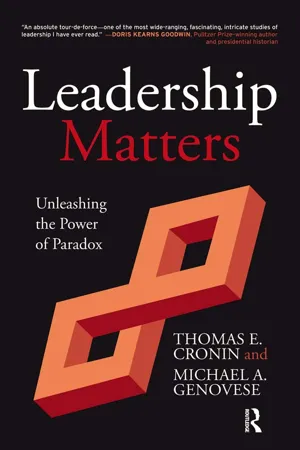
Leadership Matters
Unleashing the Power of Paradox
- 382 pages
- English
- ePUB (mobile friendly)
- Available on iOS & Android
eBook - ePub
Leadership Matters
Unleashing the Power of Paradox
About this book
Some leaders fundamentally alter the status quo whilst others guide quietly. Most leadership books emphasise specific rules, but Tom Cronin and Michael Genovese see leadership as filled with paradox. Leadership Matters offers a different view of leadership - one that builds community and responds creatively to new situations. Cronin and Genovese argue that leadership is about more than just charisma and set leaders on to a different path - to unleash the power of paradox.

CHAPTER ONE
THE PARADOXES OF LEADERSHIP
Of course, life would be easier if leadership was just a list of simple rules, but paradoxes are inherent in the trade.
—Former General Electric chairman Jack Welch1
General Douglas MacArthur is described by his biographer as a great thundering paradox of a man, “noble and ignoble, inspiring and outrageous, arrogant and shy, the best of men and the worst of men…. For each of MacArthur’s strengths, there was a corresponding MacArthur weakness.”2
“My life, my work, my position, everything I’ve done, seems intertwined with a suspiciously large number of paradoxes,” writes Vaclav Havel, the writer and intellectual who became Czechoslovakia’s president in 1989 after the collapse of the Soviet empire. Havel says that conflict, tensions, and misunderstandings upset him. Yet both his writings and his life as a political activist were full of conflict, tension, and controversy. He writes, “I’m very unsure of myself, almost a neurotic. I tend to panic easily …I’m plagued by self-doubts …yet I appear to many as someone who is sure of himself, with an enviable equanimity.” Havel liked people and bringing people together, yet was happiest when he was alone and could escape into solitary introspection as a rabble-rousing Don Quixote. “For many people I’m a constant source of hope and yet I’m always succumbing to …uncertainties.”3
Being a leader is a complex fate. Although contradictions and clashing expec-tations are part of life, they are especially present in the exercise of leadership. Leaders with great strengths often have great weaknesses as well. And what may be a leader’s strength in one area, or at one time, can prove a weakness later on. Or as in the case of Winston Churchill, vice versa. A quality that may be a strength in one context may be a weakness in another. A leader’s life is usually, as the MacArthur and Havel examples attest, a collage of conflicting expectations, dilemmas, and necessities.
We both admire and fear power. We admire and fear leaders. Likewise, we yearn for self-confident, tough-minded heroic leadership yet are also inherently suspicious of it. We at times desire decisive hierarchical leaders yet later wish to be left alone. We want leaders who are like us yet better than us. We yearn for leaders to serve the common good yet simultaneously serve particular interests. We lament the lack of leadership, yet we are harsh critics of the leaders we get. We want leaders to tell us the truth yet often get upset with them when they do. We want effective political leadership yet wish we could have it without politicians. We value leaders who have humility and compassion yet also know that sometimes it is the demanding perfectionist, control freak with narcissistic personality disorders, like Apple’s Steve Jobs, who produce valuable breakthroughs. Somehow leaders like Havel, MacArthur, and Jobs learned to live with, if not master, the paradoxes confronting them.
We ask leaders to resist being overly wed to the status quo, tradition, or convention, yet we want them to possess a sense of history and a sensitivity to human experience. We are impressed with leaders who display fearless resolve, yet we also respect those who are self-effacing, acknowledge their fallibility, and learn from mistakes.
Leaders of genius and creativity have been vital in guiding us toward liberty, economic progress, peace, and social justice. Yet if leaders have often been a source of freedom and liberation, they have almost as often been responsible for war, horrible repressions, and crimes against humanity.
Leaders learn to live and cope with contradictions. Effective leaders learn to exploit contrary and divergent forces. They become savvy synthesizers of dis-parate information, integrative thinkers who can anticipate and read changing contexts. In Joseph Nye’s useful phrase, they develop their contextual intelligence. Leadership commonly requires successive displays of contrasting characteristics. Thus leaders learn to live with ambiguous demands, shifting expectations, and sometimes fickle followers.
The effective leader in business, government, and elsewhere, much like a first-rate conductor, knows when to bring in the various sections, when to increase and diminish the volume, and how to balance opposing groups to achieve satisfying results.
Leaders are constantly buffeted by competing demands, constituencies, and policies, and must often strike a balance in order to be effective. Compromise and patience may be required in one situation, yet too much compromise or patience in other situations may be fatal.
Certain clashing expectations or contradictions are sometimes resolved by proper timing. Others have to be juggled or balanced. Effective leaders manage their time wisely while trying as well to appreciate and balance the endless stream of conflicting demands. They redefine their roles, recast strategies, reposition budgets, reorganize staff, and reorient their organizations—constantly.
This chapter explores the contradictions, paradoxes, clashing expectations, and competing demands leaders live with.
There are few fixed rules regarding leadership. It is mostly a moving target. That is why the study of leadership is more art than science.
Leadership, like life, is too complex for simplistic answers. Leadership and life are complex, contradictory, paradoxical. That is why life—and leadership—are about balance and flexibility, not absolutes and rigidity. Good leaders and healthy individuals seek a balance, deal with competing demands, are flexible.
Leadership Contradictions and Paradoxes
• We want decent, just, compassionate, and moral leaders, yet at times we admire and need tough, assertive, cunning, manipulative, and even intimidating leaders.
• Effective leadership involves self-confidence, the audacity of hope, and sometimes even a fearless optimism. However, humility, self-doubt, and self-control are also essential.
• Leaders must be representative—yet not too representative; they need to consult and engage followers, and they need to respond to them. Yet they also must educate, motivate, and unlock the best in everyone.
• Leaders must be visionaries guided by ideas, ideals, and principles, yet we also want pragmatic realists guided by logic, evidence, and level-headed rational analysis.
• Leaders invent and reinvent themselves. Their leadership usually is intenional, not accidental. Yet people also want their leaders to be open, relaxed, “authentic,” sincere, spontaneous, and to somehow emerge from within rather than be imposed upon a group.
• Leadership often calls for intensity, enthusiasm, passion, dramatization, and self-promotion—yet too much highly personalized volcanic energy can paralyze an organization. Too much of a “cult of personality” can create dependency or other organizational dysfunctions.
• Leaders need to unify their organizations or communities through effective negotiation and alliance building, yet leaders also have to stir things up and jolt their organizations out of complacency. In short, we ask them to be uniters and dividers.
• Leaders are supposed to lead, not follow the polls, yet they are often followers as much as they are leaders. One of the grand paradoxes of leadership is that leaders often follow, and followers often point the way or lead more than is appreciated. Change often comes from the bottom up rather than from the top down. And it often comes from the young rather than from establishment elites.
• Although we may reject the General George Patton or the Godfather model of leadership for most of our organizations most of the time, we still want to believe leaders make a significant difference—yet idealistic and romantic theories exaggerate the impact of leaders. Most of the time, “leaders” are agents of their organizations or are at least shaped by them more than they are agents of change.
Moral versus Manipulative
Most people want leaders to be decent, just, and “proper” in their personal conduct. Others, more focused on results, look for hard-driving personalities and insist that leaders be opportunistic, realistic, and masters of trading, accommodation, and guile.
We want leaders to be ferocious or compassionate, mean-spirited or sensitive, ruthless or cooperative, depending on what we want done, depending on the situation, depending on how much time is available, and to some extent, depend-ing on the agreed-upon “successful” role models of the recent past.
No magic formula exists. Leaders need to be sensitive to the varying expectations of their followers and aware, too, of the shifting nature of their followers’ dispositions.
However much we admire transparency, vulnerability, and an emphasis on teamwork, many of our most effective business and societal leaders have been vain, crafty, and deceitful. Thus Franklin D. Roosevelt may have devoted himself to advancing the ends of social justice and peace, but his biographers agree he was often duplicitous, vain, manipulative, and had a passion for secrecy.
Change is scary and organizations sometimes need scary, in-your-face leaders to steer them through tough times. “Great intimidators may create disharmony,” writes Stanford University professor Roderick Kramer, “but they also can create value.” He points to Bill Gates, Steve Jobs, Martha Stewart, and Michael Eisner as abrasive, forceful, and sometimes intimidating bosses.4
Management writers such as Jim Collins, Max De Pree, and Robert Greenleaf have famously argued that the best chief executives are humble, self-effacing, resolute, yet not flamboyant egotists. They find many examples to back up their contention.5 But others contend that the corporate and political worlds sometimes need flamboyant visionaries and narcissists. “Think of the people who have shaped the modern business landscape, and ‘faceless’ and ‘humble’ are not the first words that come to mind,” writes a columnist for The Economist.6
Henry Ford was as close as you get to being deranged without losing your liberty. John Patterson, the founder of National Cash Register and one of the greatest businessmen of the gilded age, once notified an employee that he was being sacked by setting fire to his desk. Thomas Watson …the founder of IBM, turned his company into a cult and himself into the object of collective worship. Bill Gates and Steve Jobs are both tightly wound empire-builders. Jack Welch and Lou Gerstner are anything but self-effacing. These are people who have created the future, rather than merely managing change, through the force of their personalities and the strength of their visions.7
Americans can become supercritical of would-be leaders who are viewed as soft, wimpy, or afraid to make unpopular decisions. This is as true in politics as it is in business. Among others, Adlai Stevenson, Jimmy Carter, Gerald Ford, Michael Dukakis, John Kerry, and Barack Obama were faulted at times for indecision, timidity, or failure to be pragmatists. Journalists merely said they did not know how to play “hardball.”8 And yet, the opposite can also lead to poor performance, as the apparent certainty of George W. Bush and Dick Cheney sometimes demonstrated.
A leader “must know when to dissemble, when to be frank. He must pose as a servant of the public in order to become its master,” wrote Charles de Gaulle in The Edge of the Sword.9 He also said leaders had to have a strong dose of egotism, pride, and hardness. Former president Richard Nixon goes even further in one of his many memoirs: “Guile, vanity, dissembling—in other circumstances these might be unattractive habits, but to the leader they can be essential.”10
We do not openly admire cunning as a quality, and we know that too much of it can destroy a dedicated leader. Yet as political scientist Clinton Rossiter noted, “a president cannot get the best out of the dozens of able figures around him or keep them under his command unless he is a master in the delicate art of manipulating men.”11
Leaders have to be uncommonly active, attentive listeners. They must “squint” with their ears. But they can’t listen forever. Eventually they must act, decide, and make judgments. People such as Hamlet waited too long to act. Others like King Lear, Othello, or Sophocles’ King Creon listened poorly, if at all, and acted in foolish haste.
Ambition is essential if a leader is to make a difference. To gain and retain power one must have a love of power, and this love of power can be incompatible with moral goodness. In fact, ambition is more often linked to qualities of pride, narcissism, duplicity, and cruelty and often raises all the worst fears associated with questionable ends justifying unacceptable means.
The intentional use of coercion, force, and even killing may, under certain circumstances, be morally justified. Leaders can’t always combat evil with goodness. Some just causes, such as just wars, require unjust means. The moral dilemma sometimes becomes a choice between two competing evils.
Leaders who are transformational can also be impatient and can display deep-seated hostility toward the status quo. They can be driven and angry, with a compulsive darker side that can make them impossible and dangerous personalities.
Leaders invariably combine toughness and softness. “Where results must be achieved quickly he must, on occasion, be ruthless if it is possible to be ruthless without injuring the confidence of his employees or the claimants to his service.”12
Yet the successful leader must also be fair. “If he becomes arbitrary, capricious, and dictatorial, he may become feared but he will also lose his qualifications for leadership. Morale has never yet flourished in an organization based largely upon fear,” writes management writer Marshall Dimock. “Sooner or later the members of such an institution find it possible to secure their revenge.”13
A leader takes care not to become too self-absorbed. Self-preoccupation becomes one’s own prison.
Leadership, divorced from worthy purposes, is merely manipulation of de-ception and, in the extreme, the wielding of repressive and tyrannical power.
Still a paradox remains. “Power, or organized energy, may be a man-killing explosive or a life-saving drug,” writes Saul Alinsky. “The power of a gun may be used to enforce slavery, or to achieve freedom.”14 And so it is with leadership. Leaders must respect the preciousness of huma...
Table of contents
- Cover
- Half Title
- Dedication
- Title Page
- Copyright Page
- Table of Contents
- Preface
- 1. The Paradoxes of Leadership
- 2. Defining Leadership
- 3. Leadership Realities
- 4. What the Classics Teach Us about Leadership: 70 From Gilgamesh to the Bible
- 5. What the Classics Teach Us: Machiavelli to Shakespeare
- 6. What the Classics Teach Us: The Rise of Constitutional Democracy
- 7. What Business Teaches Us about Leadership
- 8. What Politics Teaches Us about Leadership
- 9. What the Military Teaches Us about Leadership
- 10. What Hollywood Teaches Us about Leadership
- 11. The Darker Side of Leadership
- 12. The Creative Side of Leadership
- 13. Leadership as a Performing Art
- Acknowledgments
- Notes
- Selected Bibliography
- Index
- About the Authors
Trusted by 375,005 students
Access to over 1.5 million titles for a fair monthly price.
Study more efficiently using our study tools.
Frequently asked questions
Yes, you can cancel anytime from the Subscription tab in your account settings on the Perlego website. Your subscription will stay active until the end of your current billing period. Learn how to cancel your subscription
No, books cannot be downloaded as external files, such as PDFs, for use outside of Perlego. However, you can download books within the Perlego app for offline reading on mobile or tablet. Learn how to download books offline
We are an online textbook subscription service, where you can get access to an entire online library for less than the price of a single book per month. With over 1.5 million books across 990+ topics, we’ve got you covered! Learn about our mission
Look out for the read-aloud symbol on your next book to see if you can listen to it. The read-aloud tool reads text aloud for you, highlighting the text as it is being read. You can pause it, speed it up and slow it down. Learn more about Read Aloud
Yes! You can use the Perlego app on both iOS and Android devices to read anytime, anywhere — even offline. Perfect for commutes or when you’re on the go.
Please note we cannot support devices running on iOS 13 and Android 7 or earlier. Learn more about using the app
Please note we cannot support devices running on iOS 13 and Android 7 or earlier. Learn more about using the app
Yes, you can access Leadership Matters by Thomas E. Cronin,Michael A. Genovese,Thomas Cronin in PDF and/or ePUB format, as well as other popular books in Business & Leadership. We have over 1.5 million books available in our catalogue for you to explore.