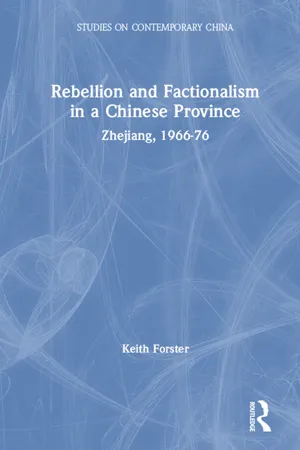
A detailed case study of provincial politics during the decade-long Cultural Revolution, which analyzes the form and changing nature of mass organizations established in China by 1966. The text traces their evolution, activities and ultimate dissolution ten years later.
Trusted by 375,005 students
Access to over 1.5 million titles for a fair monthly price.
1. The Cultural Revolution in The Provinces, Harvard East Asian Monographs, 42 (Cambridge, Mass.: Harvard University Press, 1971).
2. Keith Forster, “The Hangzhou Incident of 1975: The Impact of Factionalism on a Chinese Provincial Administration”, (Ph. D. thesis: University of Adelaide, 1985).
3. Frank P. Belloni and Dennis C. Beller, “Party and Faction: Modes of Political Competition”, in Belloni and Beller (eds), Faction Politics: Political Parties and Factionalism in Comparative Perspective (Santa Barbara, California: ABC-Clio Inc., 1978), p. 445.
4. Ann E. Fenwick, “The Gang of Four and the Politics of Opposition: China, 1971-1976”, (Ph. D. thesis: Stanford University, 1984), p. 20.
5. Lucien Pye, The Dynamics of Chinese Politics (Cambridge, Mass.: Oelgeschlager, Gunn & Hain, 1981).
6. Beller and Belloni, Faction Politics, pp. 430-7. See also, Norman K. Nicholson, “The Factional Model and The Study of Politics”, Comparative Political Studies, 5: 3 (1972), pp. 303-05.
7. Beller and Belloni, Faction Politics, pp. 419-30.
8. Andrew J. Nathan, “A Factionalism Model for CCP Politics”, China Quarterly (CQ), 53 (1973), pp. 34-66.
9. Nicholson, “The Factional Model”, p. 298.
10. William Hinton, Shenfan (London: Picador Books, 1983), p. 611.
11. Zhang Yun,
(Boost party spirit, overcome factionalism), Hongqi, No. 9 (1984), pp. 6-8. See also Keith Forster, “The Repudiation of the Cultural Revolution”, Journal of Contemporary Asia, 17: 1 (1987), pp. 71-72.
12. For example, see Hong Yung Lee, The Politics of the Chinese Cultural Revolution: A Case Study (Berkeley and Los Angeles: University of California Press, 1978); Anita Chan, Stanley Rosen and Jonathan Unger, “Students and Class Warfare: The Social Roots of the Red Guard Conflict in Guangzhou (Canton)”, CQ, 83, (September 1980), pp. 397-446.
13. For a useful discussion of class as caste, see R.C. Kraus, Class Conflict in Chinese Socialism (New York: Columbia University Press, 1981), pp. 117-39.
14. Jonathan Unger, Education Under Mao: Class and Competition in Canton Schools, 1960–1980 (New York: Columbia University Press, 1982), pp. 130-31.
15. Lee, The Politics of the Chinese Cultural Revolution, pp. 340-43.
16. Chan et al., “Students and Class Warfare”, pp. 433-42.
17. Anita Chan (ed.), “A Brief Analysis of the Cultural Revolution” by Liu Guokai, in Chinese Sociology and Anthropology, 19: 2 (1986-7), esp. pp. 73-82, 85-92. Originally published as
in a Chinese mainland underground publication and then in Taiwan in
(A Collection of Mainland underground publications), Vol. 17 (Taibei: Institute for the Study of Chinese Communist Problems, 1983). pp. 91-244.
18. Gao Yuan, Born Red (Stanford: Stanford University Press, 1987).
Notes to Chapter 1
1. See William Whitson, The Chinese High Command: A History of Communist Military Politics, 1927–71 (New York: Praeger Publishers, 1973), pp. 245-57.
2. For a biographical sketch of Jiang Hua see “Jiang Hua -- President of the Supreme People’s Court”, I&S, 16: 7 (1980), pp. 85-88; CNS, 288 (18 September 1969), pp. B12-17. The whereabouts of Jiang’s birthplace seems to have caused a great deal of confusion. The above article claims that he was born in Hubei province. Klein and Clark state that Jiang’s birthplace was in Shandong province. See D.W. Klein and A.B. Clark (eds), Biographic Dictionary of Chinese Communism, 1921-1965 (Cambridge, Mass.: Harvard University Press, 1971), Vol. I, p. 173. Jiang was in fact born in Jianghua county, Hunan province, from which place he took his name, a fact well known to the citizens of Zhejiang. For written proof, see the interview with Jiang Hua in which Jiang reminisced about Mao Zedong’s frequent visits to Zhejiang and the interviewer noted Jiang’s Hunan accent. ZJRB, December 26, 1983, p. 3. Another fact about Jiang not previously published is that ethnically he is a Yao national. Jianghua county is now a Yao autonomous county in the south of Hunan.
3. For a brief account of Wu’s life and political activities, see the articles published in ZJRB, November 6, 1978, pp. 1, 3; and Kang Keqing, Zeng Zhi and Peng Ru,
(Loyal and devoted, courageous and knowledgeable -- deeply cherish the memory of Comrade Wu Zhonglian), ZJRB, January 28, 1987, p. 2.
4. For a sketch of his career, see “Wang Fang -- Newly Appointed Secretary of the CCP Zhejiang Provincial Committee”, I&S 19: 8 (1983), pp. 67-71.
5. For a recent account of the continued strength of this network see Liang Ruinian,
(Peng Zhen’s clique in the public security network is gaining ground)
(The Tide), 3 (May 15, 1987), p. 12.
6. See Xue’s pr...
Table of contents
Cover
Half Title
Title Page
Copyright Page
Table of Contents
Acknowledgments
Abbreviations
Tables
Maps Administrative Map of Zhejiang City of Hangzhou
Introduction
One The Outbreak of the Cultural Revolution, May 1966-February 1967
Two Disunity and Violence, February-August 1967
Three From “Unity” to Renewed Disunity, September 1967-August 1968
Four Order and Unity, August 1968-September 1969
Five Military Rule in Zhejiang, 1969-72
Six The Reestablishment of Civilian Rule, 1972-73
Seven Renewed Radicalism, 1973-74
Eight The Breakdown in Local Authority, 1974-75
Nine Central Intervention, July 1975
Ten Consolidation and Renewed Instability, August 1975-September 1976
Conclusion
Notes
Appendix Biographical Sketches of Selected Party and Mass Organization Leaders of Zhejiang
Bibliography
Index
Frequently asked questions
Yes, you can cancel anytime from the Subscription tab in your account settings on the Perlego website. Your subscription will stay active until the end of your current billing period. Learn how to cancel your subscription
No, books cannot be downloaded as external files, such as PDFs, for use outside of Perlego. However, you can download books within the Perlego app for offline reading on mobile or tablet. Learn how to download books offline
Perlego offers two plans: Essential and Complete
Essential is ideal for learners and professionals who enjoy exploring a wide range of subjects. Access the Essential Library with 800,000+ trusted titles and best-sellers across business, personal growth, and the humanities. Includes unlimited reading time and Standard Read Aloud voice.
Complete: Perfect for advanced learners and researchers needing full, unrestricted access. Unlock 1.5M+ books across hundreds of subjects, including academic and specialized titles. The Complete Plan also includes advanced features like Premium Read Aloud and Research Assistant.
Both plans are available with monthly, semester, or annual billing cycles.
We are an online textbook subscription service, where you can get access to an entire online library for less than the price of a single book per month. With over 1.5 million books across 990+ topics, we’ve got you covered! Learn about our mission
Look out for the read-aloud symbol on your next book to see if you can listen to it. The read-aloud tool reads text aloud for you, highlighting the text as it is being read. You can pause it, speed it up and slow it down. Learn more about Read Aloud
Yes! You can use the Perlego app on both iOS and Android devices to read anytime, anywhere — even offline. Perfect for commutes or when you’re on the go. Please note we cannot support devices running on iOS 13 and Android 7 or earlier. Learn more about using the app
Yes, you can access Rebellion and Factionalism in a Chinese Province by Keith Forster in PDF and/or ePUB format, as well as other popular books in History & 20th Century History. We have over 1.5 million books available in our catalogue for you to explore.