eBook - ePub
Celebrity in Chief
A History of the Presidents and the Culture of Stardom
- 280 pages
- English
- ePUB (mobile friendly)
- Available on iOS & Android
eBook - ePub
About this book
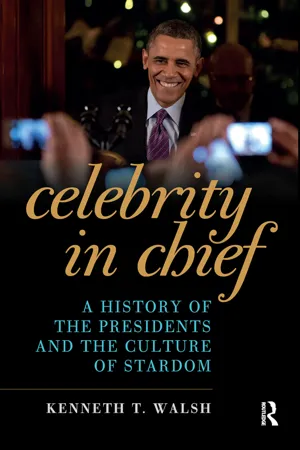
It didn t take long for Barack Obama to make his mark as the biggest political star to ever occupy the White House. Over the course of his two terms in office, Obama has injected the American presidency deeper into popular culture than any of his predecessors. He and his wife Michelle have become iconic figures, celebrities of the first order.This book, by award-winning White House correspondent and presidential historian Kenneth T. Walsh, discusses how the Obamas reached this point. More important, it takes a detailed and comprehensive look at the history of America s presidents as celebrities in chief since the beginning of the Republic. Walsh makes the point that modern presidents need to be celebrities and build on their fame in order to propel their agendas and rally public support for themselves as national leaders so that they can get things done.Combining incisive historical analysis with a journalist s eye for detail, this book looks back to such presidents as George Washington and Abraham Lincoln as the forerunners of contemporary celebrity presidents. It examines modern presidents including Barack Obama, Bill Clinton, Ronald Reagan, John F. Kennedy, Franklin Roosevelt, and Theodore Roosevelt, each of whom qualified as a celebrity in his own time and place. The book also looks at presidents who fell short in their star appeal, such as George W. Bush, George H. W. Bush, Richard Nixon, and Lyndon Johnson, and explains why their star power was lacking.Among the special features of the book are detailed profiles of the presidents and how they measured up or failed as celebrities; an historical analysis of America s popular culture and how presidents have played a part in it, from sports and television to movies and the news media; the role of first ladies; and a portfolio of fascinating photos illustrating the intersection of the presidency with popular culture."
Information

CHAPTER ONE
FORERUNNERS OF THE MODERN CELEBRITY PRESIDENTS
WASHINGTON TO CLEVELAND
George Washington: The Archetype
George Washington was, of course, America’s first president. He was also America’s first celebrity in chief, the leader who won the Revolutionary War, whose integrity was considered beyond reproach, and who was almost universally believed to be the only person capable of uniting the new nation and establishing the roots of a stable democracy.
His renown was such that in February 1789 he was chosen unanimously by the Electoral College to be the first president of the United States. On April 16 he began making his way from his estate in Mount Vernon, Virginia, to the president’s temporary residence and the nation’s first capital in New York City, where he was to be inaugurated.
He was reluctant to leave home and take on the responsibilities and public duties of his new job. He wrote in his journal on April 16: “About 10 o’clock I bade adieu to Mount Vernon, to private life, and to domestic felicity, and with a mind oppressed with more anxious and painful sensations than I have words to express, set out for New York in company with Mr. Thompson, and Colonel Humphries, with the best dispositions to render service to my country in obedience to its call, but with less hope of answering its expectations.”1
It was a remarkable seven-day journey marked by an outpouring of public affection and jubilation for the savior of the nation. In today’s terms, he was treated like a rock star. Local officials and everyday people gathered by the thousands to meet him or at least get a glimpse of him; they cheered when they saw him, amid frequent artillery salutes. There were celebrations in many towns, including Alexandria, Virginia; Baltimore, Maryland; Wilmington, Delaware; Philadelphia, Pennsylvania; and Trenton, New Jersey. When Washington arrived at Elizabeth Town, New Jersey, on April 23, a special ceremonial barge was ready to take him across the river to New York. The barge was rowed by thirteen pilots dressed in white, and various sloops and many small boats bearing local citizens accompanied his vessel across the river. His passage was marked by repeated cannon salutes from still other boats and from a fort in the harbor.2 When he landed, Washington was greeted by New York Governor George Clinton and other dignitaries, and a large procession accompanied him on foot to a house Congress had prepared as his residence.
He took the oath of office in New York’s former city hall, renamed Federal Hall, on April 30, “dressed in deep brown, with metal buttons, with an eagle on them, white stockings, a bag, and sword,” according to Pennsylvania senator William Maclay, who attended. Maclay said Washington seemed nervous, “agitated and embarrassed more than ever he was by the leveled cannon or pointed musket.” He trembled as he gave a short speech accepting the presidency.3
And from the start of his administration, Americans honored him with statues, street names, paintings, and memorabilia. The first permanent capital of the nation, Washington, the District of Columbia, was, of course, named after him.
“The American Constitution, as drafted and ratified in the late 1780s, was a splendid document,” writes political scientist Thomas E. Cronin. “Yet it did not guarantee that the American presidency would work and that Americans would enjoy both representative and effective government. Much depended on how George Washington interpreted the Constitution and how his countrymen would respond to his leadership. He carefully would have to lessen the distrust of Americans to a centralized leadership institution and earn respect and legitimacy for the fledgling Republic…. His integrity, judgment, and lengthy service (both in and out of uniform) to his country and his devotion to his troops and his countrymen set him apart from his fellow founders.”4
* * *
AS PRESIDENT, Washington set many precedents. He knew that his successors would model their behavior on his as much as possible, and that the new nation would expect this to happen, so he was very prudent in what he did. He was concerned about maintaining his reputation for being above reproach, and he didn’t want the presidency to become an imperial office such as the royal courts of Europe. There was debate initially on what to call the new president. Some suggested “Your Highness,” and others preferred “Your High Mightiness.” But Washington said “Mr. President” would be more appropriate, and this designation has been used ever since.
He felt an obligation to meet as many of his fellow citizens as he could during those early days of the Republic in the late 1700s, and he did so to the extent that he sometimes couldn’t relax at his home because of all the visitors. There are accounts of him trying to be polite but struggling to show an interest in the conversations of the people who dropped in on him, both at his estate in Mount Vernon, Virginia, and at his official residence. Sometimes he was bored; at other times he was tired and eager to go to bed after dinner.
He gave up dancing even though he enjoyed it and was good at it. But he considered it frivolous and below the stature of the president.
He limited himself to two terms, and that was the precedent until Franklin D. Roosevelt broke with tradition by seeking and winning election to four terms in 1932, 1936, 1940, and 1944 as he led the nation through the Depression and World War II.
Over the years, all sorts of lore grew up around Washington as the father of his country—tales of how he had chopped down a cherry tree and couldn’t tell a lie about it; that he threw a coin across the Potomac River, demonstrating extraordinary strength; that he was a brilliant leader during the Revolutionary War even though he lost several key battles. His celebrity status persists to this day.
* * *
WASHINGTON ABSORBED his understanding of the dominant culture of his time in various ways. He was a reader, as were all of the most influential founders, including Thomas Jefferson and John Adams. He had a library consisting of nine hundred books, including classics from ancient Greece and Rome, some fiction, and practical volumes on agriculture. Part of the gentleman’s culture of Washington and his associates was not only to read but to discuss books, along with history, philosophy, and current events, at dinner parties. As president, he hosted Thursday dinners, formal affairs in which men and women would gather to eat sumptuously, and then separate into two groups. The women talked among themselves and the men retired to a drawing room to drink and discuss what they considered important matters.
Washington, with his imposing height and bearing, embodied the look and behavior that Americans idealized and sought in their leader. He cultivated this image assiduously. “He knew he was a symbol to his countrymen, and he understood the importance of theatricality in leadership,” writes historian Tevi Troy. “He tried to convey a certain image in his dress when on horseback. Jefferson called him ‘the best horseman of his age and the most graceful figure that could ever be seen on horseback.’ Equestrian skills were held in especially high regard in those days because of the practical value and the symbolic importance of the cavalry from the time of Rome until the end of the Middle Ages. Washington’s fair for the theatrical may have come, logically enough, from his own love of the theater. According to [historian] Myron Magnet, Washington exercised ‘adroit stagecraft’ in his management of the Revolutionary War. He took on the role of stage actor who could skillfully manipulate his audience. He carefully selected his own clothes, recognizing that his impressive military uniform paralleled a costume for an actor playing a character.”5
He was adept at what we today call “branding,” and the country went along, purchasing all manner of Washington memorabilia, from artists’ renderings to engravings. “The image of a candidate or a president, whether a portrait or an emblem or what we would now call a brand, was important from the beginning,” writes historian Vicki Goldberg. “Engraved portraits of George Washington, which had been popular during his lifetime, remained popular long after his death and still show up daily on dollar bills. There are many ways of impressing an image or perception on a large number of minds, but almost all of them involve repetition and wide distribution—and visual images are particularly likely to stick in the mind.”6
Washington loved the theater, including Shakespeare, even though it was looked down upon as vulgar and lowbrow in the colonies and early United States. But he had Joseph Addison’s play Cato, which celebrated republican values and patriotism in a fight against tyranny, staged for his troops at Valley Forge during the harsh winter of 1777–1778, when morale was low.
Washington combined many roles in his successful quest to manage and enhance his celebrity. Cronin concludes, “In certain ways Washington became the nation’s first secular priest or societal shaman. In helping his fellow countrymen to transcend their parochial loyalties he helped instill a new nationalism and a new sense of collective purpose. His combination of warrior and priest, liberator, and definer of a national vision presaged additional extraconstitutional responsibilities for future American presidents.”7
Abraham Lincoln: Uncommon Common Man
Abraham Lincoln was born poor but he was a striver who worked hard to better himself. It was the ultimate American story. This is what his celebrity was based on.
He was a reader of books all his life, and kept up the habit during his presidency in the manner of founders such as Thomas Jefferson, John Adams, and John Quincy Adams. But he also understood everyday American life and, emulating Andrew Jackson, never came across as an elitist, as some previous presidents had. “While every president needs a little John Quincy Adams to govern wisely, he needs a little Andrew Jackson to get elected,” Troy writes. “The common touch was never difficult for Lincoln. His origins—the poverty, the rail-splitting, the one-room schoolhouse—were as humble as they come. But long after he left the log cabin, Lincoln retained an ability to connect with ordinary people despite his impressive intellect and knowledge.… Lincoln honed this skill as a circuit-riding lawyer whose success depended in part on being a good entertainer.… A good actor, Lincoln knew how to play to his audience.”8 This is the same talent that Ronald Reagan would have in the 1980s. Lincoln embodied the concept that someone could rise from nothing to achieve great things, and could even be president, although Lincoln eventually proved that he was hardly an average fellow. Americans, at least in the Northern states, felt he understood them.
* * *
A KEY POINT for Lincoln came when he deftly built up and then exploited his personal celebrity in the months prior to his election. The pivotal event was a speech he gave at New York’s Cooper Union, an academy in Manhattan, on February 27, 1860. Lincoln scholar Harold Holzer writes that it transformed Lincoln “from a relatively obscure Illinois favorite son into a viable national contender for his party’s presidential nomination.”9 He won that nomination three months later and took the presidency six months after that.
Lincoln realized that his speech to an important crowd in the key Eastern state of New York could make or break his chances to win the presidency, so he prepared it meticulously and delivered it brilliantly. It was a principled and reasoned stand against slavery and in defense of the Union, without the zealotry or anger that was inflaming the nation at the time.10 He would use this address as the basis for many other speeches all across the country.11 Once nominated, he mostly refrained from making speeches and referred voters to the Cooper Union address and summaries of his seven debates with Stephen A. Douglas in the 1858 US Senate campaign in Illinois. Lincoln said those debates distilled his views very well, even though he lost that Senate race.12
“As if to illustrate his metamorphosis,” writes Holzer, “the Cooper Union appearance also inspired the most important single visual record of Lincoln’s, or perhaps any, American presidential campaign: an image-transforming Mathew Brady photograph. Its later proliferation and reproduction in prints, medallions, broadsides, and banners perhaps did as much to create a ‘new’ Abraham Lincoln as did the Cooper Union address itself.”13
Lincoln had sat for photographs before, but he wanted this one to be special because it would be what amounted to his official presidential-campaign image. So he went to Brady, the most celebrated photographer of his day, and sat for a picture at Brady’s New York gallery at Bleecker Street on February 27, 1860, a few hours before his Cooper Union speech. He hoped both the speech and the photograph would add to his celebrity. They did, but getting the right photograph was a challenge.
Lincoln, fifty-one, looked weary, haggard, and awkward, and at sixfeet- four, his clothes were too small. A friend conceded that his appearance was less than appealing because he had “a large mole on his right cheek and an uncommonly prominent Adam’s apple on his throat.”14
Assessing his subject, Brady hit upon a brilliant idea. He would photograph this unattractive man standing up, at a distance, to emphasize his impressive height, rather than taking the customary head shot. Brady posed Lincoln with a false pillar in the background and a table piled with books and Lincoln lightly touching the top volume with his left hand, to suggest erudition. This technique diverted attention from Lincoln’s unappealing facial features and his ill-fitting clothes. Afterwar...
Table of contents
- Cover
- Half Title
- Title Page
- Copyright Page
- Dedication
- Table of Contents
- Acknowledgments
- Introduction The Rise of the Concept of Stardom and the Culture of Celebrity
- Chapter One Forerunners of the Modern Celebrity Presidents: Washington to Cleveland
- Chapter Two Theodore Roosevelt: The Strenuous Life
- Chapter Three Franklin D. Roosevelt: Public Advocate
- Chapter Four John F. Kennedy: Glitter and Cool
- Chapter Five Ronald Reagan: The Role of the Century
- Chapter Six Bill Clinton: Pop Icon
- Chapter Seven Barack Obama: Making History and Taking New Paths
- Chapter Eight Second Billing: From Truman to the Bushes
- Chapter Nine First Ladies: Partners in Celebrity
- Chapter Ten Presidents and Television: Primal Forces
- Chapter Eleven Presidents and the News Media: Tug of War
- Chapter Twelve Presidents and the Movies: Cinema Stars
- Chapter Thirteen Presidents and Reading: Gravitas Alert
- Chapter Fourteen Presidents and Sports: Links to Everyday America
- Chapter Fifteen Presidents and Music: Sweet and Sour Notes
- Chapter Sixteen Presidents as Trend Setters and Trend Spotters: Food, Fashion, Pets, and More
- Chapter Seventeen Consequential vs. Shallow Celebrity: All Stardom Is Not Equal
- Epilogue: The Future of Presidential Celebrity
- Notes
- Selected Readings
- Index
- About the Author
Trusted by 375,005 students
Access to over 1.5 million titles for a fair monthly price.
Study more efficiently using our study tools.
Frequently asked questions
Yes, you can cancel anytime from the Subscription tab in your account settings on the Perlego website. Your subscription will stay active until the end of your current billing period. Learn how to cancel your subscription
No, books cannot be downloaded as external files, such as PDFs, for use outside of Perlego. However, you can download books within the Perlego app for offline reading on mobile or tablet. Learn how to download books offline
Perlego offers two plans: Essential and Complete
- Essential is ideal for learners and professionals who enjoy exploring a wide range of subjects. Access the Essential Library with 800,000+ trusted titles and best-sellers across business, personal growth, and the humanities. Includes unlimited reading time and Standard Read Aloud voice.
- Complete: Perfect for advanced learners and researchers needing full, unrestricted access. Unlock 1.5M+ books across hundreds of subjects, including academic and specialized titles. The Complete Plan also includes advanced features like Premium Read Aloud and Research Assistant.
We are an online textbook subscription service, where you can get access to an entire online library for less than the price of a single book per month. With over 1.5 million books across 990+ topics, we’ve got you covered! Learn about our mission
Look out for the read-aloud symbol on your next book to see if you can listen to it. The read-aloud tool reads text aloud for you, highlighting the text as it is being read. You can pause it, speed it up and slow it down. Learn more about Read Aloud
Yes! You can use the Perlego app on both iOS and Android devices to read anytime, anywhere — even offline. Perfect for commutes or when you’re on the go.
Please note we cannot support devices running on iOS 13 and Android 7 or earlier. Learn more about using the app
Please note we cannot support devices running on iOS 13 and Android 7 or earlier. Learn more about using the app
Yes, you can access Celebrity in Chief by Kenneth T. Walsh in PDF and/or ePUB format, as well as other popular books in Politics & International Relations & North American History. We have over 1.5 million books available in our catalogue for you to explore.