- 224 pages
- English
- ePUB (mobile friendly)
- Available on iOS & Android
eBook - ePub
About this book
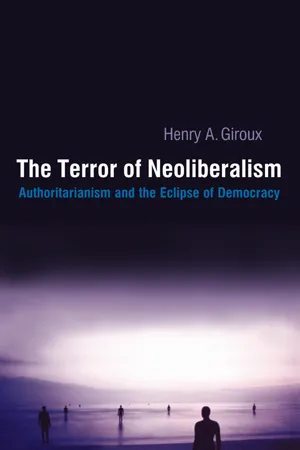
This book argues that neoliberalism is not simply an economic theory but also a set of values, ideologies, and practices that works more like a cultural field that is not only refiguring political and economic power, but eliminating the very categories of the social and political as essential elements of democratic life. Neoliberalism has become the most dangerous ideology of our time. Collapsing the link between corporate power and the state, neoliberalism is putting into place the conditions for a new kind of authoritarianism in which large sections of the population are increasingly denied the symbolic and economic capital necessary for engaged citizenship. Moreover, as corporate power gains a stranglehold on the media, the educational conditions necessary for a democracy are undermined as politics is reduced to a spectacle, essentially both depoliticizing politics and privatizing culture. This series addresses the relationship among culture, power, politics, and democratic struggles. Focusing on how culture offers opportunities that may expand and deepen the prospects for an inclusive democracy, it draws from struggles over the media, youth, political economy, workers, race, feminism, and more, highlighting how each offers a site of both resistance and transformation.
Information
1
Living in the Shadow of Authoritarianism

Introduction
I submit that neo-liberalism has changed the fundamental nature of politics. Politics used to be primarily about who ruled whom and who got what share of the pie. Aspects of both these central questions remain, of course, but the great new central question of politics is, in my view, “Who has a right to live and who does not.” Radical exclusion is now the order of the day and I mean this deadly seriously.1
Following the tragic events of September 11, 2001, the United States garnered the sympathy and respect of many nations all over the globe. The killing of 3,000 innocent people by terrorist thugs not only offered a vivid example of a grotesque assault on human life and human rights but also underscored the vulnerability of one of the world’s most powerful democracies. Tragedy was followed by myriad examples of human courage among many Americans, and a spirit of political resilience gave the federal government a renewed credibility for a short time. Controversial and albeit “leading apologist for neoauthoritarian politics,”2 former New York Mayor Rudolph Guiliani exhibited a newfound leadership that made all the more visible the principles, values, and sense of compassion central to a vibrant democracy. At the same time, the international community rallied behind the United States whose democracy appeared wounded but whose strength was revealed in its willingness to respond to an egregious act of terrorism with displays of compassion and national unity. The French newspaper Le Monde captured this sense of international solidarity and support when it proclaimed, “We Are All Americans.” But within two years, the cache of respect and regard that had been accorded the Bush administration both at home and abroad dwindled considerably as an increasing number of nations and individuals came to regard the United States as a major threat to world peace, if not to democracy itself. As Senator Robert C. Byrd put it, “In some corners of the world, including some corners of Europe and Great Britain, our beloved nation is now viewed as the world bully.”3 The Bush administration’s unilateral policy quickly turned America’s allies into some of its most severe critics. Even New York Times columnist Thomas Friedman, no enemy of dominant power, asserted that “Europeans have embraced President Bush’s formulation that an ‘axis of evil’ threatens world peace. There’s only one small problem. President Bush thinks the axis of evil is Iran, Iraq, and North Korea, and the Europeans think it’s Donald Rumsfeld, Dick Cheney, and Condi [Condoleezza] Rice.”4
The events of September 11th hastened a major shift not only in domestic and foreign policy but also “in our nation’s self-understanding. It became commonplace to refer to an ‘American Empire’ and to the United States as ‘the world’s only superpower.’”5 Embracing a policy molded largely by fear and bristling with partisan, right-wing ideological interests, the Bush administration took advantage of the tragedy of 9/11 by adopting and justifying a domestic and foreign policy that blatantly privileged security over freedom, the rule of the market over social needs, and militarization over human rights and social justice. Multilateralism in foreign affairs gave way to reckless unilateralism and a gross disregard for international law fueled by a foreign policy that defined itself through the arrogance of unbridled power. Refusing to sign a number of landmark international agreements such as the Antiballistic Missile Treaty, the International Criminal Court, and the Kyoto Protocol, the Bush administration increasingly displayed an “insulting arrogance toward the United Nations in general, and individual members in particular.”6 National security was now delineated as part of a larger policy in which the United States has the right to use preventive military force “to eliminate a perceived threat, even if invented or imagined.”7 Senator Byrd described the unprecedented Bush doctrine of preemptive strike as an irresponsible policy that sets a dangerous precedent, undermines Congress’s constitutional authority to declare war, and produces a “rising tide of anti-Americanism across the globe.”8 Global hegemony now became synonymous with national security as official policy proclaimed that any challenge to U.S. power and supremacy would be blocked by military force.9 After the attack on Afghanistan, Iraq was invaded by American forces and justified through what later was proved to be a series of blatant and misleading arguments by the Bush administration.10 Empire soon became the requisite term to define American power abroad. What has become clear since the invasion of Iraq is the willingness of the Bush administration to wage a war on terrorism at the expense of civil liberties, just as it scrapped a foreign policy that at least made a gesture toward democratic values for one that unleashed untold violence in the name of combating evil and exercising control over all other global powers. As Robert Jay Lifton points out, war has now taken on a mythic and heroic status under the Bush administration, “carried out for the defense of one’s nation, to sustain its special historical destiny and the immortality of its people.”11 Such a doctrine is far from heroic, not only resulting in widespread fear, anxiety, massive suffering, and death but also completely undermining the credibility of the American government as a bastion of democracy. The pictures of U.S. soldiers grinning as they tortured and sexually humiliated Iraqi prisoners at Abu Ghraib has further undermined the moral and political credibility of the United States both in the Arab world and around the globe. Restoring one of Saddam Hussein’s most infamous torture chambers to its original use has reinforced the image of the United States as a dangerous, rogue state with despicable imperial ambitions. As columnist Katha Pollitt puts it
The pictures and stories [from Abu Ghraib] have naturally caused a furor around the world. Not only are they grotesque in themselves, they reinforce the pre-existing impression of Americans as racist, cruel and frivolous. They are bound to alienate—further alienate—Iraqis who hoped that the invasion would lead to secular democracy and a normal life and who fear Islamic rule. Abroad, if not here at home, they underscore how stupid and wrong the invasion of Iraq was in the first place, how predictably the “war of choice” that was going to be a cakewalk has become a brutal and corrupt occupation, justified by a doctrine of American exceptionalism that nobody but Americans believe.12
Patricia Williams writing in The Nation goes further by linking the criminal abuse of Iraqi detainees at Abu Ghraib prison to a web of secrecy, violation of civil rights, and racist violence that has become commonplace on the domestic front. Referring to the public images of torture and humiliation at Abu Ghraib prison, she writes:
[I]t’s awfully hard not to look at those hoods and think Inquisition; or the piles of naked and sodomized men and think Abner Louima; or the battered corpses and think of Emmett Till…. This mess is the predictable byproduct of any authority that starts “sweeping” up “bad guys” and holding them without charge, in solitary and in secret, and presuming them guilty. It flourished beyond the reach of any formal oversight by Congress, by lawyers or by the judiciary, a condition vaguely rationalized as “consistent with” if not “precisely” pursuant to the Geneva Conventions. Bloodied prisoners were moved around to avoid oversight by international observers, a rather too disciplined bit of sanitizing.13
On the domestic front, a strange mixture of neoconservative ideologues, free-market right-wingers, and evangelical Christians began to wage another kind of war, not only against the social contract that had been put in place by Franklin Delano Roosevelt’s New Deal and Lyndon Johnson’s Great Society, but also against the secular government and the long-standing division between church and state, secular reason and religious beliefs. The needs of poor, working-class, and middle-class Americans are now under siege by the federal government, which instituted tax cuts for the richest 1 percent, increased corporate welfare, bankrolled a massive military machine, and turned a 2001 government surplus of $127 billion into a deficit of $521 billion by 2004.14 In short, public assets have been hijacked by those at the top of the economic pyramid, leaving few public resources for financially strapped state and local governments to use for addressing new problems or long-term improvements. One specific—and intended—outcome of this policy is that there is very little money or assistance available for those Americans most in need. The rich get tax handouts and corporate relief while the most basic health-care services for children, the elderly, and the disabled are either cut or dramatically reduced.15 For example, “about 270,000 children of low-income, working parents have been barred from health insurance programs in the nine states where estimates are available.”16 The Center on Budget and Policy Priorities reports that with thirty-four states making cuts over the last two years in public health insurance programs, “[s]ome 1.2 million to 1.6 million low-income people—including 490,000 to 650,000 children and large numbers of parents, seniors, and people with disabilities—have lost public-funded health coverage as a result.”17 Over 37 percent of all children lack health insurance in the world’s wealthiest nation. Under President Bush’s 2004 budget, it has been estimated that about “600,000 children will lose child-care and after-school services.”18 The long-standing social contract that was central to American democracy is not simply deteriorating, it is under sustained attack by free-market extremists and right-wingers. In what is truly one of the most glaring contradictions of the current Republican-led government, vast numbers of people are now being cut by the Bush administration from the most basic social provisions and public resources at the same time that Bush and his aids are increasingly using the hyped-up language of religious morality and “compassionate conservatism” to defend the discourse of free-market fundamentalism and a politics that largely caters to the rich and powerful. Congressman Bernie Sanders, in an exchange in 2003 with FED Chairman Alan Greenspan, provides a more specific indication of the social costs incurred by the neoconservative and right-wing free-market policies recently put into place:
You [Greenspan] talk about an improving economy while we have lost 3 million private sector jobs in the last two years, long-term unemployment is more than tripled, unemployment is higher than it’s been since 1994. We have a $4 trillion national debt, 1.3 million Americans have lost their health insurance, millions of seniors can’t afford prescription drugs, middle-class families can’t send their kids to college because they don’t have the money to do that, bankruptcy cases have increased by a record-breaking 23 percent, business investment is at its lowest level in more than 50 years, CEOs make more than 500 times what their workers make, the middle class is shrinking, we have the greatest gap between the rich and the poor of any industrialized nation, and this is an economy that is improving?19
President George W. Bush sees no irony in proclaiming in one speech after another, largely to highly selected groups of conservatives, that he is a “born again” Christian, all the while ruthlessly passing legislation that weakens environmental laws such as the Clean Air Act, opposes a U.N. resolution to fund global AIDS education and prevention, undermines the stability of Medicare, wages a budget war against disadvantaged children, denies millions of poor working adults a child tax credit, squanders the federal surplus on tax cuts for the rich, and increases corporate welfare to the tune of $125 billion as he decreases social benefits for millions of Americans, especially those who are poverty-stricken, old, young, and disabled.20
Religious fundamentalism appears to be growing in the United States, and the movement has received an enormous boost from those in power who think of themselves as “chosen.” At the same time, this mounting religious fervor, with its Manichean division of the world into the modalities of good and evil, remains inhospitable to dissent and reinforces a distinctly undemocratic view of patriotism. The slide into self-righteousness and intolerance appears to be on the rise in American life as politicians and moralists lay claim to an alleged monopoly on the truth, based on their religious conviction—an outlandish presumption matched only by utter disdain for those who do not share their worldview.21 Under the Bush administration patriotism is now legitimated through the physics of unaccountable power and unquestioned authority, defined crudely in the dictum “Either you are with us or with the terrorists.”22 When millions all over the world (including numerous international allies) protested the U.S. invasion of Iraq, Bush and his evangelical counselors simply dismissed such criticism as evidence of weakness and a refusal to acknowledge evil. As Gary Wills sums it up: “Question the policy, and you no longer believe in evil—which is the same, in this context, as not believing in God. That is the religious test on which our president is grading us.”23
This culture of intolerance and patriotic jingoism is readily shared and legitimated by the corporate controlled media and an army of intellectual cheerleaders, largely bankrolled by a powerful conservative money machine including the Olin, Heritage, Coors, and Scaife Family Foundations. Such absolutes, of course, have little respect for difference, dissent, or even democracy itself. Politics in this instance has much less in common with public engagement, dialogue, and democratic governance than with a heavy reliance on institutions that rule through fear and, if necessary, brute force. Right-wing media favorite Ann Coulter not only asserts in her book Treason that “liberals are either traitors or idiots”24 but argues elsewhere as well that John Walker, the young American captured in Afghanistan, should be given the death penalty “in order to physically intimidate liberals, by making them realize that they can be killed too. Otherwise they can be turned into outright traitors.”25 Kathleen Parker, a conservative columnist, published an article in which she cites, without challenging, a quote from “a friend” who suggested that a number of Democratic Party candidates “should be lined up and shot.”26 On the syndicated radio talk show, Savage Nation, which was aired on May 10–11, 2004, conservative host, Michael Savage referred to Abu Ghraib prison as “Grab-an-Arab prison” and stated that “We need more of the humiliation, not less…. [T]here should be no mercy shown to the sub-humans. I believe that a thousand of them should be killed tomorrow. I think a thousand of them held in the Iraqi prison should be [put on] trial and executed…. They should put dynamite in their behinds and drop them from 35,000 feet, the whole pack of scum out of that jail.”27
Such rhetorical interventions are about more than eliminating the critical function of dissent or thinking itself, both vital to the democratic health of a society; they embody a kind of violence that suggests that critics and “others” seen as enemies of the United States should be targeted and punished. Such polemic is characteristic of a distrust of not only Muslims and people of color but also the intellectual world and Enlightenment thought now viewe...
Table of contents
- Cover
- Half Title
- Title Page
- Copyright Page
- Dedication
- Table of Contents
- Acknowledgments
- Preface
- Chapter 1 Living in the Shadow of Authoritarianism I
- Chapter 2 Spectacles of Race and Pedagogies of Denial
- Chapter 3 Class Casualties: Disappearing Youth in the Age of Market Fundamentalism
- Chapter 4 Neoliberalism as Public Pedagogy
- Chapter 5 The Politics of Hope in Dangerous Times
- Chapter 6 Edward Said and the Politics of Worldliness
- Notes
- Index
- About the Author
Trusted by 375,005 students
Access to over 1.5 million titles for a fair monthly price.
Study more efficiently using our study tools.
Frequently asked questions
Yes, you can cancel anytime from the Subscription tab in your account settings on the Perlego website. Your subscription will stay active until the end of your current billing period. Learn how to cancel your subscription
No, books cannot be downloaded as external files, such as PDFs, for use outside of Perlego. However, you can download books within the Perlego app for offline reading on mobile or tablet. Learn how to download books offline
Perlego offers two plans: Essential and Complete
- Essential is ideal for learners and professionals who enjoy exploring a wide range of subjects. Access the Essential Library with 800,000+ trusted titles and best-sellers across business, personal growth, and the humanities. Includes unlimited reading time and Standard Read Aloud voice.
- Complete: Perfect for advanced learners and researchers needing full, unrestricted access. Unlock 1.5M+ books across hundreds of subjects, including academic and specialized titles. The Complete Plan also includes advanced features like Premium Read Aloud and Research Assistant.
We are an online textbook subscription service, where you can get access to an entire online library for less than the price of a single book per month. With over 1.5 million books across 990+ topics, we’ve got you covered! Learn about our mission
Look out for the read-aloud symbol on your next book to see if you can listen to it. The read-aloud tool reads text aloud for you, highlighting the text as it is being read. You can pause it, speed it up and slow it down. Learn more about Read Aloud
Yes! You can use the Perlego app on both iOS and Android devices to read anytime, anywhere — even offline. Perfect for commutes or when you’re on the go.
Please note we cannot support devices running on iOS 13 and Android 7 or earlier. Learn more about using the app
Please note we cannot support devices running on iOS 13 and Android 7 or earlier. Learn more about using the app
Yes, you can access Terror of Neoliberalism by Henry A. Giroux in PDF and/or ePUB format, as well as other popular books in Politics & International Relations & Education Theory & Practice. We have over 1.5 million books available in our catalogue for you to explore.