eBook - ePub
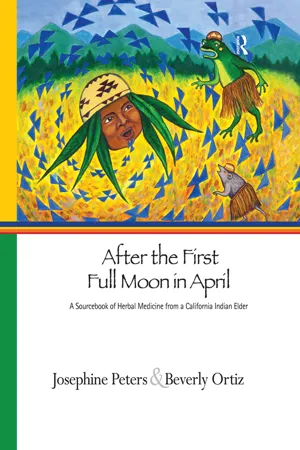
After the First Full Moon in April
A Sourcebook of Herbal Medicine from a California Indian Elder
- 221 pages
- English
- ePUB (mobile friendly)
- Available on iOS & Android
eBook - ePub
After the First Full Moon in April
A Sourcebook of Herbal Medicine from a California Indian Elder
About this book
In this extraordinary book Josephine Peters, a respected northern California Indian elder and Native healer, shares her vast, lifelong cultural and plant knowledge. The book begins with Josephine's personal and tribal history and gathering ethics. Josephine then instructs the reader in medicinal and plant food preparations and offers an illustrated catalog of the uses and doses of over 160 plants. At a time of the commercialization of traditional ecological knowledge, Peters presents her rich tradition on her own terms, and according to her spiritual convictions about how her knowledge should be shared. This volume is essential for anyone working in ethnobotany, ethnomedicine, environmental anthropology, Native American studies, and Western and California culture and history.
Information
Chapter One
A Lífe Well Líved1
At Home
A white picket fence protects the herbs, flowers, and fruit trees that Josephine Peters has planted in her Hoopa Valley yard. Inside the gate, the dog and cats offer an expectant greeting. Behind the house, an eclectic variety of chickens provide fresh eggs. Herbs hang upside down, drying, inside the enclosed porch.
Immediately inside the door of Josephine's home, a display case filled with basketry medallions, beadwork, pottery, and other local creations beckons, while the woodstove opposite warms the living room and much of the rest of the house in cold weather. In the kitchen, beading supplies and basketry materials are stored at the ready. Letters, invitations, and basketry and beadwork projects commonly adorn the kitchen table, as do boxes packed with Josephine's latest creations, ready for mailing to park and museum gift shops throughout the state and beyond. Additional sales items, meant for drop-in buyers or sales at events, are boxed nearby.
Josephine's day starts early and ends late. In the morning, she gardens and tends to the chickens, takes care of household chores, sees her youngest, Jene McCovey (Yurok), off to school, and reads the paper. She works on the daily crossword puzzle, often filling it in entirely, other times, missing only a few words. Visitors come and go throughout the day and into the evening–family members and friends to say hello, visit, and assist in the yard; friends and relatives bringing gifts of local fruit, vegetables, fish, venison, basketry materials, and herbs; nieces and nephews helping to prepare the fruit and vegetables for canning; locals and others from greater distances seeking medical advice; and tribal artisans with newly created jewelry for sale.
Day and night, Josephine tends to myriad phone calls and monitors local news on a police scanner. When she can't attend in person, she listens with rapt attention to the tribal radio station's broadcast of the home team basketball game.
Often, Josephine can be found at points near and distant sharing her herbal and other cultural knowledge at diverse public events and at schools with students of all ages; enjoying family and friends at reunions, birthday parties, and other special occasions; participating in community events and activities; attending ceremonies; or demonstrating basketry and selling culturally inspired jewelry at a variety of shows and gatherings.
In addition to the daily ebb and flow of Josephine's activities, there is a seasonal ebb and flow. After winter's high river waters, and before the onset of spring, it's time to gather river roots for basketry. Early spring is the optimal time to gather gray willow and hazel "sticks" for basketry, just as the leaves begin to form.
The gathering of most medicinal herbs takes place after the first full moon in April, when their "strength" is greatest. Other herbs, like yarrow, ceanothus, St. John's wort, and redwood sorrel, are gathered after they bloom.
April is the best time to gather alder bark, ceanothus (soapbrush), and Douglas fir for basketry. May through June is the time to gather "black fern," " (aka five-finger fern) another basketry material, and May the optimal time for angelica. Durango root achieves a "good color" for basketry dye in spring, which is also the time to make medicinal salves, when the herbs are "fresh."
In early June, canning commences with the ripening of the cherry crop. It continues through July and August to include a variety of fruits, garden vegetables, fish, and elk and deer meat. October is huckleberry gathering season, while October and November are the months to gather woodwardia for basketry, and acorns and peppernuts for food and medicine. Following the rains, mushroom harvesting commences, as does the digging of pine and spruce roots for basketry.
In 2004, Bryan Colegrove (Hupa/Yurok), reflecting on his many visits with Josephine, described the values she exemplifies and the importance of elders, family, and community in the day-to-day lives of the Karuk, Yurok, and Hupa peoples.
I'm the oldest of nine kids. My dad was a hunter and fisherman and provided for the elders. We'd go around and give deer meat and salmon to those who couldn't get it. Josephine was married to one of my uncles, and we came over and visited. She's always been special. We brought fish and deer meat. If some-one was sick, we'd ask for medicines and get something from her.
I left the area to work in Colorado, Texas, and Oregon. After I moved back in the 1980s, I started going around doing what my dad and grandfather did. I started visiting more with Auntie Jo. She was having a hard time getting around, so I'd take her some of the plants. I'd get deer meat, smoked, fresh, and canned salmon, eels, acorns, seaweed, surf fish, mussels, shells, spruce root, everything we utilize. I'd go down and gather in Mendocino, Humboldt and Del Norte Counties. If anybody needs anything, we're always sharing. If somebody needs help, you can't say no. You've got to be respectful. Respect the land and plants. (Personal communication with Jennifer Kalt, 2004)
Karuk Culture and History
Josephine Peters is Karuk by birth and upbringing, although her heritage is also Konimuhu (Shasta), a neighboring group, and Rouge River, Abenaki, from the northeastern United States. Josephine has deep bonds—socially, communally, and by marriage—to the Yurok and Hupa. She has lived most of her life within the homeland of the Hupa, along the upper Trinity River, in the verdant and expansive, five-mile-long Hoopa Valley. The cultures of the Karuk, Yurok, and Hupa are nearly the same, although all three peoples spoke, as some continue to speak, entirely distinct languages—part of the Hokan, Algonkian, and Athapascan language families (see Figure 1.1) (Bright 1978: 180; Pilling 1978: 137; Wallace 1978: 164).

Figure 1.1. View of the Hoopa Valley. Photo by Beverly Ortiz.
The homeland of the Karak is part of the ruggedly stunning, glacier- and river-carved places now known as the Siskiyou Mountains, Marble Mountains, and Salmon-Trinity Alps (Bell 1991: 20-26; Bright 1978: 180). The Karak lived, and continue to live, in a world animated by spirits. As explained by Karuk author Julian Lang (1994: 22-24):
Ikxaréeyav means God in the People's language, and refers both to our many spirit-deities, and nowadays, to the monotheistic God of modern religions. We have deified everything in the natural world. We consider all of nature to be alive, possessing both feelings and a consciousness. Hence the natural world is capable of seeing and hearing us, "blessing" us, and taking pity on us. The Earth is a physical manifestation of God's creative spirit, and we, Human Beings, are recognized by the earth as a part of the natural world.... Our sense is that all of nature grows from the Earth as strands of long hair connecting the present with the beginning of time and original knowledge.
... The Ikxaréeyavs were hyper-alive, meaning their lives were purely creative. Each moment of their existence resulted in some kind of creation: the realization of a natural law, a powerful song, or a healing herb and medicine formula to cure the gravest ill. The Earth itself was new when they were alive. And, like a new love, every moment, every movement, every idea and feeling was without precedent.2
As further explained by Kathy McCovey, also Karuk:
When the Karuk people came into the land, the spirit people taught the Karuk how to live, where to live, what to do and how to do it. When the spirit people knew that the Karuk knew how to live upon the land, the spirit people left the land to the Karuk. When the spirit people left, some of them went up into the sky; some went down into the earth; and some went into the rocks, the trees, the water, and the animals. When the Karuk people go out into the forest, they are never alone. They are surrounded by the spirit people who taught them how to live upon the land. (Personal communication with Beverly Ortiz, July 27, 2009)
The Karak social world centered on extended family; their political life on the village where they lived, each one located on dozens of flats extending along some eighty-two miles of the Klamath River, and some two miles of the Salmon River, including Three Dollar Bar, where Josephine Peters grew up. The Karuk homeland extended well beyond these village locations, into the mountains, and several miles up the Salmon River. Villages had some five to thirty semi-subterranean plank houses, one per family, and several sweathouses. Houses were the province of women, visited by men during the two daily meals at dawn and dusk; sweathouses were the province of men, a place where they reached decisions about legal matters, made "hunting medicine," and slept. "Together these two houses," explains Julian Lang, "were at the center of our culture and identity" (1994: 22).
Objects of daily use included elegantly woven baskets, carefully chipped obsidian knives and arrow points, elaborately carved cooking paddles and wooden spoons, meticulously fashioned, bowltube iris-fiber nets, and buoyant redwood dugouts purchased from the Yurok. Abalone pendants, engraved dentalia shells,3 iridescent pileated woodpecker and mallard featherwork, beargrass braids, and gray pine nut beads adorned ceremonial regalia (Bright 1978: 183-184; Kelly 1930; Lang 1994: 15-22).
The Karuk procured some of their most important foods from the river, upslope fir forests, and oak groves: salmon, deer, and tanoak acorns. They smoked, dried, roasted, or otherwise processed eels, elk, bear, small mammals, and birds and variously pounded, stone boiled, parched, and roasted bulbs, seeds, greens, and nuts.
The modern concept of an uncultivated wild, or wilderness, negates the very different, thousands-of-years-old human relationship between the Karuk, plants, other animal species, and place. It was through this relationship that they managed and reshaped their homeland with such horticultural techniques as burning that enhanced some species, while suppressing others. Although today it is nearly impossible to know exactly what that managed landscape looked like in 1850, when non-Indians intruded, we can get a strong sense of its appearance through the reminiscences of tribal elders, early photographs, and local fire records. In 1997, Ramona Starritt (Karuk), then age 92, described one such managed landscape in the mountainous regions of the Klamath River near Orleans and Happy Camp, before the fire suppression policies of the U.S. Forest Service were implemented:
The Indians burned all over.... The earlier years it would just burn, burn, burn, until the sun looked like a big orange. It just burned itself out. That was that. They did it for the purpose of their basket weaving, and for the animals. The deer had to eat. They ate the young sprouts. And you could see for miles. You weren't hemmed in with brush....
The trees were not hurt in any way. No burns, or anything, because the vegetation was not so high as it is now.... You go to where the Indians lived and burned, you'll see really tall fir trees. And pine trees and madrone trees were large.... The change came when the highways came in.... That was in the late twenties....
[E]very fall they burned. You didn't have any brush.... A lot of times it didn't burn too long, because it was clean [of organic debris]. Nothing to burn. And it didn't hurt the trees. You go to any old Indian ranch, you'll see the trees tall and healthy looking. [....] When I was young, you could see clear across the gorge.... See a bear climbing up the mountain, or a deer, or anything. (Personal communication with Beverly Ortiz, August 28, 1997)
Burning had several purposes (Lake 2007). As described by Hotelling (1978: 15-16):
The immediate objective was a productive forest assuring an ample supply of food and materials. The fire, controlled as it was, burned off the debris which no longer served a purpose, making it easy to gather the acorns and, interestingly enough, the food so gathered was shared with the wildlife.... Likewise in gathering the huckleberry, both for current and winter use, the bushes here again became large and mature and were burned which gave them young growth and a better quality berry and here again the food was shared with the animals of the forest, particularly the bear.
In addition to burning techniques, the Karuk used, and continue to use, the same horticultural methods that gardeners use in their yards: judicious harvesting, cultivation (digging), pruning, weeding, and debris clearing. Today, Karuk weavers sometimes use coppicing, the cutting back of plants during dormancy to within inches of the ground surface, as a second-best alternative to burning.
Judicious harvesting centers on prohibitions against taking more than can be processed and used. As Virginia ...
Table of contents
- Cover
- Half Title
- Title
- Copyright
- Dedication
- Contents
- Preface
- Acknowledgments
- Spirit People
- The Peppernut
- The Peppernut Story
- 1. A Life Well Lived
- 2. Gathering Ethics
- 3. Herbal Medicines and Native Plant Foods
- 4. The Plants
- 5. Non-herbal Cures
- Endnotes
- References
- Plant Index
- Medical Conditions Index
- Subject Index
- About Beverly Oritz
Trusted by 375,005 students
Access to over 1.5 million titles for a fair monthly price.
Study more efficiently using our study tools.
Frequently asked questions
Yes, you can cancel anytime from the Subscription tab in your account settings on the Perlego website. Your subscription will stay active until the end of your current billing period. Learn how to cancel your subscription
No, books cannot be downloaded as external files, such as PDFs, for use outside of Perlego. However, you can download books within the Perlego app for offline reading on mobile or tablet. Learn how to download books offline
Perlego offers two plans: Essential and Complete
- Essential is ideal for learners and professionals who enjoy exploring a wide range of subjects. Access the Essential Library with 800,000+ trusted titles and best-sellers across business, personal growth, and the humanities. Includes unlimited reading time and Standard Read Aloud voice.
- Complete: Perfect for advanced learners and researchers needing full, unrestricted access. Unlock 1.5M+ books across hundreds of subjects, including academic and specialized titles. The Complete Plan also includes advanced features like Premium Read Aloud and Research Assistant.
We are an online textbook subscription service, where you can get access to an entire online library for less than the price of a single book per month. With over 1.5 million books across 990+ topics, we’ve got you covered! Learn about our mission
Look out for the read-aloud symbol on your next book to see if you can listen to it. The read-aloud tool reads text aloud for you, highlighting the text as it is being read. You can pause it, speed it up and slow it down. Learn more about Read Aloud
Yes! You can use the Perlego app on both iOS and Android devices to read anytime, anywhere — even offline. Perfect for commutes or when you’re on the go.
Please note we cannot support devices running on iOS 13 and Android 7 or earlier. Learn more about using the app
Please note we cannot support devices running on iOS 13 and Android 7 or earlier. Learn more about using the app
Yes, you can access After the First Full Moon in April by Josephine Grant Peters,Beverly Ortiz in PDF and/or ePUB format, as well as other popular books in Social Sciences & Anthropology. We have over 1.5 million books available in our catalogue for you to explore.