- 256 pages
- English
- ePUB (mobile friendly)
- Available on iOS & Android
eBook - ePub
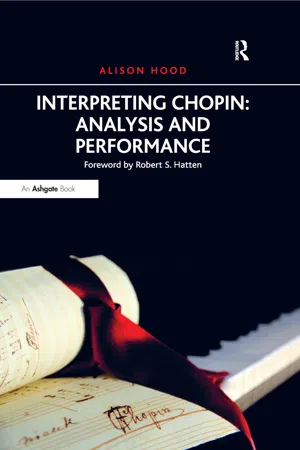
Interpreting Chopin: Analysis and Performance
About this book
Music theory is often seen as independent from - even antithetical to - performance. While music theory is an intellectual enterprise, performance requires an intuitive response to the music. But this binary opposition is a false one, which serves neither the theorist nor the performer. In Interpreting Chopin Alison Hood brings her experience as a performer to bear on contemporary analytical models. She combines significant aspects of current analytical approaches and applies that unique synthetic method to selected works by Chopin, casting new light on the composer's preludes, nocturnes and barcarolle. An extension of Schenkerian analysis, the specific combination of five aspects distinguishes Hood's method from previous analytical approaches. These five methods are: attention to the rhythms created by pitch events on all structural levels; a detailed accounting of the musical surface; 'strict use' of analytical notation, following guidelines offered by Steve Larson; a continual concern with what have been called 'strategies' or 'premises'; and an exploration of how recorded performances might be viewed in terms of analytical decisions, or might even shape those decisions. Building on the work of such authors as William Rothstein, Carl Schachter and John Rink, Hood's approach to Chopin's oeuvre raises interpretive questions of central interest to performers.
Information
PART I
REVEALING THE HIDDEN DIMENSIONS
Introduction
As noted in the Introduction, my approach to analysis illuminates the artistic content of Chopin’s music and raises important interpretive questions that a performer may wish to consider. The five elements synthesized in this approach are, by themselves, not new: (1) a focus on rhythm; (2) an emphasis on the foreground; (3) ‘strict use’ of analytical notation; (4) a focus on ‘strategy’ or ‘premise’; and (5) dialogue with performance. The combination of these elements, however, is particularly productive. Part I describes each element in turn.
Conclusion
This book contributes to that field of Schenkerian analysis laid out by such writers as Rothstein and Schachter. The primary approach is Schenkerian. Schenker’s implicit rhythmic assumptions are made more explicit in the manner of Rothstein and Schachter. Rhythmic analysis – in the form of durational and rhythmic reductions – is carried out in the manner of Schachter where it illuminates certain important or interesting facets of the piece, and rhythmic grouping forms part of the rhythmic analysis throughout.1
A Schenkerian methodological approach that incorporates rhythmic analysis elucidates fascinating aspects of Chopin’s compositional style. The chapters that follow reveal hidden repetitions on many levels that are both tonal and rhythmic, and they show how Chopin integrates both tonal and rhythmic premises and strategies. The forms of the preludes examined constitute hidden repetitions at a background level of surface rhythmic motifs. The pairs of nocturnes of Op. 27 and Op. 48 are based on similar premises. It is as if Chopin were working in each opus on two different solutions to similar compositional problems. In Op. 27 this possible pairing of the nocturnes may be taken into the realms of performance as it raises the question of whether or not they should be performed as a pair. The Barcarolle demonstrates many of the premises introduced in the analyses of the earlier works. It provides an excellent summary of the complex ways in which tonal and rhythmic events may conspire to serve a given premise and how these premises interact in the formation of the dramatic narrative of the piece.
1 For a comprehensive psychological viewpoint on grouping, the reader is referred to Lerdahl and Jackendoff’s Generative Theory of Tonal Music.
1
Rhythm
Rhythm is the lifeblood of music and its realization in performance. It is also one of the main ways that music communicates meaning and emotion. It is an essential element of interpretation, and the ability to highlight and manipulate rhythm often distinguishes amateurs from professional musicians. Indeed, many of the most important interpretive decisions performers make lie in the temporal domain. This chapter on rhythm focuses on Chopin’s compositional techniques, the analytical techniques that I have used to find these, the theory and concepts behind some of these analytical techniques, and, finally, the specific rhythmic terminology used throughout the book.1
Chopin’s Compositional Techniques
My focus on rhythm casts new light on many of Chopin’s compositional techniques and allows us to say much about the music that seems of real interpretive value. Some of the techniques revealed using this approach include hidden repetitions with a rhythmic as well as tonal profile, strategies based on finding the ‘natural’ metric organization of motifs, and the use of tonal and metric ambiguity in the service of dramatic narrative.
Hidden Repetitions with a Rhythmic as well as Tonal Profile
Many scholars have discussed hidden repetitions of pitch patterns,2 but in Chopin’s music such hidden repetitions may also have a rhythmic profile. In all six of the preludes examined here, the deepest-level background structure reflects not only the pitch patterns contained in the surface of the music but also the rhythmic and metric processes of the surface. In the context of this book, these, too, are regarded as rhythmic hidden repetitions in the manner of Schenkerian motivic hidden repetitions, and function in much the same way.
The idea of relating large-scale form to rhythm is not new. For example, in The Rhythmic Structure of Music, Grosvener Cooper and Leonard Meyer set forth a theory of rhythm describing rhythmic layers in ‘architectonic levels’, and they discuss the relationship of rhythmic patterns to larger-level form in great detail.3 They analyse Chopin’s Prelude in E♭ and find the form of this piece to be an amphibrach – a reflection of the main rhythmic material of the surface. Their architectonic levels are highly suggestive of the hierarchic levels of Schenkerian analysis. Their approach, however, is not Schenkerian. The Schenkerian aspect of my approach allows me to find hidden repetitions of pitch and rhythm. Schachter agrees that ‘the pacing of middleground or background progressions may be partly determined by the rhythms of the foreground – a very frequent possibility’.4 This is indeed the case in all of the preludes analysed here. These deep-level hidden repetitions seem to be a unique feature of the preludes, with their concise and characteristic rhythmic uniformity. I am not claiming that all of Chopin’s music has these background hidden repetitions. Likewise, Cooper and Meyer conclude that in certain cases the form of a piece acts like a rhythm and in others it does not: ‘We must conclude that a form may be a rhythm, but that no form is necessarily a rhythm.’5 The background form of many of the larger works examined does not reflect surface rhythm. Nevertheless, hidden repetitions at various levels may have important rhythmic profiles. For example, in the two nocturnes of Op. 48, hidden repetitions of the main motifs can be found throughout the piece on many levels. Furthermore, when these patterns are repeated on different levels of structure, their rhythmic patterns are often repeated as well.
Finding such rhythmic hidden repetitions raises an interesting question: To what extent can listeners actually perceive these repetitions at different levels? Chopin sets up rhythmic and tonal motifs at the surface of the music in such a way as to establish them on the ear, and then plays on the listener’s expectations. It is particularly obvious, therefore, when he changes one element, such as the metric placement of a tonal motif, as he does in Op. 48. Melodic and rhythmic expectation can also occur at deeper levels of structure when these deeper levels are within the boundaries of perceptibility. Perception of important hidden repetitions begins at the foreground and progresses to the middleground; this is evident in Op. 48 when the expected natural metric organization of the main tonal motif is clearly audible over a span of multiple bars towards the end of each piece.
Narmour’s work on melodic complexity (1992) argues that expectations create hierarchical structures that resemble Schenkerian analyses. But a more recent article (1996) may be read as a more plausible case for the reverse argument: that expectations arise on all perceived hierarchical levels of musical structure, that those levels are best described with Schenkerian analyses, and that Schenker’s theories provide a necessary underpinning for any successful implication-realization model.6
As Larson explains, ‘experienced listeners of tonal music not only perform (unconscious) aural Schenkerian analyses but also expect the music to continue in such a way that it creates the types of hierarchical patterns that occur in such analyses’.7 On the subject of perceptibility of deeper levels in Schenkerian analyses, Larson comments:
Whereas Schenker’s claims about relationships between distant pitches have proven controversial, some more recent authors have recast his claims as claims about the perceptions of skilled listeners (Larson 1997c; Lerdahl and Jackendoff 1983; Westergaard 1975). Others report experiments that support these claims about perception (Dibben 1994; Marvin and Brinkman 1999).8
Recent work in the areas of cognition, expectation and perception thus supports an analytical approach that investigates musical hierarchies.
A listener’s expectation of rhythmic and melodic continuation constantly alters as a piece progresses. Chopin often plays on this by subtly changing the motif each time – either tonally or rhythmically. Larson elucidates:
Of course, in music as in language, expectation and retrospection may continuously reshape the meanings we give to what we hear. David Lewin (1986) offers a model of music perception that grants an important role to such real-time processing of musical meaning. Hallgjerd Aksnes (2002) discusses ‘the constant reinterpretation that goes on during the listening act’ as ‘an important aspect of musical meaning’ (23).9
Indeed, Schenker also recognized perception as being in a constant state of flux – a fact that was not evident in his analyses:
It is important to keep in mind this difference between analysis and perception. Schenker’s later writings dwell on analysis – so they insist on showing one and only one interpretation of a passage. But Schenker had a different view of perception – he recognized its multivalent and context-changing character … the best way to show that one event may be conceived in contradictory ways is to use different analyses – so that the univalent clarity of contradictory Schenkerian analyses can show how a given passage may be perceived in different ways.10
My analysis of the Prelude in G minor follows this advice by using two different graphs to illustrate that mutually exclusive interpretations of the main motto are possible. This piece provides a particularly clear example of this constant reinterpretation and retrospection, as the listener is continuously reinterpreting tonal meaning on multiple levels throughout.
The relationship between how we hear or perceive music and the way that music is structured in levels highlights the importance of identifying these connections between levels. But what of deeper-level hidden repetitions that may not be possible to perceive or hear? Fred Lerdahl and Ray Jackendoff’s A Generative Theory of Tonal Music is based on describing such listener perceptions. They do not believe that metre can be perceived on larger levels. In fact, they state that its perception is ‘so hypothetical that it would seem wise to give up the attempt altogether’.11 Lester’s belief is similar to that held by Lerdahl and Jackendoff, and he is reluctant to acknowledge larger levels of metric structure, mainly because of his belief that they cannot be perceived by a listener.12 On the other hand, Jonathan Kramer disagrees with Lerdahl and Jackendoff, stating that ‘we hear on deeper levels as well, up to that of entire movements’, and that he would ‘defend the experience of metrically accented timepoints as quite real at deep levels and as independent of rhythmic accents’.13
I take a slightly different approach in this debate, and offer insights into Chopin’s music that may be of interest to both parties. The analyses show that these compositions have deep-level hidden repetitions that are both rhythmic and tonal, irrespective of whether or not they can be perceived by the listener. Lester (and Lerdahl and Jackendoff) on one side of the argument, and Kramer on the other, devote little attention to distinguishing between hypermetre as a theoretical construct and our ability to perceive it in a given performance.
My approach to metre understands it as a phenomenon that people could potentially experience but may not necessarily experience, particularly at deeper levels. Perceptibility of these deeper-level metres does not affect their existence. This approach to metre can be compared to Larson’s. If we exam...
Table of contents
- Cover Page
- Interpreting Chopin: Analysis and Performance
- Copyright Page
- Contents
- List of Tables
- List of Music Examples
- Foreword by Robert S. Hatten
- Preface
- Acknowledgements
- Introduction
- PART I REVEALING THE HIDDEN DIMENSIONS
- PART II PRELUDES OP. 28
- PART III NOCTURNES
- PART IV THE BARCAROLLE
- Select Bibliography
- Index
Trusted by 375,005 students
Access to over 1.5 million titles for a fair monthly price.
Study more efficiently using our study tools.
Frequently asked questions
Yes, you can cancel anytime from the Subscription tab in your account settings on the Perlego website. Your subscription will stay active until the end of your current billing period. Learn how to cancel your subscription
No, books cannot be downloaded as external files, such as PDFs, for use outside of Perlego. However, you can download books within the Perlego app for offline reading on mobile or tablet. Learn how to download books offline
Perlego offers two plans: Essential and Complete
- Essential is ideal for learners and professionals who enjoy exploring a wide range of subjects. Access the Essential Library with 800,000+ trusted titles and best-sellers across business, personal growth, and the humanities. Includes unlimited reading time and Standard Read Aloud voice.
- Complete: Perfect for advanced learners and researchers needing full, unrestricted access. Unlock 1.5M+ books across hundreds of subjects, including academic and specialized titles. The Complete Plan also includes advanced features like Premium Read Aloud and Research Assistant.
We are an online textbook subscription service, where you can get access to an entire online library for less than the price of a single book per month. With over 1.5 million books across 990+ topics, we’ve got you covered! Learn about our mission
Look out for the read-aloud symbol on your next book to see if you can listen to it. The read-aloud tool reads text aloud for you, highlighting the text as it is being read. You can pause it, speed it up and slow it down. Learn more about Read Aloud
Yes! You can use the Perlego app on both iOS and Android devices to read anytime, anywhere — even offline. Perfect for commutes or when you’re on the go.
Please note we cannot support devices running on iOS 13 and Android 7 or earlier. Learn more about using the app
Please note we cannot support devices running on iOS 13 and Android 7 or earlier. Learn more about using the app
Yes, you can access Interpreting Chopin: Analysis and Performance by Alison Hood in PDF and/or ePUB format, as well as other popular books in Media & Performing Arts & Ethnomusicology. We have over 1.5 million books available in our catalogue for you to explore.