- 176 pages
- English
- ePUB (mobile friendly)
- Available on iOS & Android
eBook - ePub
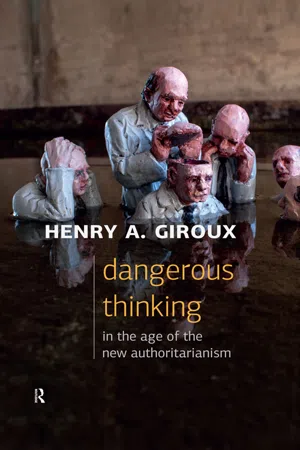
Dangerous Thinking in the Age of the New Authoritarianism
About this book
Giroux probes the depth and range of forces pushing the United States into a new form of authoritarianism, one that connects the Orwellian surveillance state with the forms of ideological control made famous by Aldous Huxley. Addressing how neoliberalism, or the new market fundamentalism, is shaping a range of registers from language and memory to youth and higher education, Giroux explores how education in a variety of spheres is transformed into a type of miseducation perpetuated through what he calls a "disimagination machine"-one that reproduces the present by either distorting or erasing the past. But Giroux is not content to focus on how matters of politics, subjectivity, power, and desire are colonized through forms of miseducation; he is also concerned with the educative nature of politics as the practice of freedom and how the emphasis on critique must be matched by a politics and discourse of resistance, hope, and possibility. This becomes particularly evident in his chapters on Noam Chomsky and Howard Zinn. Thinking Dangerously makes clear that at the heart of the struggle for a radical democracy is the reviving of the radical imagination as the basis for new forms of political and collective struggle. Probing these issues through a series of interrelated essays and important interviews, Giroux provides an accessible, layered, and sustained example of how thinking dangerously is central to and connected with the struggle over the radical imagination and the fight to fulfill the promise of a radical democracy.
Information
SECTION 1
Orwell and Huxley’s America
1
Between Orwell and Huxley
America’s Plunge into Dystopia
In spite of their differing perceptions of the architecture of the totalitarian superstate and how it exercises power and control over its residents, George Orwell and Aldous Huxley shared a fundamental conviction. They both argued that the established democracies of the West were moving quickly toward a historical moment when they would willingly relinquish the noble promises and ideals of liberal democracy and enter that menacing space where totalitarianism perverts the modern ideals of justice, freedom, and political emancipation. Both believed that Western democracies were devolving into pathological states in which politics was recognized in the interest of death over life and justice. Both were unequivocal in the shared understanding that the future of civilization was on the verge of total domination—or what Hannah Arendt called “dark times.”
While Neil Postman and other critical descendants have pitted Orwell and Huxley against each other because of their distinctively separate notions of a future dystopian society,1 I believe that the dark shadow of authoritarianism that shrouds American society like a thick veil can be lifted by re-examining Orwell’s prescient dystopian fable 1984, as well as Huxley’s Brave New World, in light of contemporary neoliberal ascendancy. Rather than pit their dystopian visions against each other, it might be more productive to see them as complementing each other, especially at a time when, to quote Antonio Gramsci, “The old world is dying and the new world struggles to be born; in this interregnum a great variety of morbid symptoms appear.”2
Both authors provide insight into the merging of the totalitarian elements that constitute a new and more hybridized form of authoritarian control, appearing less as fiction than a threatening portent of the unfolding twenty-first century. Consumer fantasies and authoritarian control; “Big Brother” intelligence agencies and the voracious seductions of privatized pleasures; the rise of the punishing state, which criminalizes an increasing number of behaviors and invests in institutions that incarcerate and are organized principally for the production of violence; the collapse of democratic public spheres into narrow, market-driven orbits of privatization—these now constitute the new order of authoritarianism.
Orwell’s Big Brother has more recently found a new incarnation in the revelations of government lawlessness and corporate spying by whistleblowers such as Chelsea Manning, Jeremy Hammond, and Edward Snowden.3 All of these individuals revealed a government that lied about its intelligence operations, illegally spied on millions of people who were not considered terrorists or had committed no crime, and collected data from every conceivable electronic source to be stored and potentially used to squelch dissent, blackmail people, or just intimidate those who fight to make corporate and state power accountable.4 Orwell offered his readers an image of the modern state in which privacy was no longer valued as a civil virtue and a basic human right, nor perceived as a measure of the robust strength of a healthy and thriving democracy. In Orwell’s dystopia the right to privacy had come under egregious assault, but more than that, such ruthless transgressions of privacy pointed to something more sinister than the violation of individual rights. The claim to privacy, for Orwell, represented a moral and political principle by which to assess the nature, power, and severity of an emerging totalitarian state. Orwell’s warning was intended to shed light on the horrors of totalitarianism, the corruption of language, the production of a pervasive stupidity, and the endless regimes of state spying imposed on citizens in the mid-twentieth century. Orwell opened a door for all to see a “nightmarish future” in which everyday life becomes harsh, an object of state surveillance, and control—a society in which the slogan “ignorance becomes strength”—morphs into a guiding principle of mainstream media, education, and the culture of politics.
Huxley shared Orwell’s concern about ignorance as a political tool of the elite, enforced through surveillance and the banning of books, dissent, and critical thought itself. But Huxley believed that social control and the propagation of ignorance would be introduced by those in power through the political tools of pleasure and distraction. Huxley thought that this might take place through the use of drugs and genetic engineering. But the real drugs and social planning of late modernity are found in an entertainment and public pedagogy industry that trades in pleasure and idiocy—most evident in the merging of neoliberalism, celebrity culture, and the control of commanding cultural apparatuses extending from Hollywood movies and video games to mainstream television, news, and the social media.
Orwell’s Big Brother of 1984 has been upgraded in the 2015 edition. As Zygmunt Bauman points out, if the older Big Brother presided over traditional enclosures such as military barracks, prisons, schools, and “countless other big and small panopticons,” the updated Big Brother is concerned with not only inclusion and the death of privacy but also the suppression of dissent and the widening of the politics of exclusion.5 Keeping people out is the extended face of Big Brother, who now patrols borders, hospitals, and other public spaces in order to spot “the people who do not fit in the places they are in, banishing them from … ‘where they belong,’ or better still never allowing them to come anywhere near in the first place.”6
This is the Big Brother that pushes youthful protests out of the public spaces they attempt to occupy. This is the hypernationalistic Big Brother clinging to notions of racial purity and American exceptionalism as a driving force in creating a country that has come to resemble an open-air prison for the dispossessed. This is the Big Brother whose split personality portends the dark authoritarian universe of the 1 percent, with their control over the economy and use of paramilitarized police forces on the one hand, and on the other their retreat into gated communities manned by SWAT-like security forces. Fear and isolation constitute an updated version of Big Brother. Fear is now managed and buttressed by normalizing the neoliberal claim that it be accepted as a general condition of society, dealt with exclusively as an individual consideration, disassociated from the politics and moral panics endemic to an authoritarian society, and used to mobilize the individual’s fear of the other. In the surveillance state, fear is misplaced from the political sphere to the personal concern with the fear of surviving, of not getting ahead, of unemployment, and of the danger posed by the growing legions of alien others. As the older order dies and a new one struggles to be born, Gramsci’s vision rightly identifies a liminal space that has given rise to monsters, all too willing to kidnap, torture, and spy on law-abiding citizens while violating civil liberties.7 He is also right in suggesting that while such an interregnum offers no political guarantees, it does provide, or at least gestures toward, reimagining “what is to be done,” how it might be done, and who is going to do it.8
Orwell’s 1984 continues to serve as a brilliant and important metaphor for mapping the expansive trajectory of global surveillance, authoritarianism, and the suppression of dissent that has characterized the first decades of the new millennium. The older modes of surveillance to which Orwell pointed—including his warnings regarding the dangers of microphones and giant telescreens that watch and listen—are surprisingly limited when compared with the varied means now available for spying. Orwell would be astonished by this contemporary, refashioned Big Brother given the threat that the new surveillance state poses because of its reach, and the alleged “advance” of technologies that far outstretch anything he could have imagined, technologies that pose a much greater threat to both the personal privacy of citizens and the control exercised by sovereign power.
As Marjorie Cohn has similarly indicated, “Orwell never could have imagined that the National Security Agency (NSA) would amass metadata on billions of our phone calls and 200 million of our text messages every day. Orwell could not have foreseen that our government would read the content of our emails, file transfers, and live chats from the social media we use.”9 Snowden, Cohn, and other critics are correct about the dangers of the state’s infringement of privacy rights, but their analysis should be taken further by linking the issue of citizen surveillance with the rise of “networked societies,” global flows of power, and the emergence of a totalitarian ethos that defies even state-based control.10 For Orwell, domination was state imposed and bore the heavy hand of unremitting repression and a smothering language that eviscerated any appearance of dissent, erased historical memory, and turned the truth into its opposite. For Orwell, individual freedom was at risk under the heavy hand of state terrorism.
In Orwell’s world individual freedom and privacy were under attack from outside forces. For Huxley, in contrast, freedom and privacy were willingly given up as part of the seductions of a soft authoritarianism, with its vast machinery of manufactured needs, desires, and identities. This new mode of persuasion seduced people into chasing commodities, and infantilized them through the mass production of easily digestible entertainment, disposable goods, and new scientific advances in which any viable sense of agency was undermined. The conditions for critical thought dissolved into the limited pleasures of instant gratification wrought through the use of technologies and consuming practices that dampened, if not obliterated, the very possibility of thinking itself. Orwell’s dark image is the stuff of government oppression, whereas Huxley’s is the stuff of distractions, diversions, and the transformation of privacy into a cheap and sensational performance for public display. Neil Postman, writing in a different time and worried about the destructive anti-intellectual influence of television, sided with Huxley and believed that repression was now on the side of entertainment and the propensity of the American public to amuse itself to death.11 His attempt to differentiate Huxley’s dystopian vision from Orwell’s is worth noting:
Orwell warns that we will be overcome by an externally imposed oppression. But in Huxley’s vision, no Big Brother is required to deprive people of their autonomy, maturity and history. As he saw it, people will come to love their oppression, to adore the technologies that undo their capacities to think. What Orwell feared were those who would ban books. What Huxley feared was that there would be no reason to ban a book, for there would be no one who wanted to read one. Orwell feared those who would deprive us of information. Huxley feared those who would give us so much that we would be reduced to passivity and egoism. Orwell feared that the truth would be concealed from us. Huxley feared the truth would be drowned in a sea of irrelevance. Orwell feared we would become a captive culture. Huxley feared we would become a trivial culture, preoccupied with some equivalent of the feelies, the orgy porgy, and the centrifugal bumblepuppy. As Huxley remarked in Brave New World Revisited, the civil libertarians and rationalists who are ever on the alert to oppose tyranny “failed to take into account man’s almost infinite appetite for distractions.” In 1984, Huxley added, people are controlled by inflicting pain. In Brave New World, they are controlled by inflicting pleasure. In short, Orwell feared that what we hate will ruin us. Huxley feared that what we love will ruin us.12
Echoes of Huxley’s insights play out in the willingness of millions of people who voluntarily hand over personal information whether in the service of the strange sociality prompted by social media or in homage to the new surveillance state. New surveillance technologies employed by major service providers now focus on diverse consumer populations who are targeted in the collection of endless amounts of personal information as they move from one site to the next, one geopolitical region to the next, and across multiple screens and digital apparatuses. As Ariel Dorfman points out, “Social media users gladly give up their liberty and privacy, invariably for the most benevolent of platitudes and reasons,”13 all the while endlessly shopping online, updating Facebook, and texting. Indeed, surveillance technologies are now present in virtually every public and private space—such as video cameras in streets, commercial establishments, workplaces, and even schools, as well as the myriad scanners at entry points of airports, retail stores, sporting events, and so on. They function as control mechanisms that become normalized through their heightened visibility. So, too, our endless array of personal devices that chart, via GPS tracking, our every move, our every choice, our every pleasure.
At the same time, Orwell’s warning about Big Brother applies not simply to an authoritarian-surveillance state but also to commanding financial institutions and corporations that have made diverse modes of surveillance a ubiquitous feature of daily life. Corporations use the new technologies to track spending habits and to collect data points from social media so as to provide us with consumer goods that match our desires, to employ facial recognition technologies to alert store salespersons to our credit ratings, and so it goes. Heidi Boghosian points out that if omniscient state control in Orwell’s 1984 is embodied by the two-way television sets present in each home, then in “our own modern adaptation, it is symbolized by the location-tracking cell phones we willingly carry in our pockets and the microchip-embedded clothes we wear on our bodies.”14 In this instance, the surveillance state is one that not only listens, watches, and gathers massive amounts of information through data mining, allegedly for the purpose of identifying “security threats.” It also acculturates the public into accepting the intrusion of commercial surveillance technologies—and, perhaps more vitally, the acceptance of privatized, commodified values—into all aspects of their lives. In other words, the most dangerous repercussions of a near total loss of privacy involve more than the unwarranted collecting of information by the government: we must also be attentive to the ways in which being spied on has become not only normalized but even enticing, as corporations up the pleasure quotient for consumers who use new digital technologies and social networks—not least of all by and for simulating experiences of community.
Many individuals, especially young people, now run from privacy and increasingly demand services in which they can share every personal facet of their lives. While Orwell’s vision touches upon this type of control, there is a notable difference that he did not foresee. According to Pete Cashmore, while Orwell’s “Thought Police tracked you without permission, some consumers are now comfortable with sharing their every move online.”15 The state and corporate cultural apparatuses now collude to socialize everyone—especially young people—into a regime of security and commodification in which their identities, values, and desires are inextricably tied to a culture of commodified addictions, self-help, therapy, and social indifference. Intelligence networks now inhabit the world of major corporations such as Disney and the Bank of America as well as the secret domains of the NSA, FBI, and fifteen other intelligence agencies. As Edward Snowden’s revelations about the PRISM program revealed, the NSA has also collected personal data from “the world’s largest Internet companies—Facebook, Yahoo!, Apple, Google—as well as extensive efforts by Microsoft to provide the agency with access to its communications platforms such as Outlook.”16 According to a senior lawyer for the NSA, the Intenet companies “were fully aware of the surveillance agency’s widespread collection of data.”17
The fact is that Orwell’s and Huxley’s ironic representations of the modern totalitarian state—along with their implied defense of a democratic ideal rooted in the right to privacy and the right to be educated in the capacity to be autonomous and critical thinkers—have been transformed and mutilated almost beyond recognition by the material and ideological registers of a worldwide neoliberal order. Just as we can envision Orwell’s and Huxley’s dystopian fables morphing over time from “realistic novels” into a “real-life documen...
Table of contents
- Cover
- Half Title
- Series Page
- Title Page
- Copyright Page
- Dedication Page
- Contents
- Acknowledgments
- Section 1: Orwell and Huxley’s America
- Section 2: The Savagery of Neoliberalism
- Section 3: Reclaim the Radical Imagination: Politics beyond Hope
- Notes
- Index
- About the Author
Trusted by 375,005 students
Access to over 1.5 million titles for a fair monthly price.
Study more efficiently using our study tools.
Frequently asked questions
Yes, you can cancel anytime from the Subscription tab in your account settings on the Perlego website. Your subscription will stay active until the end of your current billing period. Learn how to cancel your subscription
No, books cannot be downloaded as external files, such as PDFs, for use outside of Perlego. However, you can download books within the Perlego app for offline reading on mobile or tablet. Learn how to download books offline
We are an online textbook subscription service, where you can get access to an entire online library for less than the price of a single book per month. With over 1.5 million books across 990+ topics, we’ve got you covered! Learn about our mission
Look out for the read-aloud symbol on your next book to see if you can listen to it. The read-aloud tool reads text aloud for you, highlighting the text as it is being read. You can pause it, speed it up and slow it down. Learn more about Read Aloud
Yes! You can use the Perlego app on both iOS and Android devices to read anytime, anywhere — even offline. Perfect for commutes or when you’re on the go.
Please note we cannot support devices running on iOS 13 and Android 7 or earlier. Learn more about using the app
Please note we cannot support devices running on iOS 13 and Android 7 or earlier. Learn more about using the app
Yes, you can access Dangerous Thinking in the Age of the New Authoritarianism by Henry A. Giroux in PDF and/or ePUB format, as well as other popular books in Social Sciences & Education General. We have over 1.5 million books available in our catalogue for you to explore.