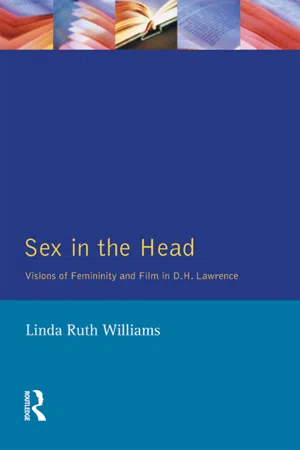
In Sex in the Head, Linda Ruth Williams uses psychoanalysis and recent feminist film theory to analyze a network of ideas which link looking with sexuality and difference, in the work of a writer who disavowed, yet covertly enjoyed, the pleasures and power of vision. The book is a departure from the long history of feminist readings of Lawrence, in that it discusses his engagement with theories of the gaze and its cultural forms - cinema, photography, painting and the visual dynamics and metaphors of literary texts - as a way of thinking through gender. It shows him arguing, on the one hand, against the evils of cinema and visual sex, while relishing, through the eyes of women, the moving spectacle of those male bodies which populate the pages of his books. It also questions what it is about the work of such an adamant cinephobe which has made it so thoroughly adaptable for film and television.
- 190 pages
- English
- ePUB (mobile friendly)
- Available on iOS & Android
eBook - ePub
About this book
Information
Chapter 1 The blindness of the seeing eye Visual vices and dark virtues in Lawrence
DOI: 10.4324/9781315504056-2
Sitting ‘between the toes of a tree, forgetting myself against the great ankle of the trunk’, Lawrence writes Fantasia of the Unconscious, his ‘tree-book’ (F, 43), and perhaps his clearest polemic against visual consciousness. The forest Lawrence conjures up is one in which the open spirit cannot fail to get involved. In it there is no question of dispassionate perception: it is monstrous, ‘profoundly indifferent’, immediately faceless, and yet entering it also opens the door to it. Like Nietzsche’s abyss, into which one looks only to find that the abyss looks back, 1 entering his forest is tantamount to extending an invitation, asking it to enter you. For a moment the ‘I’ panics, paranoid; it cannot surround itself in a defensive gaze which protects all horizons, it cannot look in all directions at once: ‘I think there are too many trees. They seem to crowd round and stare at me, and I feel as if they nudged one another when I’m not looking. I can feel them standing there’ (F, 42). This fear is uncharacteristic, especially in a book which advocates the loss of this fearful ego, the abandonment of defensive looking. And so he submits – ‘I seem to feel them moving and thinking and prowling, and they overwhelm me. Ah, well, the only thing is to give way to them.’ What this means is that in encountering the other (the forest) one allows the possibility that the forest will reach back and touch or expose something in the self which is made of the same ‘substance’. This is what Nietzsche means when he writes ‘And when you look long into an abyss, the abyss also looks into you.’ The mutuality of this is right, but the perceptual metaphor could not be further from the spirit of Fantasia. Lawrence doesn’t want to look long at anything, just to get lost in the trees and find out through their eyeless contact that once you submit to the body-without-organs of the forest, you find out how irrelevant your own organs are. For what is the point of making eye contact with something which has no eyes?
Suppose you want to look a tree in the face? You can’t. It hasn’t got a face. You look at the strong body of a trunk; you look above you into the matted body-hair of twigs and boughs; you see the soft green tips. But there are no eyes to look into, you can’t meet its gaze. You keep on looking at it part and parcel.It’s no good looking at a tree to know it. (F, 43)
Look long at a tree, and it deprives you of the ability to see – that is how the forest looks back.
‘I come so well to understand tree-worship’ continues Lawrence, for what the trees have done to him, and what an openness to the unseeing forest of ‘blood consciousness’ (which trees stand for and grow from) can do, is engender a religious state of positive unseeing. This mutual invasion causes a radical dissolution of the self; when he writes, ‘I lose myself among the trees’ (F, 44), he means it quite literally: ‘They have taken some of my soul’, but moreover they have taken away the need for familiar, visual recognition, for the motifs of ideal individuality: ‘They have no skulls, no minds nor faces, they can’t make eyes of love at you. Their vast life dispenses with all this. But they will live you down’ (F, 46).
For Lawrence the seeing eye is always blind. Better to have no eyes than to use them in ‘making eyes of love’ – better to find, instead, a ‘vast life.’ The seeing eye can take in only the surface of things, a surface which deflects and misdirects our concentration, so that we don’t even know something deeper exists – all this, for Lawrence, means that we are blind to the fact that we are blind. The seeing eye cannot see the wood for the trees: it knows their type and form, it categorises, photographs, films and names them, but it does not come near to a true, Lawrentian contact with the unconscious substance of wood. The seeing eye is fixated on conscious perception and forgets ‘darker’ connection – it assumes that everything that is, is visual.
In Studies on Hysteria Freud refers to a form of vision which disavows the seen at moments of crisis, which he calls the ‘blindness of the seeing eye’. For Lawrence, the seeing eye is specifically blind to the darkness of the self, unable to make sense of the creeping unconscious ones which emerge from the forest to merge with other parts of the self when the eyes, the agents of consciousness, are closed. His dualism is clear and familiar: in order to see ‘truly’ one must give up one’s reliance on visual verification, one must become blindly sexualised. Sight is the most inauthentic sense for Lawrence, indeed, it is hardly a sense at all – it is the sense which cuts consciousness off from sensual life. Lawrence wants us to be invaded by the forest, losing the emphasis of two-dimensional perception in full baptismal immersion.
Seeing in the dark
For Lawrence, the fact that human eyes cannot see in the dark is not a problem. We must abandon the priorities of human visual perception, and embrace other ways of knowing and touching the world. What is the problem is the primacy of visual perception, in a culture which is systematically turning the lights on in every sphere. Because we cannot see in the dark we colonise it with the values of light:
We have too much light in the night, and too much sleep in the day. It is an evil thing for us to prolong as we do the mental, visual, ideal consciousness far into the night when the hour has come for this upper consciousness to fade, for the blood alone to know and act. (F, 175–6)
In Lawrence’s world-turned-upside-down, the decadent modern self thinks its way into the night and makes sexuality the slave of cerebration. We light up the night in order to scrutinise our sex. And the pay-off, the flip-side of this perverse nocturnal vision – the power of seeing in the dark, and thus forgetting that the dark is dark, the need to scrutinise unconsciousness – is not a newly sexualised day, the opposite of a sexually depleted night, but an exhausted culture which oversleeps: ‘we protract our day-consciousness on into the night… and we tell ourselves we must sleep, sleep, sleep in the morning and the daytime’ (F, 177). The evil of becoming nocturnal for Lawrence lies in the way it inverts the natural order of things – like going to the cinema in the afternoon. The prime act of transgression is thus to actually look at sexuality, to scrutinise it (this is at the root of his critique of psychoanalysis). To look within the sexual act – to embrace scopophilic ‘perversions’ – is even worse. The most decadent form which modern sensibility takes is to lead one’s eyes beyond the natural realm of daylight to which they are appropriate, entering the darkness with them open, and looking hard at life as a range of images to be scrutinised. Just as there is something transgressive about leaving the sunshine to enter a dark cinema auditorium and watch ‘artificial’ projections – the point has been made before, but this is cinema as a latter-day Plato’s cave – so taking one’s eyes into Lawrentian darkness and then illuminating its secrets is a major critical problem. We fail to use our eyes where they are appropriate – to aid wholesome manual labour in the sunshine – and instead open them in the realm of ‘night’ where we project our mental fantasies onto our subjugated sexuality, and exhaust ourselves mentally. Too much power to the ‘outer mental consciousness and mental lasciviousness’ destroys ‘the very blood in our bodies’ (F, 176), and one of Lawrence’s solutions, at least, is a culture-wide reveille:
Every man and woman should be forced out of bed soon after the sun has risen: particularly the nervous ones. And forced into physical activity. Soon after dawn the vast majority of people should be hard at work. If not, they will soon be nervously diseased. (F, 177)
If so, the world will be turned the right-(Lawrentian)-side-up again, the lights will be turned out on sexuality, and ‘outer mental consciousness’ will be suppressed by physical labour, the proper activity of daylight. It all sounds so eminently normal, so what is at stake here to make Lawrence feel so strongly about us getting a good night’s sleep followed by a hard day’s work?
A knottier anxiety lies at the bottom of this, the issue of the primacy and encroaching power of visual sexuality. Underpinning Lawrence’s discourse on visuality is his more basic philosophy of sexual difference. Against the grain of our culture and (as feminism has identifed) its masculinisation of the gaze and powers of illumination, Lawrence identifies femininity with the values of the rising sun – with cerebral powers of illumination, and the desire to see and penetrate visually – and thus cannot bear to see them encroach upon his celebrated darkness. If women are aligned with vision and light, the (feminine) invasion of Lawrence’s dark continent of (masculine) sexuality reclaims the night. For Lawrence, it is important to go to bed when it gets dark (to be unconscious in darkness) and wake up at dawn (to be conscious in the light), actually and metaphorically, primarily because to do otherwise threatens the whole balance of power between ‘visual, ideal consciousness’ (the feminine) and Phallic, and blind, ‘blood life’. To make ‘the mistake of turning life inside-out, of dragging the day-self into night, and spreading the night-self over into the day’ is also to make the mistake of prioritising conscious ways of seeing: in this way, Lawrence argues, we also make ‘love and sex a matter of seeing and hearing and of day-conscious manipulation’ (both quotations, F, 175). In short, we then make love and sex feminine rather than Phallic, visual rather than blind. This is the range of reversals and binarities upon which Lawrence pins his whole sexual and visual discourse.
Whilst Fantasia of the Unconscious often reads like a highly systemised but certifiable schizo-rant, setting out an elaborate vision of social and individual organisation based on the intricate relationship between the solar plexus, the lumbar ganglion, and the sun and the moon (‘I may as well say straight off that I stick to the solar plexus’ 2 ) its discussion of dark and seeing selves is crucial, and clearly sets out this model. Fantasia begins with an analysis of how the individual develops from infancy, and ends in a eulogy to the delights of ‘having a wife’, the moment of heterosexual fulfilment achieved when the woefully ‘“intelligent” wom[a]n’ leaves her mind (and her eyes) behind, ‘believes in you and submits to your purpose that is beyond her’ (F, 193). There are some dark women in Lawrence, like Winifred at the start of England, My England who, ‘having once known the glow of male power… would not easily turn to the cold white light of feminine independence’ (EME, 20). Such women are not, however, as interesting as the visionary ones. To be eyeless in paradise is the goal for us all, but women have further to go to get there.
Ignoring for the moment the banal sexism of this, Fantasia demonstrates most clearly Lawrence’s ideas about the development of men and women from childhood through modern (but unfulfilled) adulthood, towards the possibility of real (Lawrentian) arrival. It is a key text, and despite its premise of an argument with Freud, one might say that it is Lawrence’s metapsychological statement, offering a strong sense of his psychobiological topography, with a narrative which traces individual development and leaves fulfilment as yet to be achieved by most of us. It is also the case history of our culture, following the growth of Lawrence’s (male) Everyman whose progress to a conclusive moment of dark healing is traced through the terms of looking and vision. Individual identity is born at the moment when the infant can see that the other – the rest of the world – is visually separate from itself. This is taken to extremes in modern individuality, and Lawrence fixes on and repeatedly represents the figure of the twentieth-century self which organises the world and understands most things primarily through the sense of sight. To go one (Lawrentian) stage further, people must transcend vision into a new, renewing, experience of darkness. This development has a parallel gender dynamic, which is that Lawrence’s Everyman is feminised – ‘it’ changes sex – as it becomes more and more reliant on vision. A curious evolution takes place, then, through which a child is born into darkness, emerges into the light which is progressively identified with femininity, and then has to undergo a culminative experience of darkness in order to find its way ‘home’ again. The seers and perverse knowers of Lawrence’s narratives are generally female, and so the final stage of immersion in darkness, of willed blindness, involves a submission of knowing femininity to the positively weighted ‘unknowing’ Phallus. Light and looking in their perverse forms are feminine, 3 and so darkness comes only when the feminine submits. Essentially, all selves are ‘dark’, but we have forgotten this. Full human arrival depends upon losing, forgetting or destroying our visual apparatus, and living ‘below the waist’:
below the waist, we have our being in darkness. Below the waist we are sightless. When, in the daytime, our life is polarised upwards, towards the open sun-wakened eyes and the mind which sees in vision, then the powerful dynamic centres of the lower body act in subservience.…And then we flow upwards, we go forth seeking the universe, in vision, speech, and thought – we go forth to see all things, to hear all things, to know all things by acquaintance and by knowledge. (F, 179)
This is the ‘daytime self’, the thinking, seeing and writing self, the self which, moreover, writes (Lawrence’s) books. This ‘wide-eyed spirit [which seeks] to bring all the universe into the range of our conscious activity’ appears here to be set in equal, respectful, opposition to the ‘other’ self in which Lawrence is more interested. This is not, however, the case: in modern times the ‘wide-eyed spirit’ has become female, its corporate form takes on a sadistic, possessive and disproportionate shape as the cocksure woman.
‘Bringing all the universe into the range of our conscious activity’ is, then, the woman’s obsession. Women have become so relentlessly ‘wide-eyed’ that their desire to look and to know is pathologically epistemophilic (to deploy a slice of jargon from Melanie Klein). Epistemophilia is ‘the impulse to search for knowledge’, a possessive desire which Klein aligns with primal sadism and other active infant drives. 4 Lawrence’s modern woman is the epistemophile par excellence; she has cathected all of her sexual desire onto the drive to know. Her will to know has possessed and perverted her ‘natural’ desires, and so she takes more into her conscious system than is good for her. When sex comes into the head, it is matched with an attitude to knowledge and thought which is passionate and (for Lawrence, perversely) sexualised. Sex in the head is twinned with the desire to know.
This is not unlike a comment made by Jacques Lacan, as quoted by Catherine Clément: ‘Desire, domesticated by the educators, put to sleep by moralists, betrayed by the Academies, has taken refuge in the passion to know.’ 5 Read one way this seems like an acutely Lawrentian statement, except that Lawrence would never term knowledge a refuge, nor would he allow that the will to know could be truly passionate. But certainly, desire is betrayed, enervated, caged and – crucially – emasculated, 6 when it is expressed as the desire for knowledge. And because the ‘wide-eyed spirit’ is more predictably vilified across the range of Lawrence’s corpus and frequently only appears as the perverse ‘passion to know’, it cannot be seen to exist in simple and equal opposition to the darker, sightless self, rather coyly situated ‘below the waist’ (the writer of Lady Chatterley’s Lover obviously hasn’t yet summoned up the courage to call a John Thomas a John Thomas). Indeed, Lawrence goes on to establish the ‘nighttime self’ as primary, the lost but fundamental core of sexual subjectivity. To experience positively this Lawrentian version of the dark night of the soul would be to rebalance our different internal selves so that the unconscious is given its fundamental priority again.
What we should do, then (and Lawrence here reaches a crescendo of prescription), is to reclaim the night of the self:
We wanted first to have nothing but nice daytime selves, awfully nice and kind and refined. But it didn’t work. Because, whether we want it or not, we’ve got night-time selves. And the most spiritual woman ever born or made has to perform her natural functions just like anybody else.We must always keep in line with this fact.Well, then, we have night-time selves. And the night-self is the very basis of the dynamic self. The blood-consciousness and the bl...
Table of contents
- Cover
- Half Title Page
- Title Page
- Copyright Page
- Copyright Page
- Contents
- Preface and acknowledgements
- Introduction: Lawrence, cinema and female spectatorship
- Chapter One The blindness of the seeing eye: Visual vices and dark virtues in Lawrence
- Chapter Two ‘…my eyes are like hooks…’: Sadism and the female gaze
- Chapter Three Putting on his glory: Lawrence’s male spectacles
- Chapter Four The pornographic gaze and the case of Lady Chatterley
- Chapter Five On being a girl: Lawrence-against-himself
- Notes
- Bibliography
- Index
Trusted by 375,005 students
Access to over 1.5 million titles for a fair monthly price.
Study more efficiently using our study tools.
Frequently asked questions
Yes, you can cancel anytime from the Subscription tab in your account settings on the Perlego website. Your subscription will stay active until the end of your current billing period. Learn how to cancel your subscription
No, books cannot be downloaded as external files, such as PDFs, for use outside of Perlego. However, you can download books within the Perlego app for offline reading on mobile or tablet. Learn how to download books offline
Perlego offers two plans: Essential and Complete
- Essential is ideal for learners and professionals who enjoy exploring a wide range of subjects. Access the Essential Library with 800,000+ trusted titles and best-sellers across business, personal growth, and the humanities. Includes unlimited reading time and Standard Read Aloud voice.
- Complete: Perfect for advanced learners and researchers needing full, unrestricted access. Unlock 1.5M+ books across hundreds of subjects, including academic and specialized titles. The Complete Plan also includes advanced features like Premium Read Aloud and Research Assistant.
We are an online textbook subscription service, where you can get access to an entire online library for less than the price of a single book per month. With over 1.5 million books across 990+ topics, we’ve got you covered! Learn about our mission
Look out for the read-aloud symbol on your next book to see if you can listen to it. The read-aloud tool reads text aloud for you, highlighting the text as it is being read. You can pause it, speed it up and slow it down. Learn more about Read Aloud
Yes! You can use the Perlego app on both iOS and Android devices to read anytime, anywhere — even offline. Perfect for commutes or when you’re on the go.
Please note we cannot support devices running on iOS 13 and Android 7 or earlier. Learn more about using the app
Please note we cannot support devices running on iOS 13 and Android 7 or earlier. Learn more about using the app
Yes, you can access Sex In The Head by Linda R. Williams in PDF and/or ePUB format, as well as other popular books in Literature & English Literary Criticism. We have over 1.5 million books available in our catalogue for you to explore.