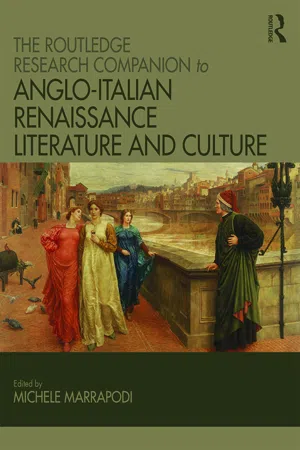
The aim of this Companion volume is to provide scholars and advanced graduate students with a comprehensive and authoritative state-of-the-art review of current research work on Anglo-Italian Renaissance studies. Written by a team of international scholars and experts in the field, the chapters are grouped into two large areas of influence and intertextuality, corresponding to the dual way in which early modern England looked upon the Italian world from the English perspective – Part 1: "Italian literature and culture" and Part 2: "Appropriations and ideologies". In the first part, prominent Italian authors, artists, and thinkers are examined as a direct source of inspiration, imitation, and divergence. The variegated English response to the cultural, ideological, and political implications of pervasive Italian intertextuality, in interrelated aspects of artistic and generic production, is dealt with in the second part. Constructed on the basis of a largely interdisciplinary approach, the volume offers an in-depth and wide-ranging treatment of the multifaceted ways in which Italy's material world and its iconologies are represented, appropriated, and exploited in the literary and cultural domain of early modern England. For this reason, contributors were asked to write essays that not only reflect current thinking but also point to directions for future research and scholarship, while a purposefully conceived bibliography of primary and secondary sources and a detailed index round off the volume.
eBook - ePub
The Routledge Research Companion to Anglo-Italian Renaissance Literature and Culture
- 528 pages
- English
- ePUB (mobile friendly)
- Available on iOS & Android
eBook - ePub
The Routledge Research Companion to Anglo-Italian Renaissance Literature and Culture
About this book
Information
Part 1 Italian literature and culture
1 Dante’s Vita Nuova and Petrarchismo A critical review of contemporary scholarship
DOI: 10.4324/9781315612720-3
If a philosophical “history of love” were ever to be written or rewritten, it could hardly dispense with Dante’s Vita Nuova and the early modern European phenomenon of Petrarchismo, whose foremost prototypes are the sonnets (sonetti or soniti) of Petrarca’s Canzoniere (hereafter, Rvf) and Dante’s dolce stil nuovo, in turn, arguably a renovation of the seemingly “dead poetics” (morta poesì) or rhetorical art of classical antiquity (represented most notably by Vergil and Cicero).1 Yet, in reading Renaissance “love poetry” along the lines of Renaissance modes of “rediscovery” of classical antiquity, our scholarship speaks not of an unequivocal return to classical conceptions but of an appropriation and transformation of antiquity into modernity. Dante and Petrarca, and even more so Petrarchismo, emerge, if only unwittingly, as catalysts for the coming into being of our own age.2
At least on the face of things, modern scholarship offers us two main lines of interpretation of Petrarchismo’s “love”: the political/economic-ideological (as with Arthur Marotti, Kenneth William, and Zygmunt Baranski)3 and the psychological (as with Gordon Braden and Dorothy Stephens).4 This is perhaps unsurprising given the modern-“scientific” and thus prototypically Cartesian roots of our scholarship, for which—again, at least on the face of things—meaning must belong either to a res cogitans or to its “objective” transposition into the sensory realm of res extensa. Neither are attempts to “sublate” psychology and ideology (whereby subjective/intensive desire comes of age upon returning to itself as objective/extensive creator of all ideologies) surprising if considered in the light of the unfolding of Cartesianism into the inverted-idealism or progressivism (Marxist or otherwise) of our “historical-objective consciousness.” The historicist reading of our authors, no less than of Petrarchismo, remains in the immediate background of all psychological and ideological readings.
The present chapter will consider the Yale scholar, Giuseppe Mazzotta, as foremost representative of the historicist reading on account of which, e.g., the subject “Dante” is fully himself only in his ever-evolving audience, his private authorship having been negated in/by his work (e.g., the Comedy).5 Here, what is genuinely meaningful is neither Dante’s subjective consciousness/authorship, nor its self-transposition in or as a particular objective work, but the historical reception or appropriation of the work, expressive of “the material forces of history.”6
The latest scholarly “receptacle” of the historicist approach to Dante and Petrarch is Martin Eisner, Boccaccio and the Invention of Italian Literature: Dante, Petrarch, Cavalcanti, and the Authority of the Vernacular, Cambridge Studies in Medieval Literature (Cambridge, UK: Cambridge University Press, 2013). The volume stands on the shoulders of renowned scholars such as Barolini and Baranski. Throughout Eisner’s pages, Boccaccio emerges as the true father of Petrarchismo and—beyond any supposed disjuncture between Petrarca (who, in reconstructing antiquity in a still fragmentary manner, set the stage for the Renaissance) and Dante (whose “universalism inspired the Romantics”)—as forerunner of an age, still in the making, defined by the universal construction of communities and traditions through digitalization. Yet, the “logic” depicted by Eisner is very old, if Thucydides’ account of Rome’s divide et impera is not irrelevant to our times. Or, to be more precise, Eisner’s work calls to mind Hegel’s intuition about History-proper as a tendency to resolve the tension between particular (Petrarca’s “empirical fragments”?) and universal (Dante’s “idealistic vision”?) into a universal free society. Yet, the “sublating” agency that Hegel names Geist appears in Eisner attributed to individual creative personalities (paradigmatically, Boccaccio) affirming their respective wills ad hoc, or in a context of historical contingency. In Eisner, history is not to be understood as self-realization and, thus, in a crucial sense, as return. The “end” of history is necessarily less real, not more real than the beginning. The price—if we are to speak of a loss—for the consummation of historical strife between “subjective” universality (mythical imagination?) and “objective” particularity (empirical rationalism?) appears to be a reification of life in the medium of technology. Petrarca’s European literary inheritance (Petrarchismo) would seem to unfold as the working out of an unresolved tension between universal (Dantean love?) and particular (Petrarchean love?)—a tension finally resolved by “idealism” placed on a materialistic or particularistic base, an inverted idealism represented by Boccaccio and a European Petrarchismo for which the poet-sive-ideologue is supposed to have set the stage through his programmatic reconstruction of Dante and Petrarca.
What remains to be seen is how we are to distinguish the upshot of Eisner’s reconstruction from the imposition of a global mask of conformity over a Hobbesian state of nature. Eisner’s loose threads invite reconsideration of the distinction between ideological and psychological readings of Renaissance love as pertaining, respectively, to objective particularity (Petrarca’s “worlds”?) and subjective universality (Dante’s will?). A historicist synthesis of the two would entail (1) the objectification of psychology into a new, universal ideology (whereby, e.g., a particular will affirms itself by adopting a universal mask), and (2) the conversion of particular objects of experience into “subjective” functions of the new ideology (so that experience is now re-grounded constructively in ideology).7
Whereas the “ideological” reading of love, articulated in the wake of a “hermeneutics of suspicion,” has it that Platonic or “ideal love” is essentially an ideological-objective reification of unfulfilled desire for conventional power (a reification historically expressed, most notably in the institutional control of desires, to speak with Foucault),8 on a “psychological” (usually neo-Romantic, at times explicitly existentialist)9 reading, our loftiest desires tend to be understood in terms of private passions and/or fears, if only where these are sublimated into Jungian archetypes.
An extended reading of Petrarca along Jungian lines (with direct bearings on Petrarchism) is found in Ève Duperray, L’Or des Mots: Une lecture du Pétrarque et du mythe littéraire de Vaucluse des origines à l’orée du XXe siècle, Histoire du Pétrarquisme en France (Paris: Sorbonne, 1997). Duperray decries a traditional eclipsing of the original allegorical valence of Petrarca’s verse beneath the aura of myth that the verse creates around itself in the first place by way of authorizing itself. This problem is taken up mutatis mutandis by many other scholars, though usually in an “ideological” key (Duperray’s argument brings to mind, e.g., Barolini’s call to “de-theologize” Dante). Now, however, we are invited to recover the “archetypal” sense of Petrarca’s myth. Even Laura emerges as a Jungian archetype, namely nature (most notably in Duperray’s ch. 1.1: “La Nature, paradigme de Laure”—pp. 40–44):10 the proper context of Petrarchist love is not poetry, but a psychology encompassing all poetry and unfolding as a historical dialectic (tending, if only asymptotically, to a synthesis) between collective symbols (poetry) and our particular lives “actualized” by appropriating (gathering back into themselves, or recollecting) the symbols into which they normally project themselves.11
A narrowly or superficially defined “psychologizing” of poets’ mode of allegory, or their “veiled speech,” comes to serve as the preliminary stage for the historicizing of poetry: the inscription of Petrarchismo in “History” singulare tantum presupposes the uprooting of Petrarchismo from its own reasons. Its own reasons are replaced by the Reason of History, if only in anticipation of this latter Reason’s explosion into existentialism’s Un-Reason. At this point, a reappraisal of Petrarca as prophet of existentialist psychology should not surprise dispassionate, by-standing readers of Nietzsche.
It is perhaps a task for future scholarship to re-investigate “the reason of poetry” in the light of considerations familiar to Renaissance (and medieval) poets, and thus in the light of their “defense of poetry.” Such a defense testifies to keen awareness of long-standing debates between Faith/Revelation and Reason—a debate at the center of which stood Averroism as mode of understanding the duplicity of language. The “poetic philosophy” of Dante and Petrarca, but also of a whole tradition of Neo-Latin “poet-theologians” across Europe, not to speak of the Renaissance as a whole, could be understood in terms of thinkers’ capacity, not so much to pretend to believe in some article of faith that they would then proceed to unmask as irrational, as to illuminate the conditions or “essential background” of faith.12 The task would be most daring, considering the Christian distinction between human/civil and divine/canon law—a distinction that had made possible the very rise of Christianity as catholic or trans-political faith. The distinction in question entailed “division of labor” between theologians legislating over properly divine things and political philosophers allowed to deliberate only over merely human things. The link between the two “labors” would be delineated most notably by St. Thomas Aquinas, for whom philosophical or “natural” reason leads to a “natural theology,” or to general conceptions of the divine from a human standpoint—truths preparing man to embrace beyond perplexity the catholic revelation of Christianity as coronation of our truly natural aspirations.13
Read in the context of an Averroist-like approach to the Christian revelation, Petrarca and Petrarchists could make use of a theological conceptual apparatus, no less than of the authority of Holy Church, to carry out a subtle (sottile) critical investigation of the grounds or “inner motives” of faith (and thereby of religious authority). What contemporary scholarship often views as Petrarca’s pre-Reformist “psychology” would then entail a poetic posturing or “conceit” (not differing in essence from the one exemplified by Dante in his Comedy, or even by Cicero in his “first-person” dialogues) through which the philosophical poet would be disclosing a “hidden” or unconventional arena (a fictitious “wilderness” or selva/sylva) for illuminating—in the medium/mirror of a web of judiciously articulated poetic metaphors—the foundations of moral life and order, specifically where morality has come to be viewed anagogically, or in Christian terms. Speaking of the divine in human form or “under the veil of vulgar...
Table of contents
- Cover
- Endorsements
- Half Title
- Title
- Copyright
- Dedication
- Contents
- Notes on contributors
- Acknowledgements
- Introduction: past, present, and future in Anglo-Italian renaissance studies
- Part 1 Italian literature and culture
- Part 2 Appropriations and ideologies
- Afterword: location and narration
- Bibliography
- Index
Trusted by 375,005 students
Access to over 1.5 million titles for a fair monthly price.
Study more efficiently using our study tools.
Frequently asked questions
Yes, you can cancel anytime from the Subscription tab in your account settings on the Perlego website. Your subscription will stay active until the end of your current billing period. Learn how to cancel your subscription
No, books cannot be downloaded as external files, such as PDFs, for use outside of Perlego. However, you can download books within the Perlego app for offline reading on mobile or tablet. Learn how to download books offline
Perlego offers two plans: Essential and Complete
- Essential is ideal for learners and professionals who enjoy exploring a wide range of subjects. Access the Essential Library with 800,000+ trusted titles and best-sellers across business, personal growth, and the humanities. Includes unlimited reading time and Standard Read Aloud voice.
- Complete: Perfect for advanced learners and researchers needing full, unrestricted access. Unlock 1.5M+ books across hundreds of subjects, including academic and specialized titles. The Complete Plan also includes advanced features like Premium Read Aloud and Research Assistant.
We are an online textbook subscription service, where you can get access to an entire online library for less than the price of a single book per month. With over 1.5 million books across 990+ topics, we’ve got you covered! Learn about our mission
Look out for the read-aloud symbol on your next book to see if you can listen to it. The read-aloud tool reads text aloud for you, highlighting the text as it is being read. You can pause it, speed it up and slow it down. Learn more about Read Aloud
Yes! You can use the Perlego app on both iOS and Android devices to read anytime, anywhere — even offline. Perfect for commutes or when you’re on the go.
Please note we cannot support devices running on iOS 13 and Android 7 or earlier. Learn more about using the app
Please note we cannot support devices running on iOS 13 and Android 7 or earlier. Learn more about using the app
Yes, you can access The Routledge Research Companion to Anglo-Italian Renaissance Literature and Culture by Michele Marrapodi in PDF and/or ePUB format, as well as other popular books in Literature & Literary Collections. We have over 1.5 million books available in our catalogue for you to explore.