- 322 pages
- English
- ePUB (mobile friendly)
- Available on iOS & Android
eBook - ePub
About this book
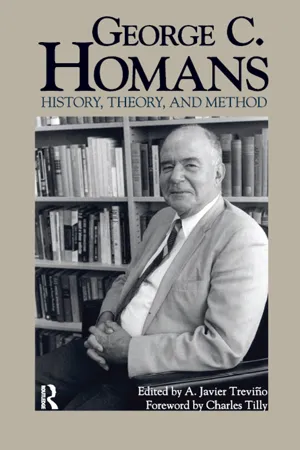
George C. Homans: History, Theory, and Method offers original essays written by scholars from the fields of sociology, history, anthropology, and literature with the aim of assessing Homans's rich and diverse intellectual contributions. It is the first volume in over thirty years to offer a reappraisal of the life and work of one of the twentieth century's leading social scientists.
Information
1
The Rise of Homans at Harvard
Pareto and the English Villagers
Although it is well known that George C. Homans spent his entire academic career at Harvard University, the nature of his rise from an undergraduate majoring in English to a tenured professor of sociology is not widely understood. Homans’s reputation as a sociological theorist rests largely on two works that articulate his social behaviorism or exchange theory, The Human Group (1950), which he described as “by far the most popular of my books” (1968: 4), and Social Behavior: Its Elementary Forms (1961). These mature works, however, were written after he had received a permanent appointment at Harvard. His earliest sociological publication, An Introduction to Pareto: His Sociology (1934), coauthored with Charles P. Curtis, was, as we shall see, significant but not decisive in establishing his permanency at Harvard. The crucial factor was his relatively unknown monograph, English Villagers of the Thirteenth Century (1941), which he affectionately characterized as “my favorite among my books” (1968: 2). In this original historical study, Homans applied selected ideas of Pareto in an attempt to explain certain medieval institutions, especially the English field systems of land holding. Although Homans later moved away from Pareto and became quite critical of his conceptual scheme, it appears that his early involvement with Pareto and the locally influential “Pareto Circle”—along with his own talent and hard work—were the keys to his successful rise at Harvard.1
The significance of English Villagers emerges even more dramatically from historical records in the Harvard University archives that provide insight into the selection of Homans over other candidates for permanency. In 1945, the Department of Sociology offered tenured positions to Homans and to Samuel Stouffer, the statistician and social psychologist best known for his work on The American Soldier. A third candidate, and surely the most famous among contemporary sociologists, was Robert K. Merton. Shocking as it may now seem, in 1945 key decision makers felt that Homans’s Pareto-influenced scholarship in English Villagers demonstrated that he was clearly superior to Merton.
BACKGROUND
Homans has provided an in-depth account of his Harvard years in the charming autobiography, Coming to My Senses: The Autobiography of a Sociologist (1984). From the very beginning, it appears, he was destined for Harvard, entering the college in 1928 “as all my Homans ancestors had been doing since 1768 and all my Adams ones from earlier still” (1984: 63). Thus, by wealth and lineage, he was a fortunate insider in the upper-class world of Harvard in the 1920s and 1930s. Indeed, a further connection that set young George apart from his equally affluent peers was the fact that, from 1932 to 1934, his father, Robert Homans, served as a member of the exclusive Harvard Corporation, the select body that governed the university.
Whether Homans was likewise destined for sociology is much more debatable. Following interests that had emerged during his years at St. Paul’s School, an exclusive secondary boarding school in New Hampshire, he majored in English and American literature. Interestingly, this program of study required that he attain knowledge of Old English that would prove indispensable in the English Villagers project. But during his undergraduate years Homans pursued poetry and developed an ambition to become a poet and writer. He published original writings in the Harvard Advocate, the undergraduate literary magazine, to whose editorial board he was subsequently elected.
Homans’s transition toward sociology may be said to have been an unintended consequence of the system of individual tutoring that President A. Lawrence Lowell had introduced during his term of office (1909–1933). By happy chance, he was placed under the guidance of Bernard “Benny” DeVoto, a parttime member of the Harvard faculty, whom Homans refers to as “the person who made the biggest single difference to my intellectual life” (1984: 85). De-Voto was then a free-lance writer making a living by selling stories to such popular magazines as Harpers, The Saturday Evening Post, and Redbook. He was also nearing completion of his book, Mark Twain’s America (1932) that would do much to develop his reputation as an interpreter of the American West.2
DeVoto assigned Homans a wide range of readings beyond those required in his undergraduate courses.3 Among them, Homans notes, were two that significantly shaped his later sociology: Bernard Mandeville’s The Fable of the Bees, on private vices and public benefits, and Vilfredo Pareto’s treatise Traité de sociologie générale, in the French translation. Indeed, DeVoto was then in the midst of a period of enthusiasm for Pareto (1935) that had begun in the late 1920s, which Wallace Stegner describes as “an intellectual crush that burned hotly for several years, at least until late in 1934” (1974: 138). So intense was DeVoto’s engagement that he attempted to introduce Pareto to the literate public in two magazine articles. In the first of these, “A Primer for Intellectuals” (Saturday Review of Literature), DeVoto described Pareto as “the Newton of sociology” who had “made possible a realistic treatment of the structure and mechanism of society” (1933a: 546).4 In a second article, “Sentiment and the Social Order, Introduction to the Teachings of Pareto” (Harpers), DeVoto characterized Pareto’s treatise as a revolutionary event that had advanced science beyond nineteenth-century assumptions:
The concept of society as an organism is metaphorical and unrealistic; the concept of cause and effect is unrealistic and too simple. For them Pareto’s application of physical science to social analysis substitutes the mathematics of complex variables and a conceptual scheme of mutual dependence. The determinism of society is the determinism of a physical equilibrium. (DeVoto 1933b: 579–80)
DeVoto was an early member of the network that came to be known as the “Pareto Circle” (see Heyl 1968) at Harvard, and he did Homans an invaluable further service by introducing him to the dominant figure in the group, Professor Lawrence J. Henderson.
THE PARETO CIRCLE
During the 1930s, there was a flurry of sociological activity at Harvard organized and coordinated by the fascinating polymath Lawrence J. Henderson. A medical doctor educated at Harvard, Henderson had begun his academic career in the university’s chemistry department. His interests, however, were unconventional and he became a pioneer in the development of biological chemistry, or physiology. In this field, he gained lasting fame through the codevelopment of a series of equations describing the acid-base equilibrium in the blood. Meanwhile, Henderson ventured into other fields, among them the history of science, in which he introduced an undergraduate course in 1911 (which DeVoto had taken).
Gradually, Henderson developed an increasing interest in the social aspects of physiology, especially its relevance to human relationships in the workplace. This led to an invitation from Dean Wallace Donham of the Harvard Graduate School of Business Administration to carry on research at the business school. In 1927, Henderson was given an office near Donham’s and pursued research on the consequences of fatigue in the workplace, with funding from the Laura Spellman Rockefeller Memorial Foundation. Meanwhile, Dean Donham had also secured the services of the Australian-born psychologist Elton Mayo, who would become the director of the famous study of working conditions and employee morale at the Western Electric plant in Chicago (also with Rockefeller Foundation funding). Henderson and Mayo, despite great differences in temperament, would develop a close relationship and do much to stimulate the early efforts of a circle of selected graduate students, including Homans. Both were deeply interested in what Mayo (1945) termed “the social problems of an industrial civilization,” and they published together (1936) on the issue of industrial hygiene.
It should be noted that all of these events were taking place, in a sense, “outside” the professional boundaries of sociology. Harvard was slow in making a commitment to the science of sociology and did not create a department in the field until 1931 (see Nichols 1992). In the decades prior to that time, sociological work was centered in two other departments in Harvard College: Economics (Church 1965), and Social Ethics (Potts 1965). The Graduate School of Business Administration then became a third site of sociological activity, under the leadership of Donham, Henderson, Mayo and other researchers, including Fritz Roethlisberger (author of the famous volume, Management and the Worker, based on the Western Electric study), and T.N. Whitehead (a professor of business and son of the philosopher Alfred North Whitehead).
In 1930, President Lowell brought to Harvard, from the University of Minnesota, the first full professor of sociology, the brilliant Russian emigré scholar, Pitirim A. Sorokin. After a year in the Department of Economics, Sorokin became chair of the new Department of Sociology in 1931. This department had only four tenured positions that were held by two professors of social ethics, Richard Clark Cabot and James Ford, by rural sociologist Carle C. Zimmerman, and by Sorokin. In order to augment this core staff, the Lowell administration appointed a sizable group of Harvard faculty as “interdepartmental” professors of sociology, with full voting privileges (see Johnston 1995). Among these were Henderson and such prominent figures as social historian Arthur Schlesinger Sr., Edwin F. Gay (economic historian and first dean of the Harvard Business School), law school dean Roscoe Pound, entomologist William Morton Wheeler, philosopher Ralph Barton Perry, vital statistician E.B. Wilson, anthropologist Ernest F. Hooton, and rising social psychologist Gordon Allport. Sociology’s personnel were rounded out by a few junior-level appointments, most significantly that of Talcott Parsons, who had transferred from Economics where he had been an instructor since 1927.
It so happened that, just at the moment of sociology’s emergence as an academic department, Henderson was becoming increasingly enthusiastic about Pareto’s approach to the field. This zeal had been developing for several years, since about 1927, when entomologist Wheeler had recommended that Henderson read Pareto’s massive tome (which Henderson, a Francophile famous for his beret and love of French wines, most likely did in the French translation). Although this enthusiasm is perhaps ultimately inexplicable, Henderson’s excitement may have been due to the belief that Pareto had defined a truly scientific approach to what had been an unscientific field.
In any case, Henderson (1932) approached Sorokin with a proposal to create a small graduate seminar devoted to studying Pareto. Sorokin (1932) quickly consented, and the venture was launched in the 1932–1933 academic year, the second year of the department’s existence. Official enrollments (i.e., paid tuitions) tended to be relatively low, but a fairly large number of graduate students and faculty participated—often by special invitation, which was a characteristic method of Henderson’s. Documents in the Henderson Papers (1936–1941) at the Harvard Graduate School of Business Administration show that the twelve initial students in the Pareto seminar included three future presidents of the American Sociological Association: Kingsley Davis, George C. Homans, and Robert K. Merton. In the early days, according to Homans’s recollection (1984: 105), the faculty participants included: economist Joseph Schumpeter, Elton Mayo, T.N. Whitehead, Fritz Roethlisberger, rising historian Crane Brinton (best known for his works on the French Revolution), Dr. Hans Zinsser (professor of bacteriology), and Talcott Parsons, as well as Harvard Corporation member, Boston lawyer, and Homans family friend Charles P. Curtis Jr.
DeVoto, himself one of the original participants, has provided a brief sketch of the seminar that emphasizes its unorthodox character and sense of excitement.
During the past academic year a group of Harvard professors, most of them scientists, met regularly every week to discuss a work on sociology that has been repudiated by most sociologists who have heard of it. Ostensibly, they were auditors at a seminar offered by the department of sociology. Actually, the halfdozen graduate students who constituted the seminar were out-numbered, outtalked, and sometimes out-shouted by the listening psychologists, anthropologists, and mathematicians, by a historian, a novelist, and a politician who were regular attendants, and by casual physicists and other learned gentlemen who occasionally dropped in, having heard that something important was going on. The professor in charge of the seminar was a biochemist. His assistant was a practicing lawyer. Both freely confessed their ignorance of sociology. (DeVoto 1933b: 569)
Homans, it will be recalled, had been an English major with little connection to sociology other than the readings assigned by his tutor, DeVoto. He had graduated in 1932, but had been unable to find work in the conditions of the Great Depression, having failed in an effort to work as a reporter for a Midwestern newspaper. Suddenly, however, Henderson reached out to him and brought him into the Pareto Circle, a move that would launch him on his famous career in social science. As he recounts:
He [Henderson] wanted someone to serve as his legman and assist in handling the arrangements for the seminar. He knew I was familiar with the Traité; he knew I was unemployed and he invited me to serve. … In effect, I was simply the junior member of the seminar. What I did not appreciate was that … from that moment on I was a made man. (Homans 1984: 104–105)
Thus, without any intentional plan, Homans found himself “present at the creation.”
Henderson considered Pareto’s Traité to be a work of genius. He was particularly impressed by the way in which Pareto brought a natural science method to bear on the problem of nonlogical action. In other words, the elusive phenomena of group sentiments, rationalizations, and ideologies (which Pareto referred to as “residues,” “derivations,” and “derivatives”) could be comprehended in a manner similar to physics or economics (which dealt with rational action in society). Again, it was not the conceptual categories and their numerous subtypes (e.g., “persistent aggregates”) that appealed to Henderson, but rather the overarching methodology that seemed to offer the basis for a new and valid social science.
As an interpreter of Pareto, Henderson placed great emphasis on the idea of “system,” which he believed pervaded the Traité. Indeed, Henderson felt that Pareto himself should have made this cardinal point clearer in his exposition, so that it did not become obscured by the array of examples of nonlogical action. In the small volume, Pareto’s General Sociology: A Physiologist’s Interpre...
Table of contents
- Cover
- Half Title
- Title Page
- Copyright Page
- Table of Contents
- Foreword: Homage to Homans
- Introduction: The Sentiments and Activities of George C. Homans
- 1. The Rise of Homans at Harvard: Pareto and the English Villagers
- 2. A Medievalist for the Twentieth Century: George C. Homans and Social History
- 3. Efficient Causes, Final Causes, and Human Nature: George C. Homans and Social Anthropology
- 4. Elements and Identity: Homans as an Industrial Sociologist
- 5. Homans’s Vision of Social Exchange
- 6. Homans and Emerson on Power: Out of the Skinner Box?
- 7. Exchange, Affect, and Group Relations
- 8. Homans and the Study of Justice
- 9. The Return of the Ghost of Utilitarianism: Talcott Parsons and the Theory of George C. Homans in the 1960s
- 10. Theorizing in Sociology: The Advocacy of George C. Homans
- 11. Bringing Obligations Back into Human Rights: Political Thought in George Caspar Homans
- 12. George C. Homans’s Life in Poetry
- Index
- About the Contributors
Trusted by 375,005 students
Access to over 1.5 million titles for a fair monthly price.
Study more efficiently using our study tools.
Frequently asked questions
Yes, you can cancel anytime from the Subscription tab in your account settings on the Perlego website. Your subscription will stay active until the end of your current billing period. Learn how to cancel your subscription
No, books cannot be downloaded as external files, such as PDFs, for use outside of Perlego. However, you can download books within the Perlego app for offline reading on mobile or tablet. Learn how to download books offline
Perlego offers two plans: Essential and Complete
- Essential is ideal for learners and professionals who enjoy exploring a wide range of subjects. Access the Essential Library with 800,000+ trusted titles and best-sellers across business, personal growth, and the humanities. Includes unlimited reading time and Standard Read Aloud voice.
- Complete: Perfect for advanced learners and researchers needing full, unrestricted access. Unlock 1.5M+ books across hundreds of subjects, including academic and specialized titles. The Complete Plan also includes advanced features like Premium Read Aloud and Research Assistant.
We are an online textbook subscription service, where you can get access to an entire online library for less than the price of a single book per month. With over 1.5 million books across 990+ topics, we’ve got you covered! Learn about our mission
Look out for the read-aloud symbol on your next book to see if you can listen to it. The read-aloud tool reads text aloud for you, highlighting the text as it is being read. You can pause it, speed it up and slow it down. Learn more about Read Aloud
Yes! You can use the Perlego app on both iOS and Android devices to read anytime, anywhere — even offline. Perfect for commutes or when you’re on the go.
Please note we cannot support devices running on iOS 13 and Android 7 or earlier. Learn more about using the app
Please note we cannot support devices running on iOS 13 and Android 7 or earlier. Learn more about using the app
Yes, you can access George C. Homans by A Javier Treviqo,Charles Tilly in PDF and/or ePUB format, as well as other popular books in Social Sciences & Historiography. We have over 1.5 million books available in our catalogue for you to explore.