- 220 pages
- English
- ePUB (mobile friendly)
- Available on iOS & Android
eBook - ePub
About this book
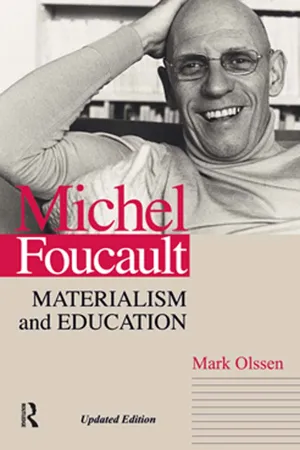
"Olssen ! brings Foucault to life and sheds new light on understanding his work...Educationalists and scholars across the disciplines will welcome this interpretation of Foucault." Michael A. Peters, University of Glasgow "Olssen distills in brilliant and succinct language the core of Foucault's most important insights. This is a book that every student should read in order to understand how to link theory to practice, and educational thought to legacy and work of one of Europe's great thinkers." Henry Giroux, McMaster University Michel Foucault is arguably one of the most important thinkers of the twentieth century, and his works are some of the most difficult to grasp. Mark Olssen offers an accessible overview of Foucault's thought, putting into context the relevance of Foucault's ideas. Olssen adds important new insights to Foucault scholarship by bringing to light the influences of other thinkers such as Marx, Nietzsche, Gramsci, Habermas, and others on Foucault's development as a thinker, and their influence on the deep historical materialist strand that grounds and uniquely characterizes so much of Foucault's thought.
Information
1
Introduction

Jürgen Habermas commented after Michel Foucault’s death in 1984 that “within the circle of the philosophers of my generation who diagnose our times, Foucault has most lastingly influenced the Zeitgeist” (Habermas, 1986: 107). Given that Habermas was for many years one of Foucault’s staunchest critics, this was tribute indeed. Foucault was not only to become France’s most prominent post-war philosopher, but, as David Macey (1993: xi) has observed, “he … successfully crossed the great divide that separates the purely academic world from the broader cultural sphere.” In order to answer the questions “What is it he has done?” and “What significance does what he has done have for an understanding of political, social, and educational analysis?” it is necessary first to position Foucault in relation to the dominant intellectual currents of his time.
At one level of abstraction, Foucault’s main achievement and goal was to counterpoise the philosophy of the concept to the philosophy of consciousness. In this he reacted against the dominance of Sartrean existentialism instancing a dividing line that ran between a philosophy of experience, of meaning, of the subject, and of consciousness on the one hand, and an anti-humanist philosophy of concepts and structures on the other. On the one side stood Sartre and Merleau-Ponty. On the other stood Cavaillès, Bachelard, Koyré, Canguilhem, and Althusser (Macey, 1993: 33).
In a different sense, and within this context, Foucault can be viewed as a sociologist of knowledge, and at the same time as a historian and as a philosopher. Such representations seem plausible given Foucault’s self-chosen title of chair, which he occupied at the Collège de France as the “Professor of the History of Systems of Thought.” His central works comprise studies of the emergence of phenomena, events, and processes that have come to be seen as taken-for-granted within the history of European culture. Among his earlier works one was concerned with the history of madness during the Classical age, and another with the birth of a discourse of clinical medicine during the late eighteenth century. In the 1960s he wrote on the human sciences and the nature of knowledge. In the 1970s he presented a history of the prison and of new modes of discipline as they occurred in the nineteenth century. Later in the 1970s he wrote on the history of sexuality to oppose the idea that sexuality reveals some “deep truth” about the self and to expose the fallacy of the view that the human sciences are concerned with uncovering rather than constructing the objects of their domain. In an important sense Foucault’s work seeks to uncover not the development of rationality, but the ways new forms of control and power are legitimated by complex discourses that stake a claim to rationality and that are embedded in diverse institutional sites.
Foucault’s lasting contribution is as a historian and a philosopher of science, though not of the sort who can be neatly labeled in terms of disciplinary home, but rather a scholar who defies neat intellectual classification and who rejects the institutional basis of disciplinary affiliation. Although his works can be considered histories by virtue of their objects and temporal reference, the objectives and conceptual and theoretical resources are drawn from philosophy. According to Clare O’Farrell (1989: 3), a stronger case can be made to consider Foucault’s writings as philosophies rather than as histories. There is, she says, a “constancy of philosophical quest” which underpins the historical shifts in emphasis and reinterpretations he makes of his work. While I would agree with O’Farrell on this point, I would argue further that the mix of historical and theoretical concerns means they are not straightforwardly philosophical treatises either. If his work has a coherence, a possible additional designation, in my view, is as a sociologist of knowledge in the traditions of Marx, Durkheim, and Mannheim. The sociology of knowledge seeks to relate patterns of thought to social situations and thereby reveal how knowledge is a product of social structures and social interaction. Foucault’s approach fits such a designation as revealed in the illumination as to how the human sciences as forms of power-knowledge have been implicated with social structures, and in the repeated effort on Foucault’s part to expose the individualist, and especially bio-medical roots of modern knowledge as expressions of power-knowledge.
To present an account of Foucault’s life can only be undertaken against the background that Foucault’s own attitude to texts on or about the self mirrored Nietzsche’s (1983: 97) distaste for “all the learned dust of biography.” There is an important sense, however, in which each of Foucault’s books must be seen as part of his biography and related to changes within his life. In their important book Michel Foucault: Beyond Structuralism and Hermeneutics (1982), Dreyfus and Rabinow distinguish four stages in Foucault’s intellectual development—a Heideggerian stage; an archaeological, quasi-structuralist stage; a genealogical, Nietzschean stage characterized by a general retreat from Marxism and language philosophy; and finally, an ethical stage marked by a new concern with Greek and Stoic thought and the development of a new ethics of the self.
After entering the École Normale Superiéure as a normalien in 1946, Foucault’s intellectual and personal life was shaped in the shadow of Marxism and his close friendship with Louis Althusser, which developed in the 1940s. Although Foucault joined the Parti Communiste Français (PCF) in 1950, under the undoubted influence of Althusser, Foucault’s commitment to Marxism extended little beyond the general conviction that material economic conditions were an important influence on social and political life. Disillusioned by the nature of inter-party communist politics, his commitment was to be short-lived, however. Foucault left the PCF in 1953 and embarked on a period of relative political quietism that lasted until the mid-1960s. From then on there was a renewed interest in politics—this time of a non-communist sort—brought into focus by the events of May–June 1968, and his growing friendship with Gilles Deleuze, the “prime mover” of the Nietzschean renaissance in France. From 1968 through the next decade, Foucault started to work collaboratively with Deleuze on a number of projects. These included joint authorship of the “Introduction” to Pierre Klossowski’s 1967 translation of Nietzsche’s Fröhliche Wissenschaft, being interviewed together during 1972, and Foucault’s writing of the Preface to the 1977 English translation of Anti-Oedipus. Politically from this time Foucault became active in prison reform and in active representation of other subjugated and marginalized groups within French society.
Foucault’s writings can also be traced in relation to the varied characterizations he offers of his own work over the course of time. As Paul Patton notes, in his earlier works, written in the 1960s, Foucault represented his project as concerned to define “the limits and exclusions which make up our cultural unconscious” (1987: 227). Later, in the 1970s, he defined his central concern as being related to the issue of power, although he conceded that in his earlier works—Madness and Civilization and The Birth of the Clinic—he had scarcely used the term (Foucault, 1980b: 115). By the late 1970s, Foucault offered yet another representation of his work, defining his central interest as concerned with the historical origins of “subjectification”—“the process by which, in our culture, human beings are made into subjects” (Patton, 1987: 227). At various times throughout the course of his life, Foucault represented his oeuvre as a long-term project of discovering the elements of the “western will to truth.” Just before his death in 1984, in what is perhaps an attempt to bring these different characterizations together, he defended an intellectual ethic of “permanent revolution in thought” (Patton, 1987: 227). Notwithstanding the different accounts Foucault offered at different times, however, within a broader tradition of philosophical knowledge, Foucault’s work, I will argue, can be seen to have a more deeply structured coherence.
In terms of the major influences on his work, his intellectual and philosophical precursors, so to speak, it has been commonplace to repeat Foucault’s own acknowledgments of his substantial debts to Nietzsche and Heidegger. As he states, “for me, Heidegger has always been the essential philosopher. … My entire philosophical development was determined by my reading of Heidegger” (Foucault, 1985b: 8).
Concerning Nietzsche, he says, “I am simply Nietzschean, and I try to see, on a number of points, and to the extent that it is possible, with the aid of Nietzsche’s texts … what can be done in this or that domain” (1985b: 9).
But, as Hubert Dreyfus tells us, “it was through Heidegger that Foucault came to appreciate Nietzsche” (1992: 80–81). In Foucault’s words, “it is possible that if I had not read Heidegger, I would not have read Nietzsche. I had tried to read Nietzsche in the fifties but Nietzsche alone did not appeal to me—whereas Nietzsche and Heidegger, that was a philosophical shock!” (Foucault, 1985b: 9).
One of the central themes which Foucault shared with Heidegger and Nietzsche, as well as with French writers like Althusser, was their challenge to the Cartesian and Kantian conceptions of the subject, propounding instead the view that our own selves may be the greatest illusion of our time. This “theoretical anti-humanism” stands in contrast to the phenomenological conception that Foucault rejected. He rejects a view of the subject standing prior to history or society, maintaining that the events and categories of our world must be analyzed in relation to historical bodies of discourse “tacitly governed by anonymous rules” (Rajchman, 1985: 44).
To see Foucault as Heideggerian, or as Nietzschean, however, is to exaggerate. Notwithstanding his own views on this matter, and not wishing to underrate his debt to Nietzsche, he is not simply Nietzschean, or simply Heideggerian. Other key influences on his work include French structuralism, as well as the more mainstream French philosophy of science, including notables such as Koyré, Cavaillès, Bachelard, Canguilhem, and Althusser. These thinkers had each in their own way sought to challenge the conception of history as a universal, objective, and progressive unfolding of events governed by a conception of a unified model of science taken on from the Enlightenment, and sought to replace it with an attempt to discover an irredeemable plurality of forces and objects of knowledge, characterized, as Rajchman says, “by anonymous tacit procedures, [each] succeeding one another through breaks and ensuing ruptures—a discontinuous history” (1985: 53).
Yet another influence on Foucault came from the Annales school conception of “new history” identified with the journal Annales, which opposed “‘battle-treaty’ narrative” conceptions of history (Rajchman, 1985: 53), replacing it with broad social history. In the introduction to The Archaeology of Knowledge (1972: 3–11), Foucault acknowledges the importance of the Annales histories, drawing specifically on Braudel’s concept of serial history, as well as the notion of longue durée whereby events were seen not as discrete atoms, but rather as intelligible only within a series or coherent succession characterized by repetition over a long period and utilized conceptually for the measurement of data on economic agricultural phenomena (such as price fluctuations) (see Dean, 1994: 37–42).
Finally, Foucault was influenced by Marxism. Although he took the view that “Marxist thought is irredeemably confined by an episteme that is coming to an end” (Sheridan, 1980: 73), he could also agree, albeit in a somewhat different sense, to an interviewer’s suggestion that “Marx was at work in [his] own methodology” (Foucault, 1988a: 46). As these two instances might suggest, Foucault’s relationship to Marxism was not straightforward. Although for the most part he was critical of Marxism, a great deal of what he wrote can be seen as a response to Marxism. As Balibar has noted, “the whole of Foucault’s work can be seen in terms of a genuine struggle with Marx and … this can be viewed as one of the driving forces of his productiveness” (1992: 39). The main criticisms of Marxism were directed against the methodological models and philosophical conceptions it embraced, especially its attachment to various forms of Hegelianism, as well as its undue emphasis on economic determinants and forms of power. As Foucault states, “to put it very simply, psychiatric internment, the mental normalization of individuals, and penal institutions have no doubt a fairly limited importance if one is only looking for their economic significance” (1980b: 116).
In that Foucault departs from Marxism, his own approach nevertheless constitutes a form of consistent historical materialism that has theoretical implications for the analysis of social and educational systems. In seeking to demonstrate such an approach as a correct reading of Foucault, linguistic readings of his work such as that of Christopher Norris (1993) which represent him as part of the linguistic turn in French philosophy, where “there is nothing beyond [the] prison-house of language” and where “language (or representation) henceforth defines the very limits of thought” (1993: 30), will be dispelled in the process of being corrected. Rather, Foucault will be represented, as Habermas has suggested, “not merely as a historicist,” but at the same time as a “nominalist, materialist and empiricist” (1987a: 257).
Because the distinctiveness of Foucault’s approach can best be seen in contrast to other major philosophical systems and thinkers, this study directs considerable attention to examining Foucault’s relationship to Marxism, as well as to Kant, Gramsci, Heidegger, Habermas, the Greeks, and Spinoza. By so locating Foucault, it is possible, I will argue, to expose the distinctive character of his philosophical contribution. In relation to education, there is in Foucault’s approach a double emphasis that constitutes an ordering principle for this work. On the one hand, attention is directed to discursive practices that perform an educative role in the constitution of subjects and of human forms of existence. On the other hand, forms of education are constituted and utilized for the purposes of collective ethical self-creation, a theme Foucault emphasized in his latter works.
This work is divided into three sections. Part I provides an introduction to Foucault as a distinctively materialist thinker, focusing on the distinctiveness of his methods of research (Chapter 2) as well as his theoretical conception of power and of the historical constitution of the subject (Chapter 3).
Part II considers Foucault as a historical materialist. This section seeks to bridge the divide between linguistic receptions of Foucault and historical materialism by pointing to Foucault’s developing interest after 1968 in the relationship between discursive and extra-discursive dimensions of reality. In this context it will be argued that Foucault’s analysis of the double relation between power and knowledge differs radically from the self-referential textuality of Derrida and his followers (Chapter 4). Chapter 5 goes on to examine the central differences between Foucault’s version of historical materialism and Marxist versions, noting the central rejection of the Hegelian conception of a closed totality and the developing suggestion of what may be represented as a form of post-structuralist Marxism. Although many authors have criticized Foucault’s project on the grounds of epistemological and moral relativism, it is argued in Chapter 6 that relativism is not an insuperable problem for Foucault and that there are various ways to resolve the problem of self-referentiality in his work. Although Foucault’s notions of materialism are anti-Marxist in their rejection of modes of production, dialectical method, and ideology critique, such an assessment should not obscure some deficiencies in Foucault’s account relating to power and structure or to the nominalistic form of analysis adopted. As a consequence, the sources, substances, and dispersal of power are not concretely related to institutional practices as clearly as they might be. Chapter 7 explores the issue of whether the addition to Foucault’s approach of insights from Gramsci can serve as a corrective to some of these deficiencies.
Part III explores various themes relating Foucault’s work to education. Chapter 8 outlines Foucault’s critical epistemology and his relationship to Kant, seeking to elucidate Foucault’s conception of knowledge in ...
Table of contents
- Cover Page
- Half-Title Page
- Cultural Politics & the Promise of Democracy
- Title Page
- Copyright Page
- Dedication
- Contents
- Preface to the Enlarged Paperback Edition
- 1 Introduction
- Part I The Modified Realism of Michel Foucault
- Part II Considering Foucault as Historical Materialist
- Part III Foucault and the Tasks of Education
- Bibliography
- Index
- About the Author
Trusted by 375,005 students
Access to over 1.5 million titles for a fair monthly price.
Study more efficiently using our study tools.
Frequently asked questions
Yes, you can cancel anytime from the Subscription tab in your account settings on the Perlego website. Your subscription will stay active until the end of your current billing period. Learn how to cancel your subscription
No, books cannot be downloaded as external files, such as PDFs, for use outside of Perlego. However, you can download books within the Perlego app for offline reading on mobile or tablet. Learn how to download books offline
Perlego offers two plans: Essential and Complete
- Essential is ideal for learners and professionals who enjoy exploring a wide range of subjects. Access the Essential Library with 800,000+ trusted titles and best-sellers across business, personal growth, and the humanities. Includes unlimited reading time and Standard Read Aloud voice.
- Complete: Perfect for advanced learners and researchers needing full, unrestricted access. Unlock 1.5M+ books across hundreds of subjects, including academic and specialized titles. The Complete Plan also includes advanced features like Premium Read Aloud and Research Assistant.
We are an online textbook subscription service, where you can get access to an entire online library for less than the price of a single book per month. With over 1.5 million books across 990+ topics, we’ve got you covered! Learn about our mission
Look out for the read-aloud symbol on your next book to see if you can listen to it. The read-aloud tool reads text aloud for you, highlighting the text as it is being read. You can pause it, speed it up and slow it down. Learn more about Read Aloud
Yes! You can use the Perlego app on both iOS and Android devices to read anytime, anywhere — even offline. Perfect for commutes or when you’re on the go.
Please note we cannot support devices running on iOS 13 and Android 7 or earlier. Learn more about using the app
Please note we cannot support devices running on iOS 13 and Android 7 or earlier. Learn more about using the app
Yes, you can access Michel Foucault by Mark Olssen in PDF and/or ePUB format, as well as other popular books in Philosophy & Education Theory & Practice. We have over 1.5 million books available in our catalogue for you to explore.