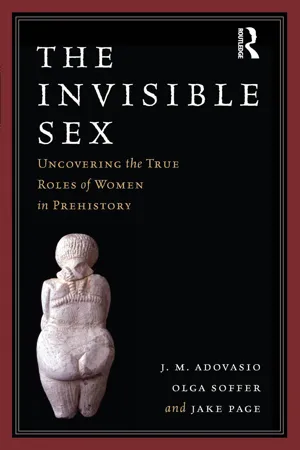
eBook - ePub
The Invisible Sex
Uncovering the True Roles of Women in Prehistory
- 320 pages
- English
- ePUB (mobile friendly)
- Available on iOS & Android
eBook - ePub
The Invisible Sex
Uncovering the True Roles of Women in Prehistory
About this book
Shaped by cartoons and museum dioramas, our vision of Paleolithic times tends to feature fur-clad male hunters fearlessly attacking mammoths while timid women hover fearfully behind a boulder. Recent archaeological research has shown that this vision bears little relation to reality. J. M. Adovasio and Olga Soffer, two of the world's leading experts on perishable artifacts such as basketry, cordage, and weaving, present an exciting new look at prehistory. With science writer Jake Page, they argue that women invented all kinds of critical materials, including the clothing necessary for life in colder climates, the ropes used to make rafts that enabled long-distance travel by water, and nets used for communal hunting. Even more important, women played a central role in the development of language and social life—in short, in our becoming human. In this eye-opening book, a new story about women in prehistory emerges with provocative implications for our assumptions about gender today.
Information
PART 1
THE BEGINNINGS
1
THE STORIES WE HAVE BEEN TOLD
In which the authors present tales of male derring-do and explicate their failures in accounts of the deep past, along with a bit of the history of science and the reasons why women have not been found in those old tales.
Since the beginning of archaeology, stories like the following three have been told, illustrated, and taken as the true way in which our ancestors lived and worshipped and fed themselves. They are in much the same vein as most museum dioramas of ancient times and are matched by most magazine and book illustrations as well. Warning: these tales can be dangerous to your understanding of the human past.
THE PLACE: A hill overlooking the Vezere Valley in southwestern France, not far from a cave called the Grotte de Rouffignac.
THE TIME: 14,000 years ago.
A group of men makes its way single file along a steep and narrow path that winds up a limestone hill. It is dusk, and the day has been stormy and dark. Impatient gray clouds have commanded the sky, and from time to time they have sent spring rains down, turning the path to mud and making footing difficult. The weather is yet to feel the true onset of spring—that day when the sun begins to warm the earth and the winds turn kind.
The men climb silently in the gathering dusk. Some of them are slender, in their teens. Others are filled out, in their prime, having lived thirty or even a few more years. Among them are three boys, alert and excited but subdued with apprehension. They shiver, though not from the remnant cold of winter. They know they face an ordeal, but they have not found out its dimensions yet, which makes it all the scarier. Tonight they will become men. Later they will learn the arts of hunting, of mating, of being responsible providers for their yet unborn sons and daughters.
Some of the men carry branches that will be used as torches once they have been surrounded by the oncoming dark. Others carry spears with shafts of rare hardwoods, topped with serrated bone points affixed with cord or sinew. One of the men in the front of the line struggling up the path has a leather pouch slung across his shoulder. It is full of red and black powders ground from local minerals like hematite or magnetite. Another, the oldest one with white in his hair, carries a knife of flint and a flat soft stone with a depression hollowed out of it. In the depression animal fat has solidified. In it lies a fiber wick. When lit, it will be the first light into the depths of the sacred cave whose entrance they now are nearing.
Below them, the last of the day’s light glints off the river, a shining serpent that lies along the length of the valley still brown with the winter’s dead grasses. The three boys take their last glimpse of the valley and apprehensively follow the men into the dark mouth of the cave, the flint knife gleaming in their minds’ eyes. The older man has led the way, his tiny flame glowing. Behind him, the man with the leather pouch walks gravely, followed by the men with torches, who alternate with those carrying spears. Huge shadows leap wildly on the rocky walls, and a low chanting like a distant wind begins to fill the cave—words the three boys can barely make out, words they have not heard before. For all they know, it is the cave itself that sings. They see the forms of animals emerging from the walls and the ceiling as the shadows dance past.
Deeper into the magic cave they go, and the ceiling begins to come closer until the men ahead stoop over, crouch, their torches’ flames blackening the stones. The smoke from the torches burns the eyes of the three boys, but they say nothing. Soon the ceiling has lowered to the point where everyone must crawl, scraping their bellies along the mud and stone of the floor.
At last (it seems a very long time but it has only been a short trip), they reach a chamber where they can all stand, the men in little groups. The boys huddle in the middle. All around them are the sweeping figures of the great bison, graceful horses, the grand mammoths, all looming high above on the walls. In the flickering light of the torches and the gathering murk of smoke, they come alive. They seem to move.
Preparations begin. The oldest man selects an empty spot on the wall while the man with the leather pouch of powders—the one they now start to call the Painter—prepares his paints. The boys are taken to the unpainted wall, where the oldest man begins to sing. His flint knife is nowhere to be seen. He sings a story about hunting, about the habits and the wiles of the animals they hunt, about great hunts where everyone rejoiced in the bounty, and about failures: times when the hunters themselves were hunted and fell prey in the great and bloody exchange that sustains the world. The old man sings of times when the animals left, disappeared, because the hunters forgot to honor their spirits and give due homage to the Owner of the Animals.
All the while the Painter works. He takes the black mineral powder into his mouth, mixes it with his saliva, and blows a spatter of black onto the wall, making a dark line. As the songs gather momentum and the hypnotic power of the chant turns the men to stomping and dancing, the boys are amazed to see a mammoth materialize on the wall before their eyes. The Singer carries on, an insistent monotonous song that properly asks the Owner of the Animals to share them. He chants the secrets and prayers for killing the huge beasts respectfully, the prayers that these boys will memorize along with so much else this night. The magical mammoth glistens on the wall, as suddenly a long shriek arises in the gloom and the best of the group’s hunters leaps forward to hurl a throwing spear at the image.
Its ivory point snaps. A mark is gouged from the mammoth—a gouge that marks the beast’s heart—and the spear clatters to the ground. The old man, the Singer, hands it to one of the boys and bids him throw it. The boy hesitates, looks about him at the grinning men, shrieks as best he can, and throws.
The ritual continues until dawn. Some time thereafter, the boys emerge into the light on the hill overlooking their valley. They bear the reddening welts and incisions of ritual, they bear the beginning of the hunters’ wisdom, and they have become men—untested yet, but men nonetheless.
Home beckons, and from the high ground amid the aroma of dew they can see that a small herd of reindeer, seven in all, has left the cover of the trees and, in the early morning mist, is drinking from the river far below, skittish, lovely in the thin light of the morning.
WHAT’S WRONG WITH THAT PICTURE?
The Grotte de Rouffignac is one of the richest sites of prehistoric images in Europe and the world. It contains more than 250 engravings and paintings of prehistoric animals, the work of people who lived toward the end of the last Ice Age. This astonishing exhibition extends some 500 yards from the cave’s entrance into the labyrinths beyond. One hundred and fifty-four mammoths are pictured, including one enormous specimen today called Grandfather. Although the cave is privately owned, the public is still welcome to visit it.
The story told here is typical of many that have arisen, at least in outline, from about a century and a half of study and guesswork about these astounding images found principally in western European caves. Most scholars and most people call these images art; we shall return to this topic later on. Many scholars say that it is when these images began to appear—about 30,000 years ago—that anatomically modern humans finally reached the height of brain power and creativity that characterizes today’s human beings. This is most likely true.
In this story, there are of course no women present, no girls being initiated. For decades, artistic achievement was seen as a man’s world, as was hunting: the procurement of meat. The presumption has been that the extraordinary caves like Lascaux and this one not far from the town of Les Eyzies, which some take as the “capital” of European prehistory, were a man’s world. The implication was (and still is in many such accounts and illustration) that women of the period may well have never set foot in such places and, if they did, certainly were not actively involved in their creation. There is absolutely no evidence, however, that women and girls were not participants. Indeed, there is not even any evidence that men were involved.
THE PLACE: A promontory overlooking the confluence of two small rivers that, a half day’s walk toward where the sun rises, empty into a larger river known today as the Dnieper. The landscape all around is flat, hardly rising above the riverine flood plain in today’s Ukraine. Steep-sided ravines slice through the surrounding cold dry grasslands. In the river valleys themselves, stunted trees—mostly pine and birch—grow in stands. For nine months a year this is a landscape of awesome desolation and temperatures that can drop to 40 degrees below zero, but in the three, sometimes two, months of summer it warms to the low 70s and teems with fecund life.
THE TIME: 14,000 years ago, a late summer day when the breezes of morning foretell the long season of cold to come. People must now ensure that they have the needed stores of meat and clothing to see them through the dark cold days ahead.
Some 15 families have gathered in a group at the confluence of the two rivers. They are dressed in their summer furs: tailored parkalike tops with hoods thrown back, and lightweight suede trousers that end as form-fitting boots. In the warmth, some of the men have bared their bodies to the waist. On the promontory above, several of the men keep a lookout lest the nearby herd of mammoths moves down river. The mammoths, a herd of some 30 adults and younger animals, graze on the lush grasses of the river’s edge. They rarely move far from a river, needing mammoth amounts of water to quench their mammoth thirst and to cool down their shaggy bodies.
Below the lookouts, the camp bustles with preparatory activity. Many of the men are going over their hunting gear, making sure that their ivory throwing and thrusting spears are sharp and in order. The working edges are polished with pieces of gneiss or sandstone. One hunter, an expert stoneworker, knaps (chips) long flint blades from a specially prepared core. These he will turn into keen-edged knives for skinning and butchering the animals killed. There is an air of suppressed excitement among these hunters, men in their prime and a few younger ones whose tasks will call for less expertise than the experienced leaders of the hunt. Another group of men is readying the beaters: flat mammoth shoulder and hip blades that the younger men will strike with long thin shin bones topped with bits of soft fur. The fearsome noise, along with the flaming torches some will carry, will drive the mammoths into the range of the great hunters once the sun has reached the height of the sky.
As planned, the band of hunters rises and moves stealthily in various directions down the river toward the unsuspecting herd. Within the hour, they have all taken up their positions, surrounding the herd, each as close as he can get without being detected by the naturally near-sighted beasts. The mammoths, having drunk their fill from the river and feeling drowsy in the midday heat, have earlier moved into the shade provided by the low trees along the river.
Torches are lit. The drumming begins. Fifteen screaming hunters leap up and race toward their prey, closing in on the herd and driving it toward the nearby ravine. The animals, terrified by the noise, the fire, and the missiles that rain down on them, charge ahead into the ravine, tumbling thunderously over one another, bellowing in pain and fear, legs broken, helpless. The men descend into the melee and, with their powerfully built thrusting spears, deliver the coup de grace to mammoth after mammoth, young and old, until within an hour all the animals are dead. Their warm carcasses lie ready for butchering.
By the end of the afternoon, choice pieces of mammoth meat have been sliced away from the bones of a few of the dead beasts, and a grand feast begins. All in the group—some 70 people in all, young and old—fill their bellies with meat roasted over sizzling fires while the hunters retell the high drama of the chase, the adrenaline-filled thrusting and leaping of the kill, the spouting of warm blood. Later that night, stomachs full and hearts content, the group will sleep. Tomorrow they will busy themselves hacking their bountiful harvest into smaller packets of meat that can be stored in pits dug for that purpose, stores that will see them through yet another windswept, freezing winter. The larger bones of the mammoths will be used to rebuild their bone houses; others will feed the fires that warm them in the cold. Little will go to waste. The prayers made so earnestly to the Owner of the Animals have been answered, and the people will survive another year in this place.
WHAT’S WRONG WITH THAT STORY?
The village built of mammoth bone houses on the promontory above the two small rivers—the Ros and the Rossava—was discovered by archaeologists in 1966 and called Mezhirich. The site is still under study, but the remains of some 150 mammoths were found in the vicinity. Adult mammoths weighed in at about three tons, of which more than a ton was pure animal protein. The first archaeologists at this site assumed that the Paleolithic people of Mezhirich, with their specialized mammoth-hunting culture, lived in this same place for as much as an entire generation, so plentiful were herds of mammoths and other large prey animals in the neighborhood of the rivers. In other river valleys in this large region, they assumed, either the hunters were not as adept or the herds were less plentiful, and those Ice Age groups needed to move more often, leaving behind less impressive ruins for the archaeologists to discover.
Today one can see dioramas of such hunting villages with mammoth bone houses in many museums, including the American Museum of Natural History in New York, Chicago’s Field Museum, the Hot Springs Museum in South Dakota, and Le Thot in the Dordogne region of France. The first such house excavated has been reconstructed in the Museum of Paleontology in Kiev, Ukraine.
In hunting “scenes” such as the story above, and the dioramas, there is little sense that women are present except as passive consumers. That they might have assisted in the butchering, if not the hunting itself, was not considered until recently. But more to the point, we will see later in the course of this book that such hunts, in which huge numbers of these enormous beasts are slaughtered, probably never happened. Such hunts appear now to be myth-making on the part of the paleoanthropological community.
THE PLACE: A narrow rocky canyon in the foothills east of the Grand Tetons in present-day Wyoming.
THE TIME: 11,000 years ago.
Seven men stride into the mouth of a canyon and descend into the shade. It is midsummer, hot, and the men wear only skins around their loins. They carry long thrusting spears tipped with finely chipped points of chert, some longer than a man’s hand. The hunters are an advance party, headed north, exploring new country. Where they have come from, farther to the south, the game has grown sparse. No longer do the great elephantine mammoths still roam in large herds, and, with the rapid drying of the world in the south, the vast herds of giant bison have all moved north. It has been some time now since these men have enjoyed a successful hunt, and the women and children they left on a promontory a few miles back have been complaining for days.
The canyon narrows as it deepens, and an even narrower side canyon opens to the north, a slight trickle of water reflecting the sun. The men slow down, chatter quietly among themselves, and then turn up the side canyon. They have seen the droppings of mountain sheep and horses alongside the water. Some 15 minutes later, they reach a place where the canyon turns west toward the high mountains. Cautious now, having seen the whitening bones of a few bison and sheep, they follow the canyon west and are brought up short by the sight of a huge bear lying in the shade below the canyon wall, gnawing on the carcass of what appears to be a freshly killed bighorn ram.

Figure 1-1.
Prehistoric hunters in America battling a giant bear.
Prehistoric hunters in America battling a giant bear.
ANDRE DURENCEAU/National Geographic Image Collection, Image ID 613071
In a brief whispered conference, the men decide to scare the bear away from its prey. They approach silently, bare feet on rock, ducking behind boulders, moving forward. Now, within some 30 yards of the bear and his distinctive pungent musky smell, they leap out as one, screaming, rushing at the creature. Enraged, the bear rears up and roars. His huge head with its wide mouth rises some 14 feet; he towers over the attacking band of hunters. A huge paw at the end of a long and slender arm slashes the lead hunter across the chest, sending him hurtling backward onto the rocks. The other arm reaches for another attacker, who jams his spear at the bear’s stomach, and the other hunters leap and duck, feinting, thrusting, screaming.
WHAT’S WRONG WITH THAT STORY?
This advance party is known today as Clovis Man, from the exquisitely made spear points that were first discovered near the town of Clovis, New Mexico, in the 1930s. Clovis Man arrived in North America, it seemed, 11,500 years ago, and his points and other weapons and tools have since been found sporadically throughout the lower 48 states. Until recently it was almost universally believed that Clovis Man was the first entrant into the New World, the greatest and fastest-moving hunter to appear anywhere on earth. Within less than a millennium, proliferating Clovis hunters had managed to reach the southernmost tip of South America and along the way had sent some 30-odd genera (not species but genera) of large mammals to oblivion.
The absolute epitome of this Clovis myth—for that is what it has turned out to be—is embodied in this story and in the accompanying illustration. So ferocious was Clovis Man that without much thought to their safety, a handful of them would supposedly have attacked an animal we call the great short-faced bear, known to science as Arctodus simus. On all fours, this bear stood as high as the shoulder of a moose, and its long limbs probably gave it the capability of short bursts of horselike speed. It was almost surely the continent’s ultimate carnivore, standing at the very pinnacle of the food chain and capable of bringing down any prey except perhaps an adult mammoth. That any group of humans armed with only spears would ever attack such a creature is of course ludicrous. They would instead have exercised all their wiles to stay out of the way of such a profoundly dangerous killer. Yet, the very reverse image leaped into the imaginations of people who had convinced themselves that these supposed first Americans were preternaturally gifted hunters, capable of feats now known only from the special-effects departments of Hollywood.

How does such a notion come about? There is no known evidence of any kind that humans took on these huge bears, but we have modern illustrations of such activity, not for pulp magazine...
Table of contents
- Cover Page
- Half Title page
- About The Authors
- Series page
- Title Page
- Original Title Page
- Copyright Page
- Dedication
- Contents
- Authors' Preface
- Introduction
- Part One The Beginnings
- Part Two The Road to Thoroughly Modern Millie
- Part Three Peopling the World
- Acknowledgments
- Selected Bibliography
- Index
Trusted by 375,005 students
Access to over 1.5 million titles for a fair monthly price.
Study more efficiently using our study tools.
Frequently asked questions
Yes, you can cancel anytime from the Subscription tab in your account settings on the Perlego website. Your subscription will stay active until the end of your current billing period. Learn how to cancel your subscription
No, books cannot be downloaded as external files, such as PDFs, for use outside of Perlego. However, you can download books within the Perlego app for offline reading on mobile or tablet. Learn how to download books offline
Perlego offers two plans: Essential and Complete
- Essential is ideal for learners and professionals who enjoy exploring a wide range of subjects. Access the Essential Library with 800,000+ trusted titles and best-sellers across business, personal growth, and the humanities. Includes unlimited reading time and Standard Read Aloud voice.
- Complete: Perfect for advanced learners and researchers needing full, unrestricted access. Unlock 1.5M+ books across hundreds of subjects, including academic and specialized titles. The Complete Plan also includes advanced features like Premium Read Aloud and Research Assistant.
We are an online textbook subscription service, where you can get access to an entire online library for less than the price of a single book per month. With over 1.5 million books across 990+ topics, we’ve got you covered! Learn about our mission
Look out for the read-aloud symbol on your next book to see if you can listen to it. The read-aloud tool reads text aloud for you, highlighting the text as it is being read. You can pause it, speed it up and slow it down. Learn more about Read Aloud
Yes! You can use the Perlego app on both iOS and Android devices to read anytime, anywhere — even offline. Perfect for commutes or when you’re on the go.
Please note we cannot support devices running on iOS 13 and Android 7 or earlier. Learn more about using the app
Please note we cannot support devices running on iOS 13 and Android 7 or earlier. Learn more about using the app
Yes, you can access The Invisible Sex by J. M. Adovasio,Olga Soffer,Jake Page in PDF and/or ePUB format, as well as other popular books in Social Sciences & Archaeology. We have over 1.5 million books available in our catalogue for you to explore.