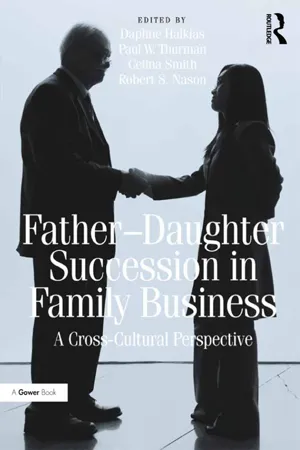
eBook - ePub
Father-Daughter Succession in Family Business
A Cross-Cultural Perspective
- 336 pages
- English
- ePUB (mobile friendly)
- Available on iOS & Android
eBook - ePub
Father-Daughter Succession in Family Business
A Cross-Cultural Perspective
About this book
To whom does a father, retiring from his life as a successful entrepreneur, pass control of the business he has built? Once it would always have been his eldest son, but increasingly women are becoming involved in family firms having risen to positions of influence and leadership. Using revealing case studies from the daughters who succeeded their entrepreneur fathers in a wide variety of challenging situations, cultures and continents, Father-Daughter Succession in Family Business discusses the changes which have led to daughters gaining influence in more and more family businesses. It looks at the tensions this succession can produce between old notions of how men and women should behave, and the new style of leadership that often comes about when a woman takes the helm. This book will help consultants, business educators, and researchers, as well as those who are themselves involved in significant family managed enterprises to better understand why it can no longer be assumed in any part of the World that the first born son will take over the reins of the family business.
Preface:
Where Culture, Family and Business Meet: Developing Cross-National Research on the Father–Daughter Succession Process in Family Firms
Why Focus on Culture in the Succession Process of Family Business?
The family firm is an increasingly vital player in the global economy. One of the events that may disrupt the smooth evolution of a family business is a generation transition and succession. An important issue that is evolving in the family business literature is the increasing involvement of women in leadership/management roles in businesses and, more specifically, the family firm. In the developing economies of Asia and Africa as well as the developed ones in North America, Europe, Australia, and New Zealand there is sparse case study research in the extant literature on cross-cultural gender issues in the family firm ownership and succession (Halkias et al., 2008; 2010).
If entrepreneurship can be considered as an event induced by socio-cultural factors (Shapero and Sokol, 1982), the cultural variable gains greater significance when applied to the quality of the relationship between family members involved in the succession process and specifically, in this book, for the case of father to daughter. National culture generates behavioral changes through family, training, education, traditions, lifestyles, politics, religion and degrees of masculinity–femininity, individualism–collectivism (Hofstede, 1997; Trompenaars and Hampden-Turner, 2003). Within family firms, the cultural context can affect behaviors and, in the same way, management styles, be they an individual’s, the family’s or the firm’s (Barbot, 2004). In line with this, other recent research has addressed the issue of national cultural attitudes influencing the entrepreneurial behavior and outcomes of an ethnic or regional population (Ibid.).
With respect to the lack of research integrating culture on one hand and the specificity of females taking over family businesses, the research presented in this book by an eminent group of scholars aims at exploring the influence of culture—ethnic, regional, religious—on the process of father–daughter succession in family firms. We were particularly interested in exploring the cultural variables influencing father–daughter succession in family businesses across 14 cultural settings never before considered in the extant literature.
Entrepreneurship is truly a phenomenon which is above all cultural. With this in mind, the successful transmission of a firm involves respecting the national culture in which it is found.
(Barbot et al., 2004:4)
The research model used as a foundation for developing a methodology for these case studies was presented in a landmark cross-national study conducted by Barbot et al., (2004) exploring the influence of culture among father–daughter succession in France and Tunisia. This study identified factors which influence the succession process according to two different cultural contexts. Its hypotheses highlighted that beyond sexual diversity (female/male), the stages of the succession process could change within the same gender of successors (females) due to cultural factors. Within the succession frame of the daughter taking over, differences can be stated and explained through the predominance of national culture in family and managerial relationships. On the basis of these observations and adopting a comparative approach, Barbot et al. (2004) investigated differences and/or similarities between how father to daughter successions occur in Tunisian and French family businesses.
In their conclusions, Barbot et al. (2004) stated that with respect to entrepreneurship in general and family business succession in particular, their investigation illuminated that researchers must take into account the cultural context.
The recognition of the importance of tradition leads us, by no means, to consider societies as motionless, mere reflections of folkloric caricatures. Finally, we may conclude that best practice research cannot be undertaken as an end to itself. Indeed, instead of imitating other countries, it is necessary to identify the value of one’s own traditions. Each country is characterized by “fundamental traits which pass the test of time.”
(D’Iribarne, 1989)
A Defining Model to Research the Cultural Variable in Family Business Succession
In order to address the question of the specificity of father–daughter transfer, while considering the impact of the cultural variable, Barbot et al. (2004) adopted a dialectic model (see Figure P.1) stressing the character of the two types of transmission (managerial and patrimonial) and the psychological characteristics of the key actors. By depicting the succession process as based on two principal actors (in this case father and daughter), the retained model integrates both the psychology of the actors and their intertwining (which constitutes one of the essential characteristics of family business). Equally demonstrated is the impact of culture on relationships between the primary subjects of the process.

Figure P.1 A multidimensional model of succession in family businesses
Source: Barbot, Bayad and Bourguiba, 2004
Family relationships change and vary across cultures. This difference will eventually give way to modifications in father–daughter succession across culture. On the basis of this model and in line with a comparative framework, our study aimed to be cross-cultural in nature. The main interest of this book’s contribution lies in illustrating the importance of the cultural dimension in the process of handing over family businesses from father to daughter. The cultural approach chosen seeks to better understand the systems of representation, the internal reasoning of each firm (the ways of being together) so as to adapt management practices to national/cultural particularities. The case studies presented differences and/or similarities between how 14 family businesses, representing different ethnic cultural value systems, are passed on from father to daughter.
Biographical Narration: Giving Voice to the Daughter Chief Executive Officer and Father’s Legacy
Biographical data for the case studies of the father–daughter succession process across cultures as personated in this book were collected through the qualitative method of biographical narration. This method follows a swiftly increasing interest on the part of social sciences in the study of lives. Among others, methods of oral history, ethnography, narrative, and autobiography are relaying how individuals give meaning to their life experiences. Methodological and theoretical developments in this kind of research within the social sciences have given rise to an increase in literature addressing issues regarding the collection of materials, the use and interpretation of oral and written biographical accounts, audience, and reflexivity. Biographical narrations draw out common themes and emerging concerns between the subject and the researcher on his/her environment, past history, present moment, and future life path (Halkias and Caracatsanis, 2011; Lund Thomsen, 2006). The biographical narrative method presents a viable research method for understanding how the past lives of family firm leaders allow us to make sense of the reasoning behind certain actions in the father–daughter succession process, as well as highlight cultural elements of this succession process.
If one is to understand how daughter–successors navigate in diverse national and cultural settings, it is methodologically sound to gather data on their personal history. By this approach, a researcher can assign pertinence to the daughter’s recounting of experiences and interactions. Such modes of investigation further allow for similarities and differences among the daughter–successors being studied cross-nationally to emerge and, through this undertaking, cultural influence, entrepreneurial dynamics, and common practices can be identified. Researchers can then also link personal value systems and exogenous factors relating to cultural, political and/or social movements and how interplay in these areas influences identity construction of the individual daughter–successor in the family business.
Epilogue
The told story of the father–daughter succession must first be presented from the individual daughter–successor’s biographical account. This takes us to an innovative research approach for holistically studying the father–daughter succession process in family businesses across cultures. In this book, we combine the two variables of enduring cultural values and the daughter’s biographical narration into a single story presented in each of these case studies. The methodological significance of bringing these two variables together lies in giving researchers the means to explore the personal evolution of these women and thus give meaning to the family and managerial imperatives inherent in enabling a smooth father–daughter succession for family businesses across cultures.
Bibliography
Barbot, M.C., Bayad, M. and Bourguiba, M. 2004. Transmission, des PME Familiales: Étude Exploratoire de la Relève Père-Fille en Tunisie. Paper presented at the Actes du Séminaire, l’Entrepreneuriat en Tunisie, Quelles Recherches? Quelles Formations?. ENIT, Tunis, 29–30 April 2004.
D’Iribarne, P. 1989. La Logique de l’Honneur - Gestion des Entreprises et Traditions nationals. Paris: Seuil. p. 280
Halkias, D. and Caracatsanis, S. 2011. The Evolution of Researching Female Immigrant Entrepreneurship: A Commentary, in Female Immigrant Entrepreneurs: An Economic and Social Phenomena (pp. 3–7), edited by D. Halkias, P. Thurman, N. Harkiolakis, and S. Caracatsanis. Farnham: Gower Publishing.
Halkias, D., Thurman, P., Harkiolakis, N., Katsioloudes, M., Stavrou, E., Swiercz, P.W. and Fragoudakis, M. 2010. Father–Daughter Succession Issues in Family Business among Regional Economies of Asia. International Journal of Entrepreneurship Venturing, 2(3/4), 320–346.
Halkias, D., Thurman, P., Abadir, S., Katsioloudes, M. and Harkiolakes, N. 2008. Daughters’ Intentions to Succeed Fathers in the Family Business: Securing the Future of the Family Enterprise in the Local Economies of Asia. Paper presented at the 2emes Journees Georges Doriot, HEC, Paris, 15–16 May 2008.
Hofstede, G. 1997. Cultures and Organizations. New York: McGraw-Hill.
Lund Thomsen, T. 2006. Self-employment Activities Concerning Women and Minorities: Their Success and Failure in Relation to Social Citizenship Policies, PhD Defence, March 3. Available at: http://www.amid.dk/assets/pdf/Phd-TLT-abstract.pdf [last accessed December 2009].
Shapero, A. and Sokol, L. 1982. The Social Dimensions of Entrepreneurship, in The Encyclopaedia of Entrepreneurship (pp. 72–90), edited by C. Kent, D. Sexton and K. Vesper. Englewood Cliffs: Prentice-Hall.
Trompenaars, F. and Hampden-Turner, C. 2003. L’Entreprise Multiculturelle. New York: McGraw-Hill.
Introduction:
“How Did All This Get Started?” A Pioneer of Father–Daughter Family Business Succession Research Remembers and Looks Ahead
Over 20 years ago, when I researched, wrote, and published my doctoral dissertation on the topic of father–daughter succession in family-owned firms, daughters faced an uphill battle if they wanted to be seriously considered as their fathers’ successors. Despite their myriad of accomplishments and breakthroughs, despite having proved their capabilities in the organizational, political, and leadership arenas, to be considered as viable successors to their fathers in the family firm was rare. At the time, daughters represented what Lyman et al. (1985) called an “untapped resource” for the estimated 98 percent of the 1 million registered corporations in the USA that were believed to be family-owned (Alcorn, 1982:1) and for 175 of the Fortune 500 companies that were considered family-owned (Beckhard and Dyer, 1981:1), as well as for 90 percent of America’s 15 million businesses that were thought to be family-owned at the time (Pine and Mundale, 1983).
Women were overlooked as potential leaders for the family business as a result of the stereotypes that business families and society held about women and work. Such attitudes were woven into the fabric of generations and shaped not only the family but also the culture of the business. Daughters were often viewed as temporary employees in the business—until they married or had children—and thus were not given the same encouragement and developmental opportunities in the business as their brothers. There was no assumption that daughters would work in the business during the summer and holiday breaks; in addition, daughters were not included in any discussions about the business around the dinner table; daughters were not encouraged to get a business education. Because of these limiting stereotypes, 50 percent of potential heirs to the family business—the daughters—were excluded from crucial early training. While the reason often given for advancing a son over a daughter is that he possessed experience and had a certain readiness, in many cases, it was, in fact, often the result of gender bias.
The absence of daughters as successors despite the prevalence of family firms in the United States of America (USA) and despite the increasing numbers of women in the workforce, offered an excellent research opportunity. It was within this context that I turned my attention to the topic of father–daughter succession in family-owned firms. At the time, there was no empirical research that had been conducted on the topic. I had the opportunity to break new ground. I didn’t do it alone, of course. I built on the work of dear colleagues such as Barbara Hollander and Dr Mathilde Salganicoff. I was guided by my brilliant and insightful dissertation advisor, Dr Will McWhinney, who saw the need for this research. I benefitted from the critique and rigorous questioning of my dissertation committee including Dr Salganicoff, Dr Jody Veroff, and Dr Ana DiStefano.
In my long career as a professor, researcher, trainer, and consultant, working with families in business, I have seen successful transitions between generations, and some failures as well. I have seen strong women succeed against great odds, and I have seen some equally strong women succumb to the pressures of prevailing attitudes and leave their family business. In my current role as Professor of Management and Entrepreneurship and Director of the Center for Innovation and Change Leadership at Suffolk University’s Sawyer Business School in Boston, I lead seminars and consult with executives in every kind of business, from small shops to large global corporations. From the family businesses I have worked with, I have learned much about the perseverance and dedication it takes to turn a dream into a business reality, and I’ve met many wonderful families who sustain the dream and keep their business thriving, despite the challenges.
I grew up in a business family and have worked with business families throughout my career. I know what it’s like to be a woman in a family business. I have worked with daughters who wish to take over their father’s construction business, and with daughters who must compete with their brothers for the CEO position of a multinational corporation.
The role of daughters in family enterprise is heavily influenced by the societal context that relates to the role and expectations of women in business, and in the family. Over the past 20 years, there has been a growing cultural acceptance of women in top leadership roles, developed concomitantly with the rise in the percentage of organizations expecting women to succeed as leaders of family firms. Notable companies with daughters in top management roles included, for example: (USA) S.C. Johnson, Carlson Companies, Mars, LA Lakers, Marriott, Fidelity Investments, L.L. Bean, The Schaeffler Group, Playboy Enterprises, Jockey International and (Europe) Monodor S.A., The Ronveaux group, L’Oréal, The A. Lagrou Companies, Detry S.A....
Table of contents
- Cover Page
- Title Page
- Copyright Page
- Contents
- List of Figures
- List of Tables
- About the Editors
- Notes on Contributors
- Acknowledgments
- PART I PROLOGUE
- PART II ASIA
- PART III AFRICA
- PART IV EUROPE
- PART V NORTH AMERICA
- PART VI SOUTH AMERICA
- PART VII OCEANIA
- Epilogue: Future Considerations for Cross-Cultural Research in Father–Daughter Succession
- Index
Trusted by 375,005 students
Access to over 1.5 million titles for a fair monthly price.
Study more efficiently using our study tools.
Frequently asked questions
Yes, you can cancel anytime from the Subscription tab in your account settings on the Perlego website. Your subscription will stay active until the end of your current billing period. Learn how to cancel your subscription
No, books cannot be downloaded as external files, such as PDFs, for use outside of Perlego. However, you can download books within the Perlego app for offline reading on mobile or tablet. Learn how to download books offline
Perlego offers two plans: Essential and Complete
- Essential is ideal for learners and professionals who enjoy exploring a wide range of subjects. Access the Essential Library with 800,000+ trusted titles and best-sellers across business, personal growth, and the humanities. Includes unlimited reading time and Standard Read Aloud voice.
- Complete: Perfect for advanced learners and researchers needing full, unrestricted access. Unlock 1.5M+ books across hundreds of subjects, including academic and specialized titles. The Complete Plan also includes advanced features like Premium Read Aloud and Research Assistant.
We are an online textbook subscription service, where you can get access to an entire online library for less than the price of a single book per month. With over 1.5 million books across 990+ topics, we’ve got you covered! Learn about our mission
Look out for the read-aloud symbol on your next book to see if you can listen to it. The read-aloud tool reads text aloud for you, highlighting the text as it is being read. You can pause it, speed it up and slow it down. Learn more about Read Aloud
Yes! You can use the Perlego app on both iOS and Android devices to read anytime, anywhere — even offline. Perfect for commutes or when you’re on the go.
Please note we cannot support devices running on iOS 13 and Android 7 or earlier. Learn more about using the app
Please note we cannot support devices running on iOS 13 and Android 7 or earlier. Learn more about using the app
Yes, you can access Father-Daughter Succession in Family Business by Paul W. Thurman,Robert S. Nason, Daphne Halkias in PDF and/or ePUB format, as well as other popular books in Business & Business General. We have over 1.5 million books available in our catalogue for you to explore.