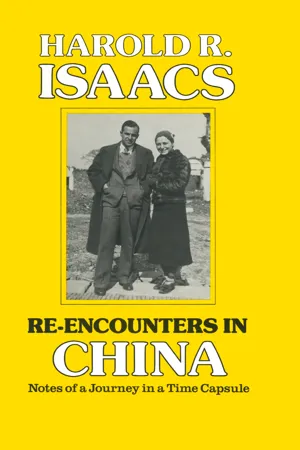
- 208 pages
- English
- ePUB (mobile friendly)
- Available on iOS & Android
eBook - ePub
About this book
First Published in 1985. This book provides an observation of the Chinese Revolution by a journalist who returned to China in 1980 and can give a unique perspective and insight into that traumatic experience. Harold Isaacs who in the 1930s knew Soong Ching-ling (Mme. Sun Tay-sen) one of the great women of modern history, sensitivity brings to the reader the revolutionary ideals and dreams of the people of Shanghai.
Time Capsule in Shanghai
OCTOBER 1980
Huddling under an umbrella in a chilly rain on a darkening afternoon, we stood before a stone marker in the Cemetery of the Martyrs in Lunghua, at the southern end of Shanghai. It was one of about a hundred such heavy mottled reddish brown stones standing in even rows. Under them, we were told, lay about one thousand martyrs of the revolution buried in mass graves. A single high shaft of plain gray stone rose at one side, overlooking the field of the dead. From the outside, but for this shaft, the place was all but invisible from the road going by it in this shabby far-off corner of the great city.
Those buried here, said the official in charge, were mostly soldier dead, killed during the final advance on the city by Mao's Liberation Army in 1949, with the addition of some who had died earlier fighting the Japanese, These remains were all brought here from the older Hungjao Cemetery when this new park was made ready in 1959. There were scattered others, he added vaguely, buried here since then. But none, it appeared, dated further back than the remains of the twenty-four bodies buried under the stone before which we stood. This was the grave of the much-chronicled "Five Martyred Writers" and the long anonymous "nineteen others" executed at Chiang Kai-shek's Shanghai-Woosung Garrison Headquarters, not far from this spot, on the night of February 7, 1931. After the Communist victory, their remains had been dug up out of the grounds of the headquarters compound, moved first to a temporary grave elsewhere in the city and finally to this place. Only then did most of the anonymous "others" regain the identities that had lain so long buried with their bones. The stone before us bore photographs not only of the famous Five but of seven others, and the names of seven more for whom pictures could not be found, leaving only five to be listed still as "unknown."
I stood there in the downpour, swept by a great jumble of feelings of waste and failure and anger and irony and sadness and loss coming out of the killing of the dreams of these young people and the killing of my own, mingled in half-shredded memories and the crowded overlay of nearly fifty years covering what had happened to them, and to me, in Shanghai so long ago. They were long gone, but here I was, on a journey of re-encounter, invited by the Chinese Writers Association to re-connect with some of that past, to meet some of its survivors, and here, at this place, to remember its dead.
* * *
I had come to stand at this spot because the story of these Five and the "nineteen others" had a vivid part in the shaping of my own life, I had never met them. They were arrested and executed only a few weeks after I arrived in Shanghai in early December 1930, a twenty-year-old tyro journalist in search of experience and definition, with only the dimmest flickers of political ideas in my head. I had studied something of the history of modern China, the century-long record of Western and Japanese encroachment on its sovereignty, the wars waged to control its territory, trade, and wealth, the revolutions that tried to wrench it from its desiccated past and suffocating present. Indeed, learning these things was part of what had drawn me to make my way to China as soon as I finished at Columbia College; it had taken me nearly a year, with stops to work in Honolulu and the Philippines, to get there. But I knew nothing real about the degrading life and oppressive politics of the scene into which I had come. I found work as a reporter, first with the American-owned Shanghai Evening Post & Mercury, and then, as an editor, with the China Press, newly acquired by a Chinese syndicate from its previous American owners. In these jobs, I began to learn the who-was-who and the what-was-what in this treaty port center of Western power and influence in China. The master race foreigners—British, French, American, Japanese—with their special preserves and their arrogantly held privileges dominated the subordinated and subjected Chinese in all their varieties of second-placeness, from the unbelievably rich in their great mansions down to the burden-carriers, the maimed and bleeding and whining beggars, the child prostitutes and abandoned infant dead in the streets.
The Shanghai of the early 1930s was very much the creature of its peculiar history, with its foreign-ruled enclaves created by treaties imposed nearly ninety years before, the International Settlement* and French Concession, and the sprawling Chinese city that grew up around all the licit and illicit sources of work and wealth that they provided. Treaty-protected foreigners enjoyed extraterritorial "rights"—independent political status in the country, exemption from Chinese legal jurisdiction and taxation—and the advantage of a five percent limit on China's power to tax the imports that entered the country through these treaty port establishments. These places, rights, and privileges were guarded by the foreign powers with fleets of warships and garrisons that were speedily enlarged in times of trouble (as in 1927 when the British Concession at Hankow was over-run and Shanghai seemed threatened in the same way) and with their own police forces and courts to maintain their own rule and control over their own space.
The Chinese who lived in and around these foreign enclaves were in effect a colonial population, the "natives" of a regime complete with all the trappings of the European colonial system, including the discriminations, exclusions, and racial attitudes practiced by the foreign masters and the submissive acceptance of the "treaty-port mentality" by great numbers of Chinese in their role as subjects. For many, shame and anger remained near the surface of this acceptance. It was the older more deeply rooted Chinese chauvinistic pride more than anything else that fueled the nationalist revolution that challenged this state of affairs in the 1920s. Even when he had blunted that revolution when he seized power in a coup in 1927 and began massacring his Communist allies, Chiang Kai-shek had to keep pressing the nationalist demand for abrogation of the "unequal treaties" and rendition of the foreign concessions. This was a demand, incidentally, to which his foreign friends and mentors did not yield until long after they had been deprived of their "rights" and driven from the treaty ports by their rivals, the upstart imperialist Japanese. The United States did not sign a new treaty relinquishing extraterritoriality—its first ever "equal" treaty with China—until 1943.
Society in Shanghai in the early 1930s was made up of the familiar colonial pieces: foreigners of the treaty powers, a privileged caste; an upper class of treaty port Chinese grown wealthy as participants, adjuncts, agents—"compradore" was the China coast word—of foreign enterprise, and more limitedly as aspiring competitors; a large class of Chinese white collar employees and workers making their living in both foreign and Chinese establishments; and a great mass of helot-like poor that kept flocking in from the ravaged and impoverished countryside, providing an endless supply of the laborers, human beasts of burden, beggars, prostitutes, criminals, and ultimately helpless people who left some 50,000 dead babies on the streets of the city each year—there was a philanthropic organization whose sole activity consisted of picking up and disposing of these tiny corpses. Greater Shanghai in 1930 was a city of more than three million with about 50,000 foreigners, half of them Japanese.
The French Concession existed largely as a base for the operations of the criminal gangs rooted in the old network of Yangtze Valley secret societies. They controlled the opium smuggling, gambling, prostitution, and assorted other rackets which were such a large part of the life of the city. By 1927, these gangs had come to play a cardinal political role, serving as agents of the Kuomintang in dealing with unions, radicals, and other opponents of the regime. Their principal leader, Tu Yueh-sheng, was treated with deference by both the Kuomintang and foreign authorities and was invariably referred to in the Chinese and foreign press as "a prominent merchant" and "philanthropist." These were the elements that provided much of the atmosphere and incident of the Shanghai of Malraux's La Condition Humaine, a novel built, with remarkable fidelity to the main facts, around the events of Chiang Kai-shek's coup in Shanghai in 1927.
In the British-dominated International Settlement (Americans, Japanese, and some token Chinese also sat on the Municipal Council), a characteristically more elaborate structure of formal legality was maintained to support the idea that the Settlement was a rock-like island of Anglo-Saxon justice in the chaotic sea of Chinese lawlessness that swirled around it. As such, the Settlement had provided asylum over the years for varieties of political "outs," especially those in whose survival foreigners had an interest or by whom they did not feel threatened. Faction-fighting warlords and politicians of high and low order were safe inside the foreign boundary. In the 1930s, Shanghai was full of such refugees from the conflict of cliques and persons in and around the newly established regime of Chiang Kai-shek. In its Shanghai version, the British "rule of law" could be stripped down to its barest pretenses and still provide some cover, some limited freedom of movement, and even of publication, for opponents of the regime. What was dangerously "illegal" outside could be at least "semilegal" or even "legal" inside the Settlement boundaries.
Where real or alleged Communists were concerned, however, these margins of difference narrowed and all but disappeared. From 1927 on, the task of ferreting out and disposing of these more dangerous enemies became a shared concern of the foreign and Kuomintang authorities. The Shanghai Municipal Police had its own "Special Branch" to deal with political matters and, like the Kuomintang, it recruited defectors and informers from among the Communists. The legal system was readily bent to these special needs. Extradition of Chinese criminals from the Settlement to Chinese jurisdiction required proceedings in a Settlement court to establish that there was a "prima facie" case against them. This was done with due care when the accused had done nothing worse than steal or kill; it became a swift and farcical procedure when it involved individuals arrested as "Communists." Between 1930 and 1932, Settlement courts handed over 326 real or alleged Communists to the Kuomintang, the prima facie case frequently consisting of the production of a piece of "Communist literature," often a simple anti-Japanese leaflet. No one ever knew how many of these disappeared into Kuomintang prisons or, like the Five Writers and those nineteen others arrested that January night in 1931, went to their deaths at the hands of Kuomintang executioners waiting just beyond the Settlement limits.
My grasp of these matters came in stages. What I saw first was a scene dominated by the brutally unequal relationship between "foreigner" and "Chinese." It took a little more time for me to bring into focus more of what lay also between "Chinese" and "Chinese." The week the Five Writers and the nineteen others were executed, I was just beginning my brief tenure as one of the editors of the China Press under its new Chinese owners. It was to be the first Chinese-owned English-language daily ever published in the city. I took a grandly naive view of the opportunity. "A new path is to be blazed," I wrote in an exuberant front page editorial. "We hope to give our readers a clear and coherent and accurate picture of China today." Unlike the blinkered foreign press, we would offer our readers the fruits "of intellectual honesty and newsgathering efficiency." Hitherto, the English-reading public was "handicapped in its judgment for lack of facts. Our columns shall offer the solution." I also wrote a full page advertisement that we ran in other newspapers the same day, proclaiming in heavy black type: "The new China Press aims to fill a hole that has been empty since the first foreigner stepped ashore on Chinese soil."
Well, it did not take long for this experience to run its course. I quickly learned what gyrations it took to help edit a daily in Shanghai for a Chinese syndicate that also owned several Chineselanguage dailies, was subject to the pressures of the Kuomintang government in Nanking, and had as its managing director a man named Hollington Tong, who had once been Chiang Kai-shek's teacher and had become one of Chiang's most faithful, tense, timid, and voluble minions. He and I argued almost every night, usually over what could and could not be said in stories and headlines dealing with news from Nanking. Besides having to learn how to tread lightly on the thin ice of Chinese politics, I had to discover the game of substituting words for realities which was played one way or another every day, some days more wildly than others. The example I remember best came one day in an official Kuo Min News Agency report in its regular daily service which said that as a result of talks about modifying the system of extraterritoriality, the American and British warships had left their usual mooring places in the Whangpoo River off the Bund. I first went out to have a look, then came back and called Kuo Min's man in Shanghai whose name was Li Choy, whose head was always cocked, expression always quizzical, mouth always crooked with a sardonic smile. I told him the gray ships were still there, as he and I knew they would be. "Not according to our report," he said, and hung up.
Holly Tong and I had become friends, after our fashion. I had come even to enjoy our arguments mainly because I learned so much from them. He looked kindly on me mainly, I think, because one night I tried to dissuade him from answering a summons to go to Nanking where a factional crisis of some kind was coming to a head and I thought he might be arrested. (Years later he reminded me of that night in the midst of another argument about censorship we were having in Chungking in 1944 when he was Chiang's Minister of Information and I was a war correspondent for Newsweek.) When I quit the China Press in May 1931 after only four months, Holly accepted my resignation. A broken vase, "no matter how cleverly mended," he wrote me sadly, could never again be as it was. But he saved "face" for both of us by appointing me a roving correspondent, beginning with an announcement, featured on the front page with pictures, that I and a friend, a South African newsman named Frank Glass, were leaving for a trip up the Yangtze River.
Glass and I left Shanghai to see something of this vast country, chugging up the great river in a squat little steamer, draft shallow enough to make it almost flat-bottomed, steel-plated around the bridge for armor against rifle fire from unfriendly "bandits" on the riverbanks. Wherever we stopped to load or offload cargo at riverports—Kiukiang, Hankow, Shasi, Wanhsien, Ichang—for hours and days ashore we wandered the streets and alleys, looking, asking, taking in the glares or curious stares of people and a thousand other wordless impressions of the life around us. During the long slow days of passage against the wide river's swift current, we engaged in endless hours of talk about the world and its affairs, politics, and how one lived one's life. From the bridge our captain, a hard-seamed American named Anderson, never failed to toot salutes to passing American and other foreign gunboats, also squat and shallow-drafted craft, which patrolled the whole length of the river, periodically reassuring missionaries and businessmen in the riverports, fearful always of some Chinese trespass on their extraterritorial rights and property. We were forever passing great and small junks and sampans carrying people and goods through the vast central valley of the land. One prime item of their cargo was opium. Opium was officially contraband. At every port there was an "Opium Suppression Bureau." But opium moved in many of these boatloads, and at every port the "smugglers" stopped in at the Opium Suppression Bureaus to contribute to the opium trade tribute that made up a substantial part of Chiang Kai-shek's revenues. At the valley's end beyond Ichang where the great Yangtze Gorges began, we were pulled through the churning current by long lines of naked trackers straining at their ropes, edging slowly forward along paths cut out of the storied cliffs lining the upper reaches of the river, coming finally to Chungking, a thousand and five hundred miles inland from the sea.
From Chungking, where Glass turned back, I went on alone for weeks more, by bus, pony, and on foot, to Chengtu and beyond, deep into western Szechwan as far as Tachienlu at the beginning of the Himalayan ascent into Tibet. From that last stretch at the far end of this long journey of discovery, one encounter and two moments of sensation rise unbidden to the surface of memory. The encounter was with a young American missionary couple with whom I stayed as a paying guest in their comfortable western-style house inside of the compound of the major missionary institution in this part of the country, West China Union University, in Chengtu. In a conversation that must have begun with some aggressive questioning by me, I discovered that they were deeply troubled by what they had come to see as the intolerable contradictions of the missionary enterprise and their own role in it. They were close to deciding to leave, or were at least facing their dilemma with great pain. I do not know what choice they made, but I remember gratefully that they taught me one of my early lessons about what I eventually came to call "witless generalizations" about the varieties of human experience.
The first of the two moments of sensation was the fragrance of kwei-hua, a thickly growing golden bloom, that reached me one day on the road west of Chengtu, rising from gardens ahead of me planted long ago by some royal or ducal master of this land, carried in the air for miles by the western breeze, drawing the traveler on like a character in an ancient tale toward some ineffable enchantment. The second was the sight of the great mountains rising from the western Szechwan plain, so close and clear from where I looked up at them from a spot near the foot of the steep road leading up the slopes from Tachienlu. There was an open market there by the road where mountain people, so different in face, figure, dress, and speech, came down to exchange wares with the lowland Chinese. From one of them I bought the two Tibetan tankas, temple hangings, old and stunning, that still hang on our walls. I came there day after day and finally had to wrench myself away, fighting off the impulse to keep on going up that road into those mountains and on to the top of the world that lay beyond them.
There were sights and beauties enough along the whole way I had come, enough to teach me how to look ever after at Chinese painting, but never enough to offset for more than a relieving moment the daily exposure to what one never saw in Chinese painting, namely people, masses of human beings trapped in toil and poverty and disease. Not all the fragrance of all the kwei-hua in China could cover the stench and filth that pervaded so many places through which I could walk like a visitor from another planet, not subject to any of their pains and rigors as, indeed, being an extraterritorial foreigner, I was not subject to their laws. I had only to hold my nose against the smell for a few hours at a time. And as though chance itself was intent on extending this experience to extremes, having come upriver through so many scenes of ordinary hardship imposed on people by a social order, I went back downriver amid extraordinary suffering inflicted by a great natural disaster, all the deaths and unattended mass miseries of the Yangtze River flood of 1931. Floating corpses and wreckage glutted the river all the way down, my first experience of horror on such an enormous scale.
Except for pulling a few stranded refugees aboard the small boat, I traveled down the Min River back to the Yangtze at Suifu, 200 miles west of Chungking, I passed through all of this as an onlooker, helpless and unhelping. This separation of fates and involvement bore in on me hard throughout this journey across the whole breadth of the country in those months. Of foreigners I had encountered here and there I wrote at the time, sweepingly as was my wont but not too in...
Table of contents
- Cover
- Half Title
- Title
- Copyright
- Contents
- Preface
- Time Capsule in Shanghai
- Soong Ching-ling
- Ting Ling
- Mao Tun
- Liu Tsun-chi
- About Lu Hsun
- Chen Han-seng
- The Doctored Photo
- Wang Hsin-ti
- Wu Chiang
- Chen Yi
- Of the Larger Politics
- Canton
- A Note on Some Readings
- Romanizations
Trusted by 375,005 students
Access to over 1.5 million titles for a fair monthly price.
Study more efficiently using our study tools.
Frequently asked questions
Yes, you can cancel anytime from the Subscription tab in your account settings on the Perlego website. Your subscription will stay active until the end of your current billing period. Learn how to cancel your subscription
No, books cannot be downloaded as external files, such as PDFs, for use outside of Perlego. However, you can download books within the Perlego app for offline reading on mobile or tablet. Learn how to download books offline
Perlego offers two plans: Essential and Complete
- Essential is ideal for learners and professionals who enjoy exploring a wide range of subjects. Access the Essential Library with 800,000+ trusted titles and best-sellers across business, personal growth, and the humanities. Includes unlimited reading time and Standard Read Aloud voice.
- Complete: Perfect for advanced learners and researchers needing full, unrestricted access. Unlock 1.5M+ books across hundreds of subjects, including academic and specialized titles. The Complete Plan also includes advanced features like Premium Read Aloud and Research Assistant.
We are an online textbook subscription service, where you can get access to an entire online library for less than the price of a single book per month. With over 1.5 million books across 990+ topics, we’ve got you covered! Learn about our mission
Look out for the read-aloud symbol on your next book to see if you can listen to it. The read-aloud tool reads text aloud for you, highlighting the text as it is being read. You can pause it, speed it up and slow it down. Learn more about Read Aloud
Yes! You can use the Perlego app on both iOS and Android devices to read anytime, anywhere — even offline. Perfect for commutes or when you’re on the go.
Please note we cannot support devices running on iOS 13 and Android 7 or earlier. Learn more about using the app
Please note we cannot support devices running on iOS 13 and Android 7 or earlier. Learn more about using the app
Yes, you can access Re-encounters in China by Harold R. Isaacs in PDF and/or ePUB format, as well as other popular books in History & Chinese History. We have over 1.5 million books available in our catalogue for you to explore.