eBook - ePub
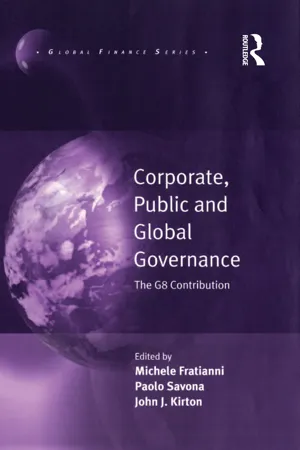
Corporate, Public and Global Governance
The G8 Contribution
- 324 pages
- English
- ePUB (mobile friendly)
- Available on iOS & Android
eBook - ePub
About this book
The intensifying pace of globalization has led to a questioning of the traditional approaches to governance at the corporate, national and international levels. The crash of the dot-com bubble and the outbreak of corporate accounting scandals in the United States, along with the debt burden of financial institutions in Japan and Europe, have led to demands for major reforms. Consequently, national governments are confronting stronger demands for new ways to regulate corporations to fulfil their social responsibilities and generate growth in a competitive world. This volume explores three central questions: what forms of corporate governance are most desirable for the globalizing world of the twenty-first century? What forms of public governance are most appropriate in this new age? And how well are the world's leading national governments pioneering the needed policies and practices? The book offers an analysis of the G8's role in assisting governments and corporations to work together to design and deliver a superior approach.
Information
Introduction
Chapter 1
Governance amid Globalisation: Corporations, Governments, and the G8
The New Challenges of Corporate and Public Governance
At the beginning of the 1990s, the world rejoiced in the transformation of the Soviet Union and bloc into free market economies with autonomous private sector corporations, regulated under the rule of law by democratic national governments and supported by the principles and power of international organisations — from the old International Monetary Fund (IMF) to the new World Trade Organization (WTO) — devoted to making their choice of free market capitalism work. The booming U.S. economy led many to believe that the free market–oriented American model of corporate, public, and global governance was the harbinger for the national experiences and global regime that would dominate the 21st century. The U.S.-hosted summit of the Group of Eight market democracies in 1997 in Denver seemed to suggest that all the world’s major powers were united in their acceptance of this approach to the new world.
Then came the 1997–99 Asian-turned-global financial crisis, which infected America itself with the collapse of the Long-Term Capital Management (LTCM) hedge fund in the autumn of 1998. At the same time, a stagnant continental Europe and Japan offered no convincing alternative model of how to proceed. During the financial crisis, Russia defaulted — raising doubts about how devoted it would be to its new capitalist path. Subsequent financial crises and defaults in Brazil and Argentina raised further questions about how the American-pioneered model would work in the emerging developing countries, and how the global institutions should respond or reform.
As the 21st century dawned, the collapse of America’s dot.com-fuelled stock market and economy further assaulted confidence in the American model. The subsequent terrorist attacks on the U.S. on 11 September 2001 strongly suggested that the U.S. would fundamentally alter the rules to privilege the state and its security concerns over those of the private sector and its efficiency and profitability drive. Soon after came the spectacular sequence of corporate scandals: from Enron, WorldCom, Tyco, and Global Crossing in the U.S. through Nortel in Canada and Parmalat in Europe to collapsing financial institutions in Japan. Yet just as these collapses led to greater modesty among all members of the G8 about the virtues of their traditional national models of corporate and public governance, the divisions bred by the U.S.-led invasion of Iraq in the spring of 2003 made it difficult for the world’s leading powers to come together to chart a new way ahead.
Thus, at the start of the new century, the intensifying pace of globalisation and the shocks it has brought have called into ever more serious question the traditional approaches to governance at the corporate, national government, and global levels. The need for new global approaches in response has been rendered more acute. Within the corporate community, the old model of national firms based in national markets regulated by national governments is fading fast. It is being banished by the strengthening forces of globalisation and the corresponding shifts in corporate strategy toward the regional and global supply chain and marketplace. Globalisation is forcing firms radically to alter longstanding production, marketing, and management strategies in order to survive and thrive in a more densely interconnected world (Lawton 2001). Compounding the pressure is accumulating evidence from the three regions of the G8 that the old ways no longer work. In the United States, the collapse of the dot.com boom and the outbreak of corporate accounting scandals at many of America’s other leading and once most trusted firms have led to widespread calls for reform and far-reaching action in response. In Canada, accounting failures in leading firms such as Nortel have produced a similar response. In Japan, the collapse of several major firms, the heavy debt burden and opaque reporting practices of financial institutions, and the failure of past government efforts at reform have brought mounting concern throughout the country and beyond. In Europe, contracting or collapsing corporations shrouded in scandal, such as Italy’s Parmalat, have generated anxiety across a continent mired in sluggish growth. In Russia, the assault on Yukos has raised deep concerns about the survival of the rule of law for domestic firms, about a welcoming environment for investment by foreign multinational corporations (MNCs), and even about the government’s commitment to basic democratic values (Goldman 2005; Porshakov 2006). In rapidly emerging giants such as China, and emerging economies and developing countries in transition everywhere, professional, transparent, responsible corporate governance, an end to corruption, and respect for the rule of law are widely seen as the key drivers of economic growth, social cohesion, and good democratic political governance as well (Whalen 2005; Imle 1999).
Throughout the world, there are thus growing demands for major reforms of the corporate sector so that firms might effectively perform their role as rational productivity-enhancing economic actors underpinning the G8 and global growth (Fratianni et al. 2003; Gourevitch and Shinn 2005; Gourevitch 2003). At the same time, a newly empowered civil society and an intensely interested array of employees, investors, pensioners, suppliers, customers, consumers, and those in the surrounding local communities are placing greater economic and social demands on firms from the outside (Kirton and Hajnal 2006; Winston 2002). As most major national governments struggle with burgeoning fiscal deficits and move to concentrate scarce budget resources on a new generation of security threats, firms are being asked to meet ever higher and broader standards of corporate responsibility to cope with the social and environmental concerns, on a global scale, demanded by this empowered citizenry (Prakash and Hart 1999; Estrin 2002; Kirton and Trebilcock 2004; Clapp 2005; Wrage and Wrage 2005).
As a result, national governments are confronting stronger demands for new ways to regulate ‘their’ corporations, both to generate growth and to fulfil their social responsibilities in an increasingly competitive world. And they have responded, none with more speed and severity than the United States with the swift passage of the far-reaching Sarbanes-Oxley Act in 2002. That act used the nation-state’s legal power to impose new requirements and penalties on private sector firms in the U.S., and on those from abroad that wish to do business there. Yet it immediately raised an outcry from America’s closest partners about its unilateral effort to impose a system extraterritorially that assaulted many others’ historically embedded national practices and that had doubtful global benefits (Engelen 2004a, 2004b; Gersemann 2004; Legrain 2004; Whalen 2003, 2004, 2006). And, within a few years, America’s own firms were highlighting the act’s disadvantages with such ferocity that some in the U.S. government seemed willing to back off.
In part, America’s rethinking flowed from the fact that globalisation is limiting government’s ability to regulate corporations, especially in the face of vigorous competition from China and other countries where lesser standards prevail. The dark side of globalisation, in the form of the terrorist attacks of September 11, 2001, and an upsurge in transnational crime, is bringing more onerous demands from national governments to put public security first. At the same time, a more open global marketplace makes it easier for firms to flee to jurisdictions where regulatory costs are lower, the public infrastructure more supportive, and governments more willing to let private sector actors behave freely. In the face of these intensified pressures of globalisation, even the most powerful national governments are losing faith that the historical, publicly supported models of corporate governance that served them so well for so long are adequate for the new age (Brean 2001). The ‘insider’ institutional model favoured by Japan and Germany now seems to be a recipe for inefficiency, inflexibility, stagnation, and deflation. Yet the ‘outsider’ market model long heralded by the U.S., Britain, and Canada, and offered as the model for the new Russia, no longer appears to be a certain recipe for vibrant growth, leapfrogging productivity, income equality, and good jobs. National governments know they need to change and all major governments are looking to one another in their search for the proper ways to act. They do so to discover a better model to meet their own needs. They do so also because they know their neighbours’ choices will directly affect how well their own approaches will work at home.
Thus, corporate governance — a subject long the preserve of national and even sub-federal governments — is now intruding onto the international agenda, and indeed ‘going global’ at an accelerating pace. The result is an enhanced need for international cooperation, not only to harmonise or otherwise reduce friction between different national systems (Ostry 1997), but now also to collectively define the best way for all to proceed in the new age. Yet this new need and ensuing effort come at a time when the international institutions that have long led such activity — notably those of the Organisation for Economic Co-operation and Development (OECD) and the United Nations — are facing new challenges of their own. In all these established organisations, firms are demanding a greater and more direct role in international governance, even as other sectors of civil society demand a similar role for themselves to offset the disproportionate power that they claim business already has (Hajnal 2002). At the same time, the international institutions know they need the participation and resources that business and the other stakeholders bring. With UN secretary general Kofi Annan’s Global Compact, as well as the work of the IMF, the Financial Stability Forum, and other financial institutions in developing codes and standards, a substantial start has been made (Cragg 2000; Sethi 2002; Aaronson 2002).
Yet larger issues remain at the forefront of both corporate and public concern. In the most general terms, should the emphasis be placed on a freely functioning marketplace, guaranteed by transparency, stakeholder accountability, and voluntary standards? Or does the new globalising era require a new generation of intergovernmental institutions and regulation, comparable in magnitude to the UN–Bretton Woods galaxy created more than half a century ago, but far different in design? In the field of international finance, the issue has been highlighted by the debate over the need for a formal, global sovereign debt-restructuring mechanism, beyond the collective action clauses in bond contracts preferred by the private sector and governments such as Mexico. In the field of international trade, the dilemma is well expressed by the outstanding question of how much and how firms’ intellectual property rights should be overridden by public health concerns. And in the field of environmentally sustainable development, it arises again in the Kyoto Protocol’s demand for hard law requirements with targets and timetables, as opposed to the preference expressed at the World Summit on Sustainable Development (WSSD) in Johannesburg for public-private partnerships and a voluntary, market-based approach. Even in the reigning political-security question of rebuilding Iraq, the instinct to write off accumulated debts for the new government on an ad hoc basis, at the request of a few sponsor states, competes with the call to create a new intergovernmental regime with firm rules and independent judges to determine which of the world’s many debt-burdened governments can fairly secure their claim.
The G8 Response
It is thus not surprising that the issues of corporate and public governance, and their interconnections, increasingly command the attention of the G7 and G8 major market democracies. The G7/8 summit and system have long been concerned with corporate governance, as their initial focus in the 1970s on macroeconomic policy gave way in the 1980s to microeconomic issues and then, in the 1990s, to the behaviour of firms themselves. The G7/8’s interest in corporate behaviour and its regulation initially focussed outside the G7, as the democratic revolution in Russia and the transition economies, and the global financial crisis directed attention to how poor corporate governance in once distant countries could badly harm the global economy and thus the G7 itself. The seminal shocks of the collapse of Britain’s Barings Bank in 1995 and America’s LTCM in 1998 brutally brought the issue home (Baker 2006). The G8’s corporate governance agenda of the 21st century has thus come to centre on how things work within the individual firms within the G8 countries. It is a question so close to home, so domestic and so intimate, that no G8 government is willing to delegate its treatment to the international organisations of the UN or even the broadly multilateral institutions where G8 governments have greater control. The G8 is thus emerging, in terms of the new corporate governance agenda, as the global governor of first and last resort.
The 1995 Halifax Summit marked the G7’s first major foray into the issue of corporate governance, due to the springtime collapse of Barings Bank and the summit’s focus on whether the world’s existing international institutions could cope with the global community’s 21st-century needs. At Halifax, the leaders asked for private pension plans to bear more of the burden of an aging society, welcomed private sector participation in the Global Information Society, and concentrated on the supervision of international financial institutions (IFIs), especially in the fields of banking and securities.
As the dynamics of globalisation intensified, and the 1997–99 global financial crisis took hold, the G7/8’s agenda and action on corporate governance, as well as its related public and global governance dimensions, expanded commensurately. The G7/8 rapidly came to address the behaviour of large MNCs themselves. With regard to countries such as Russia, it took up the need for a stable rule of law for companies and a corporate culture to convince investors and other stakeholders that rational market-oriented behaviour is replacing the gangster capitalism of old. The global financial crisis bred a G7-led effort to create global codes of conduct to govern the behaviour of financial institutions and corporations in developing and emerging economies, bringing the issue of corporate governance to centre stage (Kaiser et al. 2000). At Cologne in 1999 and Okinawa in 2000 the G8 placed a new emphasis on transparency and accountability, on combating money laundering and tax evasion, on having corporate behaviour promote the new priorities of human security, and on setting the rules to shape the information technology revolution. These moves made corporate governance of core concern to the G8 over a broad policy terrain. Genoa 2001 signalled that good governance, in both its corporate and national government dimensions, on issues such as corruption, is essential to development in very poor regions such as Africa as well.
The following year, 2002, saw the G8 take a major step forward, as the September 11 terrorist attacks and the Enron and WorldCom scandals forced North American leaders to act (Masciandaro 2004). Meeting in Halifax on 15 June, the G7 finance ministers called on Russia to ‘strengthen the financial sector, improve corporate governance and the investment climate, and combat money laundering and terrorist financing’ as the key to self-sustaining democratisation and growth (G7 Finance Ministers 2002). Immediately afterward, the G8 leaders, in their G8 Africa Action Plan, welcomed ‘the adoption on June 11 by the NEPAD Heads of State and Government Implementation Committee of the Declaration on Democracy, Political, Economic and Corporate Governance and the African Peer Review Mechanism’ and called for ‘strengthening public financial management and accountability, protecting the integrity of monetary and financial systems, strengthening accounting and auditing systems, and developing an effective corporate governance framework’ (G8 2002).
Issues of corporate and public governance were at the centre of the 2003 G8 summit in Evian, as the G8 took up the formidable task of charting a new path for the world. That summit, the first in a new cycle, dealt with a French government proposal to strengthen corporate governance, in the wake of Enron and other scandals that had broken on the eve of the G8 summit the year before. The French sought ways to strengthen corporate responsibility and build a responsible market economy. The British mounted the Extractive Industries Transparency Initiative (EITI), intended to increase transparency about the large sums of money flowing from resource industries to the coffers of national governments that recurrently sought concessional loans and debt relief from the IFIs. At the G8 finance ministers meeting on the road to Evian, France raised the issue of regulating international credit rating agencies. France was aiming to secure a transparent, accountable set of principles, agreed upon by the agencies themselves, to deal with potential conflicts of interest in one of the remaining unregulated components of the international financial industry. The Evian Summit itself dealt more broadly with the need to reform the banking and financial sector in Japan and Germany as part of an enhanced effort to generate global growth. In its larger development agenda, it privileged sectors such as water, where the practices of the world’s major MNCs, in public-private partnerships, were a prime concern. And in the political-security field, with combating terrorism through controlling weapons of mass destruction (WMD), preventing conflict, and constructing a new Iraq on the agenda, the G8 saw that corporations also played a critical role. Corporate and public governance — and coherence — was essential throughout the summit agenda.
While Evian marked the G8’s advent into corporate, public, and global governance as a primary concern, the 2004 Sea Island Summit made important advances as well. One was in the fight against corruption, where a detailed new framework was established and backed by specific plans of cooperative G8–national government action with willing partners around the world. Yet despite such advances, and despite the new spirit of cooperation overtaking the divisions regarding the spring 2003 war in Iraq, pronounced differences among G8 partners remained. They easily agreed on the centrality of combating corruption and fostering good governance as keys to development in poor countries. But they remained at odds over the emphasis to be placed on investing in an institutional capacity or demanding campaigns against corruption as a precondition for concessional resource transfers, and on whether the onus to act lay on corporations or governments, in developed or developing countries. And they authorised both the British-driven EITI and the American-led framework against corruption, rather than integrating the competing approaches into a single, G8-wide regime.
These divisions remained for the British-hosted 2005 summit at Gleneagles, Scotland. They were exacerbated as soaring oil prices and demands for far-reaching debt relief and official development assistance (ODA) led to questions about the best way to ensure that a now democratic, oil-rich but still poor Nigeria was placed firmly on the track to sustaina...
Table of contents
- Cover Page
- Title Page
- Copyright Page
- Contents
- List of Tables
- List of Contributors
- Foreword
- Preface and Acknowledgements
- List of Abbreviations
- PART I INTRODUCTION
- PART II GLOBALISATION’S CHALLENGES FOR GOVERNANCE
- PART III CORPORATE GOVERNANCE
- PART IV PUBLIC GOVERNANCE
- PART V THE GOVERNANCE OF GLOBALISATION
- PART VI THE G8 CONTRIBUTION
- Documentary Appendices
- Bibliography
- Index
Trusted by 375,005 students
Access to over 1.5 million titles for a fair monthly price.
Study more efficiently using our study tools.
Frequently asked questions
Yes, you can cancel anytime from the Subscription tab in your account settings on the Perlego website. Your subscription will stay active until the end of your current billing period. Learn how to cancel your subscription
No, books cannot be downloaded as external files, such as PDFs, for use outside of Perlego. However, you can download books within the Perlego app for offline reading on mobile or tablet. Learn how to download books offline
Perlego offers two plans: Essential and Complete
- Essential is ideal for learners and professionals who enjoy exploring a wide range of subjects. Access the Essential Library with 800,000+ trusted titles and best-sellers across business, personal growth, and the humanities. Includes unlimited reading time and Standard Read Aloud voice.
- Complete: Perfect for advanced learners and researchers needing full, unrestricted access. Unlock 1.5M+ books across hundreds of subjects, including academic and specialized titles. The Complete Plan also includes advanced features like Premium Read Aloud and Research Assistant.
We are an online textbook subscription service, where you can get access to an entire online library for less than the price of a single book per month. With over 1.5 million books across 990+ topics, we’ve got you covered! Learn about our mission
Look out for the read-aloud symbol on your next book to see if you can listen to it. The read-aloud tool reads text aloud for you, highlighting the text as it is being read. You can pause it, speed it up and slow it down. Learn more about Read Aloud
Yes! You can use the Perlego app on both iOS and Android devices to read anytime, anywhere — even offline. Perfect for commutes or when you’re on the go.
Please note we cannot support devices running on iOS 13 and Android 7 or earlier. Learn more about using the app
Please note we cannot support devices running on iOS 13 and Android 7 or earlier. Learn more about using the app
Yes, you can access Corporate, Public and Global Governance by Michele Fratianni,Paolo Savona in PDF and/or ePUB format, as well as other popular books in Politics & International Relations & Globalisation. We have over 1.5 million books available in our catalogue for you to explore.