eBook - ePub
Bloodlines
Recovering Hitler's Nuremberg Laws from Patton's Trophy to Public Memorial
- 280 pages
- English
- ePUB (mobile friendly)
- Available on iOS & Android
eBook - ePub
Bloodlines
Recovering Hitler's Nuremberg Laws from Patton's Trophy to Public Memorial
About this book
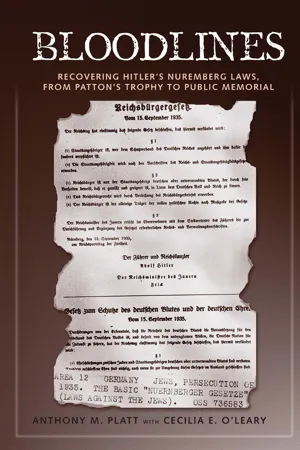
At the end of World War II, an American military intelligence team retrieved an original copy of the 1935 Nuremberg Laws, signed by Hitler, and turned over this rare document to General George S. Patton. In 1999, after fifty-five years in the vault of the Huntington Library in southern California, the Nuremberg Laws resurfaced and were put on public display for the first time at the Skirball Cultural Center in Los Angeles. In this far-ranging, interdisciplinary study that is part historical analysis, part cultural critique, part detective story, and part memoir, Tony Platt explores a range of interrelated issues: war-time looting, remembrance of the holocaust, German and American eugenics, and the public responsibilities of museums and cultural centers. This book is based on original research by the author and co-researcher, historian Cecilia O'Leary, in government, military, and library archives; interviews and oral histories; and participant observation. It is both a detailed, scholarly analysis and a record of the author's activist efforts to correct the historical record.
Chapter 1
Origins Stories
We, the survivors, see everything from above, see everything at once, and still we do not know how it was.
(W. G. Sebald, 1999)
Paradise for Humanists
During the summer of 1999, Cecilia O'Leary and I were awarded fellowships to study California's cultural history at the prestigious Henry E. Huntington Library and Art Gallery in Southern California.1 We expected our stay in secluded San Marino to be a leisurely break from preparing classes and our everyday lives as politically active intellectuals. Instead, we soon found ourselves in the middle of a passionate controversy about public history. Little did we imagine that a scholarly project on nineteenth-century Western history would lead us to an exploration of modern European history, Nazi legislation, the relationship between anti-Semitism and racism, fascist sympathies among California's elite, and the cultural politics of libraries and museums. And I certainly had no idea that this comfortable sabbatical in a sylvan retreat would trigger an exploration of contradictions in my own Jewish identity.
The Huntington, as it is known, is one of the oldest and most distinguished private institutions in the United States, globally recognized for its extraordinary library of rare books, exclusive collection of fine art, and elegant gardens. "Outside I have found a Garden of Eden for botanists," reported a visiting scholar in the 1940s, "and inside a paradise for humanists."2 For almost eighty years, since it opened its doors on a full-time basis to visitors in 1928, the "breathtaking" Huntington has been on every tourist list as "one of the real jewels of Southern California."3 Architecturally, its Beaux Arts buildings and palatial grounds evoke the imposing grandeur and gravitas of a European estate. Today, the half million annual visitors come primarily to stroll through one hundred and thirty acres of gardens; to visit the galleries in order to see Thomas Gainsborough's "Blue Boy" and other well-known examples of eighteenth and nineteenth century British and French art; and to attend special events, such as the popular Lincoln and Washington exhibitions mounted in the 1990s.
Most visitors, however, are oblivious to the fact that at the center of the Huntington is its library, which by the 1940s had achieved a worldwide reputation as a "Research Shangri-La" among scholars interested in its specialized collections on "the intellectual development of the English-speaking peoples."4 The Huntington now houses close to eight hundred thousand rare books and reference books, almost half a million photographs, more than half a million prints, maps, and ephemera, and four and one-half million manuscripts on British and American history, literature, art, and science.5 Treasured items include the Ellsemere manuscript of Chaucer's The Canterbury Tales (ca. 1410), the Gutenberg Bible (ca. 1455), original letters of Washington, Jefferson, Franklin, and Lincoln, a collection of early editions of Shakespeare, and first editions of Wordsworth, Shelley, and Thoreau.6
Cecilia and I found ourselves in the middle of this exclusive establishment, two of only two thousand researchers a year with access to the library's resources. We were there with a handful of other fellows, competitively selected, for the summer 1999 program. As professors in a state university system, with a demanding teaching load and few opportunities for research, we looked forward to steeping ourselves in the Huntington's unique collection, with time off to stroll through acres of manicured gardens and take afternoon tea in the Rose Garden Room. At the end of May we turned in our grades for the spring semester, closed down our home in Berkeley, and loaded up the car with our bikes and beach equipment, ready for the good life in the sun. We planned to do research on weekdays, but not make work into an obsession, especially since Cecilia was recovering from a serious illness. We had rented a house with a large pool in nearby Pasadena and invited family and friends to join us at the weekends for barbeques, hiking the Mt. Wilson trail, and workouts at the local health club. On June 1, the Huntington's staff welcomed us into the inner sanctum, briefed us on an extensive list of dos and don'ts, and assigned us our own desks in the library's clubby reading room.
Our proposed project focused on public amnesia: how California's violent origins have been largely forgotten and replaced by "invented traditions."7 Our aim was to understand how the state's preoccupation with utopian visions has obscured the bloody tragedies and atrocities that accompanied the rise of the Golden State. "Nowhere else were we Americans more affected than here, in our lives and conduct," wrote philosopher Josiah Royce in 1886, "by the feeling that we stood in the position of conquerors in a new land."8 More than a century later, myths of progress have obscured the state's genesis in militarism and conquest. In California, says Joan Didion reflecting upon her own upbringing, "we did not believe that history could bloody the land, or even touch it."9 Our research would illuminate, we hoped, the processes by which a variety of narratives became tapered into official history and embedded in everyday life—shaping the way we teach history in our schools and colleges; commemorating significant dates, people, and events; and enshrining historical significance in statues, symbols, and public holidays.
Cecilia had just completed a book on American patriotism that focused on how the nation battled over cultural definitions of loyalty and citizenship in the aftermath of the Civil War.10 Drawn to this topic by her experience in the anti-war movement, she wanted to understand why the Right has so effectively monopolized the symbols of nationalism.11 Now she intended to examine how the Mexican-American War, the Gold Rush and settler vigilantism, the Indian Wars, and the Spanish-American War in the Philippines shaped cultural rituals of patriotism in the West. My research would focus on how textbooks, travel guides, and the popular press glorified, justified, or minimized California's long history of violence and warfare.
We could not have found a better place than the Huntington to study the narrative of California: the stories, images, and symbols perceived as standing for the cultural essence of the state. Its collection of Western Americana includes diaries, correspondence, magazines, photographs, advertisements, and the personal papers of the men and women who created influential images of the Golden State. The Huntington's collections, we hoped, would enable us to understand the making and remaking of "the California story." We did not realize at the time that our investigation would take us across unanticipated historical and geographical borders, revealing "invisible connections that determine our lives ... and how the threads run."12
Eating breakfast on the patio by the pool on the last Saturday of June, I opened up the Los Angeles Times to read a front-page story that caught and retained my attention for the next five years. "Hitler Papers, Held Since '45 by Huntington, to Go on Display," read the headline.13 It was a surprise to me and most of the world that the Huntington had stored an original copy of the Nuremberg Laws, including Hitler's "Blood Law," in its most secure, bombproof vault for the previous fifty-four years.
Over the weekend, I looked for more information about this unexpected announcement and found it everywhere: in the New York Times, on the Internet, and on television and radio talk shows. The last time anything this important had had happened to the Huntington was in 1991 when it provided access for scholars to its photographic archive of the Dead Sea Scrolls, an event that enhanced the Library's public-spirited reputation.14 The Huntington is accustomed to routinely receiving flattering publicity about its world-famous acquisitions, popular exhibits, and breathtaking gardens.15
Once again, Huntington officials expected to draw favorable worldwide attention to its announcement on June 26, 1999, of its ownership of a rare original copy of Hitler's Nuremberg Laws, which it had possessed since 1945.16 Three days later, for the first time in the United States, the documents would be put on public display in Los Angeles at the Skirball, a shimmering, new Jewish cultural center that is prominently located in the Sepulveda Pass. What caught my attention in the story was that the Huntington had kept the Nuremberg materials off the books since 1945, without disclosing their presence to scholars or the public—preserved but not accessioned.
The Huntington, it was reported, would continue to own the documents, but would loan them to the Skirball for an indefinite period. In addition, the Huntington announced its loan to the Skirball of a "deluxe edition of Hitler's Mein Kampf whose nightmarish vision was realized by the Nuremberg decrees." The Nuremberg Laws and the book, claimed the Huntington, "were both presented to General George S. Patton, Jr. by his troops in 1945, and were later given to the Huntington by the general, along with correspondence from the general to the Huntington concerning all of these materials."17
The Huntington's announcement that it owned the original Nuremberg Laws struck a note of incongruity. Perhaps it was the revelation of an icon that evoked one of Europe's most notorious tragedies in juxtaposition to a stately library that had been imagined in the early twentieth century as a "Parthenon in Pasadena."18 The Huntington was the personal vision of Henry Edwards Huntington, who made a small fortune through development of the Pacific Electric Railway Company and other shrewd real estate speculation in and around Los Angeles. In 1913, Edward Huntington—as family and friends knew him—married his uncle's widow, Arabella, thereby combining the family's grand fortune amassed by railroad tycoon Collis Huntington of "Big Four" fame.19 After ruthlessly buying up the contents of more than two hundred libraries, Huntington moved his nationally acclaimed collection from New York to the West Coast, much to the grumbling of the national guardians of cultural taste who regarded Southern California as the "hinterlands."20
When the Nuremberg Laws surfaced in the exclusive residential enclave of San Marino in the summer of 1999, thousands of miles from their birthplace sixty-four years earlier, there was an extraordinary flurry of media activity. The Huntington's announcement drew more publicity than its public relations department could handle. The event was covered around the world in one thousand print and six hundred television stories.21 Beyond the Los Angeles Times, it was a front-page story in the Washington Post. CNN reported the event, as did the Sunday Herald in Scotland, Agence France Presse, and the International Herald Tribune. The New York Times reported the story on June 26 and again with translations of the Nuremberg Laws in its July 4 "Week in Review." Robert Skotheim and Uri Herscher, the presidents of the Huntington and Skirball respectively, were interviewed together on National Public Radio ...
Table of contents
- Cover
- Title
- Copyright
- Dedication
- Contents
- List of Illustrations
- Acknowledgments
- Definitions
- Quotations
- 1 Origins Stories
- 2 Present Absences
- 3 Tall Like Germans
- 4 Human Betterment
- 5 Blood and Honor
- 6 Hitler's Signature
- 7 Patton's Trophy
- 8 Outpost of Civilization
- 9 White Man's Burden
- 10 Loot
- 11 In Limbo
- 12 History Lessons
- 13 Past and Present
- Abbreviations
- Chronology
- End Notes
- Sources and Bibliography
- Index
- About the Authors
Trusted by 375,005 students
Access to over 1.5 million titles for a fair monthly price.
Study more efficiently using our study tools.
Frequently asked questions
Yes, you can cancel anytime from the Subscription tab in your account settings on the Perlego website. Your subscription will stay active until the end of your current billing period. Learn how to cancel your subscription
No, books cannot be downloaded as external files, such as PDFs, for use outside of Perlego. However, you can download books within the Perlego app for offline reading on mobile or tablet. Learn how to download books offline
We are an online textbook subscription service, where you can get access to an entire online library for less than the price of a single book per month. With over 1.5 million books across 990+ topics, we’ve got you covered! Learn about our mission
Look out for the read-aloud symbol on your next book to see if you can listen to it. The read-aloud tool reads text aloud for you, highlighting the text as it is being read. You can pause it, speed it up and slow it down. Learn more about Read Aloud
Yes! You can use the Perlego app on both iOS and Android devices to read anytime, anywhere — even offline. Perfect for commutes or when you’re on the go.
Please note we cannot support devices running on iOS 13 and Android 7 or earlier. Learn more about using the app
Please note we cannot support devices running on iOS 13 and Android 7 or earlier. Learn more about using the app
Yes, you can access Bloodlines by Anthony M. Platt,Cecilia Elizabeth O'Leary in PDF and/or ePUB format, as well as other popular books in History & Museum Administration. We have over 1.5 million books available in our catalogue for you to explore.