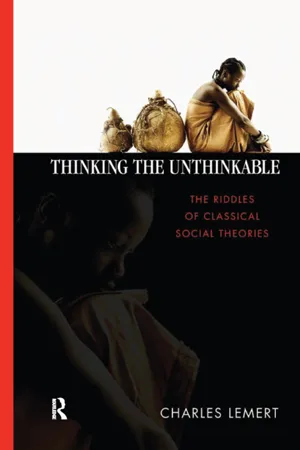
- 208 pages
- English
- ePUB (mobile friendly)
- Available on iOS & Android
eBook - ePub
About this book
In the eloquent style for which he has become famous, Charles Lemert writes of social theory as no one else. Thinking the Unthinkable is offered as text for instruction, yet it defies the prevailing assumption that social theory is a method for clarifying the facts of social life. Lemert shows how social theory began late in the 19th century as a struggle to come to terms with the failure of modern reason to solve the social problems created by the capitalist world-system. Since then, social theory has developed through twists and turns to think and rethink this Unthinkable. Hence the surprising innovations of recent years-postmodern, queer, postcolonial, third-wave feminist, risk theories, among others arising in the wake of globalization. Once again, Lemert has made the difficult clear in a book that students and other readers will treasure and keep.
Trusted by 375,005 students
Access to over 1.5 million titles for a fair monthly price.
Study more efficiently using our study tools.
Information
II
Unthinkable Social Things
Five Solutions to the Riddle of the Defiant Darkness, 1848–1914
Light and Dark
Already by the time of early industrial capitalism in the mid-nineteenth century, the light of reason could not explain the persistent darkness. If wealth is the material sign of intelligent and good action, then the dark clouds of social and economic injustice continue to haunt the modern dream of enlightened humanity. In this world of postmodern capitalism at the beginning of the fully modern world’s third century, Marx’s riddle still gets to the heart of the mysterious facts. Global wealth early in the twenty-first century is greater by incalculable magnitudes than ever it was in Marx’s nineteenth century. Yet, globally, the poor suffer disease and poverty incalculably remote from the modern pretense of social decency.
Where to Look in the Dark?
According to legend, there was once an old man who had lost his glasses in a field at night. A passing stranger came upon him searching in the light of a lamp by the road. The stranger offered to help. But after looking for a while he asked the man exactly where he had lost his glasses. When the stranger was told the truth—that they were somewhere in the dark field—he asked why then look by the road. The man answered: “Because the light is over here.”
The tale of the old man is ironic and must be respected for its wisdom. He was, after all, serious as to his purpose and reasonable in his method. One can hardly find what is lost in the night without light.
But what is one to do when the field is so dark and the light so dim?
—An old, ironic parable; not a joke
What could be a more confounding practical puzzle than to spill sweat and blood to make life better than for those who came before, only to suffer as the ancestors had? What might be worse would be to have the glitzy advantages of the wealthy minority of the species thrown in your face by the omnipresent media. The big change brought on by the new factory system is that manufacturing, as opposed to farming or early mercantile capitalism, requires workers to live close by the factories, which means also living close by, if not next door to, the owners of the factories. The both could see how the other half lived and the differences could not be denied. Even this proximity declined after the end of the factory system late in the twentieth century. Then came the depressing effect of telecommunications and media of all kinds that, now, remove the human marginals from direct contact with the well-off, while at the same time bombarding them with images of what they do not and cannot have.
For those at the global bottom it is plain enough that the benefits of the modern world are bestowed upon (and not earned by) an ever smaller minority on the rarefied heights of social and economic privilege. The new political freedoms and the booming industrial system of early modernity were considered the two most important elements necessary for the building of the modern, allegedly good, society. But, by the third century after, fewer and fewer of those excluded hold out any hope of cashing in modernity’s promissory note. More disturbing still, those at the top of the stratified mountain are increasingly giving up what honest liberal convictions they once professed. Early in the twenty-first century, the rich and powerful attend to the poor and miserable only when it serves their passing interests. If a tsunami takes away their winter playgrounds, they may write a generous check. But when genocide and starvation ravage the African interior, they will at best drop a few coins as they rush by looking for petroleum gold.
Even in Marx’s day, when the realities of industrial dirt and darkness first came to light, it did not take long for word to get around that life in factory towns like Manchester in the north of England or mill towns like Lowell in New England was no better than in the rural before. The poor are poor, but they are not stupid. They talk to each other. The news spreads. But now, as the light of liberal values begins to fade, the word spreads on the wings of visual despair.
When a government document like the one quoted on the next page is meant to advertise a well-appointed museum, the visitor is advised to read closely. The sparkle of its nationalist praise for America’s “industrial preeminence” and the “roots of American industry and its working people” is meant to shed good light on what was once a very dark corner for the workers. The words are a bright light that blinds the viewer.
From its founding in 1821, the Boott Cotton Mill complex was one of America’s more important factories, eventually to be referred to as the cathedral of industry. Today those mills are closed, as are many of the industrial cathedrals of the nineteenth century. Today, in Lowell, Massachusetts, the remains of Boott Mill have been restored as a museum and converted into high-end apartments for high-tech professionals north of Boston. Many of them, in their idle moments, may visit these restored ruins of early capitalism; some may even get the idea that industrial wealth does not trickle down on the workers. In the days when cotton milling was the major industry it is certain that mill workers were pressed to hard labor in dark and cold corners.


America’s self-image is founded in part on the nation’s rapid rise to industrial preeminence by World War I. While there is no single birthplace of industry, Lowell’s planned textile mill city, in scale, technological innovation, and development of an urban working class marked the beginning of the industrial transformation of America. Visitors can see today [in the 2000s] the working components of this early manufacturing center—the dam and nearly six miles of canals that harnessed the energy of the Merrimack River; the mills where the cloth was produced; a boardinghouse representing the dozens of like buildings that housed the workers; the churches where they practiced their faiths; the ethnic neighborhoods. These are the roots [in the 1800s] of American industry and of American working people.
—From a U.S. government brochure advertising Lowell National Historical Park (2005)
640 million children do not have adequate shelter;
500 million children have no access to sanitation;
400 million children do not have access to safe water;
300 million children lack access to information (TV, radio or newspapers);
270 million children have no access to health care services;
140 million children, the majority of them girls, have never been to school;
90 million children are severely food deprived;
700 million children suffer at least two or more of the above deprivations;
1,000 million children are deprived of a safe and healthy upbringing;
50% of children in the developing world suffer the effects of HIV/AIDS, war, poverty.
—UNICEF, State of the World’s Children, 2005 (2004)
In the modern world, light always trumps the dark, in all the various insidious senses of the term. Hence the riddle of modernity with which classic social theory struggled. Social theorists are spiritual heirs of the old man who lost his glasses, venturing as best they can beyond the light of the lamp posts, paid for and planted by town leaders with their own stake in lighting the way to a better life. Social theory looks in the darkened fields for the truth that has been lost. Thus it is inevitable, given the rule of unequal halves, that social theory would have begun amid the revolution of 1848 and ever since has groped in the field that has grown up over the dead who died in the capitalist revolution that inspired the vision of a social one.
5
Revolutionary Reasons
Karl Marx and the Melting of Solid Modernity
Why has the modern revolution not led to a better life for the masses?
When, in 1848, Karl Marx and Friedrich Engels wrote the Manifesto of the Communist Party, they wrote the modern world’s first, and still most succinct, manifesto for revolution in a revolutionary time. For them, the revolution of 1848 was a sign of radical changes that would redress the injustices of the capitalist order. In the spring of 1848 a revolutionary spirit swept all the major capitals of Europe. Many hoped—as did Marx and Engels—that the bourgeois order would soon collapse, opening the way for truly modern political freedoms for the masses. Yet, within months, the rebellions were overthrown, clearing the way, still again, for the dominance of the rising bourgeois class and its well-reasoned exploitation of the working class.
The world revolution of 1848 was, thus, a reminder of the instability of the new democratic politics. At the same time, 1848 lay near the midpoint of the economic transformation of the capitalist system from the early factory system that milled cotton from the Americas into clothing for Europe to the full industrial system of the 1860s made possible when, in 1855, Henry Bessemer perfected the technology for smelting iron necessary to the efficient production of steel, which in turn was the structural foundation of industrial manufacturing.
Class, the structuring of social groups, including their habits and attitudes, determined by any system, even the modern capitalist one, that distributes wealth and income unevenly.
The history of all hitherto existing society is the history of class struggle.… Freeman and slave, patrician and plebeian, lord and serf, guild-master and journeyman, in a word, oppressor and oppressed, stood in constant opposition to one another….
The modern bourgeois society that has sprouted from the ruins of feudal society has not done away with class antagonisms. It has but established new classes, new conditions of oppression, new forms of struggle in place of the old ones.… Our epoch, the epoch of the bourgeoisie, possesses, however, this distinctive feature; it has simplified the class antagonisms. Society as a whole is more and more splitting up into two great hostile camps, into two great classes directly facing each other: Bourgeoisie and Proletariat.… The bourgeoisie has at last, since the establishment of Modern Industry and of the world-market, conquered for itself, in the modern representative State, exclusive political sway. The executive of the modern State is but a committee for managing the common affairs of the whole bourgeoisie.
The bourgeoisie, historically, has played a most revolutionary part.… It has pitilessly torn asunder the motley feudal ties that bound man to his “natural superiors,” and has left remaining no other nexus between man and man than naked self-interest, than callous “cash payment.” … It has resolved personal worth into exchange value, and in place of the numberless indefeasible chartered freedoms, has set up that single, unconscionable freedom—Free Trade. In one word, for exploitation veiled by religious and political illusions, it has substituted naked, shameless, direct, brutal exploitation.
The bourgeoisie cannot exist without constantly revolutionizing the instruments of production, and thereby the relations of production, and with them the whole relations of society.… All fixed, fast-frozen relations, with their train of ancient and venerable prejudices and opinions, are swept away, all newly-formed ones become antiquated before they can ossify.
All that is solid melts into air, all that is holy is profaned and man is at last compelled to face with sober senses, his real conditions of life, and his relations with his kind. The need of a constantly expanding market for its products chases the bourgeoisie over the whole surface of the globe. It must nestle everywhere, settle everywhere, establish connections everywhere.
—Karl Marx and Friedrich Engels, Manifesto of the Communist Party (1848)
Much has been said of Marx, enough perhaps to create the impression that social theory is not much more than a kind of Marxism. This would understandably deflate the interest of some readers in social theory, if only because Marxism seems to be dying as a political philosophy. It is true that much evil has been done under the banner of Marxism, nearly as much as has been done in the name of capitalism.
Yet, political history aside, it would be irresponsible to underestimate Marx’s importance as a founder of social theory. He was, in a word, the first thinker in modern time to develop the structural method, without which there could be no social theory of so large and important a system as the modern world-system. One of the reasons modernity is so fraught with riddles is that it is the first massive social structure of global proportions. Under the best of circumstances, social structures are invisible to the naked eye. No one can actually see the whole of a social structure like the capitalist market economy or the democratic state. They are much too large in relation to the lives individuals lead. Structures are known by their effects, not by direct observation. Strictly speaking, there is not even such a thing as an isolated micro-structure—that is, a social structure of small social things, like a local factory. On the ground of the daily grind it is possible to see only what jumps in your face. Social structures endure not because of their raw power but by the power of their ability to encourage the repetitive actions of those affected by them. This creates many problems for social theorists, not to mention ordinary people, who have an urgent need to understand them; and the problems become even more stubborn when, as today, the structures are global.
The modern West was the world’s first truly global system. There were of course great empires in the past. But only the modern states of the European Diaspora had the wherewithal (and the arrogance) to successfully impose their own structural forms everywhere in the world (or, at least, everywhere that there was an economic value to be extracted). Empires of the ancient civilizations attempted to control and thus to impose their systems on very large areas. But when, for example, the Roman Empire declined, the Romans left behind roads and aqueducts, even civil codes and a language that ever after influenced modern societies. But not eve...
Table of contents
- Cover
- Title Page
- Copyright Page
- Table of Contents
- Preface
- I WHAT IS SOCIAL THEORY? Total Destruction, Bead Lust, and Other Unreasonable Social Things
- II UNTHINKABLE SOCIAL THINGS Five Solutions to the Riddle of the Defiant Darkness, 1848–1914
- III THE EXILED OTHERS THINK THE UNTHINKABLE The Classic Solutions Encounter Differences and Possibilities
- Bibliographic Essay and Other Acknowledgments
- Index
- About the Author
Frequently asked questions
Yes, you can cancel anytime from the Subscription tab in your account settings on the Perlego website. Your subscription will stay active until the end of your current billing period. Learn how to cancel your subscription
No, books cannot be downloaded as external files, such as PDFs, for use outside of Perlego. However, you can download books within the Perlego app for offline reading on mobile or tablet. Learn how to download books offline
We are an online textbook subscription service, where you can get access to an entire online library for less than the price of a single book per month. With over 1.5 million books across 990+ topics, we’ve got you covered! Learn about our mission
Look out for the read-aloud symbol on your next book to see if you can listen to it. The read-aloud tool reads text aloud for you, highlighting the text as it is being read. You can pause it, speed it up and slow it down. Learn more about Read Aloud
Yes! You can use the Perlego app on both iOS and Android devices to read anytime, anywhere — even offline. Perfect for commutes or when you’re on the go.
Please note we cannot support devices running on iOS 13 and Android 7 or earlier. Learn more about using the app
Please note we cannot support devices running on iOS 13 and Android 7 or earlier. Learn more about using the app
Yes, you can access Thinking the Unthinkable by Charles C. Lemert in PDF and/or ePUB format, as well as other popular books in Social Sciences & Feminism & Feminist Theory. We have over 1.5 million books available in our catalogue for you to explore.