- 276 pages
- English
- ePUB (mobile friendly)
- Available on iOS & Android
eBook - ePub
About this book
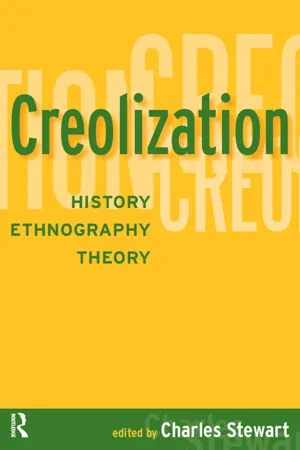
Social scientists have used the term "Creolization" to evoke cultural fusion and the emergence of new cultures across the globe. However, the term has been under-theorized and tends to be used as a simple synonym for "mixture" or "hybridity." In this volume, by contrast, renowned scholars give the term historical and theoretical specificity by examining the very different domains and circumstances in which the process takes place. Elucidating the concept in this way not only uncovers a remarkable history, it also re-opens the term for new theoretical use. It illuminates an ill-understood idea, explores how the term has operated and signified in different disciplines, times, and places, and indicates new areas of study for a dynamic and fascinating process.
Information
 | Creolization: History, Ethnography, Theory |
CREOLIZATION HISTORICIZED
The concept of creolization has a rich and varied history stretching back to the sixteenth century. Even if the word did not appear until later, the idea arose implicitly the moment the term “creole” was coined in the early colonial period.1 “Creole” denoted the offspring of Old World progenitors born and raised in the New World. How did creoles become creoles? This was the question of creolization at the outset. What transformations did creoles undergo, and how did they differ from their Old World relatives? These questions could also be posed in relation to creoles in other parts of the world, such as Mauritius and Réunion in the Indian Ocean.
By and large creolization had negative connotations at first. Emigration to a distant environment was thought to transform Europeans into a different sort of people. As the historian Antonello Gerbi observed: “The distinction was not ethnic, economic, or social, but geographical. It was based on a negative jus soli, which took precedence over the jus sanguinis” (1973:182). During the run up to independence, as several of the early chapters in this volume document, societies in the Americas appropriated and recast creolization as a more fortunate process productive of cultures and individual abilities distinct from, and possibly superior to, those found in the Old World. New World societies embraced their local identity, thereby valorizing the process of creolization. The term “creole” obviously continues to have positive connotations for self-identifying creoles in Trinidad, Cape Verde, Mauritius and elsewhere.
As Philip Baker and Peter Mühlhäusler (this volume) show, “creole” came to be applied to mixed languages, or nonstandard versions of an accepted language, from the late seventeenth century onward. In the mid-twentieth century, linguists reached a consensus view of creole as a type of language that emerged when pidgins (contact languages facilitating trade between Europeans and locals) were learned as mother tongues by subsequent generations. Creolization thus refers to the linguistic restructuring in the domains of grammar, phonology, lexicon, and syntax involved in the formation of creoles.
Historians, linguists, and anthropologists have attempted to understand the social conditions of plantation slavery in which creole languages took shape and out of which creole societies grew (Brathwaite 1971; Chaudenson 2001; Mintz 1971; Trouillot 1998; Vaughan 2005). These studies point to the cruel and painful social circumstances of creolization. Françoise Vergès (this volume) presents a particularly evocative picture of the conditions of deprivation under which creolization occurred on Réunion.
Some anthropologists have been attracted by the creole linguistic model of a creole continuum (or postcreole continuum) of intermediate languages (mesolects) found in countries such as Guyana or Jamaica (see Eriksen, this volume). Mesolects typically span from the standard form of a European language, the acrolect, to the most fully creole basilect. Hannerz (1987), drawing on Drummond’s study of Guyana (1980), applied this model of a linguistic continuum to the apparent continua of cultural repertoires in world societies generally. Urban elites tend to travel and absorb globally circulating cultural forms (such as knowledge of kungfu films) to a greater degree than town-dwellers who, in turn, incorporate more of these exogenous forms than do remote villagers. Granted that different societies draw on roughly the same globally available stock of culture, the cultural continua developing in different places form by similar processes, and using common materials. For Hannerz, “this world of movement and mixture is a world in creolisation” (1987:551). The entities that we once called “cultures” are all becoming subcultures (Hannerz 1992:218).
The tributaries of the term become further complicated if we consider the contributions of Creole intellectuals, primarily from the French Caribbean island of Martinique. This body of thought began with the reflections of the novelist and essayist Édouard Glissant collected in his volume Le Discours antillais, (Caribbean Discourse, 1989 [1981]). There he generalized the Caribbean experience of creolization as a globally occurring process. All cultures have absorbed and continue to absorb influences from other cultures. Since no one has been spared creolization, no one can assert “purity” of origins as a pretext for domination (1989:140). In later writings Glissant has elaborated his view of creolization as an unending, fluid process that cannot be reduced or essentialized, and he applied ideas such as diffraction and transversality to capture the creative, unpredictable results of cultural contact (Dash 1998:155; Glissant 1995).
The succeeding generation of Martinican writers declared “a world evolving into a state of Creoleness.”2 At first blush this seems to agree with Glissant and independently to converge on Hannerz’s position. Yet, as Mary Gallagher explains (this volume), the insistence on “Creoleness” (créolité) has turned creolization from a process into a static quality. Caribbean Creoles—and primarily French Carribbean Creoles, at that—become the forerunners and the prophets of world Creoleness. They participate in a temporally complex condition of cultural knowledge validated simultaneously by their historical emergence from the plantation past and by their current dedication to expressing this inward authenticity through the medium of art.
* * *
The foregoing should make it clear that the concept of creolization is at once fascinating, fertile and potentially very confusing. Those who approach it from one or another of the disciplinary approaches or literary currents mentioned above, or with the normative meaning from a particular historical period in mind, are in for some surprises should they encounter it outside their own familiar territory. The present collection offers the opportunity to understand this diversity, while also providing clues as to how these various strands of meaning may historically relate to one another. This volume, at one level, presents a collective effort to historicize creolization.
HISTORY, ETHNOGRAPHY, AND THEORY
The historical and ethnographic studies in this volume enable one to evaluate the thorny issue of whether the terms “creole” and “creolization” can be extended for use in current theories of globalization (for example, those of Hannerz 1987, 1996a, b; see Hall 2003 and Palmié 2006). In contemporary theory it is not clear if the concept denotes anything different from the apparently synonymous terms “syncretism” and “hybridity” (Stewart 1999). All these terms, currently used in positive senses to describe the resilience, creativity, and inevitability of cultural mixture, had extremely pejorative meanings in the past. In the cases of syncretism and hybridity, various writers have examined these pasts and reappropriated the terms through a positive reevaluation of the political significance of mixture.3
Faced with a similar proposition in the case of creolization, scholars have baulked at releasing the term from certain of its historical meanings. Sidney Mintz, the doyen of Caribbeanist anthropologists and social historians alike, has criticized Hannerz and his fellow travellers for borrowing creolization “from a geographically and chronologically specific New World setting, without serious attention to what the term meant, or to what historically specific processes it stood for.” Today’s globalization does not bear comparison with the Caribbean where, “people … subject to the original processes of creolization were—among other things, and with their children—manacled for life.” Historical Caribbean creolization involved the loss and refashioning of cultural materials—becoming “hemispheric Americans of a new sort” (1996:302; see also Mintz 1998). The historical realities of creolization are, on this view, too extreme to serve as models of contemporary cultural mixtures such as eating a Big Mac in Tokyo, belonging to the Madonna fan club in Singapore, or even moving from Nigeria to the United Kingdom and becoming naturalized as a British citizen.
Contemporary ethnographers of the Caribbean such as Aisha Khan (2001, 2004) have offered another set of reasons why the Caribbean experience of creolization cannot usefully serve as a model for a world in creolization. In Trinidad, for example, local opinion assumes creolization to involve genetic mixture between the two oldest exogenous populations of the island: the black descendants of African slaves and whites of European descent (Khan 2001:280). As relative latecomers, the Sino- and Indo-Trinidadian populations did not figure in the original creole equation. Numerous ethnographic studies document the ambivalence that has greeted recent Indo-Creole cultural productions such as Chutney Soca, or the phenomenon of douglas—mixed Indo-Afro offspring (Khan 2004; Munasinghe 2001; Puri 1999; Stoddard and Cornwell 1999). East Indians apparently remain sidelined from the creole game. This situation undermines the image of total creole openness assumed by cultural theorists. If the world is in creolization the Caribbean, paradoxically, might have some catching up to do.
The reservations articulated by Mintz, Khan, and others reveal the challenges that history and ethnography can pose to theory. Creolization belongs to “middle range” theory; it is a found object, as is “taboo” or “shaman,” each of which also initially had particular social and historical contexts of use but which have now been applied to many different time periods and societies. The ongoing comparative theoretical use of these terms inevitably grates on the sensibilities of specialists on Siberian and Polynesian societies, much as the use of creolization irritates Caribbeanists. Stephan Palmié (this volume, a; see also Palmié 2006), in fact, presents an articulate plea for not allowing the Caribbean signature term “creolization” to float out freely in general theory. One can see the virtue of high theoretical neologisms such as Derrida’s différance, which avoid this sort of historical or ethnographic challenge altogether.
Unlike “totem,” “taboo,” or “shaman,” “creole/ization” arose within the West, and it has the Latin roots to show for it. Creolization did not depend on the writing of academics in order to travel. As Miguel Vale de Almeida shows (this volume), sailors, traders, and slaves spread it along their routes, and its uptake as an ethnonym or language denominator meant that the term has always been available in many parts of the world over the centuries. Simply put, “creole” and “creolization” have meant lots of different things at different times. As with all natural language development, trying to control it is like putting one’s finger in a dike that has already burst. Can the Caribbean exercise copyright over the meaning of creolization? Even should such a copyright be attempted, which strand of meaning and which century in the Caribbean would it generalize—the sixteenth or the seventeenth, when to be a creole meant purity of descent, or the twentieth, when it meant mixture? The word and the concept existed at early stages outside the Caribbean—in Latin America and in Portuguese colonies and in vastly separated areas such as the Indian Ocean. The term “creole” has itself creolized, which is what happens to all productive words with long histories.
This observation underscores the fact that new usages can be unpredictable from the point of view of the past precisely because they do not take shape according to rule-governed trajectories. One of the earliest creole linguists, Hugo Schuchardt (Baker and Mühlhäusler, this volume) made this point when he criticized the view, widely held in the late nineteenth century, that a set of “exceptionless” rules governed all historical sound changes among the various Indo-European languages. The neogrammarian proponents of this “sound-change law” (Lautgesetz) assumed a Darwinian evolution of languages toward greater complexity (Alter 1999:123; Wilbur 1972:90). Their conception in terms of a “family tree” (Stammbaum) and language “families” paralleled contemporaneous nationalist notions of unmixed populations speaking discrete mother tongues. Schuchardt interrupted this ethno-racial idyll by asserting that sound changes are better explained as the results of external influences such as language contact, social pressure and conscious imitation in the name of fashion. These unpredictable contingencies could not be swept aside as inconsequential exceptions to neogrammarian rules, which held that language changed according to mechanical, physiological processes (at the level of the individual) motivated by time alone (Schuchardt 1972 [1885]:51]. Schuchardt’s observations on historical linguistics—largely ignored during his lifetime—surely grew out of his familiarity with contemporary creole languages (Fought 1982:429).
The semantics of creolization have similarly proceeded in multiple directions only intelligible post hoc, as is the case with history generally. To use one part of this history to negate other parts implies that development should be regular proceeding from a certain point in the past. The various essays assembled here expose the striking diachronic plurality of creolization thereby making the concept a platform for multiple theoretical departures.
Hannerz’s use of creolization to propose a continuum model of global flows and accommodations represents just one application of creolization in social theory. A different theoretical extension from the concept would be that of Kobena Mercer, who drew on the linguistic restructuring involved in the formation of creole languages. Writing with the Black British diaspora in mind Mercer applied creolization as part of a Bakhtinian dialogical struggle over meaning in the following influential passage:
Across a whole range of cultural forms there is a “syncretic” dynamic which critically appropriates elements from the master-codes of the dominant culture and “creolises” them, disarticulating given signs and re-articulating their symbolic meaning. The subversive force of this hybridising tendency is most apparent at the level of language itself where creoles, patois, and black English decentre, destabilise and carnivalise the linguistic domination of “English”—the nation-language of the master-discourse—through strategic inflections, re-accentuations and other performative moves in semantic, syntactic, and lexical codes. Creolising practices of counter-appropriation exemplify the critical process of dialogism…. (1988:57; quoted in Hall 1990:236 and Young 1995:25)
The analysis of resistance in diaspora situations has not been built upon further with specific reference to the idea of creolization. In social science usage “creolization” seems, rather, to have flattened out into an expressive buzzword used in concatenation with “syncretism,” “hybridity,” or “mixture”—as, indeed, it already is in the passage fr...
Table of contents
- Cover
- Half Title
- Title Page
- Copyright Page
- Table of Contents
- Acknowledgments
- 1. Creolization: History, Ethnography, Theory
- 2. Creole Colonial Spanish America
- 3. Creoles in British America: From Denial to Acceptance
- 4. The “C-Word” Again: From Colonial to Postcolonial Semantics
- 5. Creole Linguistics from Its Beginnings, through Schuchardt to the Present Day
- 6. From Miscegenation to Creole Identity: Portuguese Colonialism, Brazil, Cape Verde
- 7. Indian-Oceanic Creolizations: Processes and Practices of Creolization on Réunion Island
- 8. Creolization in Anthropological Theory and in Mauritius
- 9. Is There a Model in the Muddle? “Creolization” in African Americanist History and Anthropology
- 10. Adapting to Inequality: Negotiating Japanese Identity in Contexts of Return
- 11. The Créolité Movement: Paradoxes of a French Caribbean Orthodoxy
- 12. Creolization Moments
- About the Contributors
- Index
Trusted by 375,005 students
Access to over 1.5 million titles for a fair monthly price.
Study more efficiently using our study tools.
Frequently asked questions
Yes, you can cancel anytime from the Subscription tab in your account settings on the Perlego website. Your subscription will stay active until the end of your current billing period. Learn how to cancel your subscription
No, books cannot be downloaded as external files, such as PDFs, for use outside of Perlego. However, you can download books within the Perlego app for offline reading on mobile or tablet. Learn how to download books offline
Perlego offers two plans: Essential and Complete
- Essential is ideal for learners and professionals who enjoy exploring a wide range of subjects. Access the Essential Library with 800,000+ trusted titles and best-sellers across business, personal growth, and the humanities. Includes unlimited reading time and Standard Read Aloud voice.
- Complete: Perfect for advanced learners and researchers needing full, unrestricted access. Unlock 1.5M+ books across hundreds of subjects, including academic and specialized titles. The Complete Plan also includes advanced features like Premium Read Aloud and Research Assistant.
We are an online textbook subscription service, where you can get access to an entire online library for less than the price of a single book per month. With over 1.5 million books across 990+ topics, we’ve got you covered! Learn about our mission
Look out for the read-aloud symbol on your next book to see if you can listen to it. The read-aloud tool reads text aloud for you, highlighting the text as it is being read. You can pause it, speed it up and slow it down. Learn more about Read Aloud
Yes! You can use the Perlego app on both iOS and Android devices to read anytime, anywhere — even offline. Perfect for commutes or when you’re on the go.
Please note we cannot support devices running on iOS 13 and Android 7 or earlier. Learn more about using the app
Please note we cannot support devices running on iOS 13 and Android 7 or earlier. Learn more about using the app
Yes, you can access Creolization by Charles Stewart in PDF and/or ePUB format, as well as other popular books in Social Sciences & Social History. We have over 1.5 million books available in our catalogue for you to explore.