eBook - ePub
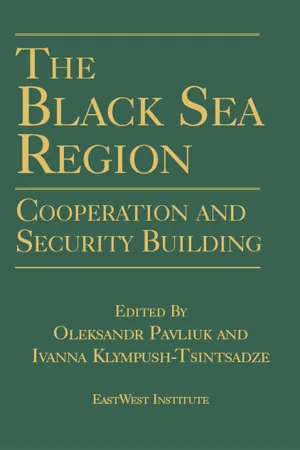
The Black Sea Region
Cooperation and Security Building
- 328 pages
- English
- ePUB (mobile friendly)
- Available on iOS & Android
eBook - ePub
About this book
The ring of countries bordering the Black Sea make up one of the unstable subregions of former Soviet republics, satellites and neighbours. This volume analyses the security issues in the Black Sea region and the development of mechanisms that would promote cooperation and conflict management.
Information
1
Is the Black Sea a Region?
At one point in the Histories, Herodotus describes what it is like to be at the mouth of the Bosphorus gazing out over the tumultuous expanse of the Black Sea. He stands at the top of the Clashing Rocks, the two large boulders that guard the entrance to the sea, known even long before his time for their role in nearly ending Jason’s quest for the Golden Fleece. Looking out from the small altar to Apollo built on top of one of the rocks, Herodotus describes the great rivers that drain the lands to the north, the modern Danube, Dnepr, and Don. The view from here, he says, is “a sight indeed worth seeing. No sea is as marvelous as the Black Sea.”1
Anyone who has scrambled past the fish restaurant and over loose pebbles to the top of the Clashing Rocks can understand Herodotus’s fascination with the sea and the lands around it. But what Herodotus and other ancient writers saw as a distinct region—a set of shared cultures or histories, a network of economic and political connections—has since been lost. Neal Ascherson’s eloquent travel book, Black Sea, was one attempt to resurrect a sense of the sea as an arena of historical interaction,2 but beyond that, the attempts to understand the Black Sea as a distinct place have been few.3
Part of the reason for the dearth of thinking about the Black Sea region is that scholars and policy analysts have only recently begun to question the geographical lenses through which they conceptualize the objects of their study. In both Europe and the United States, research on both domestic politics and international relations, and even on history and culture, are conducted within the same national and regional boundaries as during the Cold War. Grant-making bodies and government-sponsored programs reinforce these boundaries. Research on “Eastern Europe” is funded through one budget line, work on “the former Soviet Union” or something called the “New Independent States” through another.
This mental map, however, is of distinctly modern vintage. Europeans have long thought of the continent’s eastern reaches as a benighted land, the frontier between civilization and barbarism, but the idea of a distinct place called “Eastern Europe”—stretching from Poland to Bulgaria—is a recent product.4 Not all that long ago, such a schema would have seemed strange, not only to western academics and adventurers, but also to indigenous scholars, travelers, and political leaders. In the past, especially in southeastern Europe, the mental cartography of Europe’s east was rather different from what it is today. “The Balkans,” as a label for an entire area, only began to appear at the end of the nineteenth century, and until well after the First World War, many writers still considered Greece, Turkey, and the south Caucasus to be part of a distinct area, sometimes labeled the “Near East.” Ukraine was at times part of Europe, at times part of the Near East, at times even, strangely, the gateway to Central Asia.5
Over the last decade, the conceptual map of Europe’s east has changed considerably. Some former Communist states are now NATO members; they, and perhaps soon others, will also join the European Union. New international relationships have been forged, including a host of new efforts to define new regions and sub-regions.6 The revival of interest in the Black Sea is part of that process. It is easy to dismiss the idea of a “Black Sea region.” Clearly, the six littoral countries—Bulgaria, Romania, Ukraine, Russia, Georgia, and Turkey—are at differing levels of economic and political development: Among those six, there is one NATO country, one former superpower, two countries negotiating for membership in the EU, and one state that does not even control all of its territory. If we widen the focus to the entire swath of territory from the Adriatic to the Caspian, the diversity in economic performance, political reform, and basic national interests becomes more striking still.
Yet things were not always so. There was, at various times in history, a distinct region defined by the Black Sea and its hinterlands, although the boundaries and character of that region have been changeable. Over the last decade, there has been considerable effort to revive that entity, through the establishment of the Black Sea Economic Cooperation (BSEC) organization in 1992. At summit meetings and ministerials, the eleven member states of BSEC, from Albania to Azerbaijan, stress the need for closer cooperation on matters of common concern: the environment, trade, development, and even security. Whether this is a laudable development or a pipedream remains to be seen, but it does point to the fact that the sea—like all bodies of water, perhaps—continues to be more a bridge than a boundary.7 Looking at the sea as a distinct realm of political, economic, and cultural interaction might actually be preferable to clinging to an outmoded vision of an “Eastern Europe” born of the exigencies of the Cold War.
This essay offers a framework for thinking conceptually about the Black Sea as a region. It is organized around three sets of questions: First, what is a region, and is the Black Sea one? Second, what are the obstacles to Black Sea regionalism today? And third, is there reason for optimism or pessimism about the prospects for discernible Black Sea region building in the future? The sections below consider each of these issues in turn.
What—and When—is a Region?
There are no clear criteria for distinguishing a genuine region from any other piece of the world’s real estate. Some areas that share a host of cultural, linguistic, or historical commonalities are divided into a range of antagonistic states, such as the South Slav lands in the 1990s. Other areas that have few basic historical or social features in common sometimes manage to sustain a sense of common identity and engage in cooperative foreign policy relationships. The search for a set of timeless, objective traits for establishing what sets off a real region from an imagined one is futile, for in the end regions lie where politicians say they lie.
Moreover, how regions are defined shifts over time. The boundaries of no existing region of the world are stable. Europe is not the same thing today that it was during the Cold War, and even that was very different from the Europe of the nineteenth century. Central Asia, formerly a label that referenced the Soviet republics east of the Caspian, is today likely to include the Xinjiang region of China or Pakistan and Afghanistan. North America was little more than a geographical marker until the North American Free Trade Agreement (NAFTA) created a genuine commonality of interest among the United States, Canada, and Mexico. What counts as a region, then, depends very much on the particular lenses we are wearing when we ask the question, as well as the historical period on which we are concentrating. Rather than asking what a region is, it might actually be more appropriate to ask when it is.
Even if we accept the slipperiness of regions, however, there are still several analytical questions that are worth pursuing. The literature on regions and regionalism within the social sciences is now vast, but three main themes, all of which have relevance for the study of the Black Sea, stand out. One concerns the sources of regional connections and identities. How do individuals and groups, speakers of different languages with allegiance to different cultural or national traditions, come to see themselves as part of larger territorial entities beyond local communities and across nation-states? How do patterns of migration and trade, for example, connect communities over time and space? What is the relationship between regional integration in one sphere, say, economic interdependence, and a sense of connectedness in other domains, such as culture or politics?
A second theme is the way in which outsiders come to conceive of particular territorial zones as regions. What constellations of power—political, military, economic, intellectual—enable one group of people to reify innocuous geographical or cartographical boundaries into meaningful frontiers of culture, power, and identity? What is the relationship between how outsiders perceive regional boundaries and the way the inhabitants of those zones understand themselves and their immediate neighbors—and why does it all matter, anyway?
A third theme is the problem of regionalism itself, that is, self-conscious projects for crafting a sense of belonging to a broad community based on territorial proximity, common domestic policies, or cooperative foreign policy. These projects might be limited to a territory within a particular country (the regionalism of the American South or of the British Midlands, say) or may focus on bringing together a group of nation-states (the regionalism of the Pacific Rim). But how do they arise? Why do some succeed while others come to appear futile efforts at crafting a regional space in the face of powerful countervailing interests? Like nations, regions may be “imagined” by political elites,8 but they are not imagined out of nothing. Defining who is inside and outside a region is an essentially political process involving systemic constraints, the goals of political elites, domestic institutions, international organizations, and transborder communities, none of which may have exactly the same vision of what constitutes the legitimate boundaries of the region in question.9
Various scholars have offered radically different answers to such questions. Systemic theorists and political economists usually see the growth of regions as either a function of rising or declining hegemony or as a response to the pressures of globalization.10 Neoliberal institutionalists and constructivists stress common foreign policy goals or shared identities, both of which may be further enhanced by the very institutions of cooperation that they originally spawned.11 State-level explanations focus on the patterns of interaction among states with similar regime types or domestic interest groups, or in more recent literature, the strategic interaction between domestic elites and international institutions.12
Each of these dimensions of regions and regionalism is of relevance in understanding the Black Sea. Today, it is difficult to see how the peoples around the sea might think of themselves as having some essential set of characteristics in common. There is nothing like a Black Sea identity common to Romanians, Turks, and Georgians; nor do either peoples or their political leaders in any of the littoral states seem to think of the fact that they encircle a single body of water is of preeminent importance. Other identities—Balkan, European, Islamic, Slav—seem to be far more important to average citizens than an attachment to the sea.
This does not, however, mean that the Black Sea is not a “real” region. After all, parts of the world that we normally think of as real regions look rather ephemeral once we begin to define an essential set of traits that they are meant to hold in common. Is Europe a region, and if so, what are its boundaries? Is Eastern Europe a region, even if the political ideology that once defined it—Communism—disappeared more than a decade ago? Are Africa or Asia regions, when the diversity of languages, cultures, and levels of political development across them is immense?
Regions are not about essential identities but rather concern a set of essential connections that bind together the lives of peoples and polities. And on this score, the Black Sea looks rather more like a reasonable candidate for status as a distinct region. But where we say this region actually lies depends on our particular perspective as to what a region means—and when it is supposed to exist. As an ecological space, the Black Sea region stretches from central Europe all the way to the Ural mountains. The rivers that run into the Black Sea drain all or part of twenty-two countries, and the effluents carried in those riverways have a profound effect on the sea’s ecology. If our criterion for membership in the region is a border on the sea itself, then the Black Sea region is much smaller, including only six countries. But if the criterion is membership in a political organization devoted to building a region, BSEC, then the region is somewhere in between, including almost a dozen countries in the wider southeastern Europe, with others even farther afield today seeking membership.
At various times in history, the sea and its hinterlands have been united under a single power; at other times the area has been divided among a fissiparous array of principalities, kingdoms, and later, nation-states. Herodotus, writing in the fifth century B.C., thought of the place as a distinct unit, as did the geographer Strabo, who described the lands around the sea four centuries later. It was so much of a region to the ancient Greeks, in fact, that they called it simply “the sea”—Pontus—as if no more specific label were necessary, just as Homer was known as “the poet.”13 That was a time when Greek trading colonies had been established all along the sea’s coastline, carrying wheat and fish back to mainland Greece and Ionia, and returning with wine and pottery. The unity of the sea during this period, from roughly the middle of the first millennium B.C. through the first third of the first millennium A.D., was destroyed by the rise of independent political units around the littoral—the Dacian state in the west, the Bosphoran kingdom in the north, the kingdom of the Pontus in the east.
Rome, at times, managed to achieve some degree of control over these outlying areas, but that “control” usually meant little more than a string of fortifications keeping watch over a restless frontier. Even Byzantium, which sought to protect its interests in the Black Sea region and the wealth of products that it offered, could never establish order over all the sea’s coasts. During the late Byzantine period, another form of regional unity emerged with the arrival of Venetian and, more importantly, Genoese traders. From their entrepôts in Crimea and on the Don river, the Italians re-created something like the string of busy ports that had been active under the Greeks, with ships crisscrossing the sea and building a regional economy that was a vital link in the chain stretching all the way from the Adriatic to China.
The rise of the Ottomans checked the power of the Italian city-states in the region, just as it destroyed the relative peace that had prevailed under the Byzantines. By the end of the fifteenth century, the Italian colonies had been taken by the Ottomans and the sea itself brought under the hegemony of the Sultan. It was never a genuine “Ottoman lake,” for trade among the sea’s coasts as well as secondary trade between Black Sea ports and the Aegean continued apace. It would, however, be several centuries before European ships would once again sail the Black Sea.
It was the rise of Russia that broke Ottoman hegemony and launched the sea on into its next historical era. Throughout the eighteenth century, first under Peter the Great and later under Catherine, the northern coast of the Black Sea came gradually under the control of the Russian Empire. Over the next century, the Ottoman military and commercial hold on both the western and eastern shores was gradually rolled back, with the Russian Empire establishing new ports that were opened up to trade from western Europe. The sea, once again, had become a genuinely international space, and its shores were no longer under the sway of a single power.
As the Ottoman empire weakened in the nineteenth century, the sea’s shores became dotted with newly emergent nation-states, the successors of the former empires. Each sought to carve out its own sphere of influence, with some suddenly becoming maritime powers: the kingdoms of Romania and Bulgaria; the briefly independent republics of Georgia and Ukraine; and the successor to the Ottomans, republican Turkey. Throughout the better part of the twentieth century, that division continued, even during the time when most of the shoreline—from Bulgaria north around to Georgia—was governed according to a single political ideology: Soviet-style Communism. The sea at this stage was more a barrier than a bridge, the front line in the global confrontation between capitalism and the NATO alliance and Communism and the Warsaw Pact. It was not until the fall of the USSR that the possibility of genuine cooperation among the littoral states once again became a possibility. But ironically, this was also a time when the ability of those states even to control their own territory—much less cooperate with their neighbors—proved a major challenge, as economic crisis, state weakness, and military conflict came to characterize the broad region of th...
Table of contents
- Cover
- Half Title
- Title Page
- Copyright Page
- Table of Contents
- Preface
- List of Abbreviation and Acronyms
- List of Contributors
- Introduction
- 1. Is the Black Sea a Region?
- 2. Cooperative Efforts in the Black Sea Region
- 3. Littoral States and Region Building Around the Black Sea
- 4. The Unresolved Conflicts in the Black Sea Region: Threats, Impacts on Regionalism, and Regional Strategies for Conflict Resolution
- 5. Energy and Pipeline Security in the Black Sea and Caspian Sea Regions: Challenges and Solutions
- 6. National Democratic Security Structures in the Making: Achievements and Obstacles in the Black Sea Region
- 7. Military and Naval Balance in the Black Sea
- 8. New Security Threats in the Black Sea Region
- 9. Democracy in the Black Sea Region: The Missing Link in Regional Security
- 10. The New Security Environment in the Black Sea Region: A Role for International Institutions
- Conclusion
- Index
Trusted by 375,005 students
Access to over 1.5 million titles for a fair monthly price.
Study more efficiently using our study tools.
Frequently asked questions
Yes, you can cancel anytime from the Subscription tab in your account settings on the Perlego website. Your subscription will stay active until the end of your current billing period. Learn how to cancel your subscription
No, books cannot be downloaded as external files, such as PDFs, for use outside of Perlego. However, you can download books within the Perlego app for offline reading on mobile or tablet. Learn how to download books offline
Perlego offers two plans: Essential and Complete
- Essential is ideal for learners and professionals who enjoy exploring a wide range of subjects. Access the Essential Library with 800,000+ trusted titles and best-sellers across business, personal growth, and the humanities. Includes unlimited reading time and Standard Read Aloud voice.
- Complete: Perfect for advanced learners and researchers needing full, unrestricted access. Unlock 1.5M+ books across hundreds of subjects, including academic and specialized titles. The Complete Plan also includes advanced features like Premium Read Aloud and Research Assistant.
We are an online textbook subscription service, where you can get access to an entire online library for less than the price of a single book per month. With over 1.5 million books across 990+ topics, we’ve got you covered! Learn about our mission
Look out for the read-aloud symbol on your next book to see if you can listen to it. The read-aloud tool reads text aloud for you, highlighting the text as it is being read. You can pause it, speed it up and slow it down. Learn more about Read Aloud
Yes! You can use the Perlego app on both iOS and Android devices to read anytime, anywhere — even offline. Perfect for commutes or when you’re on the go.
Please note we cannot support devices running on iOS 13 and Android 7 or earlier. Learn more about using the app
Please note we cannot support devices running on iOS 13 and Android 7 or earlier. Learn more about using the app
Yes, you can access The Black Sea Region by Oleksandr Pavliuk,Ivanna Klympush-Tsintsadze in PDF and/or ePUB format, as well as other popular books in Politics & International Relations & Business General. We have over 1.5 million books available in our catalogue for you to explore.