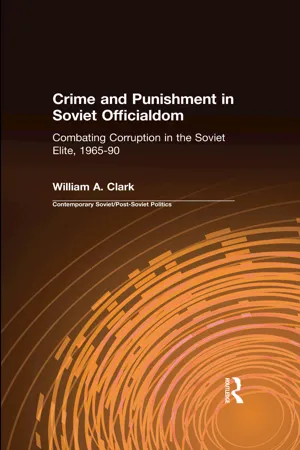
eBook - ePub
Crime and Punishment in Soviet Officialdom
Combating Corruption in the Soviet Elite, 1965-90
- 288 pages
- English
- ePUB (mobile friendly)
- Available on iOS & Android
eBook - ePub
Crime and Punishment in Soviet Officialdom
Combating Corruption in the Soviet Elite, 1965-90
About this book
This study of official corruption and the politics of anti-corruption campaigns offers a comprehensive empirical, comparative and theoretical analysis of this phenomenon as both system and symptom. It highlights the structure, impact and function of political elite corruption from 1965-1990.
Information
1
Introduction
Corruption, Politics, and Soviet Society
If the study of corruption teaches us anything at all, it teaches us not to take a political system or a particular regime at face value. Corruption, after all, may be seen as an informal political system.
—James C. Scott1
Conceptualizing Corruption
Despite the popular perception of an accepted universal understanding of "corruption," different conceptualizations of the term exist. What is more, many of these conceptualizations contradict other notions of the term, or emphasize quite different aspects of the phenomenon. Such being the case, it is important at the outset to explore these varying and competing notions of corruption, to evaluate their claims, and to settle in on a useful usage of the term for the present purposes of examining official corruption in the Soviet setting.
Most standard accepted definitions of corruption fall into one of three basic categories, or, rather, highlight three distinct metaphors. First, corruption frequently is conceived of in terms that bring to mind physical decay, decomposition, and disintegration. Here, corruption is seen as unwholesome or putrid. Second, corruption is used to describe a decline in morality, a fall from grace, a loss of innocence, or a deterioration from a state of purity. Finally, and more relevant to our concern for the corruption of public officials, corruption has been defined as involving the perversion of an official's public duties, usually for personal gain. In this sphere of official corruption, the trust society places in public officials is betrayed, the office itself is corrupted, and a general decline in the legitimacy of the public authorities obtains if such practices come to be perceived as symptomatic of public officials as a whole. This conceptualization highlights the fact that "corruption" shares the same root as "rupture"; both words originate from the Latin rumpere or ruptus: to break/broken. What follows is a list of definitions that accentuate this third conceptualization of corruption.
- "Corruption is behavior of public officials which deviates from accepted norms in order to serve private ends."2
- "Corruption is behavior which deviates from the formal duties of a public role because of private-regarding ... pecuniary or status gains; or violates rules against the exercise of certain types of private-regarding influence."3
- "The cry 'You are corrupt!' is moral and political more than a legal accusation, and the connotations of decay, depravity, secretiveness and self-interest are well understood as being incompatible with official position in public office: public trust is betrayed."4
- "There is fairly general agreement in the literature on what corruption means: namely, the use of public office for private advantage."5
- "Corruption can be said to exist whenever a power-holder who is charged with doing certain things ... is by monetary or other rewards not legally provided for, induced to take actions which favor whoever provides the award and thereby does damage to the public and its interests."6
- "Corruption is an extra-legal institution used by individuals or groups to gain influence over the actions of the bureaucracy."7
- "Corruption, like the concept of power, is a relational term ... that implies a serious violation of standards or expectations associated with a broader set of public relationships and processes."8
- "Corruption [is defined] as the behavior of public officials which diverges from the formal duties of a public role to serve private ends."9
- "At its most basic level, corruption is the abuse of public roles and resources for private benefit."10
- "An agent is personally corrupt if he knowingly sacrifices his principal's interest to his own, that is, if he betrays his trust. He is officially corrupt if, in serving his principal's interest, he knowingly violates a rule, that is, acts illegally or unethically albeit in his principal's interest."11
Each of these ten definitions of corruption, however, opens up several thorny issues regarding just what constitutes the "public interest," or the expectations of those who hold public office. The public interest changes over time and place, and is defined at any given time in different ways by different societal groups. Moreover, the behavior of public officials is also subject to different ethical criteria; in a word, different people at different times expect different types of behavior from those who hold the public "trust."
Meier and Holbrook have recently made the useful distinction between corruption and ethics, and such a distinction is apposite for any attempt to conceptualize corruption in a comparative setting. As they put it, corruption "is probably only a small subset of the behaviors that might be considered unethical."12 The authors point to Paul Appleby's work on morality and administrative ethics, in which the latter argues that unethical behavior is generally considered substantially more than just illegal activity (the operational definition of corruption defended below). For example, Appleby includes as unethical official behavior such "legal" behavior as the unwillingness to assume the responsibilities associated with a public office, the inability to deal with constituents of that office, the failure to use institutional resources efficiently, and the failure to anticipate bureaucratic problems. None of these activities violates the law, yet they may in varying degrees violate the public "trust" or the public "interest." This concern is perhaps best summarized by John Waterbury: "A legally corrupt person may arouse no normative reprobation; [and] a person judged corrupt by normative standards may be legally clean."13
Comparative research into corruption, then, with the differing cultural forces, varying sets of expectations on official behavior, to say nothing of the lack of consistency in these factors over time, magnifies these problems of the ethics-corruption connection. Ethics cannot be usefully defined as merely the compliance with formal regulations; nor can such compliance be a guarantee of ethical behavior. As one student of corruption puts it, "corrupt behavior is condemned and censured. 'Corruption' is a pejorative term. However, applying the label to behavior on the part of public officials in many non-Western countries immediately poses a dilemma of intriguing dimensions."14 In sum, one must conclude that to study corruption is not to study ethics, per se. Attempts to equate the two render comparative research into the phenomenon of corruption especially problematic.
Conceptualizing Corruption in Comparative Perspective
Despite the existence of a sizable body of literature that deals with the phenomenon of official corruption on moral or ethical grounds, the concept of corruption is most appropriately seen as a legal construct. This is not to say, of course, that moral and ethical considerations are inappropriate to any discussion of corruption; on the contrary, the persistence in every society of corrupt practices, as well as the particular motivations of individuals who engage in "corrupt" behaviors, often raise normative concerns. Indeed, as stated above, in normal parlance the word "corruption" implies moral decay, disintegration, degradation, and deterioration—all of which carry an obvious pejorative flavor. This fact notwithstanding, however, scholars interested in examining the phenomenon of "corruption" in a comparative perspective must approach their subject matter legalistically, not normatively, if meaningful and valid generalizations are to be attained.
Traditionally, comparative research has been subject to charges of "bias," "cultural imperialism," "ethnocentrism," and the like. This is no less true for research into governmental, or official, corruption. Much of the cross-national research into this social phenomenon has entailed the implicit, and often explicit, application of Western standards of official conduct and societal mores to non-Western settings, resulting many times in the condemnation of the latter based on a set of ethical "rules of the game" that do not even exist within that society. What is considered "corrupt" behavior in the United States, for instance, may be considered acceptable and legitimate in another society within which different sets of social mores obtain. For example, the bestowal of gifts by private individuals upon public officials may raise eyebrows (and legal charges) in Washington, but may be seen as part of traditional custom in a regional capital of an African state. In like fashion, the concept of corruption varies temporally as well as spatially. For example, what is presently considered electoral "fraud" and "corruption" in the United States might not have merited comment during the period of the so-called "Spoils System." That is, what was ethically acceptable in the early 1800s might be considered morally wrong today.
What the above details, then, is the fact that the utilization of "corruption" strictly as a universal moral or ethical construct is fraught with a variety of threats to valid inference. There is nothing inherent in a behavior that makes it "corrupt." Whether an action is corrupt depends on the social context within which it occurs. As one set of researchers put it:
Actions are "situated" within socio-cultural contexts.... Corruption [can] be regarded as a negotiated classification of behavior rather than as an inherent quality of behavior. Such a classification is accomplished by the application of certain tacit, common sense interpretative criteria, dependent on specific social contexts and embedded in stocks of knowledge.15
To argue otherwise leads the researcher to impute or superimpose the label of "corruption" onto a set of behaviors that may not be so considered by the society within which those behaviors took place. It would lead, likewise, to the application of such pejorative labels on past behaviors that were considered absolutely acceptable and appropriate by the society at the time the acts were performed. To do so would, again, allow other cultures to determine the morality of our own, other eras to apply their morality to ours. In the interest of objective social scientific analysis, this state of affairs is unacceptable. Because of this non-universality of societal norms over time and place, scholars must rely on the specific set of institutionalized values that obtain or obtained in the society under study. The quotation cited above referred to "corruption" as a "negotiated classification." In each society, the politics of the day go a long way in determining the outcome of these "negotiations." The politics of meaning is, like other political games, determined in large part by the distribution of power within the system. As Berger and Luckmann aptly put it, "He who has the biggest stick has the better chance of imposing his definitions of reality."16 Whatever the outcome of the political "negotiations" over meanings, the laws of the system that prevail at any given point in time codify these classifications and, as "proxies" for the public interest, are the most appropriate guides to follow. It is in this sense that concepts like "corruption" are legal constructs. Inasmuch as they function as the institutionalized representation of the "public interest," it is the prevailing legal codes that determine if an act is "corrupt" or not.
The understanding of "corruption" as essentially a legal concept points to a number of other characteristics of the phenomenon that merit elaboration here. The concept of governmental, or "official," corruption, the focus of this work, presupposes the existence of a significant level of public institutionalization. The law-based notion of official corruption, which may be defined as behavior of public officials aimed at the acquisition of forbidden or circumscribed benefits and made possible as a result of their official duties or position, can exist only in those societies that have a relatively well-developed notion of public office. That is, those traditional or "patrimonial" societies that support no real distinction between "private" and "public," no notion of "public" office separate from the pursuit of private ends, no institutionalized set of structures by and through which "public" ends are pursued, and no set of codes that describe and place limits on the range of socially approved behavior, have no real conception of corruption, per se; there may be disloyalty, there may be betrayal, there may be broken or disrupted relationships, but not "corruption." Such systems do not possess a formal "legal" system and thereby do not exhibit official corruption. In the sense, then, that corruption is a legal construct, it exists only in those societies throughout history that have experienced some level of institutionalization or, as some have put it, "modernization."
Indeed, a large number of scholars believe it is exactly this period of modernization that gives rise to a sort of cultural schizophrenia that is defined, on the one hand, by the persistence of traditional patrimonial customs and, on the other hand, by the development of rational-legal approaches to governance. The process of institution building, considered by many the hallmark of modernization, creates a formal system of governing that must, if it is to gain legitimacy, overcome a legacy of informal, localized patrimonial rule. As Joseph S. Nye has argued,
[B]ehavior that will be considered corrupt is likely to be more prominent in less developed countries because of a variety of conditions involved in their underdevelopment—great inequality in distribution of wealth; political office as the primary means of gaining access to wealth; conflict between changing moral codes; the weakness of societal and governmental enforcement mechanisms; and the absence of a strong sense of national community.17
Such transition...
Table of contents
- Cover
- Half Title
- Title
- Copyright
- Dedication
- Contents
- Preface
- 1. Introduction: Corruption, Politics, and Soviet Society
- 2. Public Administration and the Structure of Corruption in Soviet Officialdom
- 3. Corruption in the Political Elite, 1965-1990
- 4. Combating Corruption in Soviet Society
- 5. The Politics of Corruption and Anti-Corruption in the Soviet System
- 6. Official Corruption, the Soft State, and the Future of Reform
- References
- Author Index
- Subject Index
Trusted by 375,005 students
Access to over 1.5 million titles for a fair monthly price.
Study more efficiently using our study tools.
Frequently asked questions
Yes, you can cancel anytime from the Subscription tab in your account settings on the Perlego website. Your subscription will stay active until the end of your current billing period. Learn how to cancel your subscription
No, books cannot be downloaded as external files, such as PDFs, for use outside of Perlego. However, you can download books within the Perlego app for offline reading on mobile or tablet. Learn how to download books offline
Perlego offers two plans: Essential and Complete
- Essential is ideal for learners and professionals who enjoy exploring a wide range of subjects. Access the Essential Library with 800,000+ trusted titles and best-sellers across business, personal growth, and the humanities. Includes unlimited reading time and Standard Read Aloud voice.
- Complete: Perfect for advanced learners and researchers needing full, unrestricted access. Unlock 1.5M+ books across hundreds of subjects, including academic and specialized titles. The Complete Plan also includes advanced features like Premium Read Aloud and Research Assistant.
We are an online textbook subscription service, where you can get access to an entire online library for less than the price of a single book per month. With over 1.5 million books across 990+ topics, we’ve got you covered! Learn about our mission
Look out for the read-aloud symbol on your next book to see if you can listen to it. The read-aloud tool reads text aloud for you, highlighting the text as it is being read. You can pause it, speed it up and slow it down. Learn more about Read Aloud
Yes! You can use the Perlego app on both iOS and Android devices to read anytime, anywhere — even offline. Perfect for commutes or when you’re on the go.
Please note we cannot support devices running on iOS 13 and Android 7 or earlier. Learn more about using the app
Please note we cannot support devices running on iOS 13 and Android 7 or earlier. Learn more about using the app
Yes, you can access Crime and Punishment in Soviet Officialdom by William A. Clark in PDF and/or ePUB format, as well as other popular books in Politics & International Relations & Politics. We have over 1.5 million books available in our catalogue for you to explore.