eBook - ePub
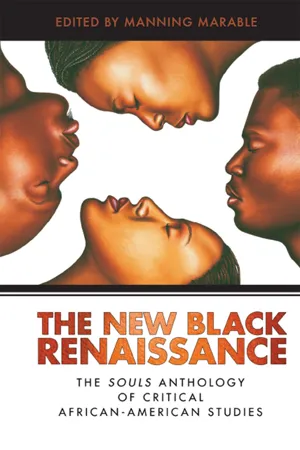
New Black Renaissance
The Souls Anthology of Critical African-American Studies
- 352 pages
- English
- ePUB (mobile friendly)
- Available on iOS & Android
eBook - ePub
New Black Renaissance
The Souls Anthology of Critical African-American Studies
About this book
Against a backdrop of multiculturalism and Afrocentricity in the intellectual traditions of African-American studies, this book sets new standards and directions for the future. It is the first book to systematically address the many themes that have changed the political and social landscape for African-Americans. Among these changes are new transnational processes of globalization, the devastating impact of neoliberal public policies upon urban minority communities, increasing imprisonment and attendant loss of voting rights especially among black males, the surging of Hispanic population, and widening class differences as deindustrialization, crack cocaine, and gentrification entered urban communities. Marable and a cast of influential contributors suggest that a new beginning is needed for African-American scholarship. They explain why Black Studies needs to break its conceptual and thematic limitations, exploring "blackness" in new ways and in different geographic sites. They outline the major intersectionalities that should shape a new Black Studies-the complex relationships between race, gender, sexuality, class and youth. They argue that African-American Studies scholarship must help shape and redirect public policies that affect black communities, working with government, foundations and other private institutions on such issues as housing, health care, and criminal justice.
Information
1. Rethinking Black Studies
MANNING MARABLE
Living Black History: Resurrecting the African-American Intellectual Tradition
I
We all “live history” every day. But history is more than the construction of collective experiences, or the knowledge drawn from catalogued and stored artifacts from the past. History is also the architecture of a people’s memory, framed by our shared rituals, traditions, and notions of common sense. It can be a ragged bundle of hopes, especially for those who have been relegated beyond society’s brutal boundaries.
I believe that historically oppressed people in the United States generally think about “living history” very differently from those closer to centers of power. The oppressed tend to privilege myth over accuracy, romantic resistance over silent subordination. To my knowledge, very few black poets have written lyrics in praise of Booker T. Washington, Condoleezza Rice, or Clarence Thomas. By contrast, there are literally hundreds and hundreds of powerful poems, plays, jazz symphonies, and even an opera inspired by Malcolm X. Blacks even make critical distinctions about “authenticity” among their most celebrated and popular public figures. Several years ago, for example, I inquired about the critical differences between Dr. Martin Luther King, Jr., and Malcolm X to the students in my Malcolm X seminar at Columbia. One black student quickly responded that the distinction was easy to make: “Dr. Martin Luther King, Jr., belongs to the world, but Malcolm X belongs to us.”
At Malcolm X’s Harlem funeral in 1965, Ossie Davis’s eulogy and memorable description of Malcolm X as a “black shining prince” captured both the tragedy and triumph of the moment. Several months ago, interviewing my friend Ossie for Columbia University’s Malcolm X Project, I asked why he had used that particular word—“prince.” Ossie replied that Malcolm X had inspired awe and admiration among black people worldwide, and deep love among the residents of Harlem in particular, because he consistently spoke truth to power. “He was the person that we wished we all could be.” But blended throughout the fabric of myth and legend was also tremendous pain and sadness. “A prince,” Ossie explained, “is not a king.” Malcolm’s greatness is found in his personal determination to become more than he was. His life’s journey had been brutally cut short, his full potential unfulfilled.
C.L.R. James, the Trinidadian radical intellectual, made a similar observation in a 1967 London lecture. James described Malcolm X as “that great fighter whose potentialities were growing so fast that his opponents had to get rid of him.”1 James did not share Malcolm’s black nationalist political philosophy, but it is not difficult to imagine “Nello” (as he was generally and widely known among friends) interrogating the militant black Muslim in an intense but casually intimate, lengthy conversion. Nello had an enormous curiosity about peoples and cultures of all kinds. He particularly wanted to identify and to comprehend the historical and social forces that constructed and produced a personality such as Malcolm X.
My theoretical approach to black studies, and my understanding of what “living history” means for the African American community, is best represented by James’s remarkable 1970 essay, “Black People in the Urban Areas of the United States.” “The [black] people who dominate the inner cities numerically cannot possibly work out a plan or have any programme by which they can improve their own situation which does not take into consideration the city as a whole,” James observed. “A new situation has arisen for the urban black, for thinking in terms of the whole city means that you are automatically thinking in terms of the state and from the state you find yourself facing the whole nation.”2 Social historians have said for decades that the resis-tance movements of the African-American community throughout its history, but especially dating from the Great Migration of the early twentieth century, have been the basic template for other American social protest movements. This is undeniably true, but not only in the United States but throughout much of the modern world. The “Civil Rights Movement” (historian Clayborne Carson and I, among others, strongly prefer the term “Black Freedom Movement”) spawned the modern women’s rights movement, the gay and lesbian rights movement, the Chicano liberation struggle, as well as many others. The Black Panthers directly inspired the Puerto Rican Young Lords Party, AIM (American Indian Movement), and even struggles among white American senior citizens calling themselves the “Gray Panthers.” Few Americans, regardless of race, can recall the most memorable words or ideas expressed in a George W. Bush presidential address. Few will ever forget “I Have a Dream,” uttered by Martin on the steps of the Lincoln Memorial that hot August afternoon in 1963. Stamped deeply on public memory, it is now central to our understanding of what American democracy should be.
Martin’s language still resonates for us today, not simply because he was a moving and powerful orator, but because what he was talking about actually had real depth and social meaning to every American. Even the white segregationists who hated him and rejected his politics understood the significance of what was being said. This explains to a considerable extent why most white Americans refuse to interrogate the meaning of “whiteness,” or how white racial identity was historically constructed from the social processes that directly involved the trans-Atlantic slave trade, chattel slavery, and massive American Indian removal to reservations. White Americans are reinforced to handle the common history they share with African Americans very differently than we do. They have, in short, not a clue that virtually every major advance in expanding and reforming this nation’s democratic institutions was directly caused, or profoundly influenced by, the black American struggle for freedom.
Most white Americans, for example, do have a somewhat vague awareness of what the American Civil War was, but possess no detailed, personal understanding about slavery, abolitionism, and why the conflict came about. Because my great-grandfather, Morris Marable, was sold on an auction block in West Point, Georgia, at the age of nine in 1854, I have acquired consequently a very different relationship to those distant events 150 years ago. When we feel personally connected with events from the past, they help to shape our actions today, thus bending the construction and trajectory of future history. Knowledgeable civic actors can draw important lessons from history, which does incrementally increase civic capacity. Historical amnesia blocks the construction of potentially successful social movements. As the distance between the past, present, and future becomes shorter and closer, individuals can acquire a greater sense of becoming the “makers” of their own history.
C.L.R. James understood all of this, and much more:
The black people in the United States are the most socially united group in the country; they all have one unifying characteristic—they suffer from that historical development which has placed them in the role of second class citizens. There is no other national group which automatically constitutes one social force with a unified outlook and the capacity to make unified moves in politics and to respond to economic problems…. It is from America’s urban blacks that many people all over the world have historically gained a consciousness of the problems that black people suffer and their attempts to overcome them.3
“Race” has always been the fundamental contradiction within the American state, and its politics. That is because, as King and Malcolm X both completely understood, U.S. democracy was constructed on a distinctively racial foundation. The nation’s first law, the 1790 Emigration Act, limited citizenship solely to “free white persons.” That helps to explain why most Asians born in continental Asia could not legally become U.S. citizens until 1952. That is why the majority of black voters could not cast ballots in a U.S. presidential election until 1968. Racism matters in the United States.
II
“Leadership” is the creative capacity of individuals of any group to realize that group’s specific objective interests. Black leaders from abolitionist Frederick Douglass to former presidential candidate Jesse Jackson have therefore interpreted black leadership primarily as capacity-building-from-below: building structures of group advocacy and resistance, which were genuinely and organically linked throughout black civil society and its varied institutions. Intellectuals who assumed leadership roles in the black community have in very general terms endeavored to make vital contributions to that struggle through their own work and research. Any scholar who, like W.E.B. Du Bois or myself when I was a boy, was forced to sit in the Jim Crow section at the back of a public bus usually feels much more like a black person and much less like a Ph.D.
Malcolm X did not think of himself as an “intellectual,” in the traditional sense of the term. Much of the historical literature and political commentary highlights Malcolm X’s oratorical ability, his great skill as a debater, and overwhelming charisma as an individual. In certain respects, perhaps Malcolm’s widely recognized mastery as a public speaker detracts attention from his impressive analytical contributions as a leading public intellectual.
What, after all, is an “intellectual,” and what comprises intellectual leadership? Marxist theorist Antonio Gramsci suggested that “all men are intellectuals,” although “not all men have in society the function of intellectuals…. Each man … carries on some form of intellectual activity, that is, he is a ‘philosopher,’ an artist, a man of taste, he participates in a particular conception of the world, has a conscious line of moral conduct, and therefore contributes to sustain a conception of the world or to modify it, that is, to bring into being new modes of thought.”4 Gramsci’s model of the intellectual is also linked to the practical tasks of transforming theoretical concepts into real social forces, which in turn have the potential for influencing the events of daily life. In other words, the intellectual is not removed from the society, but instead conceives the spectrum of possibilities for a new social world, and through articulation seeks to persuade others to accept that vision. “The new intellectual,” Gramsci observed, “can no longer consist in eloquence, which is an exterior and momentary mover of feelings and passions, but in active participation in practical life, as constructor, organiser, permanent persuader’ and not just a simple orator.”5 This captures the essence of what Malcolm X attempted to accomplish, for himself and his people: to break the devastating mental shackles of dependency and self-hatred imposed by centuries of slavery and segregation, to imagine a world without white supremacy and black inferiority, and to construct strong social institutions to perpetuate and protect the cultures and communities created by people of African descent. Central to this effort are the contestation of the “master narrative” and the construction of an alternative history.
Gramsci considered the public intellectual to be both critic and catalyst, the source of new insights about society, while possessing the ability and dedication to turn ideas into new realities. These criteria for intellectual engagement have, interestingly enough, been the standards which have been integral to the intellectual traditions of black America. African-American intellectual work, since the middle of the nineteenth century, has been largely anchored to three great principles and practices. As I have suggested in other works, the black American intellectual tradition has been first “descriptive, that is, presenting the reality of black life and experience from the point of view of black people themselves.” Second, it has been “corrective,” a concerted attempt to challenge and to critique the racism and stereotypes that have been ever present in the main discourse of white academic institutions. And third, this tradition has been “prescriptive,” an intellectual orientation which consistently connected scholarship with collective struggle, social analysis with social transformation.
Most of the classic texts which comprise the canon of African-American studies are firmly anchored within this tradition. W.E.B. Du Bois’s entire intellectual life and magnificent body of scholarship are obviously the standard by which the entire field can be judged. And to a surprising degree, this model of intellectual praxis, of theoretical interrogation and practical political activity, appears and reappears generation after generation. James Weldon Johnson (1871–1938) is today perhaps best known as a literary scholar, novelist, and lyricist; he co-authored with his brother J. Rosamond Johnson the black national anthem, “Lift Ev’ry Voice and Sing,” and wrote The Autobiography of an Ex-Colored Man (1912), God’s Trombones (1927), Black Manhattan (1930), Along This Way (1933), and other works. But Johnson saw himself, and was largely viewed by his contemporaries, as a public intellectual engaged in practical political struggles for the empowerment of black people. Johnson served as United States counsel to Venezuela and Nicaragua, worked as an attorney and political journalist, and was from 1920 to 1930 the Executive Secretary of the National Association for the Advancement of Colored People (NAACP). Richard Wright (1908–1960) was an outstanding novelist and social critic, the author of Native Son (1940), Black Boy (1945), and Pagan Spain (1957). But Wright was also an activist in the U.S. Communist Party during the Great Depression, and in the 1950s was a leading figure in the pan-Africanist movement. He attended the historic 29-nation gathering of African and Asian countries at the 1955 Bandung Conference in Indonesia, and authored a blistering attack against racial prejudice, White Man Listen (1957), which anticipated many of Malcolm X’s key ideas.
Malcolm X was born in an extraordinary generation of black intellectuals whose lives and careers were all profoundly defined by the chaotic events of the Great Depression, the Second World War, the global struggle between Communism and capitalism represented by the Cold War, and the eruption of anti-colonial political movements and social revolutions throughout the Third World. Within Malcolm X’s cohort, some of the most prominent black activist intellectuals were novelist/social critic James Baldwin, Julius Nyerere of Tanzania, Eduardo Mondlane of Mozambique, Agostinho Neto of Angola, Amilcar Cabral of Portuguese Guiné, Harold Cruse, Ella Baker, Vincent Harding, Septima Clark, Bayar...
Table of contents
- Cover
- Half Title
- Title Page
- Copyright Page
- Table of Contents
- Introduction
- Part I Remapping the Black Experience
- Part II Old Constructs, New Contexts
- Part III Beyond Traditional Boundaries
- About the Contributors
- Index
Trusted by 375,005 students
Access to over 1.5 million titles for a fair monthly price.
Study more efficiently using our study tools.
Frequently asked questions
Yes, you can cancel anytime from the Subscription tab in your account settings on the Perlego website. Your subscription will stay active until the end of your current billing period. Learn how to cancel your subscription
No, books cannot be downloaded as external files, such as PDFs, for use outside of Perlego. However, you can download books within the Perlego app for offline reading on mobile or tablet. Learn how to download books offline
Perlego offers two plans: Essential and Complete
- Essential is ideal for learners and professionals who enjoy exploring a wide range of subjects. Access the Essential Library with 800,000+ trusted titles and best-sellers across business, personal growth, and the humanities. Includes unlimited reading time and Standard Read Aloud voice.
- Complete: Perfect for advanced learners and researchers needing full, unrestricted access. Unlock 1.5M+ books across hundreds of subjects, including academic and specialized titles. The Complete Plan also includes advanced features like Premium Read Aloud and Research Assistant.
We are an online textbook subscription service, where you can get access to an entire online library for less than the price of a single book per month. With over 1.5 million books across 990+ topics, we’ve got you covered! Learn about our mission
Look out for the read-aloud symbol on your next book to see if you can listen to it. The read-aloud tool reads text aloud for you, highlighting the text as it is being read. You can pause it, speed it up and slow it down. Learn more about Read Aloud
Yes! You can use the Perlego app on both iOS and Android devices to read anytime, anywhere — even offline. Perfect for commutes or when you’re on the go.
Please note we cannot support devices running on iOS 13 and Android 7 or earlier. Learn more about using the app
Please note we cannot support devices running on iOS 13 and Android 7 or earlier. Learn more about using the app
Yes, you can access New Black Renaissance by Manning Marable,Adina Popescu,Khary Jones,Patricia Lespinasse in PDF and/or ePUB format, as well as other popular books in Social Sciences & African American Studies. We have over 1.5 million books available in our catalogue for you to explore.