- 220 pages
- English
- ePUB (mobile friendly)
- Available on iOS & Android
eBook - ePub
About this book
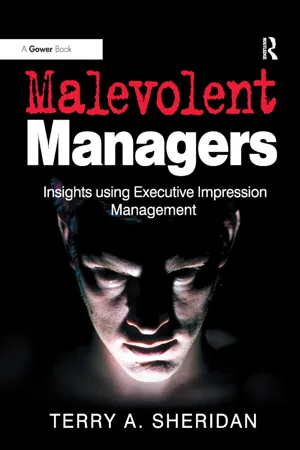
Dr Terry A. Sheridan employs a new and unique theoretical perspective to examine how malevolent, tyrannical and mediocre managers commonly use violence in the workplace, not necessarily physical violence, but bullying, overt and covert emotional abuse - all forms of negative behaviour that are damaging to individuals and organisations. The theoretical basis for the author's analysis and prescriptions is the new perspective of Executive Impression Management, which stems from Dr Sheridan's research into the differences between a number of types of executives from their co-workers' point of view. That investigation developed indicators to identify different negative management types and also helped define what has been called respectful management - the sort exercised by those managers who are good stewards. What makes this book unusual is that it is derived from qualitative research and covers an area where hardly any scholarly work has been produced. The author argues that the research methodology employed has resulted in a better understanding of impression management than has hitherto been possible. It addresses the confusion that often abounds regarding who is a good or bad manager and the fact that we can identify bad management through measures of company or organisational performance, but not how and why it went wrong. It will assist the leadership of organisations to make the right decisions about recruitment and promotion and to identify and challenge poor performance effectively.
Chapter 1
A New Typology of Discerning Management Behaviour
This book was born out of the findings that inadvertently emerged out of a qualitative study of managerial fraudsters. In this book there are the previously missing pieces to the management jigsaw: the ‘whys’ and ‘hows’ of bad management are presented for the first time. Executive Impression Management typology gives an understanding how bad management works and therefore how to find good managers to give you the respect that we all deserve in the workplace.
The doctoral research that I undertook was centred on the problem of how to identify managers who will defraud an organisation. The question came about through my work with managers as I had set up a locum management service for small business owners. Being a previous business owner myself for many years I knew how hard it was to find someone trustworthy.
It seemed to me to be a sensible proposition that an unemployed manager could be placed for a short time in a business to perform the stewardship function. After all there were many small business owners and unfortunately many unemployed managers at the time. Having had a stint as a locum manager I realised that indeed it was feasible. What was important was quick learning, shadowing the business owner before his absence and documenting all procedures. This was based on a foundation of trust between the business owner and the locum. In fact what happened was even a better outcome than just business-sitting, the small businesses were improved with the locum manager’s knowledge of systems and business efficiencies. However, it founded on being able to trust the locum I was sending in, particularly as I knew that many small business owners tended to be conservative in their outlook and suspicious of everyone. One failure meant the demise of the venture. There is no such thing in the locum business of a D grade; it is all or nothing. Not only that, having a small business usually entailed tying up the family home and other assets, so the ramifications of allowing in a fraudster in their absence were extremely high.
As I interviewed many managers I became anxious on not knowing if I could really trust the person sitting in front of me. The desperation at that time with relatively high unemployment rate of managers was palpable, and having had a taste of it myself I knew how important a job, even a short-term assignment, made all the difference to a tired résumé. The competition was fierce and the demand to be placed was high.
I knew that people could easily lie through many of the psychological tests, which are based on self-reporting. If a person was honest the test had a better chance of reflecting what was within a person’s character, but I also knew that people had a good chance of being self-delusional — myself included, which led me to think that I was a better manager than I actually was. Sometimes we are blind to our faults and we cannot see them. A beautifully written résumé and a presentable candidate could be very persuasive, but a liar could easily provide that presentation even with a slick interview.
My experience taught me that the current selection and recruitment process was inherently flawed. Superficiality blossomed on cronyism and connections rather than intelligence, qualifications and life experience. This was my observation gathered from my UK, Canadian as well as Australian experience, and I learnt that merit was a good thing to have, but will not necessarily lead to success. My career spanned academia, non-profit management, small business and later large organisations, so I knew what I was talking about, being on either side as a candidate or as an employer.
Knowing this ‘fact of life’ which was not particularly fair but it was either join them or not work at all, eventually led me to hold psychological testing, the testers and the recruiters at some distance. There was obviously no holy grail of finding out if the candidate was a good one or not, it was based on other irrelevant factors. Being a female manager was one count against me and coming from England — being a ‘Pom’ was the second black mark when I arrived in Australia. I must say that I had some fun with my first name being Terry and spelt with a ‘y’ not an ‘i’: most Australian recruiters and employers thought I was a male. I would get the look of total desperation by the receptionist up to the chief honcho who clearly did not know what to say. One employer admitted that they were only looking at males for the position despite the fact of equal opportunity legislation. I got in the front door with my résumé and career experience but I was shown the back door through other factors, other than what was required for the management position.
Apart from not choosing me, I wondered what was going on in the selection process. I followed the careers of the successful candidates of the positions that I competed for, in the newspapers and media. Before long I saw a pattern of revolving doors and put it down to toxic organisations and was thankful that I did not receive the poisoned chalice. But over time there were a minority who seemed to be toxic themselves. Whichever position they achieved somehow the implicit knowledge in managerial circles opined that it would not work out, and the result was exactly as predicted. The problem I faced with wanting to hire a candidate for a locum position was: whom could I trust? I could probably have selected someone that had a good probability to being successful, but the probability and possibility of that risk management decision was too high, I needed a nil result. I was therefore in a hazardous situation and I needed to manage it, otherwise I would lose everything.
This challenge was easily overcome by existing executive recruiters who offered a second candidate if the original placement ‘did not work’ out in the first six months. This is all well and good, but what happens if the agency places another dud, or worse, a corporate psychopath who wrecks the organisation? I took the responsibility heavily regarding the selection process and I felt driven to ensure that I had the right person to place as a locum.
This personal history was the reason that led me into framing the research question of which manager could I trust. I was beginning to develop my own theoretical model, which will be discussed later, but while it was effective, it did not show up potential fraudsters. At the beginning I only had the Myers-Briggs Type Inventory (MBTI),1 a world-renowned and accepted test in personality traits, and my own intuition, which was normally good but could be completely wrong in some instances. The MBTI is a brilliant way of sorting out people’s choices for careers. It also gives insight into the stress response of an individual when the type ‘inverted’. Jung2 regarded this as the Shadow coming out, but it only happens when we are under continual stress.
Being an avid researcher I was always looking up studies about people and had developed quite an inventory of knowledge of various aspects and the resulting tests. Nothing seemed apparent to tell me about whom I could trust, and absolutely nothing about if someone would defraud a business either. So I set up the study looking at a group of convicted fraudulent managers and explored another group of non-fraudster managers. As I knew that the fraudsters would most likely tell me that they were innocent or some other rationale for their imprisonment, I felt that I should talk to the co-workers of these managers rather than waste time on fabricated stories. The fraudster group of co-workers was fascinating and I believe that I have found a way of identifying the possibility of a manager becoming a fraudster. What I was not expecting was that the new bit of theory that I discovered would give insight to the managers who were not fraudsters but neither were they good for the organisation. The co-workers described an underlying malevolence to these managers and now totally accidentally, we have a way of identifying these toxic managers, despite their protests to otherwise.
The inadvertent discovery of different types of impression management that co-workers perceive has led me to write about the findings and their implications for organisations. From an extensive literature review I learnt that this was the first time that co-workers were studied and that it was also the first time that managerial fraudsters of any type were investigated through the perspective of their co-workers.
Using impression management theory as a framework I found five different types of impression management given off to the co-workers. Because there is confusion naming this phenomenon as Managerial Impression Management, I named it Executive Impression Management. It exists in the workplace, and it was different from ‘normal’ impression management. With this new piece of theory we can now identify two types of interaction that fraudster managers exude, plus a further three types that non-fraudster managers give off. The two fraudster types of Executive Impression Management have been dealt with in Managerial Fraud.3 This book will concentrate on the latter three non-fraudster types, namely the Tyrant Executive Impression Management, the Mediocre Executive Impression Management and the Respectful Executive Impression Management, how they were discovered, what are their characteristics and an evaluation of their usefulness. Executive Impression Management gives us the answer to the ‘whys’ and ‘hows’ of bad management. No one wants it in their organisation, but I dare say that most organisations have it whether they like it or not.
The benefit for us to understand these different types of Executive Impression Management is that decisions can be made with far more insight at hiring or at internal promotion so that the best manager may be selected. Another area of usefulness is when there are investigations into behaviour that are a matter of complaint and grievance, a logical typology can be used to understand what is underlying the aggrieved performance. This can be used by senior managers or other employees as the typology is simple to understand and this book will act as a reference to the overt managerial behaviour as to what is going on underneath.
In matters of bullying for instance, often the target is unaware of what is happening, apart from having conflict with a particular manager. Once the behaviour is put into the Executive Impression Management framework, the type of impression management can be identified and the ensuing complaint about the bullying has a point of reference and therefore legitimacy. The latter criterion is particularly beneficial as frequently the target of bullying is confused and is unable to identify the true cause; Human Resource managers sometimes have loyalties elsewhere in the organisation and other staff can unwittingly add to the pressure on the recipient. Often a target will blame himself and there are known cases of suicide after a bullying episode by malevolent managers.4
The typology is also very powerful in giving the bullying target the means to understand the violence perpetrated towards him particularly as performance issues are often used as a cover for bullying behaviour. Furthermore, other managers can easily be hoodwinked into the debate when the perpetrator states that it is a lack of performance as the central issue. Whenever performance is a problem, look to the person labelling it as such, together with, one hopes, the self-evident data that are used for the indictment. Without proof and understanding of what really is happening, these two factors muddle any review of what is identified as a performance problem. Furthermore, using the typology will give a clearer understanding of violence in the workplace, the means to how it is conducted and who is likely to be a perpetrator.
On the other hand, a workplace that is dominated by Respectful Executive Impression Management will be successful not only due to harmony with employees, but they will be productive, which in turn will realise in greater profit as there is far less energy spent on negativity. As simplistic as this may be, a company that is bringing in good returns may not necessarily be one whose managers are respectful. Other factors can interfere, such as monopolies, dirty tactics, over-charging customers, government interference, and so on, that disturb the equilibrium of the market place. However, a company based on respect for each other and demonstrates it clearly in its management, will inevitably be profitable.
Some people ask how many organisations are negative versus those entities that are managed with the positive energy of respect. My guess is that malevolent management administers about 80 per cent of organisations and that is why so many employees are suffering from work stress, become disaffected and are not inclined to give their all in their work performance. Tell-tale signs are poor customer or supplier relations, high employee turnover, strikes, abuse of privilege in travel arrangements and receipts, taking longer to do what another can do in far less time. This describes of course, most workplaces. Those run by respectful management are rare to come by and are strikingly different, completely opposite to malevolent managed workplaces.
To me this is an inevitable sign of negativity of the management. It is absolutely pointless to declare ‘Do what I say, not what I do.’ It is also ridiculous to put up cute statements of values and/or ethics in the reception area, when back-office behaviour is a daily contradiction. Employees are not stupid; they quickly learn the modus operandi via tacit knowledge in the organisation on what to do or what not to do.5 The new employee’s learning curve is quickly ascertained via what the management say and do. This informal line of information to the new employee also demonstrates the subtlety of power in organisations. But no one notices the informal induction method as it is as much to us as eating breakfast in the morning. It is part of our humanity, our everyday social interaction.
This book will outline why and how the study was implemented as it gives the reader considerations of data never before collected. The focus of the study and the methodology used meant that the results would be more likely exploratory in account rather than hypothesis testing. The theory behind the new Executive Impression Management types will be discussed. The types will be described in some detail using the respondents’ words to comprehend the nature of these managers. The managers who use particular types of Executive Impression Management determine the type of violence in the workplace will also be addressed. Finally, a forward move into non-violent workplaces as expressed by managers who use Respectful Executive Impression Management will be discussed.
_______________
Notes
1 Briggs Myers, I. and P.B. Myers (1995). Gifts Differing: Understanding Personality Type. Mountain View, CA, Davies-Black Publishing.
2 Jung, C.G. (1971). Psychological Types. London, Routledge & Kegan Paul.
3 Sheridan, T.A. (2014). Managerial Fraud: Executive Impression Management, Beyond Red Flags. Farnham, Gower.
4 Read, L. (2013). ‘BBC criticised over workplace bullying after death of Russell Joslin’. Coventry Telegraph. Coventry, Trinity Mirror Midlands.
5 Smith, E.A. (2001). ‘The role of tacit and explicit knowledge in the workplace’. Journal of Knowledge Management 5(4): 311–21.
Chapter 2
Theoretical Underpinnings to the Research
This chapter addresses some of the theoretical underpinnings to the inte...
Table of contents
- Cover
- Half Title
- Dedication
- Title Page
- Copyright Page
- Table of Contents
- List of Figures
- List of Tables
- Acknowledgements
- Foreword
- 1 A New Typology of Discerning Management Behaviour
- 2 Theoretical Underpinnings to the Research
- 3 The Findings Regarding the Respectful Executive Impression Management
- 4 The Tyrant and Mediocre Executive Impression Management
- 5 How to Identify a Malevolent Manager
- 6 The Impression Management Strategies used by Non-fraudster Managers
- 7 Methods of Malevolent Managers
- 8 Confronting the Malevolent Manager – The Careful Process of Unmasking
- 9 How to Choose a Manager Who Uses Respectful Executive Impression Management
- 10 How to Instil Respect in your Workplace Despite Malevolent Managers and your Position in the Organisation
- 11 Sharing is Caring
- Conclusion
- Appendix A
- Appendix B
- References
- Index
Trusted by 375,005 students
Access to over 1.5 million titles for a fair monthly price.
Study more efficiently using our study tools.
Frequently asked questions
Yes, you can cancel anytime from the Subscription tab in your account settings on the Perlego website. Your subscription will stay active until the end of your current billing period. Learn how to cancel your subscription
No, books cannot be downloaded as external files, such as PDFs, for use outside of Perlego. However, you can download books within the Perlego app for offline reading on mobile or tablet. Learn how to download books offline
Perlego offers two plans: Essential and Complete
- Essential is ideal for learners and professionals who enjoy exploring a wide range of subjects. Access the Essential Library with 800,000+ trusted titles and best-sellers across business, personal growth, and the humanities. Includes unlimited reading time and Standard Read Aloud voice.
- Complete: Perfect for advanced learners and researchers needing full, unrestricted access. Unlock 1.5M+ books across hundreds of subjects, including academic and specialized titles. The Complete Plan also includes advanced features like Premium Read Aloud and Research Assistant.
We are an online textbook subscription service, where you can get access to an entire online library for less than the price of a single book per month. With over 1.5 million books across 990+ topics, we’ve got you covered! Learn about our mission
Look out for the read-aloud symbol on your next book to see if you can listen to it. The read-aloud tool reads text aloud for you, highlighting the text as it is being read. You can pause it, speed it up and slow it down. Learn more about Read Aloud
Yes! You can use the Perlego app on both iOS and Android devices to read anytime, anywhere — even offline. Perfect for commutes or when you’re on the go.
Please note we cannot support devices running on iOS 13 and Android 7 or earlier. Learn more about using the app
Please note we cannot support devices running on iOS 13 and Android 7 or earlier. Learn more about using the app
Yes, you can access Malevolent Managers by Terry A. Sheridan in PDF and/or ePUB format, as well as other popular books in Business & Business General. We have over 1.5 million books available in our catalogue for you to explore.