eBook - ePub
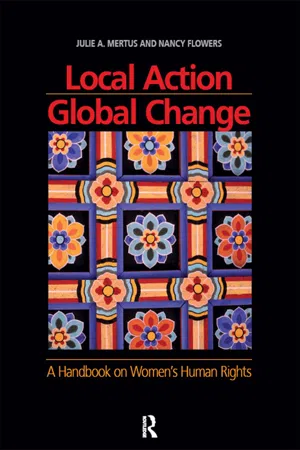
Local Action/Global Change
A Handbook on Women's Human Rights
- 368 pages
- English
- ePUB (mobile friendly)
- Available on iOS & Android
eBook - ePub
About this book
This handbook on women's human rights is an integrated set of fourteen teaching and learning units. Together, they are designed to identify key issues in women's human rights, define concepts, outline different methodologies for achieving women's human rights, and offer a wide range of activities to facilitate teaching, learning, and discussion of women's human rights challenges. Included in every chapter are a statement of key objectives, background information, discussion questions, special issue boxes, strategies and examples for taking action, and learning activities. Also included are key UN documents and international law bearing on women's human rights. Handouts, checklists, assessment forms, and activist organizations round out the range of reference materials provided. User-friendly, jargon-free, authoritative, and packed with hands-on information, the handbook is an essential resource for anyone working in the field, human rights professionals, scholars, students, and activists.
Information
1 Introduction to Women's Human Rights
DOI: 10.4324/9781315633619-1
Why Was This Book Written?
All human beings, female and male alike, are entitled to the same human rights. Historically, however, violations based on biological and gender differences have not been recognized as human rights violations. Even organizations dedicated to the protection of human rights have often failed to devote attention to abuses against women or to develop effective methods to investigate gender-based violations. Most women and girls themselves remain unaware of their human rights and of the documents and mechanisms that define and protect them.
We use the phrase human rights to emphasize that we are talking about fundamental, indivisible claims that governments must protect. Advocacy groups increasingly express their demands in human rights terms because experience has shown that doing so is an effective way for having their concerns met. At the same time, we stress women’s human rights to underscore that the practice of human rights is not gender-neutral. Just as women and girls often experience human rights violations in a manner different from men and boys, so the resources women and girls bring to addressing human rights issues differ as well. Hence the solutions for bias and abuse against women and girls must reflect their specific needs.
A worldwide movement is working toward recognition and protection of the human rights of women and girls. Central to that effort is education. Only women and girls who know about their human rights can take effective action to exercise and advocate for them. Local Action/Global Change was written to be a flexible, practical tool in the service of this movement—to share information about women’s human rights with women, men, and organizations everywhere and to initiate and develop strategies for translating these rights into action for positive social change.
Who Can Use This Book?
An earlier version of this book1 was translated into more than a dozen languages and used around the world in countries ranging from Romania to Thailand to Egypt. The book’s audience, like the power of human rights for social change, has proven to be vast and diverse. Factory workers on their lunch break, school-teachers enrolled in advanced training, judges and police officers considering mandatory reforms, staff of international development and human rights organizations searching for advanced training skills, university students preparing papers, and seminarians polishing sermons have all used Local Action/Global Change in their work.
This current version gives greater attention to training possibilities and includes new sections on globalization, development, and adequate standards of living, while retaining the clear language, practical learning activities, and extensive examples and data that made the earlier book so popular. Its new and updated material also better meets the needs of professional staff with international development organizations and government agencies at all levels.
As an overview of the field of women’s human rights, Local Action/Global Change does not aspire to be a human rights primer or an introduction to gender: Excellent resources for both are readily available elsewhere.2 Because everyone needs to learn about the human rights of women and girls, Local Action/Global Change was designed for the broadest possible audience. It combines information on the principal topics of women’s human rights with learning activities for making them meaningful and strategies for taking action to realize them. The activities require no special materials or resources, only time to meet and talk. Every effort has been made to allow for wide differences in culture, age, religion, geography, economics, and politics.
How Is This Book Organized?
Each chapter addresses topical issues on women’s human rights. Even readers interested in just a single topic are encouraged to read the present chapter, on general human rights principles and techniques, as well as Chapter 2, on women’s human rights to equality and nondiscrimination, as these provide an overview that can facilitate a full understanding of any issue.
Local Action/Global Change contains principles and methods of human rights education, more than eighty learning activities, a guide to facilitating learning, and a variety of complementary resources: notes at the end of each chapter that include web addresses for a wealth of dynamic websites with updated information and new links, appendices with analytical charts to serve as workshop tools, guidelines for facilitating a workshop, explanations of how to seek redress for human rights violations through the proper channels, a glossary of key terms, a bibliography for further research, and an index of topics discussed in the book.
Each chapter beyond the present one uses the following general framework to address specific issues in women’s human rights:
- Objectives for the chapter
- A “Getting Started” section introducing and defining the chapter topic
- Learning activities focusing on the principal issues of this topic
- Boxes within the text offering statistics, special information, and examples
- Strategies for taking action on the issues under discussion
- An examination of international human rights law on this topic
- A “Remembering Core Concepts” section.
What Methodology Does This Book Employ?
Local Action/Global Change invites readers to engage fully in learning about the human rights of women and girls. To this end, it provides both factual information and participatory exercises. Some people will read Local Action/Global Change on their own; others will experience the book collectively with the aid of a facilitator. Some will use all of the chapters; others might focus on a single chapter. In all cases, however, women’s human rights need to be seen in a holistic context.
The Conceptual Context
Every woman’s human rights issue needs to be understood in both its theoretical and concrete particulars. The concepts of human dignity and equality inform all discussion of women’s human rights. Chapter 2, “Women’s Human Rights to Equality and Nondiscrimination,” sets forth these and other fundamental human rights concepts such as universality, interdependence, and indivisibility. Even the most pragmatic activist would want to be grounded in this framework, with its principles woven into every educational effort.
Furthermore, because all human rights are interconnected and interdependent, no issue can be considered in isolation. A woman’s right to education, for example, cannot be separated from her rights with respect to the family, the work-place, the economy, or public life. For this reason, Local Action/Global Change provides frequent cross-references among chapters. For example, in Chapter 3, “Women’s Human Rights in the Family,” the discussion of the “public-private split” directs readers to a related section in Chapter 7, “Women’s Human Right to Freedom from Violence.” Facilitators should emphasize this interrelatedness among human rights whenever they use the book.
The Personal Context
Human rights begin, as Eleanor Roosevelt, chair of the UN commission on human rights from 1946 to 1951, observed, “in small places … close to home.” Each subsequent chapter of Local Action/Global Change also begins close to home, with a “Getting Started” section that draws on individual experience with a human rights topic and provides opportunities to tell personal stories and include local culture and history. The focus shifts continually between the objective and the subjective, with background information and data on specific subtopics followed by exercises that elicit personal reflection and discussion. To create an empowering learning environment, facilitators need to establish a similar balance between introducing external, “expert” information and honoring the first-hand knowledge of the participants.
The Factual Context
Each chapter of Local Action/Global Change provides substantive information, including background, statistics, and illustrative examples of both human rights abuses and victories. Although not intended as a resource documenting human rights abuses, Local Action/Global Change includes factual illustrations in order to delineate the issues that are especially relevant and to identify their principal subtopics. Both kinds of material serve to inform the individual reader as well as provide facilitators with a basis for mini-lectures or handouts.
Where possible, factual information is drawn from United Nations sources, as these are widely available and accepted. In addition, the text draws extensively from the Beijing Platform for Action, the final document of the Fourth World Conference on Women (1995). Although the Platform for Action is not a legally binding document, it does provide an indication of worldwide understanding of the human rights of women and girls;...
Table of contents
- Cover Page
- Half-Title Page
- Title Page
- Copyright Page
- Table Of Contents
- Acknowledgments
- Foreword
- Prologue
- Chapter 1: Introduction to Women's Human Rights
- Chapter 2: Women's Human Rights to Equality and Nondiscrimination
- Chapter 3: Women's Human Rights in the Family
- Chapter 4: The Human Rights of Young Women and Girls
- Chapter 5: Women's Human Right to Health
- Chapter 6: Women's Human Rights to Reproduction and Sexuality
- Chapter 7: Women's Human Right to Freedom from Violence
- Chapter 8: Women's Human Right to an Adequate Standard of Living
- Chapter 9: Women's Human Rights and Globalization
- Chapter 10: Women's Human Rights and Work
- Chapter 11: Women's Human Right to Education
- Chapter 12: Women's Human Rights in Politics, Public Life, and the Media
- Chapter 13: Human Rights of Refugee, Displaced, and War-Affected Women
- Chapter 14: The Road Ahead: Local Action and Global Change
- Appendix I Analytical Tables: Analyzing Human Rights Problems, Implementing Human Rights Strategies
- Appendix II Participatory Methodologies for Educators and Facilitators
- Appendix III Using Human Rights Systems and Mechanisms
- Glossary
- Bibliography
- Index
- About the Authors
Trusted by 375,005 students
Access to over 1.5 million titles for a fair monthly price.
Study more efficiently using our study tools.
Frequently asked questions
Yes, you can cancel anytime from the Subscription tab in your account settings on the Perlego website. Your subscription will stay active until the end of your current billing period. Learn how to cancel your subscription
No, books cannot be downloaded as external files, such as PDFs, for use outside of Perlego. However, you can download books within the Perlego app for offline reading on mobile or tablet. Learn how to download books offline
Perlego offers two plans: Essential and Complete
- Essential is ideal for learners and professionals who enjoy exploring a wide range of subjects. Access the Essential Library with 800,000+ trusted titles and best-sellers across business, personal growth, and the humanities. Includes unlimited reading time and Standard Read Aloud voice.
- Complete: Perfect for advanced learners and researchers needing full, unrestricted access. Unlock 1.5M+ books across hundreds of subjects, including academic and specialized titles. The Complete Plan also includes advanced features like Premium Read Aloud and Research Assistant.
We are an online textbook subscription service, where you can get access to an entire online library for less than the price of a single book per month. With over 1.5 million books across 990+ topics, we’ve got you covered! Learn about our mission
Look out for the read-aloud symbol on your next book to see if you can listen to it. The read-aloud tool reads text aloud for you, highlighting the text as it is being read. You can pause it, speed it up and slow it down. Learn more about Read Aloud
Yes! You can use the Perlego app on both iOS and Android devices to read anytime, anywhere — even offline. Perfect for commutes or when you’re on the go.
Please note we cannot support devices running on iOS 13 and Android 7 or earlier. Learn more about using the app
Please note we cannot support devices running on iOS 13 and Android 7 or earlier. Learn more about using the app
Yes, you can access Local Action/Global Change by Julie A. Mertus,Nancy Flowers in PDF and/or ePUB format, as well as other popular books in Politics & International Relations & International Law. We have over 1.5 million books available in our catalogue for you to explore.