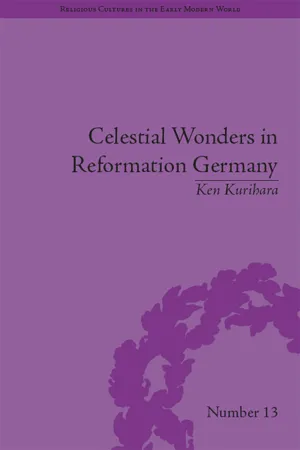
Celestial phenomena were often harnessed for use by clerics in early modern Germany. Kurihara examines how and why interest in these events grew in this period, how the clergy exploited these beliefs and the role of sectarianism in Germany at this time.
- 224 pages
- English
- ePUB (mobile friendly)
- Available on iOS & Android
eBook - ePub
Celestial Wonders in Reformation Germany
About this book
1 EXPLORING THE WORLD OF WUNDERZEICHEN
The Mansfeld Chronicle (1572), compiled by the Mansfeld deacon Cyriakus Spangenberg, vividly depicts the difficult environment people had to confront while living in the ‘Little Ice Age’. Deterioration of climatic conditions, severe storms, repeated floods, inflation, pestilence and fatal accidents regularly appear in the entries. As though putting lively accents into this gloomy narrative, Spangenberg inserts stories of wondrous incidents that occurred in the region. These include reports of misbirths, divine punishments on disbelievers and a mysterious spectre seen in the mountains, but the predominant types of wonder are celestial wonders: ‘People saw the three suns’; ‘some people … saw a cross in the sky, followed by a hand holding two Turkish sables’; ‘some say that people saw two blood-red men in the sky’; ‘in many places in the land of Sachsen, the nightly sky was seen … as if it is really burning’; ‘a blood-red beam was seen … After that a cloud stood in the sky, [which looks] like a bier for the dead with a white cloth and black cross’. Such entries frequently appear in the pages.1 Why did the prominent clergy of the city show such an interest in these phenomena? How did Spangenberg and his readers interpret these incidents? Some of the wondrous phenomena recorded in the chronicle took place in distant lands such as Lübeck – how did Spangenberg obtain information about such incidents?
In order to find answers to these questions, this chapter explores the world of Wunderzeichen literature between 1546 and 1595 so that we can grasp what kinds of celestial phenomena were called Wunderzeichen; how the media heard about these strange phenomena; how they interpreted the meaning of Wunderzeichen; and why the news of these wondrous incidents drew their attention. First we will examine six types of popular media for Wunderzeichen news in order to comprehend how stories of wondrous phenomena were circulated among people. Then Wunderzeichen will be classified into four categories, and the various examples of celestial phenomena and the interpretations attached to them by contemporary authors will be explored. A preliminary examination shows that virtually all Wunderzeichen literature carries the same message: ‘Repent, or disasters will come’. The climatic, social and political conditions of German society in the second half of the sixteenth century show that people had ample reason to fear that various catastrophes would soon befall Germany. Indeed, Wunderzeichen reflected people’s widespread fears of possible catastrophe and their desire to know what they could expect for the future. This inner concern is the background for the clergy’s use of celestial phenomena in their writings.
Media for Wunderzeichen News
The media for Wunderzeichen news can be classified into the following six categories: Einblattdruck/Flugblatt (broadsheets); Flugschrift (pamphlets); Wunderbuch (wonder books); Prognosticon or Practica (astrological predictions); sermons and other devotional works written by the clergy; and oral communication.
The most popular and readily available media was Einblattdruck, a one-page broadsheet usually consisting of a title, a woodcut illustration, a brief description of the Wunderzeichen, the author’s comments and a prayer for God’s mercy. The author often attached his own interpretation of the phenomenon and admonished readers to keep the lessons in mind. The price of a broadsheet is difficult to ascertain, but Bruno Weber estimates that one broadsheet cost at most 1–2 Kreuzer or 4–8 Pfennig in the sixteenth century.2 Usually a large woodcut illustration depicting the phenomenon is printed at the top of the sheet. In many cases, the depictions are fairly in accord with descriptions in the text. Some texts do not explain the phenomenon in detail but simply state that ‘a strange phenomenon, as depicted above, appeared in the sky’, and such examples show a strong interrelation between the text and the visual image in Einblattdruck. Since the average literacy rate of sixteenth-century Germany is estimated at around 5 per cent (though it could reach 30 per cent in urban areas), the role of visual images was significant in mass communication.
While the authors of these Einblattdruck usually remain anonymous, some texts carry authors’ names, and some of these were of prestigious status. For example, a Wittenberg broadsheet about the appearance of three suns and mysterious rainbows in March 1551 is signed by no other than Philip Melanchthon.3 Georg Henisch (1549–1618), the instructor of St Anna Gymnasium in Augsburg who is known as the editor of the first German dictionary (1616), discusses the astrological influences of the 1580 comet in an Augsburg Einblattdruck.4 Some historians assume that the report of strange eclipses and apparitions of a large army in the sky over Württemberg (1578) was written by Johann Fischart, one of the most famous authors of the German Renaissance.5 The printer of a broadsheet reporting a strange celestial fire in France (1554) claimed that the original account was written by the French court astrologer Michel de Notre Dame, better known as Nostradamus.6 At least one Wunderzeichen broadsheet was illustrated by Jost Amman, a prominent Nuremberg artist known for his Book of Trades illustrations, although most broadsheet woodcuts were made by lesser skilled artists.7 Notable authors and elaborate illustrations attached to their texts suggest that the traditional image of Wunderzeichen broadsheets as cheap, unintelligent products of popular culture needs correction.
A similar media to Einblattdruck is Flugschrift, an unbound news pamphlet or tract with multiple pages. The structure of Wunderzeichen Flugschrift is basically the same as that of the broadsheet: a sensational title on the front page, a description of the phenomenon, the author’s comments, and a prayer to God as a conclusion. However, since there is no one-page limit, an author could amplify the content of his text by reporting on more than one Wunderzeichen case or other kinds of eye-catching incidents in a single tract. A number of these pamphlets report on more than two or three cases and quote historical examples of Wunderzeichen, Scripture verses, words of ancient sages or lengthy moral teachings to enhance the commercial value of the text. While an illustration often appears on the title page, in many cases it is only for decoration rather than an accurate depiction of the phenomenon in the text. Though the price of Flugschrift depended on the size of the booklet, it is estimated to be around 20 Pfennig.8 Many of these works remain anonymous, but authors’ names do appear more frequently in Flugschrift than in Einblattdruck. Some texts also carry the date of publication or the date of composition, and this enables us to deduce the circumstances of the publication. One example is True Report and Short Account of Great and Dreadful Wunderzeichen … Appeared in the Sun (Warhafftige Bericht Vnd Kurtze Beschreibung des Grossen vnnd Erschrecklichen Wunderzeichens … an der Sonnen begeben; published in Hof, 1584), a six-page tract about a strange incident in the village of Zeyern on Easter Sunday, 19 April 1584. According to the author, Wilhelm Pletzlein, the pastor of Zeyern, fire suddenly sprang from the sun and fell onto the earth, followed by bread falling from heaven.9 The date of the publication, printed at the end of the tract, is 30 April. This means that this village pastor composed the account, sent it to a printer in Hof, and published it within eleven days of the incident – an impressive speed, considering that Hof was not a publication centre in those days. Such an example shows that Flugschrift, which did not need elaborate illustrations, was an express media that enabled quick circulation of Wunderzeichen news.
When stories printed in broadsheets and tracts were assembled into one volume, they became a Wunderbuch, a popular literary genre that newly emerged in the mid-sixteenth century. Wonder books usually catalogue stories of strange phenomena in chronological order or classify them by types of phenomena, for example eclipses, comets, rainbows and strange images. The first Wunderbuch in Germany was compiled in 1532 by Joachim Camerarius, a close friend of Melanchthon, but this work was written in Latin and not for a popular audience.10 The pioneer work of popular Wunderbuch is Wunderzeichen (1556) compiled by Hiob Fincel, a Lutheran physician and professor of philosophy at Jena University.11 The book lists all kinds of strange events after 1517, including not only celestial wonders but also monstrous births, strange behaviours of animals, manifestations of devils, and various disasters such as fires, storms, earthquakes and floods. Many of these stories were directly taken from Einblattdruck and Flugschrift. Fincel also explains what kinds of misfortunes followed after these portents appeared and asserts that the recent increase of these strange signs clearly indicates that the Day of the Last Judgement is quickly approaching. The book won such great popularity that Fincel published a second (1559) and a third volume (1562) of Wunderzeichen to update his story collection.
Soon other authors followed Fincel’s success. Immediately after the first book of Wunderzeichen appeared, a Basel humanist, Conrad Lyscothenes, published a massive volume of Wonder Work or God’s Unfathomable Lessons (Wunderwerck Oder Gottes vnergründliches vorbilden; 1557) containing thousands of stories of strange phenomena that occurred ‘from the beginning of the world’ to the present time.12 Lyscothenes’s book was written in Latin, but it was also translated into German by Johann Herold and enjoyed considerable popularity in Germany. Caspar Goltwurm, an influential church leader in Nassau-Weilburg, also published Wonder Work and Wunderzeichen Book (Wunderwerck vnd Wunderzeichen Buch; 1557), in which he categorizes wonders into six types – God’s wonders; spiritual wonders; wonders in the sky; wonders in nature; wonders on the earth; and wonders caused by the devil – and catalogues various historical examples based on this classification.13
Other authors compiled books focusing on a single type of phenomenon. For example, shocked by the great comet of 1577, Lauben pastor Sigismund Suevus compiled Comets (Cometen; 1578), in which he classified historical examples of comets in seven types based on what kinds of misfortunes followed.14 It seems that the work was well received because ten years later, the whole work was incorporated into his new book Mirror of Human Life (Spiegel des menschlichen Lebens; 1588). Georg Caesius, a pastor of Leutershausen and a well-known astrologer, also published Chronicle or Ordered Catalogue and Description of All Comets (Chronick Oder ordenliche verzeichnuß vnnd beschreibung aller Cometen; 1579), which chronologically lists all the comets in history and describes what kinds of disasters followed them.15
The immediate effects of the publication of these books were the intensification of people’s interest in Wunderzeichen and the proliferation of more discourses on celestial signs. Anyone who wanted to understand the meanings of strange phenomena could find them in these books, and if they wanted to mention celestial wonders in their own writings, they could embellish their pieces with historical examples taken from these books to convince hearers that history showed that strange phenomena really foretold disasters. As we will see in Chapters 4 and 5, Christoph Irenaeus quotes a great number of stories from the works of Fincel and Lyscothenes in his own Wunderzeichen writings, and Irenaeus’s book on comets was used as a source when Georg Caesius compiled his own comet chronicles.
Prognosticon or Practica, short tracts of astrological predictions published almost annually by astrologers (in many cases they were civic physicians, mathematicians and pastors), are also an important media of Wunderzeichen news. This genre had been one of the most popular forms of publication since the 1470s, and hundreds of sixteenth-century astrological pamphlets are still extant. These texts analyse the movements of the stars and speculate how these astrological factors affect climates on the earth and human bodies and what could happen (like plague and wars) in future years. Since they focus on the regular movements of the planets and the zodiac, technically they are different from Wunderzeichen works. However, the astrologers naturally showed great interest in celestial wonders like comets and discussed the astrological influences of these phenomena and the lesson people should learn from these signs. Sometimes they incorporated their analysis of Wunderzeichen into their Prognosticon to increase their appeal to readers. For example, in his Historic Prognosticon on the Year 1568 (Prognosticon Historicvm Auffs 1568 Jhar; 1568), Johann Hebenstreit predicts the weather conditions of that year based on his astrological analysis. However, he quickly finishes his predictions after four pages and starts discussing seven strange celestial phenomena of 1567–8 and their meanings.16 The contents of these tracts, often filled with moralizing lessons, biblical phrases and threatening examples from history, show a remarkable similarity to other types of Wunderzeichen materials.
One significant fact we must not forget is that in early modern society, the pulpit was one of the main places where people heard the latest news and learned opinions. When a mysterious sign appeared in the sky, people expected local pastors to preach about the news and express their opinions on these phenomena. Since Wunderzeichen were commonly regarded as signs of God’s wrath, the clergy paid great attention to celestial phenomena and exploited stories of wonder to press people to repent. Even if Wunderzeichen were not the main point of their sermons, preachers sometimes spiced their messages with stories of wonder, especially when they wanted to draw their audience’s attention and strike their conscience.
The most likely date for Wunderzeichen to be mentioned in preachers’ sermons was the second Sunday of Advent, because in the Lutheran ecclesiastical calendar, Christ’s prophecy of his return was assigned to be read during the service on this day. Since Christ mentioned strange celestial phenomena as one of the signs of the End Times, many preachers included the topic in their sermons. Some of these messages were later incorporated into postils, collections of commentary sermons on the Gospel. In addition, as intellectual leaders of the community, they wrote tracts and books about strange phenomena, often witnessed by themselves and sometimes requested by the laity.
All of the above media are publications; but considering that the majority of sixteenth-century people could not read and the number of printed materials was still limited, oral communion was still the more important media for Wunderzeichen news. Indeed, some accounts of wondrous phenomena printed in Einblattdruck and Flugschrift are based on hearsay. One example is Johann Wittich’s Thorough and True Repo...
Table of contents
- Cover
- Half Title
- Title Page
- Copyright Page
- Table of Contents
- Acknowledgements
- List of Figures
- Introduction: Celestial Wonders, Confessional Conflicts and Apocalypticism
- 1 Exploring the World of Wunderzeichen
- 2 Lutheran Clergy and Wunderzeichen Discourses
- 3 ‘An Eagle Hurting Himself’: Flacius’s Tract against the Interim
- 4 Irenaeus against ‘Spiritual Wolves’: Polemical Use of Wunderzeichen, I
- 5 Irenaeus against the Concord: Polemical Use of Wunderzeichen, II
- 6 Andreae’s Pastoral Use of Wunderzeichen
- 7 Celestial Wonders under the Shadow of War
- Conclusion
- Notes
- Works Cited
- Index
Frequently asked questions
Yes, you can cancel anytime from the Subscription tab in your account settings on the Perlego website. Your subscription will stay active until the end of your current billing period. Learn how to cancel your subscription
No, books cannot be downloaded as external files, such as PDFs, for use outside of Perlego. However, you can download books within the Perlego app for offline reading on mobile or tablet. Learn how to download books offline
Perlego offers two plans: Essential and Complete
- Essential is ideal for learners and professionals who enjoy exploring a wide range of subjects. Access the Essential Library with 800,000+ trusted titles and best-sellers across business, personal growth, and the humanities. Includes unlimited reading time and Standard Read Aloud voice.
- Complete: Perfect for advanced learners and researchers needing full, unrestricted access. Unlock 1.5M+ books across hundreds of subjects, including academic and specialized titles. The Complete Plan also includes advanced features like Premium Read Aloud and Research Assistant.
We are an online textbook subscription service, where you can get access to an entire online library for less than the price of a single book per month. With over 1.5 million books across 990+ topics, we’ve got you covered! Learn about our mission
Look out for the read-aloud symbol on your next book to see if you can listen to it. The read-aloud tool reads text aloud for you, highlighting the text as it is being read. You can pause it, speed it up and slow it down. Learn more about Read Aloud
Yes! You can use the Perlego app on both iOS and Android devices to read anytime, anywhere — even offline. Perfect for commutes or when you’re on the go.
Please note we cannot support devices running on iOS 13 and Android 7 or earlier. Learn more about using the app
Please note we cannot support devices running on iOS 13 and Android 7 or earlier. Learn more about using the app
Yes, you can access Celestial Wonders in Reformation Germany by Ken Kurihara in PDF and/or ePUB format, as well as other popular books in History & German History. We have over 1.5 million books available in our catalogue for you to explore.