- 260 pages
- English
- ePUB (mobile friendly)
- Available on iOS & Android
eBook - ePub
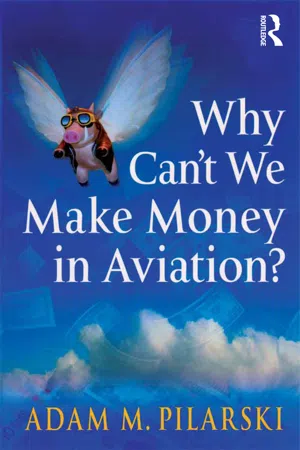
Why Can't We Make Money in Aviation?
About this book
Seemingly since the beginning of aviation history there has been discussion and speculation on the remarkable inability of the industry to generate profits. This is even more so the case now, when a number of the world's airlines are bankrupt. The failure of aviation, or at least of airlines, to produce a reasonable rate of return on investments has been a fact pondered by many at great length but never satisfactorily understood. Somehow the industry seems to violate the most basic principles of economics and business. The question as to how this is the case and how the industry managed to survive, let alone actually grow and prosper so far, is the subject of this book. It details the historical performance of the industry and critically explores the various theories proposed to explain its lack of profitability. Summarizing the analysis, the book also looks to the future, combining lessons from the past and recommendations regarding the better management of airlines. In conclusion it offers a prediction on the future of the global airline industry.
PART I How Bad Is It?
1 Reality of Losses
DOI: 10.4324/9781315547244-1
Statistics show a long history of losses for the airline industry and yet at the same time show a phenomenal growth in traffic. How can these two facts be compatible? If the industry is not profitable, where did the investment come from to enable the industry to expand as fast as it did?
Some of the quotes mentioned in the previous chapter make it sound as if aviation must be the most dismal industry in the world. The immediate disclaimer is always added that the industry by itself is not so bad, only the final user suffers. There is a popular notion that airlines lose money and everyone else makes a fortune. It is interesting to note that such a view is held by many of the participants in the aviation business. The view that others are making money while we suffer is universally held by all players. It is the purest form of the saying that the grass is always greener on the other side of the fence. This view supposedly includes aircraft manufacturers, engine producers, maintenance providers, travel agencies, financiers, and many other hangers-on who all believe that everybody else makes money except for them.
Manufacturers have held this view for a long time. Although Boeing has been profitable for years, it definitely is not wildly so with rates of return well below those of other industries. Douglas Aircraft Company was unprofitable for many years before it was purchased by Boeing. The losses Lockheed experienced in their commercial division almost put them out of business and eventually led them to abandon that area of manufacturing. The picture with regard to Airbus is clouded. One can accept the European view that Airbus is now profitable and is finally beginning to repay its loans or the American view that it is a hugely subsidized government jobs program. The fact remains though, that from a purely financial point of view Airbus has not been a stellar business venture. As a pure investment, it has brought negative real returns in the early years and the only question is whether these losses were huge or acceptable in order to help put Europe on the map of aircraft manufacturing as a major player. Since the Airbus numbers are not publicly available, the answer cannot be quantified. However, it remains a clear fact that overall, aircraft manufacturers did not make exceptional returns on their production. Smaller producers did even worse, with the likes of Dornier and Fokker no longer even in business.
So who did make money? The leasing companies? ILFC clearly did. Guinness Peat Aviation (GPA), on the other hand, went out of business and had to be taken over by General Electric (GE), although since then it has been consistently profitable under the new name General Electric Capital Aviation Services (GECAS). A number of other financiers have exited the aircraft leasing business and would object strenuously to the assertion that financing aviation is a profitable venture. It is interesting to note that Boeing actually reshaped its strategy based on the belief that everybody makes money except for the manufacturers. In 2002, Boeing started aggressively to pursue a policy of diversification. Believing that there was not enough money in pure manufacturing, they decided to expand into maintenance, modifications, finance, air traffic control, and various other peripheral businesses. The belief that Boeing could make a lot more money in businesses they had little experience in rather than in manufacturing where they have been a leader for a period approaching 90 years may sound strange. It does, though, fit with the belief that everybody else was making money. For some time, Boeing publicly expressed the view that Boeing Capital would grow to be as big and as profitable as GE Capital. Eventually, of course, Boeing reverted back to sanity. The company revamped its product line, launched a very successful new airplane, and improved marketing and manufacturing. At the same time, it gave up on or dramatically scaled down its dream of making a fortune in traffic control, computers, movie distribution, and high finance.
Within airline companies, the view that there is a greener shade of grass on the other side of the fence is also prevalent. Labor believes that management is grossly overpaid while management believes that labor represents the only people making money in aviation. There is even great dissention within labor as some groups, like the mechanics, believe that pilots are the only group making real money. At the same time shareholders believe that management and labor both make tons of money at the expense of those who have invested their hard-earned funds in the airline.
Even if we accept the (untrue) premise that everybody except for airlines makes money in aviation, the picture is still far from clear. Or, as some say, it is clear as mud. Airlines are complex businesses with various constituents. In general, the airline business has been good to the flying public. It has also been fairly good to the employees and to management. The sector which may have suffered are the financiers, although, as mentioned previously, some operating lease companies have done very well.
Looking at the various pieces of the puzzle we can see that the airline industry has had very different results depending on who is concerned. Clearly, the industry has not been in a state of decline. The statistics in the next chapter show a significant pattern of secular growth in passenger and cargo traffic experienced over many decades. These numbers belie the contention of a maturing or receding industry. As a matter of fact, an industry which is maturing is usually blessed with good returns as the various parties move into a harvesting phase and do not invest for the future. Aviation and airlines are still in a phase of great innovation, investments, entry of new players and other phenomena incompatible with a maturing industry.
Assessing the degree to which aviation has been successful over the century since its inception may be a complicated affair. Technology advocates will cite the unbelievable advances experienced by this industry: from the short flight of the Wright brothers in 1903, we have come a very long way. Planes can now carry hundreds of people to virtually any place on our globe. As a matter of fact, the 120 feet distance flown during Orville Wright’s first flight is less that the length of today’s large planes. Now, planes fly at great speed, with exceptional comfort, and at continuously increasing levels of safety.
The images we have of the glorious past where one would fly a DC-3 with movie star type stewardesses and exquisite cuisine are really a myth. In actuality, since those flights were at relatively low altitudes passengers were subject to a great deal of discomfort due to weather-induced turbulence. Air movements were felt down to the stomach. Flights were slow and the range of planes was short. Accidents were much more frequent than they are today. The DC-3 was a great plane and, justifiably, has its place assured in the history of aviation. However, it flew at an approximate cruising speed of 200 mph and had a range of around 1,500 stature miles flying no passengers. This is less than half the speed of today’s planes and less than a seventh of their range. In movies, the DC-3 flights looked pleasant and luxurious. In reality, they took forever, required frequent stops to cover long distances, were relatively unsafe, and could not operate in bad weather. The DC-3 can’t compare with the type of flights today’s technology allows us to enjoy. Non-stop flights over the Pacific and Atlantic at high altitudes in a pressurized wide-body cabin are far superior to the endless and de facto miserable flights enjoyed on the fabulous DC-3. Imagine back to 1936, when the famous Pan Am Clipper cut travel time from California to China from three weeks to just one week for Hong Kong and six days to Manila. What a revolutionary feat it must have been and how lucky the passengers of that day must have felt. However, when we consider that they were flying in an unpressurized plane which was subject to all the ups and downs of the environment plus all of their stopovers (Hawaii, the Midway Islands, Wake Island, Guam, and the Philippines); it seems primitive compared with the half day flight of today. The cost of the 1936 trip was a cool USD1,438 in then-year dollars. This was a large amount of money for that time, perhaps enough to purchase one of the islands the plane landed on.
For the purpose of this book we will concentrate on the profitability of airlines alone, leaving the rest of the players like manufacturers, suppliers, financiers and the like for another time. The book starts with the profit picture and then decomposes the various elements that defined the results.
Historical Profits in the Airline Industry
Profits, by definition, are the difference between revenues and costs. Table 1.1 shows operating profits for the airl...
Table of contents
- Cover
- Halftitle Page
- Dedication Page
- Title Page
- Copyright Page
- Contents
- List of Figures
- Preface
- Introduction
- PART I HOW BAD IS IT?
- Chapter 1 Reality of Losses
- Chapter 2 Decomposing the Elements of Losses
- Chapter 3 Forecasting
- PART II REASONS FOR LOSSES: THE NATURE OF THE BEAST (EXOGENOUS FACTORS)
- Chapter 4 Cyclicality
- Chapter 5 Ease of Access to Capital
- Chapter 6 Cost of Aircraft
- Chapter 7 Too Much Competition and the Need for Consolidation
- Chapter 8 Sexy Industry Drawing in Dreamers and Suckers
- PART III REASON FOR LOSSES: SELF-INFLICTED (ENDOGENOUS FACTORS)
- Chapter 9 Labor
- Chapter 10 Bad Management
- Chapter 11 Pricing
- PART IV REASON FOR LOSSES: OVERREGULATION
- Chapter 12 Government Regulation
- Chapter 13 Public Ownership of Airlines
- PART V HOW CAN THE INDUSTRY BE PROFITABLE?
- Chapter 14 Prescription for Health
- Chapter 15 Summary and Conclusions
- Index
Trusted by 375,005 students
Access to over 1.5 million titles for a fair monthly price.
Study more efficiently using our study tools.
Frequently asked questions
Yes, you can cancel anytime from the Subscription tab in your account settings on the Perlego website. Your subscription will stay active until the end of your current billing period. Learn how to cancel your subscription
No, books cannot be downloaded as external files, such as PDFs, for use outside of Perlego. However, you can download books within the Perlego app for offline reading on mobile or tablet. Learn how to download books offline
Perlego offers two plans: Essential and Complete
- Essential is ideal for learners and professionals who enjoy exploring a wide range of subjects. Access the Essential Library with 800,000+ trusted titles and best-sellers across business, personal growth, and the humanities. Includes unlimited reading time and Standard Read Aloud voice.
- Complete: Perfect for advanced learners and researchers needing full, unrestricted access. Unlock 1.5M+ books across hundreds of subjects, including academic and specialized titles. The Complete Plan also includes advanced features like Premium Read Aloud and Research Assistant.
We are an online textbook subscription service, where you can get access to an entire online library for less than the price of a single book per month. With over 1.5 million books across 990+ topics, we’ve got you covered! Learn about our mission
Look out for the read-aloud symbol on your next book to see if you can listen to it. The read-aloud tool reads text aloud for you, highlighting the text as it is being read. You can pause it, speed it up and slow it down. Learn more about Read Aloud
Yes! You can use the Perlego app on both iOS and Android devices to read anytime, anywhere — even offline. Perfect for commutes or when you’re on the go.
Please note we cannot support devices running on iOS 13 and Android 7 or earlier. Learn more about using the app
Please note we cannot support devices running on iOS 13 and Android 7 or earlier. Learn more about using the app
Yes, you can access Why Can't We Make Money in Aviation? by Adam M. Pilarski in PDF and/or ePUB format, as well as other popular books in Business & Business General. We have over 1.5 million books available in our catalogue for you to explore.