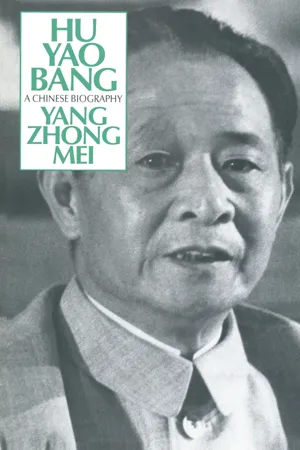
- 256 pages
- English
- ePUB (mobile friendly)
- Available on iOS & Android
eBook - ePub
About this book
Compares IT parks within the Asian Pacific in search of strategies that policy makers can adopt to: reduce the global digital divide; advance distributional equity; and soften some of the negative effects of economic globalization. "Best practices" are suggested based on these cases.
Information
1
Birthplace and Family Origins
Above the ruins of the shattered imperial rule of Mao Zedong's dictatorship, a red star now shines brightly. This red star is Hu Yaobang. From patriotic youngster under the banner of Mao Zedong, after more than half a century of turbulent storms, he stands at the forefront of the times, directing China's great reforms. The development of such an outstanding man and the changes of his thought, his belief in and hope for reform, his attitudes toward people, events, and the world, and his own personal interests and character are all subjects worthy of serious research.
Birthplace
Hu Yaobang comes from Liuyang county in Hunan province, the native place of Tan Sitong, the first person in modern China to sacrifice his life for constitutional reform. This is recorded in the biographical sketches distributed by the Chinese Communist Party introducing Hu Yaobang.
In February 1980, at the Fifth Plenum of the Eleventh Congress of the Chinese Communist Party (CCP), Hu Yaobang was elected secretary-general of the Central Committee of the CCP. On March 2, 1980, the People's Daily, in a "Biographical Sketch of Comrade Hu Yaobang," noted that he was "from Liuyang county in Hunan, born of a poor peasant family in 1915."
In a talk on May 10, 1985, Hu Yaobang revealed that he was from South township [Nanxiang] in Liuyang county. The Liuyang Gazetteer has the following entry: "The Liu district is 329 li long by 200 li wide [110 by 70 miles], reaching to Liling in the south, to Xiangtan in the southwest."1 As the crow flies, the Liuyang county town is less than forty-five miles from Liling, the hometown of the famous early leader of the Communist Party, Li Lisan, and only fifty miles from Xiangtan, the birthplace of Mao Zedong.2
The clear, fast waters of the Liuyang River, from its source on Dawei Mountain in East township, flow from one end of the county to the other, over 300 li. In modern Chinese history the Liuyang River has nurtured a number of heroes, martyrs, and men of talent, beginning with Tan Sitong of the 1898 Reform Movement; the brothers Liu Daoyi and Liu Kuiyi and Tang Caichang, who promoted Sun Yat-sen's revolutionary activities for many years; Qiao Dafeng, who gave his life raising the first banner of the 1911 Revolution in Hunan; to the untold numbers of even greater heroes who rose from the back hills to take up the cause of the Chinese Communist revolution. Wang Zhen, one of the original veterans of the Chinese Communist Party, came from North township in Liuyang county. The only woman general of the Chinese Communist Party, Li Zhen, came from East township. Yang Yong is from the same township as Hu Yaobang. The first CCP governor of Hunan province, Wang Shoudao, and Li Xin, gunnery adviser to the Chinese People's Liberation Army, both grew up along the banks of the Liuyang River.
Date of Birth
In 1984, announcing the joint venture between the Chinese Encyclopedia and the U.S. Encyclopedia Britannica in the publication of the Abridged Encyclopedia Britannica, Liaoning's Gongchandang yuan (Communist Party Member) published part of the entry on Hu Yaobang that was being prepared for publication. It read: "Hu Yaobang, born November 20, 1915, in Liuyang county, Hunan province, of a poor peasant family."3 Thus the birthdate of the secretary-general of the Central Committee of the Chinese Communist Party became known to the world via the circuitous route of a joint Chinese-American project.
When I was visiting the hometown of Hu Yaobang, I was told by a number of people of the older generation that Hu was born around midnight on a night when the moon was bright and there were few stars.
Class Background
All official CCP biographical sketches and documents made available to the public to date insist that Hu Yaobang was "born of a poor peasant family." Actually, among the widespread mountain villages of Hunan, Hu Yaobang's parents were quite ordinary peasants. Among the thirty or so peasant families of Zhonghe village, their standard of living was that of the average family. Hu's family had a nine-room, one-story house of clay tiles. They had arable fields of five or six mu [about one acre], the average yearly yield of which was nearly twenty dan [1.1 tons] of rice or wheat. In the South, China's peasants have a saying, "Ten mu of land and a three-room house are hard to come by in this world." These were the standard of middle-class comfort that peasants sought. Although the family into which Hu Yaobang was born did not have ten mu of land, they had more than half that, and they had a very spacious house, larger by far than that owned by the average peasant family.
Hu Yaobang's family lived frugally and worked hard to maintain a modest life, comfortable, warmly clothed, and well fed. The family worked together growing and preparing flax for Hu's mother to weave into Liuyang "summer cloth," a local specialty. The money earned from the sale of this cloth added to the family income or paid the tuition for Hu Yaobang's schooling. Hu's father, who had had a few years schooling himself and could basically read and write, put a great deal of emphasis on the children's education and, pooling the family's resources, was able to provide Hu Yaobang with an education seldom attained by the average peasant child.
Using Mao Zedong's definition of class divisions in China, one might classify Hu Yaobang as coming from a "middle-class peasant" background. A family with a nine-room house of clay tiles, five or six mu of arable land with a yearly harvest of nearly twenty dan, a man to till the fields, and a woman to weave would be financially self-sufficient and comfortable, able to send the son to the county middle school, and definitely not a poor peasant family.
The general view of the peasants from Hu Yaobang's hometown was that he came from a middle-class peasant family. At the time, first-year tuition at the Liuyang County Middle School was more than ten silver dollars. Room and board was one silver dollar a month, and the price of one dan of rice was two silver dollars. A poor peasant family did not have enough to keep itself warm or fed and could not possibly have spent thirty silver dollars a year to send one of its sons to the county middle school to study.
Family and Clan
Hu Yaobang's parents were still alive when Liberation came. His father died in the early 1950s, having heard only that after the success of the revolution his son had become a high official in Sichuan. In the late 1950s, Hu's mother made one trip to Beijing and stayed in the residence of her son, now a first secretary of the Central Committee, saw her grandson and granddaughter, and was frequently accompanied by her son and his wife by car to see the sights, or for a leisurely stroll through the former imperial gardens. But after a short while she returned to Zhonghe village, where she died in the early 1960s, having gone through the upheavals of the Great Leap Forward.
Hu Yaobang has one brother, four years older than himself, named Hu Yaofu. He is still in good health today. In the third issue of 1983, Ba xiaoshi yiwai (After Work) published an article, "Stories from the Banks of the Liuyang River," by the well-known writer Tian Shuang, which included a report on his interview with Hu Yaofu. This article quotes Hu Yaofu as saying,
"It was probably 1981. One of the leading cadres of Yueyang county wanted to have Dezi [Hu Yaofu's second son, Hu Dezi] transferred over there to take a high government position. By chance Hu Yaobang heard about it and got real angry. Had Dezi sent back. In April of the same year I went to Beijing and saw Yaobang. I mentioned this and he blew up. 'I told you a long time ago that [the children] De'an and Dezi should be content to stay at home and farm. You refuse to listen, and go ahead and tell Dezi to become a national official. What do you mean by this!' When he said this, I didn't know what to say, because I didn't know a thing about Dezi being transferred over there before it actually happened. So I asked him to explain. I don't know anything about politics, and I certainly never asked anyone to help me use any back doors. He didn't seem to believe me and criticized me pretty severely. 'If nobody is willing to stay on the farm and everybody wants to go become a high official, who's going to do the planting? What are one billion people going to eat?' At this point I was getting upset too, and I shouted back at him, 'Look, other people's kids can be high officials, why not mine? Dezi has graduated from junior high school. I say he should take the job!' 'To be an official you have to start at the bottom. Why does he want use his connections and go over to Yueyang?' 'You get nowhere at the bottom!' 'If you're afraid of getting nowhere then be a farmer! Stay at home quietly and be a good farmer!' Seeing that neither of us was about to budge, my sister-in-law advised Yaobang, 'First of all, you shouldn't blame your older brother. Find out what really happened. Then you can talk about it.' We parted, still mad at each other. Last year I made another trip to Beijing hoping to clear up that misunderstanding. I told him that Dezi had already resigned that position and returned home to farm again. Yaobang had also thought about his attitude and said that it was clear to him now that it was not my fault. He also advised his nephew to be content to stay home and farm, that he hoped he would do well, and that when he became a model worker he should come to Beijing again to see him."
Hu Yaobang also has a paternal cousin (female) who was married some years ago and lives in Shanzaotan village in East township. Even today Hu Yaobang's son still goes there frequently to visit his relatives.
Hu Yaobang joined the revolution early and in 1941 married Li Zhao, a student from the Chinese Women's College in Yan'an. At the time Hu Yaobang was twenty-seven and Li Zhao was twenty-one. The two were very much in love, and to show their deep respect for each other gave their daughter the mother's surname, Li, and their son the father's surname, Hu. This was also very much a mark of the equality between the sexes that prevailed during the Yan'an period. However, there has been very little public information about the members of Hu Yaobang's family. The first official introduction to the public came on March24,1984, when Hu Yaobang entertained Japanese Prime Minister Nakasone and his wife for lunch at his home in the Zhongnanhai residential area. The New China News Agency reported this as follows:
When Nakasone arrived by car at Zhongnanhai at 11:30 a.m., Hu Yaobang, his wife, and son and daughter welcomed the guests at the door of the reception hall. Hu Yaobang introduced his wife, Li Zhao, the sixtytwo-year-old member of the Beijing Advisory Committee of the Chinese Communist Party, his son, Liu Hu, who works for the Ministry of Foreign Trade, his daughter, Li Heng, editor of the magazine Zhonghua neike (Chinese Internal Medicine), and his ten-year-old granddaughter, Hu Zhizhi (in the fifth grade), to Prime Minister Nakasone and his wife.4
In addition to those mentioned by the New China News Agency, Hu Yaobang also has an elder son, Hu Deping, and a third son, Hu Dehua, a college teacher. Hu Deping graduated from Beijing University's history department in 1967. In early 1967, Deng Xiaoping and Hu Yaobang were branded as reactionary capitalist roaders by the Red Guards of Mao Zedong. Deng Xiaoping's son, Deng Pufang, and Hu Yaobang's son, Hu Deping, were also dubbed children of reactionaries. They were investigated and slandered on the orders of the Red Guard Revolutionary Committee of Beijing University, which supported the Nie Yuanzi faction.5 After the Cultural Revolution, Hu Deping passed the exam for the master's degree program in the department of Chinese intellectual history under Hou Wailu at the Chinese Academy of Social Sciences and has since become a devote of hong xue [i.e., the textual and historical study of the classical novel Dream of the Red Chamber]. He served as assistant director of the Chinese Museum of History and is now chairman of the United Front Department of the CCP Central Committee. His wife, An Li, is the daughter of An Ziwen, who before the Cultural Revolution was director of the Organization Department of the Central Committee.
Hu Yaobang's second son, Liu Hu, was born in 1946 just at the time the civil war between the Nationalists and Communists exploded again. Because the situation was very tense, Liu Hu was sent to live with Liu Shichang, who was then a local cadre in northern Shaanxi province and assistant director of the South district production cooperative. Hu Yaobang and Liu Shichang together agreed on the name Liu Hu. In 1962, Liu Shichang sent Liu Hu back to live with Hu Yaobang. In 1964, Liu Hu entered the chemical engineering department of Qinghua University in Beijing. He is now assistant director of the Technology Import-Export Office of the Chinese Ministry of Foreign Trade. His wife is the daughter of the veteran Communist and diplomat Wang Youping. In 1984, Liu Hu visited the United States for a brief investigation tour of the U.S. mining industry.
By today's standards Hu Yaobang has a large family, with three sons and one daughter, all of whom have had a good education. All are married, giving Hu Yaobang a total of five grandchildren. The two branches of the family, the old family rooted in the mountain village in Liuyang county and the new family in the Zhongnanhai residences in Beijing, have close ties.
2
Student Days
To date, none of the party resumes introducing Hu Yaobang or other biographical sketches have mentioned anything about his student background. They say simply that he "left home at age fourteen to go to the red base area to join the revolution.'' They say absolutely nothing about his education and studies.
However, an article in the People's Daily on May 26, 1983, by the well-known writer Zhang Zhenguo entitled "The Source of the River" shed some light on this subject, revealing for the first time that when this youth of fourteen left home he had already attended the first year of the Liuyang County Middle School. Also in 1983, in an article published in Zhongguo laoren (China's Elderly), Zhang Zhenguo provided some further detail on this topic. These two reports contained a letter of January 29, 1981, written by Hu Yaobang to his junior high school teacher, Yu Keying, in which he says, "I have not forgotten you, nor the other teachers I had in elementary school and junior high school. The proper and upright attitude of these teachers, never tiring of teaching others, has already given me a great deal of strength." Hu went on to invite Yu Keying to Beijing, and on July 7, 1982, the teacher and student who had not seen each other for more than half a century met at Hu's home in Zhongnanhai. Hu Yaobang was reported to have said, "Comrade Yang Yong was also your student, do you remember? Unfortunately, he is not in Beijing just now. Otherwise, he would certainly come see you!" His teacher replied, "You are very busy, I know. I must not take any more of your precious time.'' "My dear old teacher!" Hu responded. "I have been looking for my old elementary and junior high school teachers for quite some time now. You are the only one I have been able to find!"1
These two articles indicate that Hu Yaobang "was one of the School's talented students."2 It is also interesting to note that one of the generals most respected by Deng Xiaoping, Yang Yong, who once was a member of the high command of the Chinese People's Volunteer Corps in Korea, was a schoolmate of Hu Yaobang. But neither of these two articles tells us anything concrete or specific about the studies or politics of this fourteen-year-old student about to leave home. We must continue to search for footprints left behind from Hu Yaobang's student days.
From Village Tutorials to Liwen Higher Elementary School
Before formally entering elementary school, Hu Yaobang had already been tutored for more than two years in the informal village school of Zhonghe village. This school was jointly sponsored by the Hu clan and other families in the village. The room, board, and salary of the Zhonghe village tutor were shared by the families of children attending the school. Both Hu Yaobang and his older brother, Hu Yaofu, took classes with the village tutor.
The textbooks and content selected by the tutor usually followed the old custom, the Hundred Family Surnames, the Thousand Character Classic, matching simple couplets, calligraphy copy books, memorizing Tang poetry, and a little later the Mencius, the Analects of Confucius, and so forth. Hu Yaobang had a good m...
Table of contents
- Cover
- Half Title
- Title
- Copyright
- Contents
- Foreword
- Preface to the English Edition
- Preface to the Chinese Edition
- 1. Birthplace and Family Origins
- 2. Student Days
- 3. In the Red Soviet District
- 4. The Long March
- 5. Yan'an Years
- 6. The War of Liberation
- 7. Liberation: The Early Years
- 8. Rightist Tendencies and the Antirightist Campaign
- 9. From the Mao Line to the Liu-Deng Line
- 10. In the Wild Storms of the Cultural Revolution
- 11. Bombarding the "Whatever" Clique
- 12. Historic Steps in the New Long March
- 13. Personality, Character, and Interests
- 14. Thought
- 15. Hu Yaobang: A Preliminary Assessment
- Appendix: Members of the government who were formerly leaders in the Communist Youth League under Hu Yaobang, before January 1978
- Notes
- Index
- About the Author
Trusted by 375,005 students
Access to over 1.5 million titles for a fair monthly price.
Study more efficiently using our study tools.
Frequently asked questions
Yes, you can cancel anytime from the Subscription tab in your account settings on the Perlego website. Your subscription will stay active until the end of your current billing period. Learn how to cancel your subscription
No, books cannot be downloaded as external files, such as PDFs, for use outside of Perlego. However, you can download books within the Perlego app for offline reading on mobile or tablet. Learn how to download books offline
Perlego offers two plans: Essential and Complete
- Essential is ideal for learners and professionals who enjoy exploring a wide range of subjects. Access the Essential Library with 800,000+ trusted titles and best-sellers across business, personal growth, and the humanities. Includes unlimited reading time and Standard Read Aloud voice.
- Complete: Perfect for advanced learners and researchers needing full, unrestricted access. Unlock 1.5M+ books across hundreds of subjects, including academic and specialized titles. The Complete Plan also includes advanced features like Premium Read Aloud and Research Assistant.
We are an online textbook subscription service, where you can get access to an entire online library for less than the price of a single book per month. With over 1.5 million books across 990+ topics, we’ve got you covered! Learn about our mission
Look out for the read-aloud symbol on your next book to see if you can listen to it. The read-aloud tool reads text aloud for you, highlighting the text as it is being read. You can pause it, speed it up and slow it down. Learn more about Read Aloud
Yes! You can use the Perlego app on both iOS and Android devices to read anytime, anywhere — even offline. Perfect for commutes or when you’re on the go.
Please note we cannot support devices running on iOS 13 and Android 7 or earlier. Learn more about using the app
Please note we cannot support devices running on iOS 13 and Android 7 or earlier. Learn more about using the app
Yes, you can access Hu Yao-Bang: A Chinese Biography by Zhongmei Yang in PDF and/or ePUB format, as well as other popular books in Politics & International Relations & Political Biographies. We have over 1.5 million books available in our catalogue for you to explore.