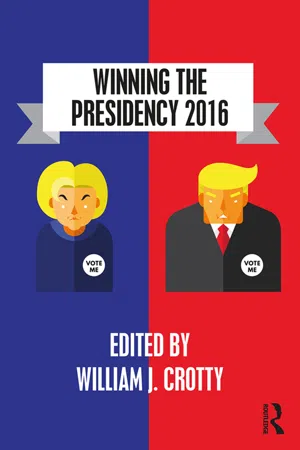
The presidential election of 2016 was unlike any in modern American history. Donald Trump, a successful businessman, well known reality television host and a political novice with no clear policy views or political attachments, ran for the presidency. His opponent was Hillary Clinton, a candidate with a long and impressive career in politics. She was the first woman nominee of a major political party and, should she have won, the first woman president of the United States. No one gave Trump much of a chance. Yet he won the election. How did he do it? What explains his political success? What can we expect from a Trump presidency? This book answers these questions. It presents a clear and definitive overview of his campaign, it controversies and setbacks and its successes. Winning the Presidency 2016 identifies who voted for Donald Trump and why. It explains why Hillary Clinton lost. Essential reading for understanding a campaign with no precedents and a presidential election that could have seismic consequences for the conduct of American government.
- 202 pages
- English
- ePUB (mobile friendly)
- Available on iOS & Android
eBook - ePub
Winning the Presidency 2016
About this book
Information
1
Not an Ordinary Election
The Presidential Race of 2016
It is what it is.
— Bill Belichick
The election of 2016 has no precedent in modern American history. The meaning of an election for a restrained conception of democratic leadership, one equal to the task of leading the world’s greatest power, constitutes the essence of a presidential race. Were the criteria met? It was a long and contentious campaign. The issues in the election ranged from domestic anger, alienation and political deadlock to international crises, fundamental concerns that will take insightful and experienced leadership.
The election, and more specifically the manner in which it was conducted, raises a number of questions. Among these, and among the more fundamental, is whether it is a blip, an aberration and exception in the long life of national elections, the manner in which they have been conducted and the underlying dynamics that have come to explain the past contests. Or, alternatively, 2016 could be an introduction to future such races, with political parties lacking influence of any magnitude and voter discontent turning to the more radical and unrestrained of candidate alternatives with consequences yet to be seen for the operation of a democratic state.
One thing is clear and that is considerable voter anger in both parties over the manner in which elected officials have largely ignored their real needs, and in particular those associated with the economic well-being of major segments of the population. The discrepancy between the promises and agendas of the candidates and parties over the last half century and the operations and priorities in office of those who would emerge as the winners in elections has much to do with the level of current discontent. The candidate races in both parties—in a strikingly different manner—serve to illustrate the point.
The outcome of the election was unexpected. It ranks as one of the major upsets in American history. Its full importance will not be known for years but it could have radical, even seismic, consequences for the future of the United States.
The Candidates and Their Campaigns
The election pitted two candidates and parties, Donald Trump, the Republican party nominee, and Hillary Rodham Clinton, the Democratic nominee, with contrasting personalities, life experiences and personal values as well as polarized conceptions of what government should do and who it should represent.
Donald Trump and His Campaign
First, there was the newcomer to politics representing the Republican party. Donald Trump was a political novice; he had never held office at any level or competed for office in a campaign. He was a New York real estate billionaire, with interests in casinos, apartment houses, office buildings, golf courses and other real estate ventures worldwide. Trump was a surprise winner of the Republican primaries which fielded a group of 17 candidates, mostly minor political figures with a sprinkling of newcomers added. None however had the party following, type of issue they could ride to victory, financing or organization needed to win. Most were also largely unknown. Trump was, among other things, a television personality, the host of a television reality show, “The Apprentice,” where Trump became known for uttering the catch phrase “You’re fired!” to contestants who failed at game tasks. The show had a wide familiarity among mass audiences.
Trump claimed to have the money needed to finance his own campaign, as opposed to creating Super Political Action Committees (Super PACs) or asking for donations. He was also at ease in front of large audiences, had a quick response to almost everything and knew how to package complex ideas in a few pointed, if often angry, words. He was not interested in the details of policy concerns, as such. What he did—through default or planning—was to appeal to white voters, less educated and generally less well-off than most, bypassed by the economic gains of recent decades. He managed to tap into their anger and frustration; their sense of being left behind as the rest of the country did increasingly better; their belief that minorities were getting preference for jobs at their expense; and their fear of multiculturalism, that the America they had known was passing. Above all was the sense of not being represented by the candidates for national office. They were isolated, ignored and exploited. Trump spoke to their concerns, acknowledged their alienation and gave voice to their frustrations. Given this, they proved willing in return to ignore or discount his excesses and failings in exchange for having someone finally speak for them in a national campaign.
Trump did not have much of a campaign organization at any level. He had few close advisors beyond the immediate members of his family. He depended on his own instincts and a sense of what would appeal to the voters who formed his constituency. At the same time, he showed an unusual disregard for the Republican party mainstream or the centrists/moderates believed to be the keys to an electoral victory. His freewheeling, tell-it-like-it-is style could, and did, get him into seemingly endless controversies. If nothing else, they kept Trump in the forefront of television news, fed the cable networks’ insatiable demand for material and commanded seemingly endless social media attention.
Donald Trump is a skilled negotiator and a successful businessman who has built an international empire. He is a world-class salesman, a savvy student of a media he uses for his own purposes, and he loves success and the personal attention that comes with it. He has shown himself to be an entrepreneur few can match and one who likes to bet big. He prizes winners and, as he has said, hates losers. He has an unchallengeable faith in his own ability and he relies almost exclusively on his own judgment and instincts. These are qualities made clear in the campaign and likely will guide his domestic policymaking and his international dealings in the presidency.
Hillary Clinton and Her Campaign
Hillary Rodham Clinton has had a long and impressive career in politics. She had been Secretary of State in the Obama administration (2009–2013); First Lady during her husband Bill Clinton’s presidency; a U.S. Senator from New York (2001–2009); and a candidate for Democratic party nominee for President in 2008, losing a close battle to Barack Obama. In addition, she had been the First Lady of Arkansas during her husband’s gubernatorial terms (1979–1981 and 1983–1992). The presidential election of 2016 was her second attempt to be the first woman to serve in the White House.
At each stop, she had compiled a list of accomplishments in advancing children’s issues, women’s rights and improvements in health care, as well as evidencing a commitment to service on an extensive number of legal commissions and committees reforming and modernizing the law and its application. After law school she worked with the Children’s Defense Fund and as a staff member of the congressional committee establishing the groundwork for the impeachment of Richard M. Nixon. She ranked as one of the most experienced and best prepared of candidates to ever seek the presidency.
Bill Clinton won the presidency in 1992 with Hillary Clinton’s help. Bill Clinton had been accused of a long-term sexual relationship by the woman involved, Gennifer Flowers. Hillary Clinton went on television to defend her husband and Bill Clinton survived the episode. The effort was to be made again when Bill Clinton was accused of having sex in the White House with an intern. He denied the accusation initially and she made an angry television appearance claiming it and a series of other attacks on their character were products of a concentrated right wing conspiracy. Bill Clinton later admitted in a brief televised address to an inappropriate relationship with the intern, publicly embarrassing his wife, among others. He was impeached by the House but acquitted by the Senate on the two articles of impeachment, perjury and obstruction of justice, allowing him to remain in office. The incident was believed to be the most critical point in a frequently contentious relationship between the Clintons. The controversies involving her husband and later those surrounding the funding and operations of the Clinton Foundation helped shape the image Hillary Clinton carried over in her presidential bid.
As First Lady, Hillary Clinton was an active advisor on a range of issues. She was given responsibility for developing a national health care plan. After two years of work, the proposed plan failed to win congressional approval. She blamed the defeat on the lobbying of health care corporations and the financial indebtedness of legislators to them.
In 2000, her career went in another direction. She was elected the first female senator from New York. Her years in the Senate were notable for her efforts to get $20 billion in federal health care and other aid for the police and service workers who responded to the 9/11 World Trade Center terrorist attacks, a determination to stimulate economic development in the poor and rural areas of New York state and her continued concern with children and women’s issues (Borchers 2016). She was reelected in 2006 with 67% of the vote.
In 2008, she ran for President. In retrospect, she may have made the mistake of continuing to serve as Senator from New York, a position she worked on virtually full time, while also attempting to run for the Democratic party’s nomination for President. Her campaign concentrated power in a competing circle of advisors. They did not get along with each other and had different strategies for the campaign. Between them, they managed to use most of her political financing before the delegate selection process began. Consequently, she was relatively underfunded compared with her adversary, Barack Obama. Her campaign underestimated the strength of the Obama challenge and never quite overcame its initial mistakes. She ended up losing a race in which she had been the heavy favorite. After the election, surprising many, she agreed to serve as Obama’s Secretary of State.
In her 2016 race, Clinton constantly contrasted her record and experience in government with Trump’s lack of it, his business ventures and his focus on a television reality show. In an election with the need for change as the undercurrent, her years of experience may actually not have helped. She could be seen, as Trump claimed, as part of the problem, a representative of the status quo. It may well have played to his self-designated role as the outsider and agent for change.
Careers, personalities, backgrounds, values, ideologies, the temperaments of the candidates, all came to shape the race for the presidency to an extent that went well beyond the ordinary. The nominees were unlike in everything from gender to their belief as to what American government stood for and what its role and mission should be. All of this would come to mark the highly unusual campaign that followed.
One final thing about the candidates: neither Hillary Clinton nor Donald Trump were trusted by large numbers of the American public. Taken together, they may well have been the two most unpopular candidates to run in a presidential election since the polls measured such things (Chozick and Thee-Brenan 2016). Gallup polling conducted October 31-November 5, 2016 showed Clinton at 57% unfavorable and Trump 62% unfavorable (Gallup 2016).
The Nomination Phase
The race to select the parties’ nominees, like the general election to come, established basic constraints in approach. With no incumbent of either party seeking reelection, it was an open race. These usually draw a large number of prospective nominees. Such was the case with the Republicans. The Democratic party appeared to have its candidate decided as early as two years before the election. Hillary Clinton, the loser in a close primary fight to Barack Obama in...
Table of contents
- Cover
- Title
- Copyright
- Contents
- List of Tables and Figures
- Acknowledgments
- Contributor Biographies
- Introduction to the Chapters
- 1 Not an Ordinary Election: The Presidential Race of 2016
- 2 The Conventional Versus the Unconventional: Presidential Nominations in 2016
- 3 The Presidential Election: A Troubled Democracy
- 4 Explaining the Vote
- 5 The Races for Congress in 2016: A Tale of Two Elections
- 6 Women and the 2016 Presidential Election: Unrealistic Expectations of Cohesiveness
- 7 Navigating through Turbulence and Troublesome Times: Latinos, Election 2016, Partisan Politics, and Salient Public Policies
- 8 The Election in Perspective
- Index
Trusted by 375,005 students
Access to over 1.5 million titles for a fair monthly price.
Study more efficiently using our study tools.
Frequently asked questions
Yes, you can cancel anytime from the Subscription tab in your account settings on the Perlego website. Your subscription will stay active until the end of your current billing period. Learn how to cancel your subscription
No, books cannot be downloaded as external files, such as PDFs, for use outside of Perlego. However, you can download books within the Perlego app for offline reading on mobile or tablet. Learn how to download books offline
Perlego offers two plans: Essential and Complete
- Essential is ideal for learners and professionals who enjoy exploring a wide range of subjects. Access the Essential Library with 800,000+ trusted titles and best-sellers across business, personal growth, and the humanities. Includes unlimited reading time and Standard Read Aloud voice.
- Complete: Perfect for advanced learners and researchers needing full, unrestricted access. Unlock 1.5M+ books across hundreds of subjects, including academic and specialized titles. The Complete Plan also includes advanced features like Premium Read Aloud and Research Assistant.
We are an online textbook subscription service, where you can get access to an entire online library for less than the price of a single book per month. With over 1.5 million books across 990+ topics, we’ve got you covered! Learn about our mission
Look out for the read-aloud symbol on your next book to see if you can listen to it. The read-aloud tool reads text aloud for you, highlighting the text as it is being read. You can pause it, speed it up and slow it down. Learn more about Read Aloud
Yes! You can use the Perlego app on both iOS and Android devices to read anytime, anywhere — even offline. Perfect for commutes or when you’re on the go.
Please note we cannot support devices running on iOS 13 and Android 7 or earlier. Learn more about using the app
Please note we cannot support devices running on iOS 13 and Android 7 or earlier. Learn more about using the app
Yes, you can access Winning the Presidency 2016 by William J. Crotty in PDF and/or ePUB format, as well as other popular books in Politics & International Relations & Politics. We have over 1.5 million books available in our catalogue for you to explore.