Marginalized Voices in Music Education explores the American culture of music teachers by looking at marginalization and privilege in music education as a means to critique prevailing assumptions and paradigms. In fifteen contributed essays, authors set out to expand notions of who we believe we are as music educators -- and who we want to become. This book is a collection of perspectives by some of the leading and emerging thinkers in the profession, and identifies cases of individuals or groups who had experienced marginalization. It shares the diverse stories in a struggle for inclusion, with the goal to begin or expand conversation in undergraduate and graduate courses in music teacher education. Through the telling of these stores, authors hope to recast music education as fertile ground for transformation, experimentation and renewal.
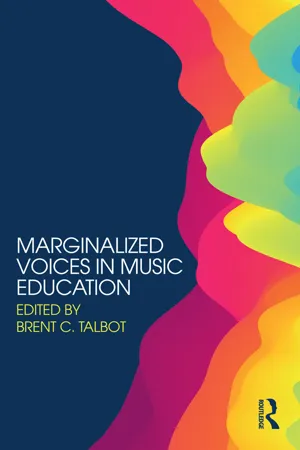
- 206 pages
- English
- ePUB (mobile friendly)
- Available on iOS & Android
eBook - ePub
Marginalized Voices in Music Education
About this book
Information
1
Speak No Evil
Talking Race as an African American in Music Education
Introduction
The goal of this chapter is to awaken the consciousness of the music education profession by sharing my own personal stories, illustrating how specific structures and social actors (i.e., professors, peers, and colleagues) in our profession perpetuate and “legitimize an oppressive social order” (Brown & Jackson, 2013, p. 18). I believe these endorsements contribute to the social realities encountered by people of color, including negotiating institutionalized Whiteness (the practice of racism in social and political institutions), questioning one’s value and sense of belonging in the profession, and grappling with the probability of “selling out”— trading one’s experiential truth in exchange for social and professional acceptance.
For centuries, African Americans have communicated their journey toward achieving equity and social justice in America by displaying their stories in their art, dance, literature, and song. Using these cultural artifacts as instruments to construct their lived experiences, African Americans were able to survive by combating racial attitudes and behaviors (Delgado, 1989). Hale Aspacio Woodruff, African-American artist and teacher, painted a collection of murals portraying “the Amistad incident” in 1839, during which African slaves revolted against their White captors and were later recaptured and placed on trial in America (Appiah & Gates, 2004). These paintings also included illustrations of the slaves being returned to Africa after winning their trial. In 1900, William Edward Burghardt (W. E. B.) Du Bois, sociologist, civil rights activist, and educator, challenged inaccurate scientific claims and popular racial caricatures of Blacks by exhibiting approximately 363 photos of young affluent African Americans at the Paris Exhibition (Bini, 2014). Alvin Ailey, African-American choreographer and activist, choreographed dances that not only included ornaments of ballet, jazz, and modern dance, but also thematic elements reflective of African-American culture and identity (Appiah & Gates, 2004). Phillis Wheatley, former slave and the first published African-American female poet, disseminated artistic descriptions of the Black slave experience in America through literary works such as “On Being Brought from Africa to America” (Appiah & Gates, 2004). She illustrated how religious dogma was used to mask the implications of colonialism (the practice of domination over another person or groups of people). Framing African Americans’ conflict with that of “the American dream” and their reality of being Black, Langston Hughes, famous African-American Harlem Renaissance poet, playwright, and anthologist, composed “Mother to Son.” This poem depicted the resistant capital African-American parents passed on to their children, urging them to never surrender to adversity. As early as the seventeenth century, Black slaves sang Negro Spirituals such as “Steal Away” and “Follow the Drinking Gourd” to protest the actions and ideals of their White oppressors and to also navigate their way to freedom. Through the use of four highly evocative vignettes, Simone (1966), pianist, singer, and civil rights activist, articulated the hardships of four African-American women in her song titled “Four Women.” These are just a few examples of how African Americans were able to not only counter a narrative dominated by White voices, but also to emancipate themselves.
Most of the published stories of people of color in music education have been constructed by White scholars of social justice and antiracist work. In “Listening for Whiteness: Hearing Racial Politics in Undergraduate School Music Programs,” Koza (2008) discussed how the perpetuation of inequality and inequity gaps in K–12 music programs, as well as admission and audition practices in higher education music programs, present challenges for students of color, often resulting in what she refers to as “the access conundrum” (p. 146). Centering on ways to increase and maintain healthy representations of minority students and faculty in higher education music programs, Clements (2009) suggested that institutions work toward finding reliable ways to recruit and retain minority students and faculty, and provide nontraditional minority students access to alternative curricula and outreach music programs. Clements included that the latter could provide students additional music career choices outside of becoming “orchestral performers, conductors, opera singers, or college music professors” (p. 55). Using an antiracist lens, Hess (2015) suggested that the profession considers how (White) privilege and other devices such as Charles Mills’ depiction of society’s preservation of privilege and power, “the racial contract,” impact and maintain dominant structures in society as well as music education. Moving beyond the university music classroom, music education researchers have also begun to interrogate racial injustices in our society and how the profession could endow cultural, musical, and social transformations in the classroom as well as the community. Following the 2015 mass shootings in South Carolina where nine African Americans were murdered in a church by a 21-year-old White supremacist named Dylan Roof, Talbot (2015) took to pen and paper, urging those in the music education profession to rethink their positions as not only educators, but also creative activists. He insisted that music educators become more politically involved in their communities through cultivating a climate of activism in the classroom and by facilitating music-making reflective of all social issues of our times, locally, and globally.
In her article titled “The Sounds of Silence: Talking Race in Music Education,” Bradley (2007) highlights several obstacles standing in the way of the profession’s ability to engage in conversations about race. These obstacles include our struggle to confront colonialism, institutionalized Whiteness, and the profession’s tendency to further sideline issues of race and racism within pluralistic platforms such as multiculturalism and social justice. She asserts that in confronting these obstacles in our music spaces, we will enable greater opportunities to engage in purposeful discussions about race. In Bradley’s articulation of colonialism, she discusses how, despite music education’s best efforts to create more inclusive musical spaces by integrating popular music courses into our curricula, a majority of the curricula is saturated by a Western musical canon, which in many cases reflects a space dominated by White bodies. While the music education profession must come to recognize obvious depictions of inequality in the core of what we teach, we must realize the untouched template of Whiteness—a modern permutation of “us” and “them” (Pinder, 2010, p. 46). In particular, Bradley (2007) emphasizes that Whites must be willing to call out their Whiteness by recognizing that their Whiteness affords them certain privileges and dispensations that are not accessible to people of color. Whether or not they are aware of it, Whites are automatically positioned at the pinnacle of a cultural hierarchy, despite socioeconomic status, education, and political associations. Acknowledging and confronting their Whiteness will not only allow Whites to acknowledge the presence of other and their social realities, but it will afford them a better understanding of how racial minorities are forced to see themselves through what Du Bois (1903/2003) refers to as “double consciousness.”
Failure to carefully articulate race and racism within pluralistic frameworks such as multiculturalism, social justice results in disastrous misunderstandings. Bradley asserts that while multiculturalism is often modeled as a gesture of inclusion of music outside the western canon, paradoxically this action also places race and racism into a generic box of otherness which lessens meanings and distinctions unique to marginalized populations. In addition, Bradley adds that Whites regularly employ diversion strategies to suppress discomfort in discussions regarding race. Tactics include diverting from race topics toward issues they believe identically align with racism (e.g., gender, LBGTQ, and religion). In 2013, #BlackLivesMatter, a rhetorical device, surfaced as a response to the racial disparities of the twenty-first century, particularly George Zimmerman’s acquittal of the murder of Trayvon Martin (Orbe, 2015). Almost immediately following, #BlackLivesMatter was “reconfigured, co-opted, and/or replaced with the more inclusive and racially neutral alternative, #AllLivesMatter” (p. 90). While it is certainly plausible that some Whites employ the latter device as a way to express commonness among all victims of racial discrimination, it also allows Whites to conceal their racism and maintain a post-racial strategy of colorblindness or “historical amnesia” (p. 94). In addition, #AllLivesMatter negates the social reality of African Americans in the United States, while consenting to a dialogue devoid of race. These approaches toward race talk contradict the intended purposes of such conversations. While I do not discredit or dismiss the voices and efforts of my fellow White colleagues, I believe that they are not able to fully articulate the social realities that people of color encounter because of their position of privilege.
Storytelling
Using the storytelling rationale (shared accounts of people of color) of critical race theory (CRT) as a means of sharing my experiences of speaking race as an African American, I illuminate how structures within the music education profession and some of its social actors silence particular voices while applauding others. According to Delgado and Stefancic (2001), CRT is a conceptual framework used to examine dominant structures that situate people of color, particularly African Americans, as recipients of discrimination (institutional, unconscious, and cultural) and racism. The foundational premise of CRT is based on several rationales1. Storytelling is referred to by many names: “voice-of-color” (Delgado & Stefancic, 2001), “chronicles” and “counter-narratives” (Brown & Jackson, 2013, p. 18), “naming one’s reality” (Delgado, 1989), and “the voice” (Ladson-Billings & Tate, 1995, p. 58). Despite nomenclature, theorists and educators alike have and continue to employ stories of the racially marginalized to make clear just how entrenched racial biases are in “the unstated norms of American law and culture” (Brown & Jackson, 2013, p. 19). The power in storytelling lies in its ability to destroy mindset—”the bundle of presuppositions, received wisdoms, and shared understandings against a background of which legal and political discourse takes place.” According to Delgado (1989), storytelling allows “outgroups” (the marginalized) to bring to the fore their narratives in efforts to subvert those of the “ingroup” (the privileged) (p. 2412). For instance, Derrick Bell, noted father of CRT, used counter-narratives to inform and deactivate preexisting narratives of his White law students at Harvard University (Ladson-Billings & Tate, 1995). In regard to how storytelling is employed, Brown and Jackson (2013) state the following:
CRT scholars use chronicles, storytelling, and counter-narratives to undermine the claims of racial neutrality of traditional legal discourse and to reveal that racism and racial discrimination are neither aberrant nor occasional parts of the lives of people of color. Rather racism and racial discrimination are deep and enduring parts of the everyday existences of people of color. (p. 19)
In the section that follows, I share my story of speaking race as an African American in music education, detailing my experience of negotiating a profession whose structures and social actors attempted to silence my voice. Last, I illustrate how my story contributes an authentic dynamic to Bradley’s (2007) articulation of those obstacles that get in the way of race talk.
My Story
Prior to starting my doctoral program at Arizona State University (ASU), I had a good idea of what I wanted to research—music programs at Historically Black Colleges and Universities (HBCUs) and Predominantly White Institutions (PWIs). Several experiences contributed to my inquiry, including early experiences of negotiating predominantly White music spaces as an African American, as well as interactions with other African Americans from HBCUs during my tenure as a college music student at a PWI and as a music professional. While I lived in a predominantly Black neighborhood in the south, I attended predominantly White schools, where I participated in school band during my middle and high school years. Although I grew accustomed to moving from one cultural and racial extreme to another, something didn’t sit well with me. I, in some way, accepted the fact that I was one of the few African Americans in my band program, but my African-American peers and I couldn’t understand why predominantly Black band programs never participated in the band competitions and festivals in which we participated. I recall asking our White band directors why we never saw those bands at competitions. Their reply was always, “Well, their band programs aren’t very good” or “They didn’t have very good teachers.” At the time, I guess I accepted it. After all, the directors were the experts. I later learned that the predominantly Black bands in my area did participate in competitions, but they were always competitions that only Black bands and Black people attended. My observations led to the following questions: Are predominantly Black band programs that bad? Why are band programs and the communities that support them segregated—if it’s illegal?
I also remember speaking with my friend, Jamal, an African American male who was an amazing jazz saxophonist with great insight on jazz. He transitioned from an undergraduate music program at an HBCU in the south to a large graduate music program at a PWI in the Midwest. While Jamal was excited to start a master’s degree in jazz performance in his new place of residency, he found quickly that his previous college experience did not equip him with the type of information that would allow him to comfortably settle into his graduate coursework. He stated that because he was behind his peers academically, he had to take extra classes to catch up and, at times, it seemed like that wasn’t enough. In addition, Jamal informed me that because he was one of the few or the only African American in many academic and social settings, he felt alone, out of place, as if he didn’t belong. Jamal wasn’t the only African-American friend or colleague who encountered similar issues of transitioning from an HBCU to PWI. There were others. While working on my masters of music education degree at The University of Southern Mississippi, a PWI in the south, I noticed that some Black graduate students who previously received their undergraduate music degrees from HBCUs also struggled. I understood what it was like to be one of the few or the only African American at a PWI, but I did not comprehend how or why African Americans from HBCUs were experiencing so many difficulties. Jamal’s and other African Americans’ experiences of transitioning from an HBCU to a PWI prompted me to ask the following: Why are individuals like my friend, Jamal, encountering difficulties during their transition from an HBCU to a PWI? Are HBCUs preparing their students for graduate study? What aspects of students’ experiences of transitioning from an HBCU to a PWI influence their degree perseverance?
After receiving a master’s degree in music education, I moved to the Southwest to teach high school band for two years, as one of the two assistant band directors. During my teaching experience, we hosted three student teachers from local HBCUs. We noticed that the student teachers largely used rote teaching and the oral tradition as instructional strategies. While these teaching approaches were appropriate in some instances, they were not always received well by the students. Also, the student teachers were often late and overwhelmed, largely because they were working on assignments that are typically completed before student teaching. I was curious as to why these student teachers were struggling and why they weren’t able to connect with our students. Was it that HBCUs and PWIs are really that different, specifically in music and how they engage students?
It seemed as though wherever I went, despite my position—student or music professional—the music profession portrayed African Americans as inadequate. I wanted to know why. Given that I planned someday to pursue a doctorate in music education, I started recording my research ideas and questions on a small Sony digital voice recorder I purchased at a local BestBuy. I invited fellow music educators and close friends to engage in conversations about my research interests, particularly in regard to HBCUs and PWIs. Most of our conversations focused on the various types of academic and racial challenges students encountered during their transitions. There was one thing that was obvious to me that I knew I would have to consider—race and racism.
I also shared my ideas with former White music professors. I explained to them that I wanted to apply to a music education doctoral program and seek to understand why so many inequalities existed between HBCUs and PWIs. I included that perhaps many of those inequalities were a direct result of issues of race and racism. Many of them were overjoyed that I wanted to pursue a doctorate, but some were not enthused that I wanted to investigate race and racism. It was interesting because all of these professors were significant contributors to my success as a music educator, and they were very supportive of equal rights and equity— so it seemed. My professors’ rationale included that I would be perceived as “the one who only talks about race,” that I would ruin my chances of finding employment in higher education, and that I would make my doctoral experience difficult because no one talks about these things, especially focusing them into a dissertation. They advised me to wait until I was established in the field or until I had tenure. I was angry and very disappointed because my professors were individuals whom I respected and, in many ways, aspired to become. It felt like they were suggesting that I research anything but race, an important factor that I believed made my experience of society and the profession much different than their own. How could they support social justice efforts on a broad spectrum yet discourage the illumination of issues that threaten ...
Table of contents
- Cover
- Title
- Copyright
- Dedication
- CONTENTS
- Preface
- Acknowledgments
- Introduction
- 1 Speak No Evil: Talking Race as an African American in Music Education
- 2 Black Keys on a White Piano: A Negro Narrative of Double-consciousness in American Music Education
- 3 Why Just Me (Or Few Others) in Music Education: An Autoethnographic Point of Departure
- 4 Negotiating Communities of Practice in Music Education: Dorothy’s Narrative
- 5 Cultural Straddling: The Double Life of a Mariachi Music Education Major
- 6 “Put Your Big Girl Panties On!”: A Female Band Director’s Career in a Culture of Masculinity
- 7 “Can’t I Sing with the Girls?”: A Transgender Music Educator’s Journey
- 8 Like Putting a Circle with a Square: A Male Alto’s Choral Journey
- 9 Zeke’s Story: Intersections of Faith, Vocation, and LGBTQ Identity in the South
- 10 A Case Study of Two Music Education Majors with Visual Impairment
- Contributors
- Index
Trusted by 375,005 students
Access to over 1.5 million titles for a fair monthly price.
Study more efficiently using our study tools.
Frequently asked questions
Yes, you can cancel anytime from the Subscription tab in your account settings on the Perlego website. Your subscription will stay active until the end of your current billing period. Learn how to cancel your subscription
No, books cannot be downloaded as external files, such as PDFs, for use outside of Perlego. However, you can download books within the Perlego app for offline reading on mobile or tablet. Learn how to download books offline
Perlego offers two plans: Essential and Complete
- Essential is ideal for learners and professionals who enjoy exploring a wide range of subjects. Access the Essential Library with 800,000+ trusted titles and best-sellers across business, personal growth, and the humanities. Includes unlimited reading time and Standard Read Aloud voice.
- Complete: Perfect for advanced learners and researchers needing full, unrestricted access. Unlock 1.5M+ books across hundreds of subjects, including academic and specialized titles. The Complete Plan also includes advanced features like Premium Read Aloud and Research Assistant.
We are an online textbook subscription service, where you can get access to an entire online library for less than the price of a single book per month. With over 1.5 million books across 990+ topics, we’ve got you covered! Learn about our mission
Look out for the read-aloud symbol on your next book to see if you can listen to it. The read-aloud tool reads text aloud for you, highlighting the text as it is being read. You can pause it, speed it up and slow it down. Learn more about Read Aloud
Yes! You can use the Perlego app on both iOS and Android devices to read anytime, anywhere — even offline. Perfect for commutes or when you’re on the go.
Please note we cannot support devices running on iOS 13 and Android 7 or earlier. Learn more about using the app
Please note we cannot support devices running on iOS 13 and Android 7 or earlier. Learn more about using the app
Yes, you can access Marginalized Voices in Music Education by Brent C. Talbot in PDF and/or ePUB format, as well as other popular books in Education & Inclusive Education. We have over 1.5 million books available in our catalogue for you to explore.