- 220 pages
- English
- ePUB (mobile friendly)
- Available on iOS & Android
eBook - ePub
About this book
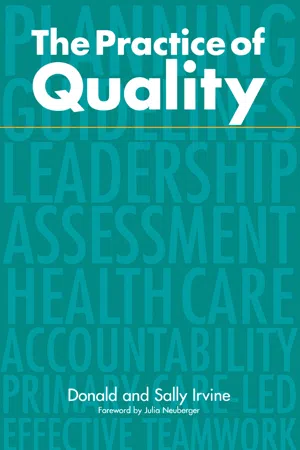
This work adopts a modern approach to quality assurance and quality improvement in general practice. It provides an introduction to the subject, enabling readers to see how best to proceed in their own practices. It revises and updates previous books by Donald and Sally Irvine on clinical audit by placing audit within the wider quality context. It is designed to provide an easily accessible approach to the basic tenets as well as speculating on the future developments in this area, and should be of interest to all members of the practice team. The themes of the book are illustrated by reference to the five major case studies provided, which describe in some detail the various ways of starting, implementing and maintaining quality assurance in general practice today. Practical examples of Total Quality Management, the use of British Standard 5750, Kings Fund organizational audit, Investors in People, and Fellowship of the Royal College of General Practitioners by assessment, are also provided. These studies are written by the practitioners, medical and non-medical, who have themselves been through the experience of turning theory into practice.
Information
Managing Quality
6
Managing practice
Management is too important to be left just to the managers
Glouberman and Mintzberg (1994)1
The previous chapters have made it clear that general practice needs to acquire a new approach to the management of patient care and clinical practice, particularly in its attempts to assure quality. Yet there are substantial obstacles to doctors’ acceptance of the close and distinct relationship between clinical management and the management of people and organizations. To achieve assured quality care, it is necessary to overcome these obstacles.
What is Management?
The starting point is an understanding of what management is. Many people have described it. Drucker2 said management is:
the job of organising resources to achieve satisfactory performance, to produce an enterprise from material and human resources. Efficient management always involves a juggling act, facing different possible objectives and deciding the priority to be put on the multiple aims an organisation has.
Another view is that management is a process whereby
- purposes
- policies
- priorities
- procedures
- performance
are established, defined, reviewed, and modified.3
Whatever the definition, management is essentially an attitude of mind. It does not constitute a profession. There is no body of established and complex knowledge and skills, normally associated with professions, that can be acquired and that others can use. Despite this, professional management has become an enormously popular concept in the last few decades, and because of this hordes of people holding a masters in business administration (MBA) have descended on business. If this quasiprofessional view of management persists, it is unlikely that doctors will accept its central role in achieving clinical quality assurance. Clinicians will continue to use their knowledge and skills to commit resources in an uncontrolled way. This will create inevitable tensions in general practice as well as in hospitals.
Managers cannot be made in a classroom alone. As Mintzberg4 says: ‘the practice [of management] remains an art with surprisingly little scientific context’.
Effective management has to be rooted in a deep understanding of the organization being managed, especially in a complex organism such as a medical practice. That is not to say that people trained in a managerial classroom cannot exhibit such characteristics, only that their ability to do so has little to do with what went on in that classroom.
There has been much written about the functions of management, not always helpful. Nevertheless, some general principles stand out which apply in general practice. These are set out in Box 6.1.
Box 6.1 Basic Management Functions
- recognize the inevitability of change
- help the organization deal with uncertainty while moving towards overall goals
- introduce stability and clarity of direction in situations of rapid change or conflict
- underpin the professional activity
- ensure that the clinical process is supported by groups of appropriate and effectively functioning staff
- apply rules appropriately and consistently
Four kinds of skills are needed to fulfil these roles successfully, and these are set out in Box 6.2.
This part of the book discusses the key components of these skills and attributes, concentrating particularly on the human skills because management is essentially a human activity. Interpersonal competence is vital to its success. Any quality-based organization has to have a culture of consent and trust, with a management style based on persuasion and continual encouragement.5
Box 6.2 Management Skills and Attributes
- human skills, such as being a group leader, building and maintaining a team, and selecting staff
- technical skills of decision making, priority setting, budgeting and planning, forecasting, establishing communications and information systems
- political skills, such as understanding and using authority, wielding personal power and personal influence to advantage, creating the conditions for change, identifying organizational opportunities
- skills concerned with an ability to take an overview and see the enterprise as a whole
Doctors and Management
Doctors need to become more involved in management decisions and management processes, both to have an effective role in the Health Service, and to have an understanding of its management needs.6 Griffiths7 said: ‘The nearer the management process gets to the patient, the more important it becomes for doctors to be looked upon as the natural managers’.
Some doctors, while initially perhaps being motivated by a sense of duty and the new demands of the Health Service, are actually now keen to improve their management skills to enable them to carry out these new roles. Some doctors find that accepting responsibility for new activities, such as effective decision making, prioritizing, managing people well, setting direction and planning ahead, represent a refreshing and stimulating challenge.
Case Study 7 illustrates the point.
It is still true, and particularly unfortunate, that the term ‘management’ deters many general practitioners today despite the illustration of its clinical value in Case Study 7. Time devoted to non-clinical activities is seen as less time for clinical work and family, which is why the priority given to organizational and management activity compared with both of these is understandably low. Management tends to be the activity that is done at the end of the day, or fitted in at lunchtime, or dumped on the most junior partner.
However, such random attention is not effective. Management, like medicine, needs firm commitment.1 General practice needs to aim at recognizing that systems and institutions are like people in that they function best with steady, not just intermittent, care. Half-hearted management can be very damaging: good management requires more than a passing glance.
Case Study 78
The partners in an urban general practice became fundholders because they believed that this would enable them to give good care while using their resources as effectively as possible.
In the early years, living within their drug budget posed no conflict within the consulting room, and the money saved was reinvested in other services for patients. However, in the fourth year, the budget allocated came much closer to real expenditure, overspending began to appear in the regular monthly figures, and the partners began to think they would end the year with a deficit.
This pressure made them all much more cost conscious, particularly in prescribing. They reacted by looking more closely at the detail of their expenditure and discussed the policies behind their clinical prescribing, focusing in particular areas that were most expensive. They scrutinized the clinical appropriateness of their actions and the quality of explanation given to individual patients. Sensitive issues began to emerge about, for example, the quality of some doctors’ knowledge of prescribing and deficiencies in the practice’s clinical audit arrangements. In these difficult situations the partners found that their ability to provide mutual support and to create a framework for improving the quality of clinical decision making became an essential, rather than a desirable, extra. In other words, the budgetary pressure had improved the quality of clinical decision making; it had not as yet reached a level that was thought to be harmful rather than beneficial to patients. If it did, the practice was clear that it would have to withdraw from the scheme.
In general practice the debate about doctors as managers is frequently confused. General practitioners are the owners of their businesses and most commonly hold the legal and the financial responsibility both for the practice as an organization and for its role in the community - the delivery of effective health care to the registered population. As such they have to take the key decisions on the direction the practice should develop and the policy framework for allocating resources - these are strategic responsibilities. How far the doctors involve themselves in the operational policies and activities such as budgeting, day-to-day resource allocation and information flows, depends on how far they are willing to devolve their centralized power base to others, a theme we take up in Chapter 12. The balance is crucial. Clinicians need to delegate to others to ensure that they release time to take key management decisions as well as time to carry out the clinical tasks that only they can. Any decision-making body within a practice, be it a clinical guideline group, a quality improvement group, or a building project group, must involve doctors in an active and informed way. Failure to do so will not achieve a satisfactory result for anybody, as demonstrated in Case Study 8.
Case Study 8
The members of a large urban practice decided that the pressures of clinical work were so great that they needed to employ a manager to take on the increasing burden of non-clinical, administrative and personnel problems. They were anxious to achieve this as quickly as possible, and, when one of the partners suggested an accountant golfing friend who was looking for a postretirement job, they leapt at the idea.
The accountant, John, had been a senior partner in a large firm, and was felt to have a great deal of business experience, as well as being able to look after the finances well. He had no clinical or health service background. The partners ‘dumped’ all the non-clinical activity on his desk, and he willingly took responsibility for it all. He was used to a disciplined and organized way of working, and had a rather autocratic style of staff management.
The partners were delighted. They received his reports at the weekly business meeting, and saw with pleasure that their accounts were looking healthier and in better order. They were pleased that he suggested cuts in both reception and senior nursing staff, and reduced staff costs generally. He introduced a performance appraisal system to increase ‘productivity’ by relating it to pay.
Unfortunately, there began to be many errors in the reception area, and a...
Table of contents
- Cover
- Title Page
- Copyright Page
- About the Authors
- Dedication Page
- Contents
- Foreword
- Acknowledgements
- Introduction
- Quality Practice - Being Aware of the Context
- Quality and Standards
- Managing Quality
- The Role of External Review in Quality
- Index
Trusted by 375,005 students
Access to over 1.5 million titles for a fair monthly price.
Study more efficiently using our study tools.
Frequently asked questions
Yes, you can cancel anytime from the Subscription tab in your account settings on the Perlego website. Your subscription will stay active until the end of your current billing period. Learn how to cancel your subscription
No, books cannot be downloaded as external files, such as PDFs, for use outside of Perlego. However, you can download books within the Perlego app for offline reading on mobile or tablet. Learn how to download books offline
Perlego offers two plans: Essential and Complete
- Essential is ideal for learners and professionals who enjoy exploring a wide range of subjects. Access the Essential Library with 800,000+ trusted titles and best-sellers across business, personal growth, and the humanities. Includes unlimited reading time and Standard Read Aloud voice.
- Complete: Perfect for advanced learners and researchers needing full, unrestricted access. Unlock 1.5M+ books across hundreds of subjects, including academic and specialized titles. The Complete Plan also includes advanced features like Premium Read Aloud and Research Assistant.
We are an online textbook subscription service, where you can get access to an entire online library for less than the price of a single book per month. With over 1.5 million books across 990+ topics, we’ve got you covered! Learn about our mission
Look out for the read-aloud symbol on your next book to see if you can listen to it. The read-aloud tool reads text aloud for you, highlighting the text as it is being read. You can pause it, speed it up and slow it down. Learn more about Read Aloud
Yes! You can use the Perlego app on both iOS and Android devices to read anytime, anywhere — even offline. Perfect for commutes or when you’re on the go.
Please note we cannot support devices running on iOS 13 and Android 7 or earlier. Learn more about using the app
Please note we cannot support devices running on iOS 13 and Android 7 or earlier. Learn more about using the app
Yes, you can access The Practice of Quality by Donald Irvine,Sally Irvine in PDF and/or ePUB format, as well as other popular books in Medicine & Family Medicine & General Practice. We have over 1.5 million books available in our catalogue for you to explore.