Data-driven analytics is enjoying unprecedented popularity among oil and gas professionals. Many reservoir engineering problems associated with geological storage of CO2 require the development of numerical reservoir simulation models. This book is the first to examine the contribution of artificial intelligence and machine learning in data-driven analytics of fluid flow in porous environments, including saline aquifers and depleted gas and oil reservoirs. Drawing from actual case studies, this book demonstrates how smart proxy models can be developed for complex numerical reservoir simulation models. Smart proxy incorporates pattern recognition capabilities of artificial intelligence and machine learning to build smart models that learn the intricacies of physical, mechanical and chemical interactions using precise numerical simulations. This ground breaking technology makes it possible and practical to use high fidelity, complex numerical reservoir simulation models in the design, analysis and optimization of carbon storage in geological formations projects.
- 282 pages
- English
- ePUB (mobile friendly)
- Available on iOS & Android
eBook - ePub
Data-Driven Analytics for the Geological Storage of CO2
About this book
Information
1
Storage of CO2 in Geological Formations
Shahab D. Mohaghegh, Alireza Haghighat, and Shohreh Amini
Contents
1.1Carbon Capture and Storage: CCS
1.2Numerical Reservoir Simulation
Carbon dioxide (CO2) is a colorless and odorless naturally occurring chemical compound that is vital to life on Earth. Naturally occurring CO2 originates from processes such as decomposition, ocean release, and respiration. Anthropogenic or manmade CO2 results from cement production, deforestation, and burning of fossil fuels such as coal, natural gas, and oil. While the production and consumption of naturally occurring CO2 seem to be close to balance, the introduction of anthropogenic CO2 to the atmosphere is altering the overall global balance of CO2. After decades of scientific research, climate scientists have concluded that the abundance of CO2 in the atmosphere is one of the main causes of potential climate change. Therefore, mitigating the production of anthropogenic CO2 has become the focus of the scientific community.
As an indicator for global climate change, climate scientists refer to the global average temperature increase of approximately 0.78°C (1.4°F) in the twentieth century. Global temperature changes have been almost proportional to the change in CO2 concentration in the atmosphere, which increased from 280 ppm in 1880 to 385 ppm in 2010 (1). This can be clearly seen in Figure 1.1. To mitigate the impact of anthropogenic CO2, different solutions have been proposed, including an overall reduction in energy consumption, substitution of high-carbon fuels such as coal with low-carbon fuels such as natural gas, and finally capture and storage of CO2 in geological formations. It seems obvious that no single solution will be the answer, and multiple solutions must be incorporated, simultaneously.
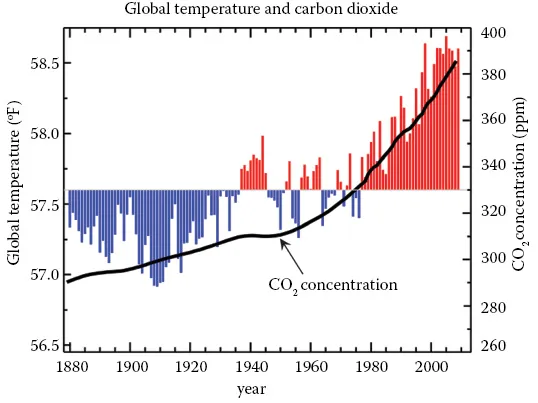
Figure 1.1
Global temperature and CO2 concentration history (SI conversion for temperature: °C = (°F − 32) × 5/9). (National Climate Data Center. 2017. http://www.ncdc.noaa.gov/indicators/)
Despite all efforts to shift energy sources to renewable and atmosphere-friendly alternatives, fossil fuels are still the most essential source of energy for industries and transportation. Considering the growth in demand, fossil fuel consumption will continue to increase and, as a result, concerns about greenhouse gas emissions and their impact on global warming and climate change are increasing.
Carbon capture and storage (CCS) may be considered a transitional technology while fossil fuels are slowly replaced by more environmentally friendly fuels. Given the fact that the transition cannot take place overnight and will require a considerable amount of time and effort to be expended, CCS could play an important role in mitigating the anthropogenic CO2 issues that are faced today. The processes associated with CCS comprise separating CO2 at the industrial level from power plants, refineries, cement plants and steel mills, transporting it to target storage locations, and finally injecting it into underground formations.
A viable means of reducing CO2 in the atmosphere is to capture and concentrate CO2 from large point sources such as power plants and petroleum refineries, and then store it by underground injection. This process is called geological carbon sequestration (GCS).
This book is dedicated to the application of solutions provided by big data analytics and data science to the geological storage of CO2. As such, some preliminary topics, such as the basics of the geological storage of CO2 as well as some of the solutions that are associated with big data analytics and data science, are covered to provide the necessary background for the main focus of the book, which is the application of big data analytics solutions to numerical modeling of the geological storage of CO2.
1.1Carbon Capture and Storage: CCS
There are several options for locations to store CO2 in an underground geological structure: depleted oil and gas reservoirs, saline aquifers, and un-mineable coal-beds. Most recently, using shale plays as potential sites for carbon storage has been considered, and multiple studies have been conducted to evaluate their viability. Each of these geological structures has its own characteristics which must be extensively studied before any CO2 is injected underground and stored for a long period (2).
Injected CO2 can be stored through a number of different trapping mechanisms (3):
•Physical trapping, in structural or stratigraphic traps, where the free-phase CO2 is physically trapped by the geometric structure of the reservoir and its cap-rock. This type of trapping is similar to hydrocarbon accumulations in a reservoir.
•Residual trapping, where the CO2 is trapped in pore spaces due to capillary pressure forces.
•Solubility trapping, which takes place when injected CO2 dissolves in the formation water.
•Mineral trapping, through which CO2 precipitates as new carbonate minerals and therefore becomes immobile.
•Adsorption trapping, which happens when CO2 is injected into coal-beds, where the CO2 adsorbs onto the surface of the coal.
Although carbon sequestration seems to be a sensible way of reducing the ever increasing level of CO2 in the atmosphere, the risk involved in this process is always a matter of concern. Safe sequestration is achieved when it is ensured that once the CO2 is injected underground it will remain safely in the structure over a long geological period (thousands of years). In general, the risk involved in CO2 sequestration in geological formations decreases as time passes. The risk associated with any geological sequestration is directly related to the geological uncertainties of the reservoir structure and operational practices, and therefore these items must be comprehensively studied for any CO2 sequestration plan. There are several different potential sites for geological CO2 storage, including depleted oil and gas reservoirs, deep saline aquifers, deep un-mineable coal seams and other unconventional plays such as shale, and finally, storage in association with CO2-EOR (enhanced oil recovery) processes.
The number of commercial CCS projects that are currently operational is not large due to a lack of business and economic justification. This does not include CO2-EOR projects, because CO2-EOR projects include the production of petroleum and many companies throughout the world are engaged in such projects. Given the fact that the stored CO2 lacks any commercial value, commencement of CCS projects for companies does not make sense from a profit point of view. Assembling new legal and regulatory frameworks could provide the required commercial justification for CCS deployment.
CCS projects consist of four different transitional phases (4):
1.Site selection
2.Operation
3.Closure and
4.Post-closure
“Site selection and development,” the first phase, covers geological, commercial, and regulatory evaluation, which takes from approximately 3 to 10 years to purchase and secure space for surface facilities and geological storage. In addition, permission acquirement and infrastructur...
Table of contents
- Cover
- Half Title
- Title Page
- Copyright Page
- Dedication
- Contents
- Nomenclature
- Acknowledgments
- Author
- Contributors
- Introduction
- 1. Storage of CO2 in Geological Formations
- 2. Petroleum Data Analytics
- 3. Smart Proxy Modeling
- 4. CO2 Storage in Depleted Gas Reservoirs
- 5. CO2 Storage in Saline Aquifers
- 6. CO2 Storage in Shale Using Smart Proxy
- 7. CO2-EOR as a Storage Mechanism
- 8. Leak Detection in CO2 Storage Sites
- Bibliography
- Index
Trusted by 375,005 students
Access to over 1.5 million titles for a fair monthly price.
Study more efficiently using our study tools.
Frequently asked questions
Yes, you can cancel anytime from the Subscription tab in your account settings on the Perlego website. Your subscription will stay active until the end of your current billing period. Learn how to cancel your subscription
No, books cannot be downloaded as external files, such as PDFs, for use outside of Perlego. However, you can download books within the Perlego app for offline reading on mobile or tablet. Learn how to download books offline
Perlego offers two plans: Essential and Complete
- Essential is ideal for learners and professionals who enjoy exploring a wide range of subjects. Access the Essential Library with 800,000+ trusted titles and best-sellers across business, personal growth, and the humanities. Includes unlimited reading time and Standard Read Aloud voice.
- Complete: Perfect for advanced learners and researchers needing full, unrestricted access. Unlock 1.5M+ books across hundreds of subjects, including academic and specialized titles. The Complete Plan also includes advanced features like Premium Read Aloud and Research Assistant.
We are an online textbook subscription service, where you can get access to an entire online library for less than the price of a single book per month. With over 1.5 million books across 990+ topics, we’ve got you covered! Learn about our mission
Look out for the read-aloud symbol on your next book to see if you can listen to it. The read-aloud tool reads text aloud for you, highlighting the text as it is being read. You can pause it, speed it up and slow it down. Learn more about Read Aloud
Yes! You can use the Perlego app on both iOS and Android devices to read anytime, anywhere — even offline. Perfect for commutes or when you’re on the go.
Please note we cannot support devices running on iOS 13 and Android 7 or earlier. Learn more about using the app
Please note we cannot support devices running on iOS 13 and Android 7 or earlier. Learn more about using the app
Yes, you can access Data-Driven Analytics for the Geological Storage of CO2 by Shahab Mohaghegh in PDF and/or ePUB format, as well as other popular books in Technology & Engineering & Chemical & Biochemical Engineering. We have over 1.5 million books available in our catalogue for you to explore.