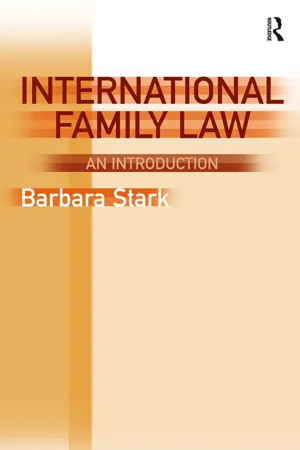
- 284 pages
- English
- ePUB (mobile friendly)
- Available on iOS & Android
eBook - ePub
About this book
International law has become part of everyday family law practice, as lawyers everywhere are confronted with questions regarding the rights of 'mail-order' brides, the adoption of children from other countries, the abduction of children by foreign parents, and domestic violence victims seeking asylum. Indeed, globalization is transforming family law, even as families themselves are being redefined. This book provides a practical overview of such issues and also examines the ways in which culture shapes family law in different countries. It provides students with a useful introduction to challenging, complicated and fascinating issues in international family law. Finally, by incorporating a comparative perspective, it gives readers an opportunity to re-examine their own legal systems.
Information
Chapter 1
Marriage
1. The Problem
Julia and Amitabh met when both were students at the London School of Economics. Julia is a citizen of the U.K. and an agnostic; Ami is a citizen of India and a Hindu. They fell in love and decided to marry. Julia wanted to marry in the Savoy Hotel in London. Ami wanted to marry in his village in India. They agreed to do both.
After a joyful wedding at the Savoy, they wrote to Ami’s Uncle in India and asked him to arrange a wedding for them there. Ami’s parents had died in an earthquake when he was 8 and he had been raised by his Uncle, who had quickly sent him off to boarding school in the U.K. Ami and Julia have just received the following letter from his Uncle:
My Dear Nephew,I am very sorry to be the one to have to tell you this, but you should probably reconsider your desire to return to Rajasthan for your wedding. You were in fact married here 18 years ago, when you were justfour years old. Your wife, Ratna, was sent to yourfather’s house when she was 11, but you had already left for boarding school when you were 9. The dowry was paid in full and I never heard of any action for divorce or annulment. I do not know where she went when your parents died.I lookforward to seeing you soon, but it would probably be unwise to attempt to marry here. Your Fond Uncle
Ami and Julia come to you. Assuming that his Uncle’s statements are true, how does this affect their marriage in London? How does it affect their planned marriage in India? Does Ami have any obligation to Ratna? What are his options?
2. Overview
Anthropologists agree that the institution of marriage began as a way to connect the families of the bride and groom. It was usually arranged between the families and often accompanied by an exchange of property (usually from the wife’ s family to that of the husband, in the form of a ‘bride price’ or ‘dowry’) and the formation of alliances. In patriarchal societies, a young woman or girl would leave her family and join that of her husband.
The modern notion of companionate marriage is very different. It also involves a long-term commitment between a man and a woman, but it is a relationship which they enter into voluntarily. Unlike traditional marriage, modern marriage resembles a partnership, a relationship of equals. Many women in such marriages, for example, work outside the home. They are more likely to have some degree of economic independence, accordingly, although they usually earn less than their husbands.
Both kinds of marriages may be found throughout the world. Traditional marriages endure in traditional societies, such as Pakistan. They may also be found throughout Africa, parts of Asia, and the Middle East alongside modern marriages. In rural areas in Kenya, for example, traditional marriages persist while modern marriages are more common in the more cosmopolitan cities. Modern marriages are most common in the industrialized North, although more traditional groups within those societies may opt for some form of traditional marriage. Among fundamentalist religious groups, such as Christian Mormons in the United States or Orthodox Jews in Israel, for example, traditional marriage is often favored.
A crucial function of both traditional and modern marriage is to establish a stable framework in which children will be cared for and supported, emotionally as well as financially. Marriage rates are falling in some regions, however, especially in northern Europe. This reflects, in part, a growing number of couples who choose to live together without marrying. As discussed in Chapters 8–10, increasing numbers of children are born out of wedlock. In addition, a growing, but still small, number of couples opt for ‘child free’ marriages in the industrialized North. In the developing South, in contrast, barrenness is often a ground for annulment or divorce.
Many States recognize multiple forms of marriage, including religious and civil marriages. Traditional marriages usually involve a religious ceremony, while modern marriage is often entered into through a secular, civil ceremony. Czechoslovakia, for example, recognizes civil as well as religious forms of marriage, but both require a procedure before a civil registrar. India recognizes several different forms of marriage. Under Hindu law, marriage is viewed as a sacrament, in contrast to Muslim law, under which marriage is regarded as a contract. The Special Marriage Act authorizes some interreligious civil marriages. The 1937 Arya Marriage Validation Act recognizes the legality of intercaste marriages. The 1955 Hindu Marriages Act, which applies to any person in India who is not a Muslim, Christian, Parsi, or Jew, establishes the legal parameters of Hindu marriage, and prohibits bigamy as well as certain degrees of consanguinity.
Prerequisites
The prerequisites to marriage fall into three categories: eligibility, consent, and formalities. In general, States determine who is eligible to enter into marriage, and require freely given consent (although the ‘consent’ required may be that of the heads of the families rather than that of the parties). In addition, States often require some ceremony, registration or similar formality to distinguish marriage from other relationships and to impress this distinction upon the parties as well as their families and their communities.
‘Eligibility’ refers to a wide range of factors. Most States impose limits based on their laws on consanguinity; that is, laws which incorporate incest taboos and prohibit close relatives from marrying, although ‘close’ has different meanings in different cultures. In Asia, for example, marriages between cousins are common while in most parts of the United States such marriages are void. Virtually all States require that the spouses be different genders. While most States impose some age limit, this ranges from ‘puberty’ (which may be deemed to begin as early as nine years for girls) to 18 or 21 years. Some countries allow different ages for men and women. Others, such as the U.S. and Germany, require both parties to be at least 18, unless they have the consent of their parents.
Reforms in traditional societies often involve raising the marriage age. Under traditional Islamic law, for example, no minimum age is established. In codifying their marriage laws, however, several Islamic States have set a minimum age at which consent is valid. In Jordan, for example, the man must be 16 and the woman 15. Other traditional societies have similarly reformed their marriage laws. In Botswana, for example, the Marriage Bill 2000 establishes 18 as the minimum age for women as well as men to marry in order to conform to contemporary human rights instruments.
Former colonial powers, such as the U.K., also set minimum ages for marriage. In India and Pakistan, for example, the Child Marriage Restraint Act of 1929 set a minimum of 18 years for girls and 21 years for boys for contracting marriage. The Act also sought to deter arranged child marriages by punishing the parents or guardians who arranged them. The Act does not, however, invalidate the resulting marriage.
Most non-Muslim States require that a person be unmarried in order to be eligible for marriage. That is, most prohibit bigamy, and a prior existing marriage is a bar to a new one. Several Muslim States, however, permit polygamy, the practice of allowing a husband to marry more than one wife. Under some interpretations of Islamic law, a husband may marry up to four wives. Polyandry, in which a woman has more than one husband, is rare. It is said to persist in certain remote regions of Tibet, where an elder brother may share his wife with his younger brothers.
Additional eligibility requirements may be imposed by religious laws or other customs. Some religious laws, for example, require that the spouses be of the same religion. Customs that remain entrenched in certain societies, in some cases notwithstanding a legal bar, include: the requirement that a woman not marry below her own caste (certain Hindu castes in India), that the woman be a virgin (Iran and Saudi Arabia), and that a bride-price, or dowry be paid (Botswana). In general, as part of the marriage contract under Islamic law, the husband pays a dower, or mahr, to the wife. This is paid in cash or in kind and is the wife’s sole property (El Alami and Hinchcliff, 1996).
Consent requirements refer to the consent of the spouses’ families in traditional marriages or to consent of the spouses in a modern marriage. Under Muslim law, a woman who has not been married before needs a guardian (wali) before she can enter into marriage. The wali’s authority varies under the interpretations of the different schools of Islam. Under the Hanafi view, for example, the wali advises the girl who has reached puberty and tries to guide her in the decisionmaking process. In Maliki, Shaf’i and Hanbali law, in contrast, a woman may never finalize her own marriage contract.
In the West, consent requirements are satisfied by the parties’ sworn statements that they are entering into the marriage voluntarily, along with the absence of any obvious condition vitiating such consent. In the state of Georgia in the U.S., for example, drunkenness at the time of the marriage by either spouse may be used to show that the marriage was not in fact consensual.
One underlying purpose of formalities is to assure that the parties’ marital status is known to the community and to the public at large. Ceremonies often reflect the traditional importance of marriage. Hindu ceremonies, for example, can last for days, but short versions with English translations are available on the Internet for contemporary British Hindus. The mix of customary and modern law which characterizes many States’ systems is often expressed in the ceremony itself. In Israel, for example, although civil marriage is available, it is virtually unknown, the overwhelming majority of couples opting instead for ‘white weddings’ which include a religious ceremony.
Formalities may also include the requirement that the couple register with a government authority. In India, for example, the Compulsory Registration of Marriage Act passed in 2002 provides a means of monitoring child marriages or bigamist marriages. Several smaller Indian states, including Rajasthan, have declined to require compulsory registration because of the continuing popularity of child marriages. In 1993, a UNICEF survey in Rajasthan found that 50% of the population had married before the age of 15 and 17% of this group were under the age of 10.
In some countries, such as France, China, and Japan, registration is considered extremely important. In Japan and France, accurate record-keeping ensures the integrity of family lineage. In China, registration is necessary in order to qualify for State benefits, which may include housing and education. In other countries, failure to register may be regarded as a mere oversight with no legal consequences for the parties.
Consequences
Marriage affects the parties’ personal status. Marital status has public consequences, such as nationality or citizenship status, eligibility for insurance coverage, entitlement to social security, intestacy, and inheritance rules. Marital status also has private, social consequences, such as the recognition by the community of the couple as a household unit.
Marriage may also involve contractual obligations between the husband and wife. The contractual aspects of the parties’ relationship often includes support obligations, either mutual or unilateral, and other expectations, such as sexual fidelity and the establishment of a household, including children. In the U.S., for example, the husband was historically required to support the wife and provide her with ‘necessaries’, such as food and shelter. This obligation is now viewed as a mutual obligation; that is, either spouse may be required to support the other. Under traditional Islamic law, similarly, the husband was required to support the wife as long as she submitted to his control. Under recent codifications, the obligation has been made gender-neutral. Under the codified law of Libya, adopted in 1984, a wife ‘who is wealthy shall be required to support her husband … during [his] hardship.’ Under Islamic law, marriage is viewed as a c...
Table of contents
- Cover
- Half Title
- Title Page
- Copyright Page
- Table of Contents
- Introduction: Why Study International Family Law?
- 1 Marriage
- 2 Partnerships Other Than Marriage
- 3 Adoption
- 4 Divorce/Marital Status
- 5 Divorce/Maintenance and Support
- 6 Divorce/Property Distribution
- 7 Reproductive Rights and Abortion
- 8 Visitation
- 9 Child Custody and Abduction
- 10 Child Support
- 11 Domestic Violence
- 12 Human Rights of the Family and Human Rights of Individuals within the Family
- Index
Trusted by 375,005 students
Access to over 1.5 million titles for a fair monthly price.
Study more efficiently using our study tools.
Frequently asked questions
Yes, you can cancel anytime from the Subscription tab in your account settings on the Perlego website. Your subscription will stay active until the end of your current billing period. Learn how to cancel your subscription
No, books cannot be downloaded as external files, such as PDFs, for use outside of Perlego. However, you can download books within the Perlego app for offline reading on mobile or tablet. Learn how to download books offline
Perlego offers two plans: Essential and Complete
- Essential is ideal for learners and professionals who enjoy exploring a wide range of subjects. Access the Essential Library with 800,000+ trusted titles and best-sellers across business, personal growth, and the humanities. Includes unlimited reading time and Standard Read Aloud voice.
- Complete: Perfect for advanced learners and researchers needing full, unrestricted access. Unlock 1.5M+ books across hundreds of subjects, including academic and specialized titles. The Complete Plan also includes advanced features like Premium Read Aloud and Research Assistant.
We are an online textbook subscription service, where you can get access to an entire online library for less than the price of a single book per month. With over 1.5 million books across 990+ topics, we’ve got you covered! Learn about our mission
Look out for the read-aloud symbol on your next book to see if you can listen to it. The read-aloud tool reads text aloud for you, highlighting the text as it is being read. You can pause it, speed it up and slow it down. Learn more about Read Aloud
Yes! You can use the Perlego app on both iOS and Android devices to read anytime, anywhere — even offline. Perfect for commutes or when you’re on the go.
Please note we cannot support devices running on iOS 13 and Android 7 or earlier. Learn more about using the app
Please note we cannot support devices running on iOS 13 and Android 7 or earlier. Learn more about using the app
Yes, you can access International Family Law by Barbara Stark in PDF and/or ePUB format, as well as other popular books in Diritto & Diritto di famiglia. We have over 1.5 million books available in our catalogue for you to explore.