![]()
Part I
So you want to go live?
We start with an overview of what live-streaming is and why you should fire up your phone to use it. (Hint: If you jump in now and begin to create an audience for yourself, you’ll be taking advantage of the hype, as well as getting ahead of your competitors.)
Then we take a look at the top apps and how they differ, so you can choose the best one for your needs.
There’s also a chapter devoted to the ‘best of the rest’: the other apps which may not be as well-known as the ‘top three’ but have their own particular features and strengths.
![]()
1
Why love live?
Introduction
As you have bought this book, you are at least a little bit interested in live-streaming! But maybe you need a bit more convincing? After all, streaming can be daunting, and as well as the rewards there are also risks.
In this chapter, both sides of the live-streaming story are presented: the facts and stats (which suggest that we are entering a perfect time to ‘go live’) but also the reputational risks of producing ‘raw’ video.
In order to remain competitive and relevant, innovative marketers must keep an eye out for what’s new, what’s hot, and what’s trending on the social media platform, and should also incorporate these new ways of connecting and communication into their strategies.
Ken Bock1
I believe that live-streaming is not a fad; it’s the future. And it’s shaking up social.
What is live-streaming?
Although all live-streaming apps vary slightly, they all allow you to broadcast live-video content that can be viewed on a phone, tablet, computer or TV. It’s a bit like Facetiming or Skyping all your followers at once.
You immediately have your own live TV station and can broadcast from wherever you are through your cell phone. You’ll have your audience literally in the palm of your hand.
With most live-streaming apps, viewers send you written comments and ‘reactions’ (icons such as thumbs-up or hearts), which appear on the screen. The broadcasts are saved on your page, account or profile until you delete them.
The facts
How did we get to crave live images?2
As humans, we have evolved to interpret visual information faster than the written word:
- 75 million people in the US watch videos online every day.
- Embedded videos on websites can increase traffic up to 55%.
- Merely mentioning the word ‘video’ in the subject line of an email can increase open rates by 13%.
- Nearly 40% of all video is watched on mobile.
- 90% of the information sent to our brains is visual: we’ve been trained to consume visual content as quickly as we can.3
Those stats suggest that people watch, but what do they subsequently do?4
- Shoppers who view video are 1.81 times more likely to purchase than non-viewers.
- 51.9% of marketing professionals worldwide name video as the type of content with the best ROI (Return On Investment).
- Retailers cite 40% increases in purchases as a result of video.
- In an eye-mapping study of search engine results pages (SERPS), video results commanded more attention than other listings.
- Mobile shoppers are three times more likely than desktop shoppers to view a video.
And what’s the take-up in ‘video marketing’?
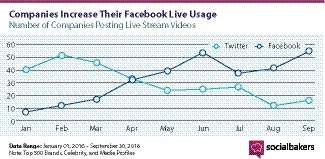
- 51% of the top publisher companies posted to Facebook Live in September 2016, up from 10% in January5 of that year.
Figure 1.1 51% of media are using Facebook Live videos, but only 11% of companies do
- Almost one-fifth of US media decision-makers are planning to invest in live-stream video ads in the next six months (as of August 2016).6
And stats for live-video (and once-live video)?
- Facebook says that by 2020, 75% of all mobile data will be video.7
- Facebook Live videos are watched three times longer than regular videos8 (on average, 20 minutes versus 2–3 minutes).9
- Native Facebook videos have a 13% organic reach and 6.3% engagement rate (much higher than the 1–3% you get on other platforms).10
- People watch 100 million hours of Facebook videos each day.11
Video is the current ‘eye candy’: it’s huge and here to stay. So, adding live-streaming to your customer engagement strategy would certainly seem to be a smart thing to do.
Live-streaming is a new game entirely because it is dynamic, not static. Once a brand goes live, their competitors must follow. Customers will come to expect it. They won’t want tired, off-the-shelf archived videos. Live broadcasting on a cell phone is the missing link between TV and social media. Period.
Ron C. Pruett12
The positives of live
Mark Zuckerberg, the founder of Facebook, has said he is obsessed with live-video: when he switched on live-stream capabilities on the platform in April 2016, one-quarter of the world’s population suddenly had the ability to stream.
Why now?
Live-streaming has been made more accessible because of advances in technology. First, more people have more-sophisticated but easy-to-use phones (Pew Research, www.pewinternet.org, reckons 72% of Americans own a cell phone). But there’s also the following available now:
- 3G and 4G and nearly 5G technology
- Cheaper data plans
- Cloud technology
- Longer-lasting batteries
- Bigger screens
- Better cameras
Plus bigger social media networks have given us immediate access to a built-in fan base of potential viewers to make it easier to create a shared and engaged experience.
Online video has become a key part of the strategic business model for both brands and marketers as they seek more innovative ways to capture consumer attention. [Live-streaming has] emerged as the medium of choice not only for person-to-person sharing, but also for business-to-consumer (B2C) and business-to-business (B2B) communication.
Dylan Mortensen13
Live-streaming is …
Fast – setting up these apps is quick and easy, and shooting is simplicity itself. In just a few seconds (it takes about ten to fire up a Facebook Live), you can go live from the middle of the action to the whole of the world, with no post-show editing.
Mobile – you can film from anywhere, at any time. And as most of these apps are mobile-to-mobile, your viewers don’t need any special equipment to watch you, and that helps them feel part of the action.
Accessible – streams have a friendly, accessible, behind-the-scenes feel. They feel more authentic and therefore make more of a connection with people than a glitzy production. Live-streaming is easy for people to consume and be involved in.
The true beauty of Periscope lies in its accessibility. Roger Federer used the app to cover his big game, so why not use it to cover your daughter’s next varsity tennis match? Big-time politicians can use it to broadcast their speeches, and so can passionate grassroots activists and community organizers.
Mitch Carson14
And if you have a customer base which is largely on say, Facebook, then they may not be bothered by an ‘amateur look’. In fact, it may appeal to them.
Inexpensive – there’s no extra cost of video cameras, studios, sound gear or editing time. The apps are free and on your phone. Why pay for ‘mass advertising’ with all the inherent waste of being seen by those who have no interest in your brand, when you can reach a bigger and more dedicated audience through your live-stream? You have a free marketing platform in your pocket – your own broadcast channel in your bag.
Integrated – the main live-streaming apps are baked-in to three of the biggest and most powerful social media platforms on the planet: Faceboo...