Charged Particle Optics Theory: An Introduction identifies the most important concepts of charged particle optics theory, and derives each mathematically from the first principles of physics. Assuming an advanced undergraduate-level understanding of calculus, this book follows a logical progression, with each concept building upon the preceding one. Beginning witha non-mathematical survey of the optical nature of a charged particle beam, the text:
Discusses both geometrical and wave optics, as well as the correspondence between them
Describes the two-body scattering problem, which is essential to the interaction of a fast charged particle with matter
Introduces electron emission as a practical consequence of quantum mechanics
Addresses the Fourier transform and the linear second-order differential equation
Includes problems to amplify and fill in the theoretical details, with solutions presented separately
Charged Particle Optics Theory: An Introduction makes an ideal textbook as well as a convenient reference on the theoretical origins of the optics of charged particle beams. It is intended to prepare the reader to understand the large body of published research in this mature field, with the end result translated immediately to practical application.
Introduction: The optical nature of a charged particle beam
Modern physics teaches that all matter is made of particles which interact with one another. Every particle is characterized by its intrinsic charge, mass, and spin. These quantities govern all interactions which a particle can have. For example, an atom consists of a cloud of negatively charged electrons orbiting a compact, positively charged nucleus. The establishment of this fact in quantitative terms has a fascinating history. It originates with the early hypothesis of Democritas, proceeds through the origins of quantitative chemistry in the seventeenth century, and culminates with the elucidation of quantum mechanics in the twentieth century. Only during the last few decades has it become possible to capture an actual image of a single atom.
Atoms are charge-neutral in their normal state, with the positive charge of the nucleus precisely offset by negative charge of the orbiting electrons. By bombarding an atom with a beam of light or charged particles, it is possible to remove one or more electrons from an atom or molecule. This forms a positively charged ion. Under special circumstances it is also possible to add electrons to form a negatively charged ion. Electric and magnetic fields act on the intrinsic charge of electrons and ions through the force known as the Lorentz force, after the physicist who first identified it in the nineteenth century. By bombarding with a very high energy beam, the atomic nucleus can dissociate into its constituent elementary particles. This is the mechanism by which a high energy particle accelerator is used to probe the fundamental makeup of matter.
Many examples of free charged particles exist in nature. Energetic ions appear as cosmic rays which pervade interstellar space, and bombard the earth’s atmosphere in large numbers. A large variety of subnuclear particles are produced in high energy particle accelerators. Many of these also appear as cosmic rays. The beam inside an electron microscope or a cathode ray tube consists of free, energetic electrons in a vacuum. Indeed, it is not difficult to form a beam of charged particles in a vacuum by making use of the intrinsic properties of matter, together with electric and magnetic fields to focus and steer the beam.
According to the laws of classical physics, a single charged particle traces out a path of motion under the influence of electric and magnetic fields. A collection of many particles emitted from a source, each with its own trajectory, form a beam.
Two common sources are shown schematically in Figure 1.1. In (a) a hot tungsten wire at the top of the figure, with a temperature of about 2000 degrees Kelvin is placed opposite a planar electrode called the anode. The anode is typically electrically grounded. Electrons are spontaneously emitted from the hot wire by the process of thermionic emission. By means of an external power supply, the tungsten wire is elevated to a negative voltage which can be anywhere between a few volts to a few millions of volts relative to the anode. This voltage is called the accelerating voltage, because the resulting electric field accelerates the particles. This forms a beam, which is analogous in several fundamental ways to a beam of light. Each trajectory in the figure corresponds to the path of a single charged particle.
Figure 1.1: (a) electron source, and (b) positive ion source.
In (b) a tungsten wire is formed into a very sharp tip. The tip is elevated to a positive voltage, typically a few thousand to a few tens of thousands of volts, relative to the planar electrode. A small amount of helium gas is admitted into the system. Helium atoms diffuse toward the vicinity of the tip, where they are ionized in the very high electric field. This is known as a gas field ionization source. Ion sources of other chemical species exist as well. Practically any material which can be ionized can be used to form an ion beam. This enables a rich variety of species of ion beams to be formed.
In all cases, an electric field accelerates the charged particles. Each particle acquires an energy equal to its charge times the accelerating voltage. A natural unit of energy is the electron-Volt, abbreviated as eV. It is the energy which a particle with one electronic charge acquires when accelerated through one volt. The beam energy is thus easily tuned to almost any desired value by simply controlling the accelerating voltage. This turns out to have considerable practical utility. Practical charged particle beams range in energy from a few eV to about fourteen trillion eV. This is the design energy of the Large Hadron Collider (LHC) at CERN, the world’s most energetic particle accelerator, located on the France-Switzerland border. Incidentally, the beam must be in a vacuum chamber in all useful particle beam instruments, since the particles would immediately be absorbed in air at normal atmospheric pressure, regardless of their energy.
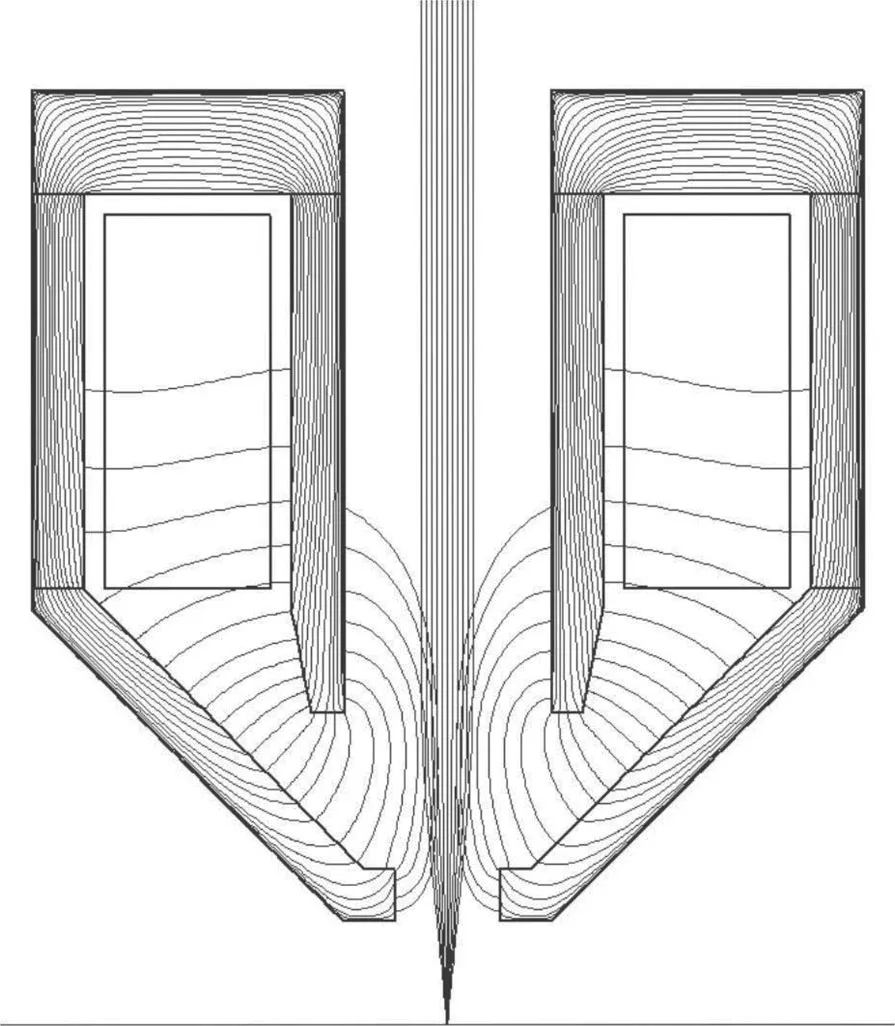
A charged particle beam is conceptually similar in many respects to a beam of light. It is therefore interesting to think about charged particle optics in an analogous way to light optics. This forms a central theme in the present study. For example, electric and magnetic fields can be configured to form a lens, which focuses the charged particle beam. An example of a magnetic lens is shown schematically in Figure 1.2. A current-carrying solenoid is depicted in the figure by the two rectangles, which represent the cross section. The solenoid is surrounded by a shroud of soft iron, which concentrates the magnetic field. The magnetic field lines bulge into the region of the electron beam, which is incident from the top of the figure. The beam is focused to a small probe at the target plane, shown at the bottom of the figure. Such an arrangement is used in a scanning electron microscope. The magnetic field lines and the electron trajectories are generated in a computer simulation by MEBS, Ltd. [63]. The beam path is 100 mm long in the figure, the beam energy is 10 KeV, and the solenoid carries 550 ampere-turns. In reality, the electrons spiral around the central optic axis. The figure is plotted in a coordinate system which rotates about the axis with the beam, so that the trajectories appear not to rotate. This is for clarity.
Figure 1.2: Magnetic focusing of a beam of electrons.
An example of an electrostatic lens is shown schematically in Figure 1.3. Electrons are emitted from a heated flat surface at zero volts relative potential on the left of the figure, and are accelerated to the right. An aperture at –10 volts forms a grid to control the total beam current. A second aperture at +600 volts forms an extraction field for emission. Finally, a high voltage electrode at +18,000 volts is located far to the right, out of the figure. The apertures both have diameter 0.6 mm, and the other dimensions in the figure scale proportionally. The curved equipotentials penetrate the space occupied by the beam, and are separated by 100 volts in the figure. These equipotentials can be regarded as forming a lens, which focuses the beam to a crossover at the right of the figure. Such an arrangement is used in a cathode ray tube. The electrostatic equipotential surfaces and the electron trajectories are generated in a computer simulation by MEBS, Ltd. [63].
Figure 1.3: Electrostatic acceleration and focusing of a beam of electrons.
In addition to focusing a beam to a pointlike spot, a lens can also be used to form a magnified image of an extended object. This is shown schematically in Figure 1.4. Every object point in the plane located at zO emits a cone of rays into the lens at plane zL. A particular object point is located a vertical distance rO from the central axis in the figure. A ray which is emitted in a direction parallel with the central axis is deflected by the lens, and intersects the central axis at the focal point located an axial distance f from the lens. A second ray passes through the center of the lens, and is undeflected. These two rays are depicted as bold lines in the figure. They intersect in a distant plane located at zI, at a point which is located at a distance rI from the central axis. In fact, all rays emitted from this object point, regardless of their angle of emission, are focused by the lens to the same image point. Since all rays converge to a single point, it is apparent that a one-to-one mapping of the object point into an image point exists. In order for this to happen, each ray must experience a change in slope which is proportional to the distance from the central axis. This is the remarkable focusing action of an ideal lens.
Figure 1.4: Imaging an off-axis point by a lens.
Since this works for any point in the object plane zO, we deduce that all object points are imaged simultaneously, each to a unique point in the image plane. This is the mechanism by which a magnified image of an extended object is formed. The negative of the ratio of rI to rO is called the magnification of the image relative to the object. By convention, the magnification is negative in this case, because the image is inverted relative to the object. By performing the construction in Figure 1.4 for multiple object points rO, it is easy to convince oneself that this magnification is the same for all object points. The magnification depends only on the relative positions of the object plane zO and the lens plane zL, and on the focal length f. The smaller the focal length f, the more the rays are deflected, and the stronger is the lens. The focal length is the same for all object points rO. For a charged particle beam, the focal length also depends on the particle energy. The higher the particle energy, the longer is the focal length. This is a direct result of the fact that a faster particle spends less time in the lens field, and is therefore deflected less than a slower particle.
The construction in Figure 1.4 works for both charged particles and light. Many striking similarities exist between light optics and charged particle optics. In both cases, no optical system is capable of forming a perfect image. Blur and distortion are always present to some degree. These imperfections are called aberrations. An important example is the so-called spherical aberration, in which the outermost rays are focused more strongly than the innermost rays. As a result, the beam is not focused to a point, but rather is blurred. This is readily apparent in Figure 1.3. Spherical aberration occurs in light optical lenses as well as charged particle lenses. In light optics, it arises from the fact that ordinary lenses have spherical surfaces, hence the name spherical aberration. It is substantially corrected in light optics by grinding the lens surfaces to a particular aspherical shape. It is not possible to shape the electric and magnetic fields of a charged particle lens in an analogous way, because the fields always obey Maxwell’s equations. Significant progress has been made over the last two decades in correcting the aberrations of charged particle lenses. The details are beyond the scope of this study. The reader is referred to two excellent references by Rose [75] and by Krivanek, et. al. [54] for precise details. Indeed, it is hoped that the present study will provide the background needed to approach this advanced topic expeditiously.
It is apparent from Figure 1.3 ...
Table of contents
Cover
Halftitle
Frontmatter
Title Page
Copyright Page
Table of Contents
Preface
1 Introduction: The optical nature of a charged particle beam
2 Geometrical optics
3 Wave optics
4 Particle scattering
5 Electron emission from solids
Appendix A The Fourier transform
Appendix B Linear second-order differential equation
Bibliography
Index
Trusted by 375,005 students
Access to over 1.5 million titles for a fair monthly price.
Study more efficiently using our study tools.
Frequently asked questions
Yes, you can cancel anytime from the Subscription tab in your account settings on the Perlego website. Your subscription will stay active until the end of your current billing period. Learn how to cancel your subscription
No, books cannot be downloaded as external files, such as PDFs, for use outside of Perlego. However, you can download books within the Perlego app for offline reading on mobile or tablet. Learn how to download books offline
Perlego offers two plans: Essential and Complete
Essential is ideal for learners and professionals who enjoy exploring a wide range of subjects. Access the Essential Library with 800,000+ trusted titles and best-sellers across business, personal growth, and the humanities. Includes unlimited reading time and Standard Read Aloud voice.
Complete: Perfect for advanced learners and researchers needing full, unrestricted access. Unlock 1.5M+ books across hundreds of subjects, including academic and specialized titles. The Complete Plan also includes advanced features like Premium Read Aloud and Research Assistant.
Both plans are available with monthly, semester, or annual billing cycles.
We are an online textbook subscription service, where you can get access to an entire online library for less than the price of a single book per month. With over 1.5 million books across 990+ topics, we’ve got you covered! Learn about our mission
Look out for the read-aloud symbol on your next book to see if you can listen to it. The read-aloud tool reads text aloud for you, highlighting the text as it is being read. You can pause it, speed it up and slow it down. Learn more about Read Aloud
Yes! You can use the Perlego app on both iOS and Android devices to read anytime, anywhere — even offline. Perfect for commutes or when you’re on the go. Please note we cannot support devices running on iOS 13 and Android 7 or earlier. Learn more about using the app
Yes, you can access Charged Particle Optics Theory by Timothy R. Groves in PDF and/or ePUB format, as well as other popular books in Physical Sciences & Science Research & Methodology. We have over 1.5 million books available in our catalogue for you to explore.