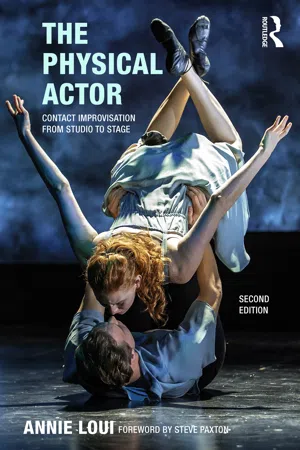
The Physical Actor
eBook - ePub

The Physical Actor

Contact Improvisation from Studio to Stage

  1. 132 pages
  2. English
  3. ePUB (mobile friendly)
  4. Available on iOS & Android
eBook - ePub

The Physical Actor

Contact Improvisation from Studio to Stage

About this book

The Physical Actor is a comprehensive book of exercises for actors. It is carefully designed for the development of a strong and flexible physical body able to move with ease through space and interact instinctively on-stage. Annie Loui draws on her training with Etienne Decroux, Carolyn Carlson, and Jerzy Grotowski to bring Contact Improvisation into the theatrical sphere. She explains how it can be used to develop alert and embodied listening skills in the actor, and how to apply it to working with texts on stage.

This book will guide the reader through a full course of movement skills, including:


  • Partnering skills


  • Spatial awareness for groups and individuals


  • Fine motor control through mime


  • Heightened co-ordination and sustained motion

New for this edition are additional partnering exercises, in-depth applications of contact improvisation to monologues and scenes, and a chapter on devising physical theatre performances.
Frequently asked questions

Yes, you can cancel anytime from the Subscription tab in your account settings on the Perlego website. Your subscription will stay active until the end of your current billing period. Learn how to cancel your subscription.
No, books cannot be downloaded as external files, such as PDFs, for use outside of Perlego. However, you can download books within the Perlego app for offline reading on mobile or tablet. Learn more here.
Perlego offers two plans: Essential and Complete
  • Essential is ideal for learners and professionals who enjoy exploring a wide range of subjects. Access the Essential Library with 800,000+ trusted titles and best-sellers across business, personal growth, and the humanities. Includes unlimited reading time and Standard Read Aloud voice.
  • Complete: Perfect for advanced learners and researchers needing full, unrestricted access. Unlock 1.4M+ books across hundreds of subjects, including academic and specialized titles. The Complete Plan also includes advanced features like Premium Read Aloud and Research Assistant.
Both plans are available with monthly, semester, or annual billing cycles.
We are an online textbook subscription service, where you can get access to an entire online library for less than the price of a single book per month. With over 1 million books across 1000+ topics, we’ve got you covered! Learn more here.
Look out for the read-aloud symbol on your next book to see if you can listen to it. The read-aloud tool reads text aloud for you, highlighting the text as it is being read. You can pause it, speed it up and slow it down. Learn more here.
Yes! You can use the Perlego app on both iOS or Android devices to read anytime, anywhere — even offline. Perfect for commutes or when you’re on the go.
Please note we cannot support devices running on iOS 13 and Android 7 or earlier. Learn more about using the app.
Yes, you can access The Physical Actor by Annie Loui in PDF and/or ePUB format, as well as other popular books in Media & Performing Arts & Acting & Auditioning. We have over one million books available in our catalogue for you to explore.

Information

CHAPTER 1

Warm-up and alignment

images
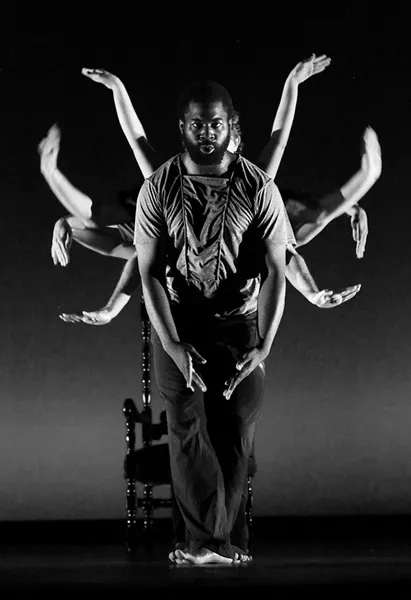
ā€œDa Vinci’s dreamā€ CounterBalance Theater’s The Dwarf (2013)
photo by Skye Schmidt

Warm-up: what we do and how we approach it

There are many paths to nirvana, and a variety of dance and martial art forms can be used for a satisfactory warm-up. However, some basic movement guidelines must be followed in structuring and practicing a warm-up for actor preparedness.
  1. 1 Begin with a simple aerobic sequence for cardiovascular engagement. I often begin a warm-up with three minutes of concentrated aerobic dancing, or run the Mao sequence (a five-minute comprehensive series of calisthenic/martial arts movements developed by Chairman Mao’s advisors to the public health). Of primary importance here is getting an increased circulation of blood flow to facilitate muscular stretch in the subsequent floor exercises.
  2. 2 Stretch and strength exercises should both be covered. They are mutually beneficial—once flexibility is improved, the supporting muscular structure must be strengthened, particularly the lower back and abdomen. Stretches must be done in a way to facilitate improvement for even the most inflexible of actors: slow extended breath with movement is useful; basic yoga stretches are optimum.
  3. 3 Pay attention to proper alignment. This refers to alignment of the spine and shoulders, pelvis, knees, and feet and should be addressed within the warm-up exercises. Alexander technique, Pilates, Feldenkrais, to name a few, all address proper placement of the body over the feet to best facilitate easeful motion. In the course of the notated warm-up and the introduction of mime isolations (in Chapter 3), I touch on a few alignment exercises I have found useful.
  4. 4 Use repetition. I had a new student respectfully address me after two weeks of class saying that he wanted to do a new warm-up—he already knew our exercises. I told him that I thought Baryshnikov probably already knew how to pliĆ©, but I suspect that he still did it every day. A daily warm-up is precisely that—a series of exercises repeated for the cumulative beneficial results. Repetition with small variations is useful in developing stretch, strength, and control. The sequence should basically remain consistent with small variations to keep the practitioner mentally alert.
  5. 5 Work intelligently. Of equal importance, and often overlooked, is the need for the actor to understand what he or she is working for in each exercise, and where to work from. For example, extending the torso out over the legs to stretch the hamstrings is a movement that needs to be initiated from the lower back. Whether you are perfect in execution today is immaterial—that you work intelligently and within your own physical limitations is imperative. ā€œBurnā€ and sharp pain are not good—a long stretch initiated correctly, relaxing everything that is not needed in that particular movement, tends to be productive.
  6. 6 Incorporate imagery. This is one of the most valuable tools for the physical actor—and warm-up exercises can be engaged in most productively by the actor if specific images are connected to the movements. This can be done with the most literal of approaches (ā€œimagine that you are a marionette with a string attached to the top of your head, elongating your spine, and pulling you upā€). For the neophyte this will probably be effective as a first attempt to connect imagery with movement; however, I find subtle suggestions most useful (ā€œthe neck is long and the shoulders wideā€). The neck may not be long, nor the shoulders wide, but the suggestion is now there—the actor should not use this as a command to make the neck long, but rather let the suggestion inform movement. I find that the actor’s body that is physically alert and fit will respond almost unconsciously to such suggestions with subtle and effective adjustments.
  7. 7 Practice respect. Aim to respect yourself as a serious training professional, respect the workspace, respect the person conducting the warm-up, and respect your colleagues; these are all modalities to be encouraged. Integrity of self within the work allows you to approach it in a relaxed and simultaneously energized state of being. The external discipline of engaging in rote exercise is useful, but only up to point. One engages consciously in the exercises, actively working on the specific task at hand. As an actor/practitioner you need to take responsibility for yourself and actively embrace the work, respecting yourself in the daily practice of your chosen profession.
HASTE
I am running from the busy subway through the evening streets by the Gare du Nord. I am late again for my beginning aikido class, and almost knock over a solitary man loitering in the doorway, elegantly dressed in a three-piece suit and smoking a cigarette. I pause, startled, and my dance clothes, aikido clothes, and left-over peanut butter sandwich fall out of my bag. The man graciously steps back, ā€œAh, excuse me Mademoiselle,ā€ and hands me my scattered belongings. I look up from the ground as I thank him. The man in the suit is my aikido sensei, MaĆ®tre Noro. ā€œOh, Monsieur, excusez-moi,ā€ I am flustered trying to articulate excuses for my lateness (the subway, the dance class that got out late), chagrined at having charged into the master teacher in this world of martial arts where hierarchy and respect are critical. He waves excuses away, ā€œEntrez, mademoiselle.ā€...

Table of contents

  1. Cover
  2. Half Title
  3. Title Page
  4. Copyright Page
  5. Table of Contents
  6. Foreword
  7. Acknowledgments
  8. Endorsements
  9. Introduction
  10. 1 Warm-Up and Alignment
  11. 2 Space
  12. 3 Mime
  13. 4 Partnering
  14. 5 Contact Improvisation Practice and Scene Study
  15. 6 Contact into Realism
  16. 7 Devising
  17. Index