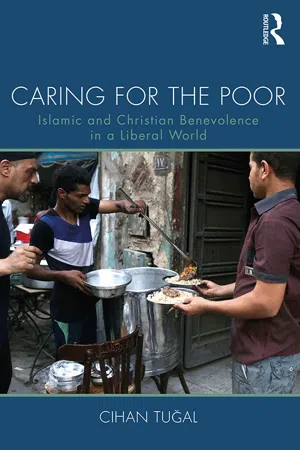
Based on several years of fieldwork in Egypt and Turkey, Caring for the Poor tells the stories of charity providers and volunteers. The book also places their stories within the overall development of Islamic ethics. Muslim charity, Tu?al argues, has interacted with Christian and secular Western ethics over the centuries, which themselves have a conflict-ridden and still evolving history. The overall arch that connects all of these distinct elements is (a combined and uneven) liberalization. Liberalization tends to transform care into a cold, calculating, and individualizing set of practices. Caring for the Poor meticulously documents this insidious process in Egypt and Turkey, while also drawing attention to its limits and contradictions (by using the American case to highlight the contested nature of liberalization even in its world leader). However, as historians have shown, charitable actors have intervened in decisive ways in the rise and demise of social formations. Tu?al raises the possibility, especially through his study of two controversial Turkish organizations, that Islamic charity might appropriate elements of liberalism to shift the world in a post-liberal direction.
- 246 pages
- English
- ePUB (mobile friendly)
- Available on iOS & Android
eBook - ePub
About this book
Information
1
Generosity as an Alternative
Is Giving a Challenge to the Market Logic?
Charity associations seem to spring up from everywhere in our contemporary world. Does this resurgence inevitably reinforce the major socioeconomic trends of our era (the neoliberal restructuring of the welfare state and the spread of business mentality to all institutions)? Or does charity breed practices and moralities that go beyond the free market? Indeed, what could be more remote from the marketplace than the sincere act of giving away a part of one’s wealth or time?
This chapter begins by handling these questions through a discussion of theories of giving. Even though seemingly removed from the immediacy of our questions, almost all the major theories of generosity have been formulated against the background of commodification. Nevertheless, the insights of these theories become helpful only when grounded in comparative-historical inquiry, since the benevolent acts under scrutiny are situated in particular societies. This specificity is best captured through a review of the (mostly new institutionalist) voluntary sector literature, studies of neoliberal subjectivity, and political economy.
The Prevalent Accounts of Giving: Community-Generation vs. Domination
What kinds of discourses, institutions, and individuals do acts of giving and caring create? Who really benefits from generosity? These questions dovetail the problem of motivation. Is the core drive behind giving an innate desire to please, to share, to communicate, to connect, and to form community? Or, alternatively, do people resort to generosity as a way of building up their reputation, or even as a method of legitimizing domination? These questions are impossible to resolve, due to the unobservable nature of drives. However, no critical discussion of giving can avoid addressing them, even if obliquely. This introduces insurmountable problems of measurement. When assessed through surveys and interviews, there are only restricted methodological means to ascertain whether the respondents are giving honest answers (they might not even be honest with themselves). Although participant observation has an edge, even the direct observer has to speculate on the actual drives (e.g. when s/he catches glimpses of contradictions between stated aims and actual behaviors).
While some discussion of motivations is unavoidable, my analyses will draw attention to actual processes and products (including discursive ones). We might have little opportunity to know whether the donor/volunteer is motivated by an “innate” desire to share and connect or by a sly logic of reputation management. However, we can know whether the end result of caring is more connection and communication throughout society or, by contrast, more division between the poor and the wealthy, and the perpetuation of the latter’s domination.
I will call the two major approaches I am drawing on “communitarian”1 and “domination” accounts of giving.2 This book will first historicize and then ultimately dissolve the theoretical opposition between communitarian and “interested,” domination-oriented giving. The opposition is historically made. This was recognized by scholars as early as Marcel Mauss (who pointed out that interested and disinterested acts, as well as market exchange and gift giving, were not institutionally separated until modernity, the only era where people developed the idea of a disinterested gift). Several theorists of giving and caring have expanded on Mauss’s insights; some have also pointed out that his historicization was inadequate (James and Allen 1998). But scholars have neglected the weight of political interventions in these historical processes. Caring for the poor integrates elements of both community-generation and domination-sustenance; but historical and political conditions determine the specific combination and relative weight of each dimension. More importantly, caring for the poor has the potential of going beyond both, though this potential is heavily circumscribed.
Giving as Community-Generation
According to the communitarian approach, giving to others has its basis in (mostly positive) aspects of social psychology. Associations, faiths, and communities instill in people dispositions to give, which generate further communities. We can call this the “virtuous cycle of giving.” Good works have biographical roots, which allow people to internalize generosity. Parents and schools teach children how to engage in volunteer work, a model of behavior they repeat later in life (Flanagan et al. 1998, p. 471; Sundeen and Raskoff 1994, p. 392; Wuthnow 1995).3 More generally, the senses of reciprocity, justice, and responsibility children get from parents form the basis of generous motivations in their adult years (Flanagan et al. 1998, p. 469; Fogelman 1997, p. 150).
Moreover, the doctrines of the major religions support giving and helpfulness (Bellah 1991; Ellison 1992, p. 413). People learn how to be selfless from the dictates of these religions. Religion not only motivates giving at the individual level, but creates altruistic communities and attachments (Wuthnow 1991). These emphases are in line with statistical findings: church membership and attendance increase volunteering (Sundeen and Raskoff 1994, p. 393).4 In sum, altruism is not an accidental choice, but an entrenched inclination ingrained in individuals through family, church, and school. Yet, is the positive relationship between churchgoing and volunteer activity due to the doctrines of religion, or its other characteristics? This question brings us to the more Durkheimian face of the communitarian approach.
The (mostly belief-based) “proto-Weberian”5 arguments above can be synthesized with Durkheimian6 arguments to come up with a fuller communitarian theorization. Basically, frequent interaction within networks increases volunteering. People who attend religious service meet others who are civically involved and thereby become more likely to volunteer. Networks built in religious institutions lead to “reserves of trust and reciprocity” (Wood 1997, p. 601). Social ties reduce the work, uncertainty, and risk involved in volunteering, thereby encouraging people to donate time and resources. Commitment to and congruence with an organization’s goals also motivate people to give beyond what is required (Murnighan et al. 1993, pp. 535–536; Wilson 2000).
Since these dynamics are observable in secular institutions too, why emphasize religion? Religious institutions, argue these scholars, have a special role in our era, since other institutions that build such ties (e.g. unions, crowded workplaces, families, etc.) have considerably weakened (Wood 1997). Religion even has a “spillover effect,” as religious citizens volunteer more for even secular organizations. Furthermore, nonreligious people who have religious friends are encouraged to participate in civic activities (Ruiter and De Graaf 2006; but see Van der Meer et al. 2010).7 The dense networks that result from religious participation render acts of caring almost natural (due to intensified flow of information, motivation, and recruitment efforts). They also increase the costs of not volunteering.
Classical sociology’s concern with community is today supplemented by an intense focus on civil society and social capital. What community did for classical sociology, civil society and social capital do for contemporary sociology. Due to his centrality in developing and popularizing the civil society and social capital paradigms, Robert Putnam’s increasing emphasis on religious networks is worth discussing. In American Grace (2010), Putnam and Campbell support the Durkheimian approach based on three broad surveys. Religiosity interacts with social capital to bolster trust, they argue, which in turn leads to giving and volunteering. Regular churchgoers help the poor, the elderly and the young more than less religious people (Putnam and Campbell 2010, p. 444–446). People who attend religious service frequently are more equipped with the skills of giving and caring (pp. 466–468). The factor that Putnam and Campbell (p. 472) single out to account for this impact of religiosity is “religious social networks (number of close friends in your congregation, participation in small groups in your congregation, and frequency of talking about religion with family and friends).” This is an important spin on Putnam’s (2000) earlier work, as the findings indicate that church attendance is much more important than any other kind of civic engagement (say, in bowling leagues, Putnam and Campbell 2010, p. 475).
In the Durkheimian literature, the emphasis is on social ties at the expense of ideas, symbols, and religious language. Yet, some authors thoroughly integrate the arguments summarized above with an analysis of religious meanings that encourage giving (Wilson and Musick 1997; Wood 1997, p. 603). The Weberian and Durkheimian trends come together vigorously in Wuthnow’s (1991, 1995) work, which can be taken as the most cogent synthesis of these two major sociological schools in the contemporary sociology of religion.
The anthropological theories of the gift provide a complementary angle to communitarian sociology and political science. Drawing on Mauss’s essay on the gift (itself a partially Durkheimian work), anthropologists argue that giving creates reciprocal bonds and expectations, which foster and bolster communal ties. Gift exchange is therefore strictly separate from commodity exchange, the goal of which is not the creation of bonds but the accumulation of things (Gregory 1980). That donors and beneficiaries do not know each other in many cases of charity does not obviate the usefulness of these insights (also see Titmuss 1997): the ties in question might be built not only between the giver and the receiver, but among givers themselves too (which, as shall be seen in my case studies, is a central part of the process).
But what if the lines between the accumulation of relations and the accumulation of things are sometimes blurry, as Bourdieu argues in his discussion of the convertibility of social capital to economic capital? What if the social ties formed through generosity have the implicit purpose of excluding some people and relegating yet others to subordinate positions?
Giving as Domination
Pushing such doubts to their logical conclusion, some scholars emphasize the benefits of generosity to especially dominant groups (Baylouny 2010, pp. 141–142). Both historians (Kidd 2002) and sociologists (Zelizer 1997) draw attention to how charity has tangible returns, such as expanded political patronage and “even the acquisition of public office.” Yet, wouldn’t communitarian scholars object that generosity really benefits the poor regardless of such perks to the rich? Domination accounts throw a doubt on this dimension of charity too. Starting with early modernity, charitable work has allowed disciplinary mechanisms to spread out from enclosed institutions (such as factories, schools, and prisons) and enter the homes and bedrooms of the poor to further regulate them (Foucault 1977, p. 212). Viviana Zelizer (1997, pp. 142, 168–169 and passim) points that whereas earlier American charity maintained status distinctions and sustained obedience, twentieth century versions were even more insidious: they attempted to control the very psyche of poor people (in order to turn them into thrifty, calculating, and productive workers and consumers).
While the communitarian literature emphasizes the solidaristic results of volunteering, critics warn that there are serious reasons to doubt this too. Communitarian scholars argue that giving produces generalized trust (Stolle 1998), as well as feelings of social responsibility toward the public in general (Flanagan et al. 1998), and the needy in particular. However, domination accounts underline that philanthropy can produce the reverse effect: the “responsibilization” of the poor (the naturalization of the assumption that poor people’s characteristics are the real cause of poverty). This assumption leads to the conclusion that the poor should become individually responsible to correct their deficiencies (Atia 2013; Roy 2010). Giving thus undermines trust (in the poor), community (among the poor), and the public (as an imagined space where the rich and poor can come together). It instead re-channels society’s resources to produce “individualized” subjects.
Pierre Bourdieu is one of the few to attempt a thorough integration of communitarian insights into an overall domination framework. Bourdieu (1990, pp. 98–99) points out that objectivist social science (in the person of Lévi-Strauss) has rightly accused Mauss of remaining trapped within the “phenomenology” of giving. Yet, objectivist accounts of giving fall into another trap: they completely ignore the seemingly “disinterested” aspects of the gift (which are core to its sustainability as an “interested” exchange). By overemphasizing the scientifically determinable rules of exchange (which people are unaware of), objectivism kills the charm, anticipation, and unpredictability of giving. As Silber (1998) also points out, uncertainty remains a core part of generosity, despite its ongoing bureaucratization (in the welfare state, NGOs, etc.). Whereas predictability and explicit calculation are at the heart of the cash economy, “ambiguity” is the core characteristic of the gift economy.
In objectivist accounts,8 giving in general and gift-giving in particular become indistinguishable from market exchange. Yet, the gift/counter-gift is different from a loan/loan payment, which is (presumably) predictable and calculable: the counter-gift needs to come later, at an unpredictable time, and in an unpredictable shape. While Bourdieu too ultimately reduces gift-giving to a form of exchange, just like other domination (and rational choice) theorists, unlike them he insists that misrecognition of the gift’s objective truth is a necessary ingredient of gift exchange (Bourdieu 1990, pp. 105–106).9 This subjective dimension of generosity is not simply false consciousness; it is rather a different kind of truth without which the cycle of generosity would collapse. For that very reason, Bourdieu speaks of a “double truth” of practices, of which generosity is a paradigmatic case (Silber 2009).
Giving, argues Bourdieu, is capital accumulation, but of a special sort. In societies where the logic of capital accumulation is denied (in Bourdieu’s case, tribal regions of Algeria), only roundabout methods can enable wealth concentration. Wealthier tribal families gain the trust of others through giving. This accumulated trust (which is core to his thinking as it is to Putnam’s, but in a different way) is then put to use when abundant labor is needed. In the absence of free labor, landholding families need voluntary help during harvest time, which they can acquire through appearing generous after each harvest (i.e. giving away excess agricultural produce).
Bourdieu points out that European societies have gradually replaced pure cash calculation for the ambiguous gift economy (through a stretched out “symbolic revolution”). However, the gift economy survives in the realms of religion, art, and family10 (even if in more commercialized and rationalized form when compared to non-modern societies) (Bourdieu 2000, pp. 195–197). In light of the growing salience of religion today, this observation gains added significance: an all-sweeping, global religious revival has the potential to subvert the modern ethical revolution through re-introducing “ambiguous” acts and “double-truths” to the center of social life. Bourdieu fails to mention (let alone discuss) this most obvious logical consequence of his own theorization.
Even though Bourdieu has done little research on the topic, at the bottom of his theory of fields we find Weber’s sociology of religion—and one essay where he translated Weber’s insights into his own language (Bourdieu 1991). Bourdieu also returned to the topic in his late writings and lectures (since religion provided perfect evidence for his “double truth” approach to “disinterested” acts). Even though these texts are full of insights, they are also symptomatic in their ahistoricity. In a particularly strong lecture given in 1994, Bourdieu mentions that the more everything else is marketized in society, the more dramatized are the noneconomic logics of religion and the family. Despite this historicization-in-passing, the essay is marked by ahistorical statements on religion, such as (Practical Reason 1998, p. 114):
The truth of the religious enterprise is that of having two truths: economic truth and religious truth, which denies the former. Thus, in order to describe each practice, as among the Kabyle, it would be necessary to use two words … apostolate/marketing, faithful/clientele, sacred service/paid labor.
Here, the religious dynamics of the Catholic Church are equated with those of tribal Algeria. The sociologist handles the functioning of the Catholic Church itself as eternal and identified with religion as such (Practical Reason 1998, p. 116, emphases mine):
Besides volunteer work,...
Table of contents
- Cover
- Half Title
- Title Page
- Copyright Page
- Dedication
- Table of Contents
- List of Tables
- Acknowledgements
- Introduction: Varieties of Care
- 1. Generosity as an Alternative: Is Giving a Challenge to the Market Logic?
- 2. The Genealogy of Islamic and Christian Ethics: From Renunciation and Redistribution to Interdependence
- 3. The World Historical Revolution in Ethics: The Dismantling of Interdependence and the Rise of the Liberal Subject
- 4. Comprehensive Religion: Communitarian Associations in Egypt
- 6. Walking the Tightrope between Professionalism and Tebligğ: Turkey’s Neoliberal Associations
- 7. Punching above Their Weight: Turkey’s Communitarian and Redistributive Associations
- Conclusion: Combined and Uneven Liberalization
- References
- Index
Trusted by 375,005 students
Access to over 1.5 million titles for a fair monthly price.
Study more efficiently using our study tools.
Frequently asked questions
Yes, you can cancel anytime from the Subscription tab in your account settings on the Perlego website. Your subscription will stay active until the end of your current billing period. Learn how to cancel your subscription
No, books cannot be downloaded as external files, such as PDFs, for use outside of Perlego. However, you can download books within the Perlego app for offline reading on mobile or tablet. Learn how to download books offline
Perlego offers two plans: Essential and Complete
- Essential is ideal for learners and professionals who enjoy exploring a wide range of subjects. Access the Essential Library with 800,000+ trusted titles and best-sellers across business, personal growth, and the humanities. Includes unlimited reading time and Standard Read Aloud voice.
- Complete: Perfect for advanced learners and researchers needing full, unrestricted access. Unlock 1.5M+ books across hundreds of subjects, including academic and specialized titles. The Complete Plan also includes advanced features like Premium Read Aloud and Research Assistant.
We are an online textbook subscription service, where you can get access to an entire online library for less than the price of a single book per month. With over 1.5 million books across 990+ topics, we’ve got you covered! Learn about our mission
Look out for the read-aloud symbol on your next book to see if you can listen to it. The read-aloud tool reads text aloud for you, highlighting the text as it is being read. You can pause it, speed it up and slow it down. Learn more about Read Aloud
Yes! You can use the Perlego app on both iOS and Android devices to read anytime, anywhere — even offline. Perfect for commutes or when you’re on the go.
Please note we cannot support devices running on iOS 13 and Android 7 or earlier. Learn more about using the app
Please note we cannot support devices running on iOS 13 and Android 7 or earlier. Learn more about using the app
Yes, you can access Caring for the Poor by Cihan Tugal in PDF and/or ePUB format, as well as other popular books in Social Sciences & Islamic Theology. We have over 1.5 million books available in our catalogue for you to explore.